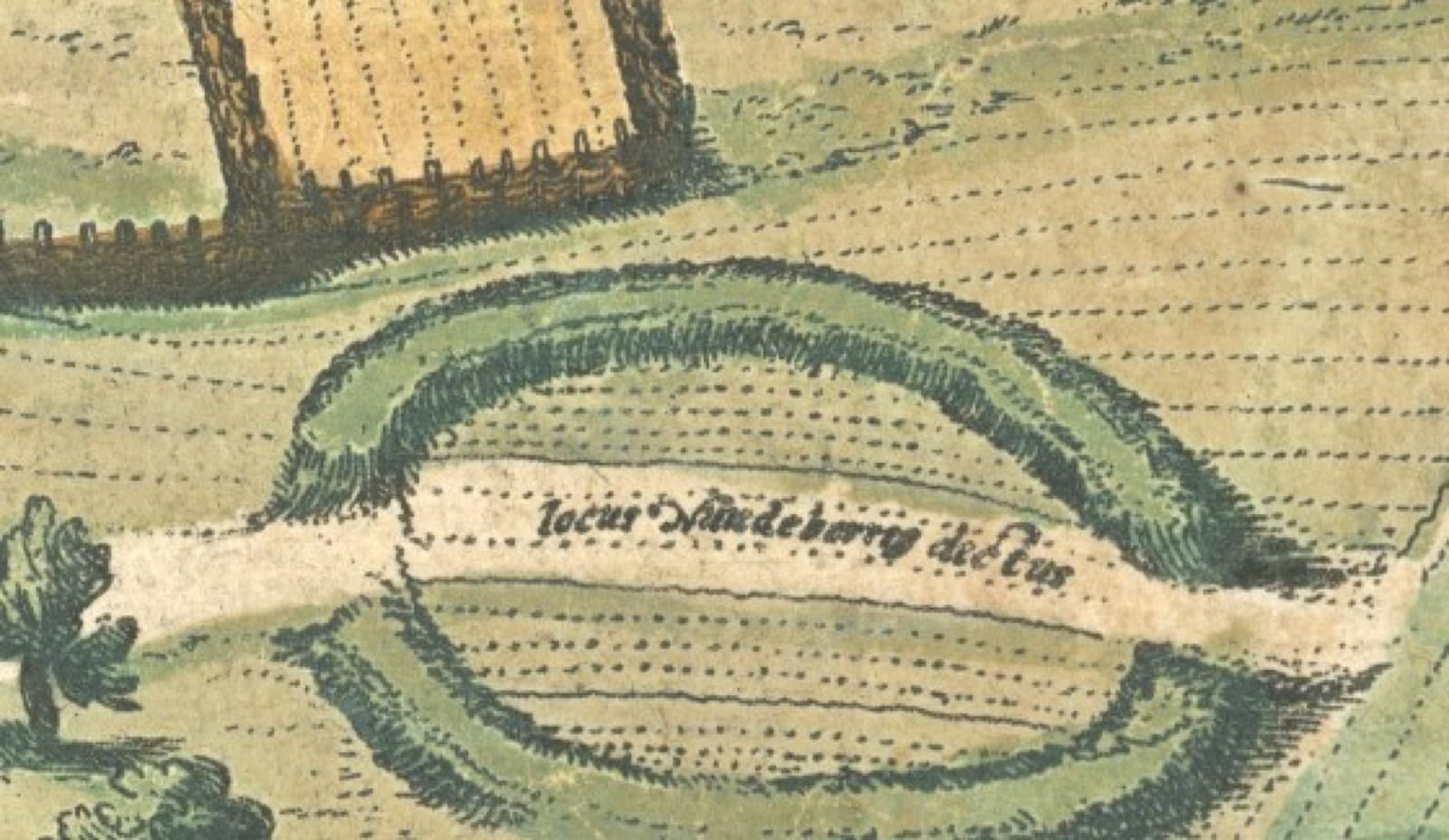
Before it was Andersen's city, Odense was Odin's shrine, and the clearest place to feel that older town is a low, ordinary rise on the south bank of the river where a Viking ring fortress lies buried and invisible. The rise is called Nonnebakken, the Nuns' Hill, and beneath its pavements, gardens, and houses sleeps one of King Harald Bluetooth's circular strongholds, built around the year 980. Nothing shows above ground. That absence is the point. This walk, "Odin's Shrine: The Viking Town by the River," reads the deep town beneath the fairytale surface, and Nonnebakken is where the reading turns from pleasant riverside stroll into something stranger: a thousand-year-old fortress you stand on top of and cannot see.
The fortress you cannot see
Nonnebakken belongs to a small, famous family. Denmark has five known ring fortresses of the Trelleborg type, perfectly circular earthworks attributed to Harald Bluetooth, who used them to help pull a scattered kingdom into one. In September 2023, on the seventeenth, UNESCO inscribed the five together on the World Heritage list. Four of them sit in open country, where you can walk a grassy ring and read the shape with your feet. Nonnebakken is the exception. It is the only one of the five that lies beneath a city centre, swallowed whole by an ordinary modern neighborhood.
Picture what the ground hides. A ring roughly 180 metres across. A moat several metres deep and wide. A rampart that may have risen five to six metres, its earthen faces clad in timber. Archaeological work in 2015 and again in 2020 confirmed the astonishing part: the fortress survives extremely well preserved under the streets, its ring still traceable even though not a stone of it breaks the surface. You do not visit a monument here. You visit a fact, and you supply the picture yourself.
The name adds a second layer. The Nuns' Hill takes its title not from the Vikings but from a Benedictine convent set up on the site more than a century after the warlord's ramparts went up. Those nuns eventually left to build a church at Dalum nearby. So the rise carries three lives stacked one on another: a fortress, then a convent, then an unremarkable street. That stacking is the whole tour in miniature, which is exactly why the route treats this buried ring as its hidden hinge rather than a throwaway stop.
Reading the deep town from the river
Hear a stop from this walk
Brandts: The Cloth Mill Reborn as a Quarter of Art
The walk begins higher up, at Odense Palace and the King's Garden, where the town's history layers the way it does at Nonnebakken. The palace grew from a medieval house of the Knights of Saint John, the Hospitallers, first recorded here in 1280. Its present main building went up in the 1720s under King Frederik the Fourth, who died inside it in 1730. When the state sold the palace to the city in 1907, the once-private royal garden opened to the public and has been a city park ever since. You meet it from the outside, as ordinary town fabric, not as a ticketed attraction. That posture, history as something you walk past rather than pay to enter, sets the tone for everything downstream.
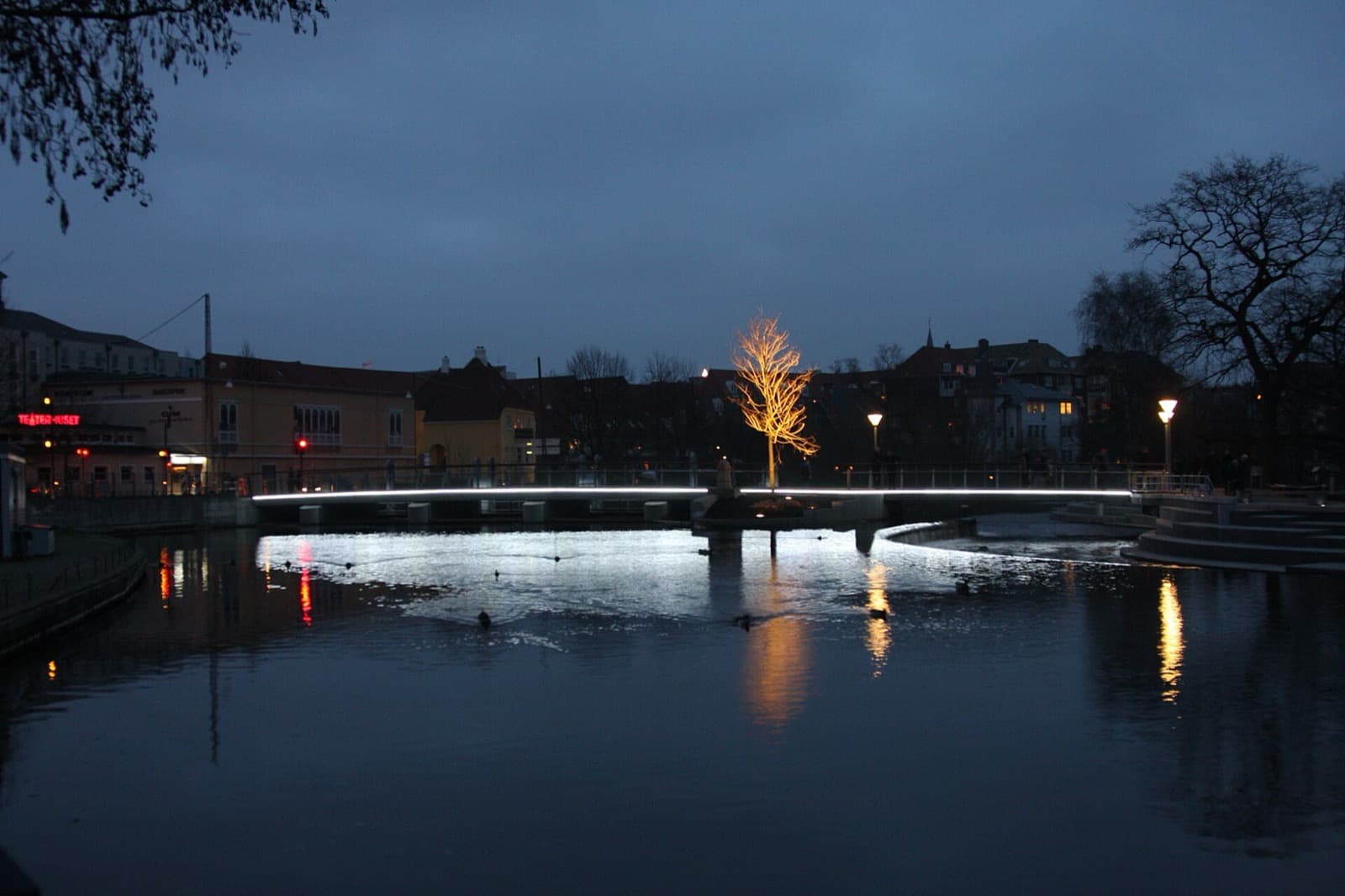
From there the route drops to the water, because the water is the reason any of this exists. The little Odense river, the Odense Aa, first drew settlement to this spot long before a fairytale was written, serving for centuries as mill-stream and washing-place. At Munke Mose, the Monks' Marsh, river boats have sailed since 1882, and in recent years they were converted to run silently on solar power, gliding downstream almost without a sound. Keep the river in view and the navigation becomes almost automatic. Nearly every stop sits on or near the Aa, so the whole route reads as one continuous riverside line, with Nonnebakken sitting quietly on its south bank.
The martyr, the ghost square, and the mill
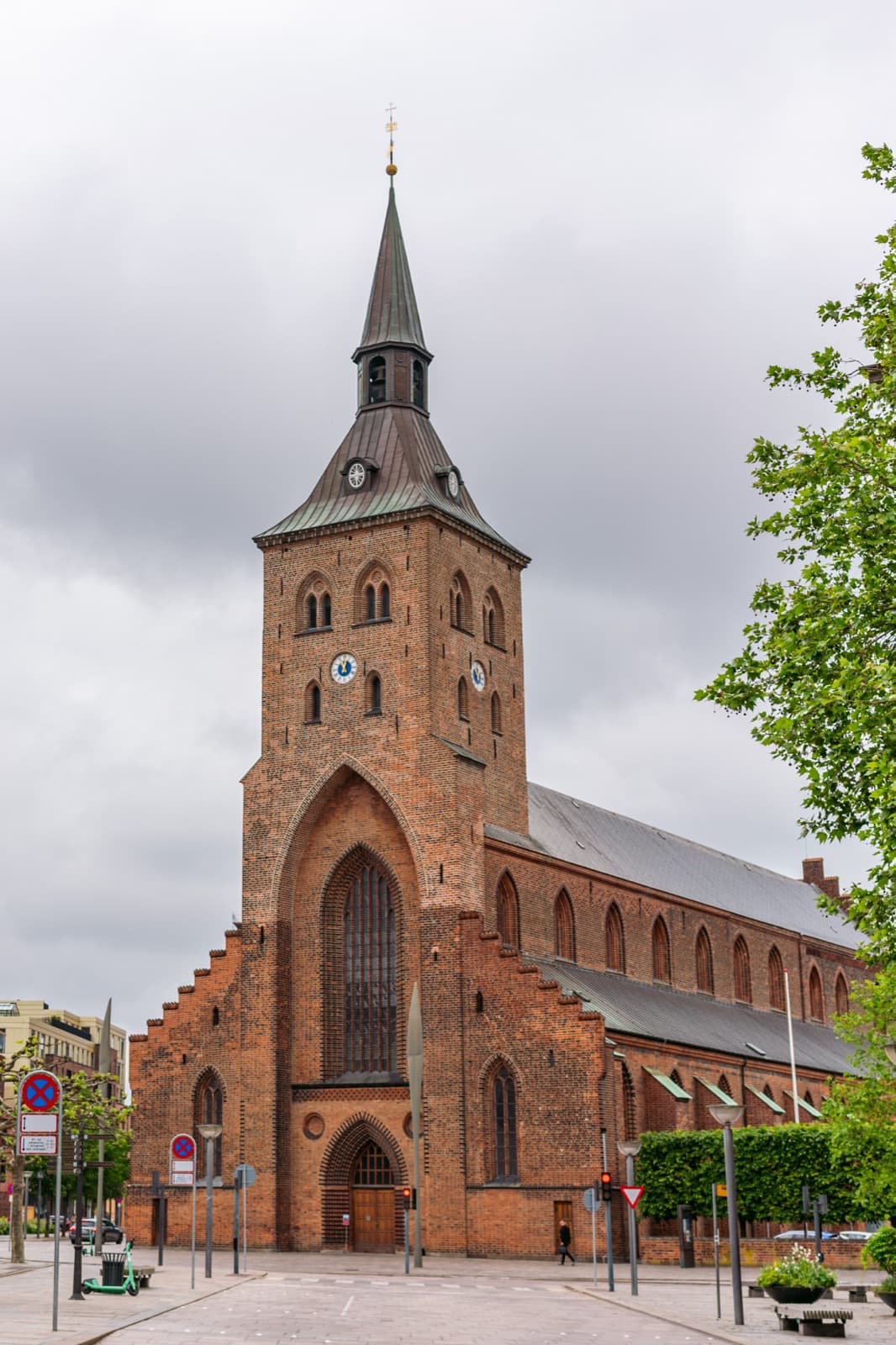
Past the buried fortress, the walk reaches Sankt Albani Kirke, a neo-Gothic Catholic church consecrated in 1908 but named for a vanished medieval priory. In that older wooden Saint Alban's, before its altar, King Canute the Fourth was killed on the tenth of July 1086, slain with his brother Benedict during a revolt over laws that favoured the church. A medieval chronicler records a lance thrust to his side. His memory did not fade: he was canonised on the nineteenth of April 1101, the first Dane ever raised to sainthood, remembered as Canute the Holy, and the priory where he died was later replaced by the town's cathedral dedicated to him. Keep the two Saint Albans separate in your mind. The church you see is modern; the priory where the king died stood a short way off and is gone.
The pattern of vanished things continues at Sortebroedre Torv, Blackfriars Square, where Dominican friars began a friary in 1238. The Reformation of 1536 handed it to the crown, its bricks and timber drifted off into other buildings, and the last remains disappeared around the 1600s. Today the friary's footprint is traced across the paving in small brass markers, a church and cloister you read underfoot rather than enter.
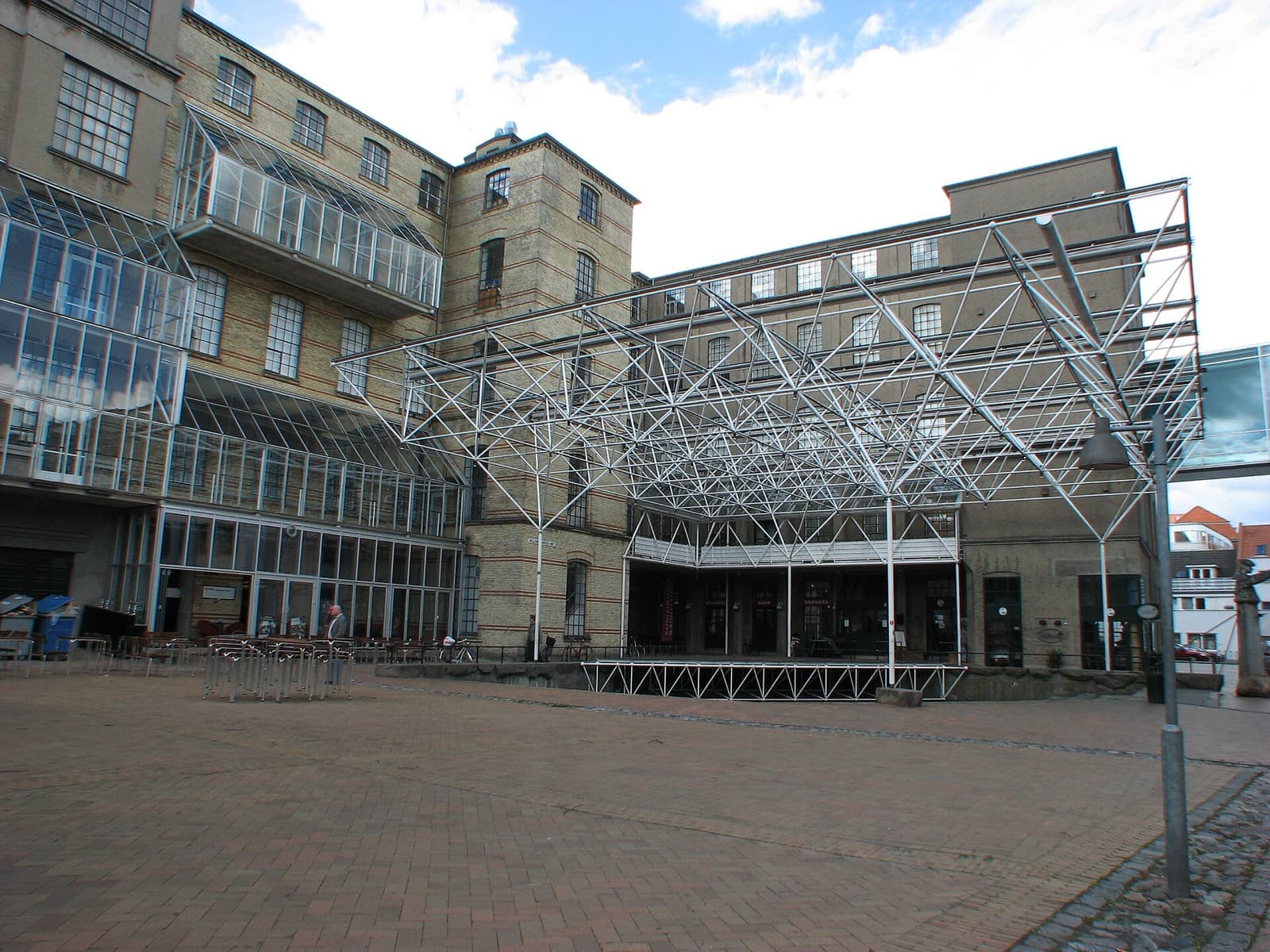
The route's final built stop reverses the direction of loss. Brandts Klaedefabrik, a great yellow-brick cloth mill, began production in 1869 with just ten employees and grew into one of the largest workplaces in Odense. When the textile industry faded, the town converted the mill from the 1980s into a cultural quarter rather than demolishing it, one of Denmark's early industrial-heritage conversions. It now holds an art museum, a fashion and interior museum, a cinema, and artists' workshops. The courtyards are free to wander, the museum charges kroner if you go inside.
The walk ends where the town breathes, in the green river valley toward Fruens Boege, Our Lady's Beeches, a riverside woodland the city bought in 1875 and where the solar boats from Munke Mose turn around. No monument, no buried fortress, no martyred king. Only water, beech, and meadow.
This is a solo walk on your own clock, no group, no schedule, short stops you can skip. Sit on the buried ring as long as you like. If you want the wider picture of the city first, browse other Odense walking tours or the Odense city page, then come back and stand on Odin's shrine.
Sources
- Tour transcript and fact audit, "Odin's Shrine: The Viking Town by the River" (Roamer), the primary verified source for every date and figure above.
- UNESCO World Heritage Centre, "Viking-Age Ring Fortresses," for the 2023 inscription of the five Trelleborg-type fortresses.
- VisitOdense, "Nonnebakken, hidden ring fortress in the centre of Odense," on the buried, city-centre character of the site.
- Wikipedia, "Canute IV of Denmark," on the 1086 killing and 1101 canonisation of the first Danish saint.
- VisitOdense, "Art Museum BRANDTS," on the cloth mill's conversion into a cultural quarter.
Ready to experience it?
Odin's Shrine: The Viking Town by the River
125 min · 6.9 km · easy
More from Odense
Explore more at your own pace.
Odense Travel Guide: Days, Transport, Safety, and Costs
One Day in Odense: A Walkable Morning-to-Evening Itinerary
Odense: The Fairytale City and the Viking Town Beneath It
Andersen's Birthplace and the Old Town of Odense: Where a Shoemaker's Son Became a Fairy Tale
Brandts Klaedefabrik: The Odense Cloth Mill Reborn as a Quarter of Art