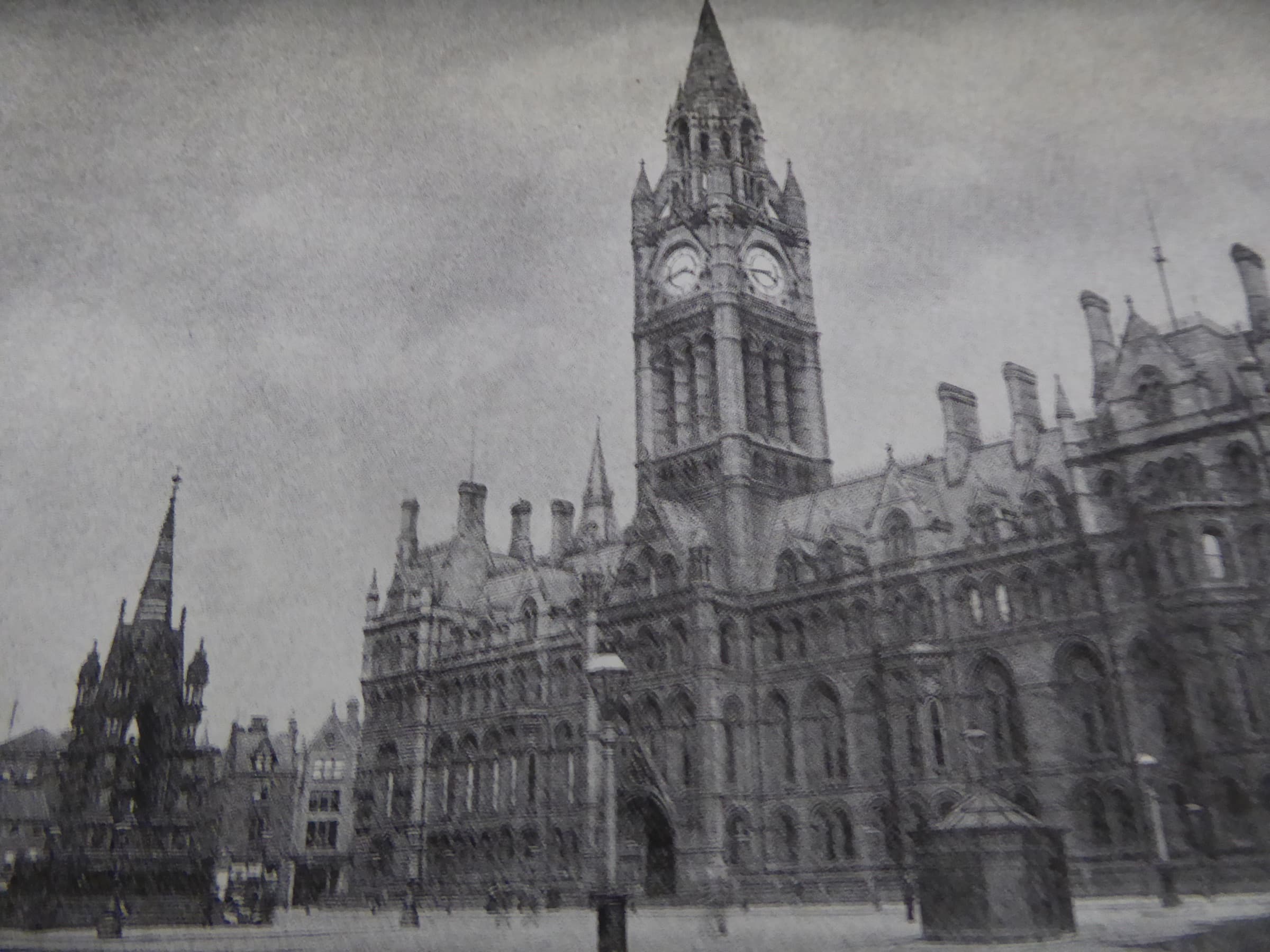
Manchester Town Hall reads, on first approach, as one confident Victorian Gothic palace by one architect. The reveal on the Civic Victorian Gothic walk is that the building was chosen through a national contest, and that the contest, the style, and the sheer scale were all parts of a single argument: that a city built on cotton could compete with the imperial capital on London's own terms.
The competition was the point
In 1868 Manchester ran a national open competition for its new town hall. It drew 137 entries. The assessors were serious figures, the classicist Thomas Leverton Donaldson and the Gothic Revival architect George Edmund Street, and they narrowed the field to a shortlist.
The famous twist is that Alfred Waterhouse was placed only fourth on pure design and aesthetics. He won anyway. His plan was judged decisively superior in layout, in the circulation of people through the building, and in the handling of natural light on an awkward, roughly triangular site hemmed in by streets. Waterhouse was appointed on 1 April 1868, the foundation stone was laid that October, and the building opened in 1877 after nine years of work and something like fourteen million bricks.
That process is itself the meaning of the building. A city could simply have commissioned a design from a favoured architect. Manchester chose instead to stage a national open competition, because the competition announced that the city would fight for architecture on the same public terms as anywhere in the country. The building's story starts with a claim to compete.
Why Gothic, and not classical
Hear a stop from this walk
Free Trade Hall: One Hundred and Seventy Years of Argument on One Site
The choice of Gothic Revival was deliberate and pointed. Neighbouring Liverpool had built its great civic monuments in neoclassical stone. Manchester went the other way, into the fashionable Victorian Gothic, partly as a spiritual nod to the city's late-medieval textile heritage and partly as a statement of modern taste. The style was an argument in itself. It said Manchester would not simply copy the established classical vocabulary of imperial power; it would make its civic statement in a register it chose for itself.
Waterhouse handled the triangular site with a plan that packed grand ceremonial spaces, offices, and a soaring clock tower into a footprint that should have defeated the arrangement. The result is regarded as one of the finest Gothic Revival buildings anywhere, a Grade I listed structure that still functions as the working seat of the city.
The Great Hall you cannot currently see
Inside the building, the Great Hall carries Ford Madox Brown's Manchester Murals, a twelve-panel scheme painting the history of the city, from Roman Mancunium to the industrial present, onto the walls of the room where the city governs itself. It is one of the most ambitious civic mural cycles in Britain.
An honest note the tour respects: the Town Hall has been closed since January 2018 for the major Our Town Hall restoration, with a confirmed reopening in spring 2027. On the walk, Stop 2 is exterior-only, and the murals are described as what waits behind the doors rather than as something you can go in and see today. When the doors reopen, the interior is the reason to come back.
What the building is claiming
Everything about the Town Hall points at London. The competition claimed Manchester would compete for architecture nationally. The Gothic choice claimed the city would set its own terms. The scale, the tower, the murals, the ceremonial rooms all claimed that a cotton city deserved civic grandeur equal to the capital. That is the thread of the whole square around it, and the wealth that paid for it came directly from the mills and warehouses on our Industrial Revolution Core walk.
For the rest of the square read as one argument, see our companion to the Civic Victorian Gothic walk, and for the wider story of how the city built its wealth and then reinvented itself, how Manchester built the modern economy and then its sound.
Ready to experience it?
Albert Square: The Town Hall That Argued the North Was London's Equal
95 min · 2 km · easy
More from Manchester
Explore more at your own pace.
Cottonopolis: How Manchester Built the Modern Economy and Then Its Sound
The Corridor That Built the Modern Economy: A Companion to the Industrial Revolution Core Walk
The Square That Argued the North Was London's Equal: A Companion to the Civic Victorian Gothic Walk
The Warehouses That Became a Sound: A Companion to the Northern Quarter Walk
Liverpool Road Station: The Building That Defined the Railway Station