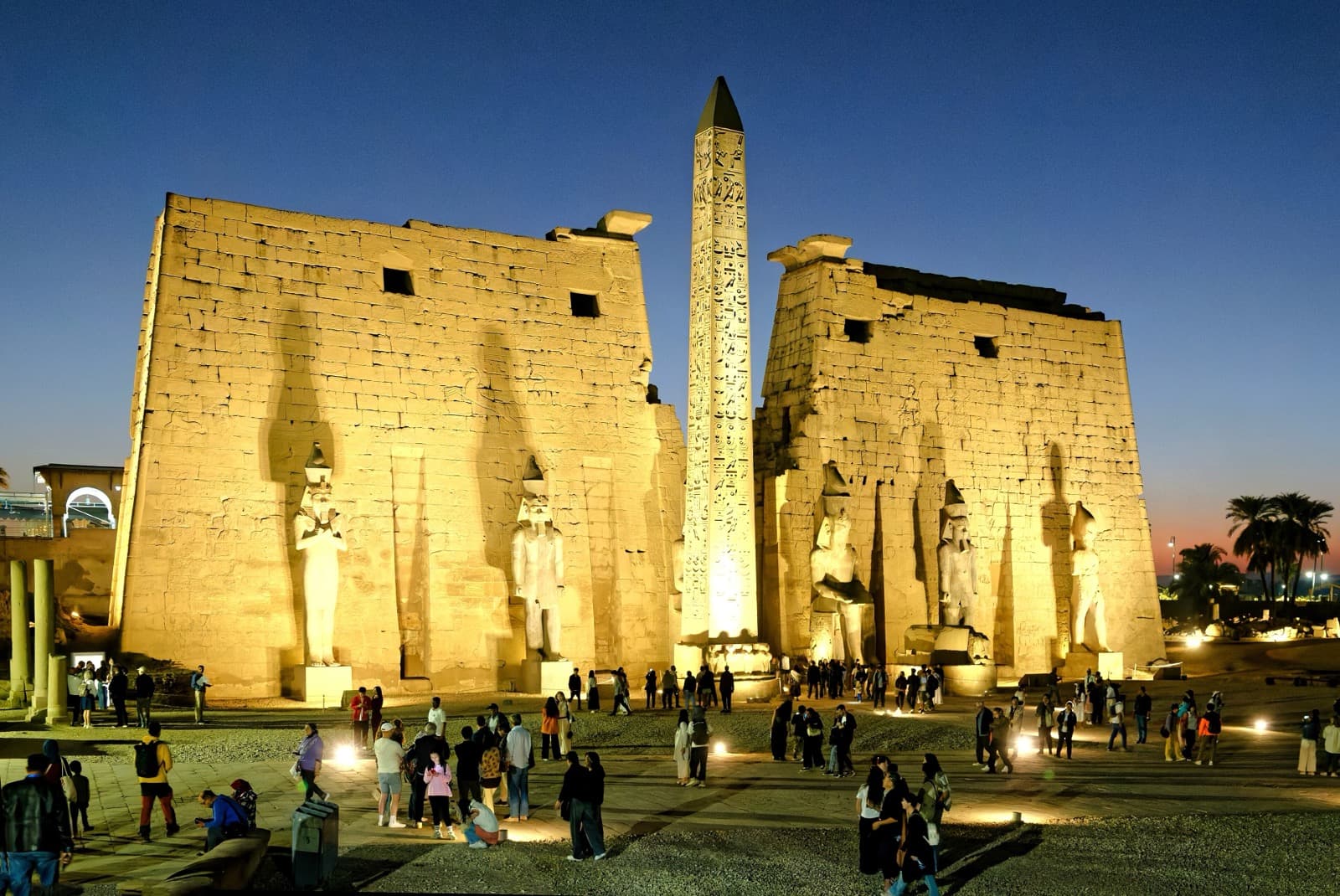
Luxor Temple is the one sanctuary in Egypt where religious worship never stopped. Pharaohs built it, Romans repurposed it, Christians raised a church inside it, and Muslims placed a working mosque on top of it, and that mosque is still in use today. Standing before the temple in modern Luxor, the single fact worth carrying with you is continuity: this ground has been holy for more than three thousand four hundred years, an unbroken chain of devotion in one place. Everything else about the temple, its colonnade, its lone obelisk, its scale, hangs off that one idea.
A temple of kingship, not just the god
Luxor Temple was built chiefly by two of Egypt's greatest builders. Amenhotep the Third of the Eighteenth Dynasty laid down its finest courts and colonnade, and Ramesses the Second added to it, with further decoration contributed by the young king Tutankhamun. It was dedicated to the Theban Triad: the god Amun, his consort the goddess Mut, and their son Khonsu.
What set it apart from the vast complex of Karnak two miles north was its purpose. Karnak honored the god Amun in his own domain, an ever-expanding city of temples. Luxor Temple was tied to something more specific: the divine aspect of kingship itself, and the annual renewal of the pharaoh's power. This was where royalty and divinity were fused once a year, in ceremony. The colonnade and courts here are among the finest in all of Egypt, but they were built to stage a single recurring event rather than to house a permanent cult in the way Karnak did.
The road the god walked
Hear a stop from this walk
The First Pylon of Karnak: Through the Gate into the City of the God
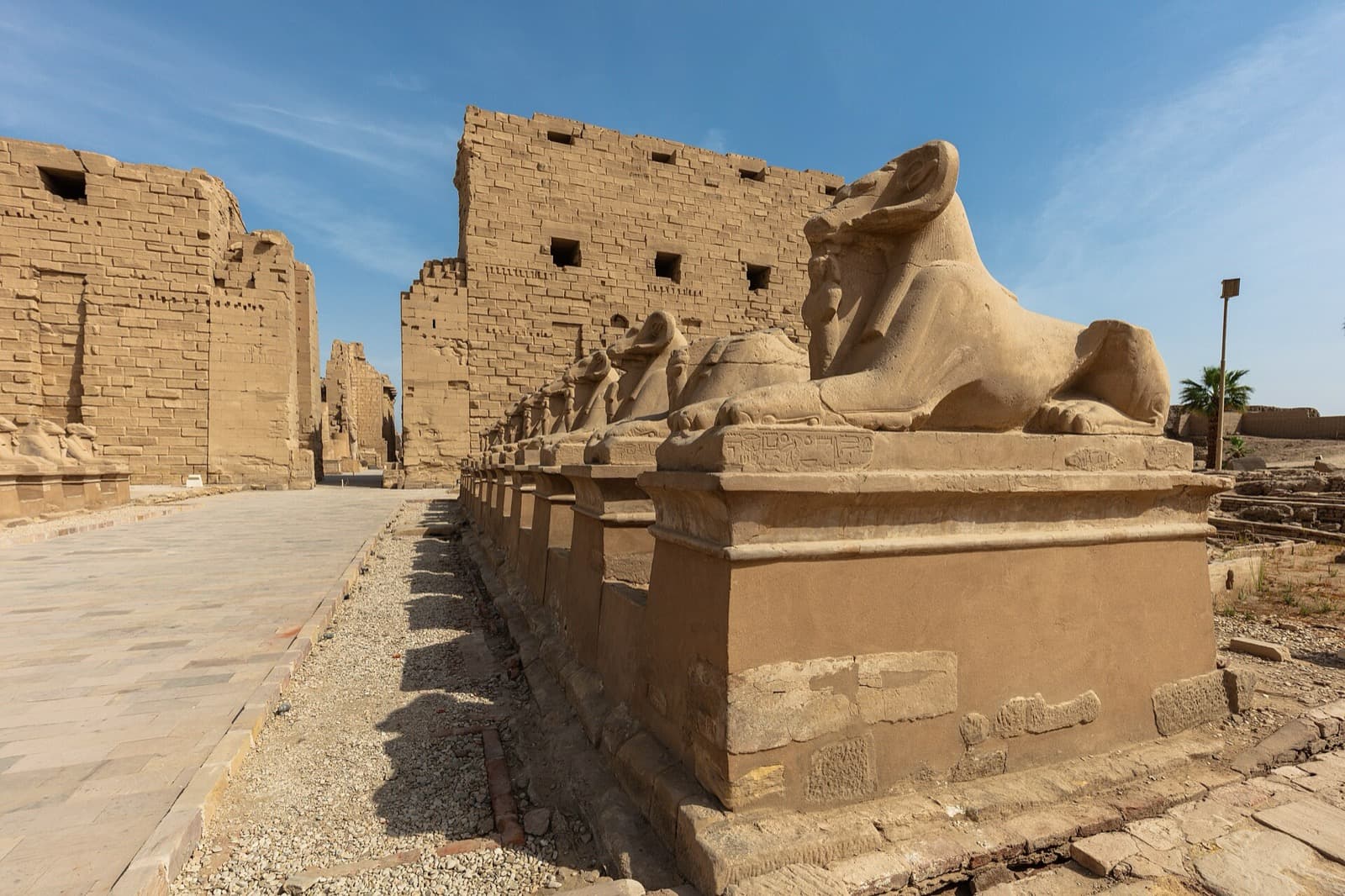
To understand why Luxor Temple exists where it does, you have to understand the Opet festival. Once a year, the sacred image of the god Amun left his home at Karnak and traveled in procession to Luxor Temple, then returned. The route between the two temples was the Avenue of Sphinxes, a processional way running nearly three kilometres straight through what is now the modern town.
That avenue was originally lined with one thousand and fifty-seven statues, of which eight hundred and seven were sphinx-shaped and two hundred and fifty carried the ram heads of the god Amun. The road was not built for people. It was built for a god to travel, and Luxor Temple was his destination. Over the centuries the sand and the growing town buried the avenue completely. The first statues were rediscovered in nineteen forty-nine, and the full avenue was excavated and ceremonially reopened only on the twenty-fifth of November, twenty twenty-one, with a televised parade. So the road that leads to the temple's door is itself a monument to burial and return, the same theme that defines the temple it serves.
The wall that reads like a ruler
Now stand in front of the temple and look up. High on one wall, well above the ancient floor level, sits the Mosque of Abu al-Haggag. It is not a ruin and it is not a museum piece. It is a living, working mosque, still used for prayer today.
Here is the detail that turns the whole site into a single legible object. The mosque's floor sits where the ground level was when the temple lay buried under centuries of accumulated sand and debris. In other words, the mosque marks exactly how deep this place was once covered. People built and rebuilt at the surface as that surface rose, century after century, and the mosque came to rest many metres above the pharaonic pavement. When you see the mosque hanging in the air above the excavated colonnade, you are reading a physical measurement of time: the gap between the mosque floor and the ancient floor is the depth of the burial.
That is why the through-line of this place is continuity rather than any single era. The ground has been sacred through the pharaonic centuries, then Roman, then Christian, then Islamic, without a break. In the Roman period part of the temple was converted into a legionary shrine, and a Christian church later stood within it, before the mosque rose atop the buried ruins. The saint the mosque honors is celebrated each year in a festival that some scholars read as a distant echo of the ancient Opet procession. The same instinct that once carried the god Amun down the avenue may still be running, in a different form, in the streets outside.
One obelisk, and its absent twin
At the temple's first pylon stands a single obelisk of red granite. It was once one of a matched pair, both carved for this gateway in the reign of Ramesses the Second, around twelve fifty B C, each cut from a single block of granite quarried at Aswan far to the south. For more than three thousand years the two stood together, framing the entrance.
Today only one remains. The other, about twenty-three metres tall, was given to France by Muhammad Ali Pasha, the ruler of Egypt, in November eighteen thirty. It was shipped down the Nile and across the Mediterranean, and in eighteen thirty-six it was raised in the Place de la Concorde in Paris, where it still stands. In nineteen eighty-one the French president formally renounced any claim to the obelisk that remained at Luxor, confirming it as Egypt's. So the gate you stand before is deliberately half-empty. Presence and absence, one here and one on the banks of the Seine, are part of what the monument now means.
What to hold onto standing here
If you take one thing from Luxor Temple, let it be this: you are not looking at a dead building. You are looking at the longest continuously sacred place many travelers will ever visit, and the mosque overhead is proof that the story never closed. The pharaohs are gone, the Opet procession is gone, but people still gather here to worship, on ground consecrated before the Trojan War. That continuity is the point.
Because the mosque is active, treat the site with care. Dress modestly, keep your voice low, and be aware of prayer times, when non-worshippers may be asked to wait. Then walk the great colonnade slowly and let the layers settle: the god's temple, the Roman shrine, the church, the mosque, all in one footprint.
Luxor Temple is the fifth stop on Roamer's self-guided audio walk through ancient Thebes, which begins at the colossal first pylon of Karnak and follows the reopened Avenue of Sphinxes into town. You set the pace, linger where the light is good, and hear the full story stop by stop. Browse more Luxor walking tours or explore what to see across Luxor before you go.
Sources
- Luxor Temple (Wikipedia): overview of construction under Amenhotep the Third and Ramesses the Second, the Theban Triad dedication, and the Mosque of Abu al-Haggag.
- Avenue of Sphinxes (Wikipedia) and CBS News coverage of the November 2021 reopening: statue counts, burial, and the reopening parade.
- Luxor Obelisks (Wikipedia) and Archaeology Travel, "The Luxor Obelisk on the Place de la Concorde": the matched pair, the 1830 gift to France, and the 1836 raising in Paris.
- UNESCO World Heritage listing for Ancient Thebes with its Necropolis: Thebes as the city of the god Amun and the scale of the Karnak and Luxor temple complexes.
Ready to experience it?
Karnak and Luxor Temple: The Great Sanctuaries of Ancient Thebes
200 min · 4.2 km · moderate
More from Luxor
Explore more at your own pace.
Luxor Travel Guide: Days, Transport, Season, Safety, Budget
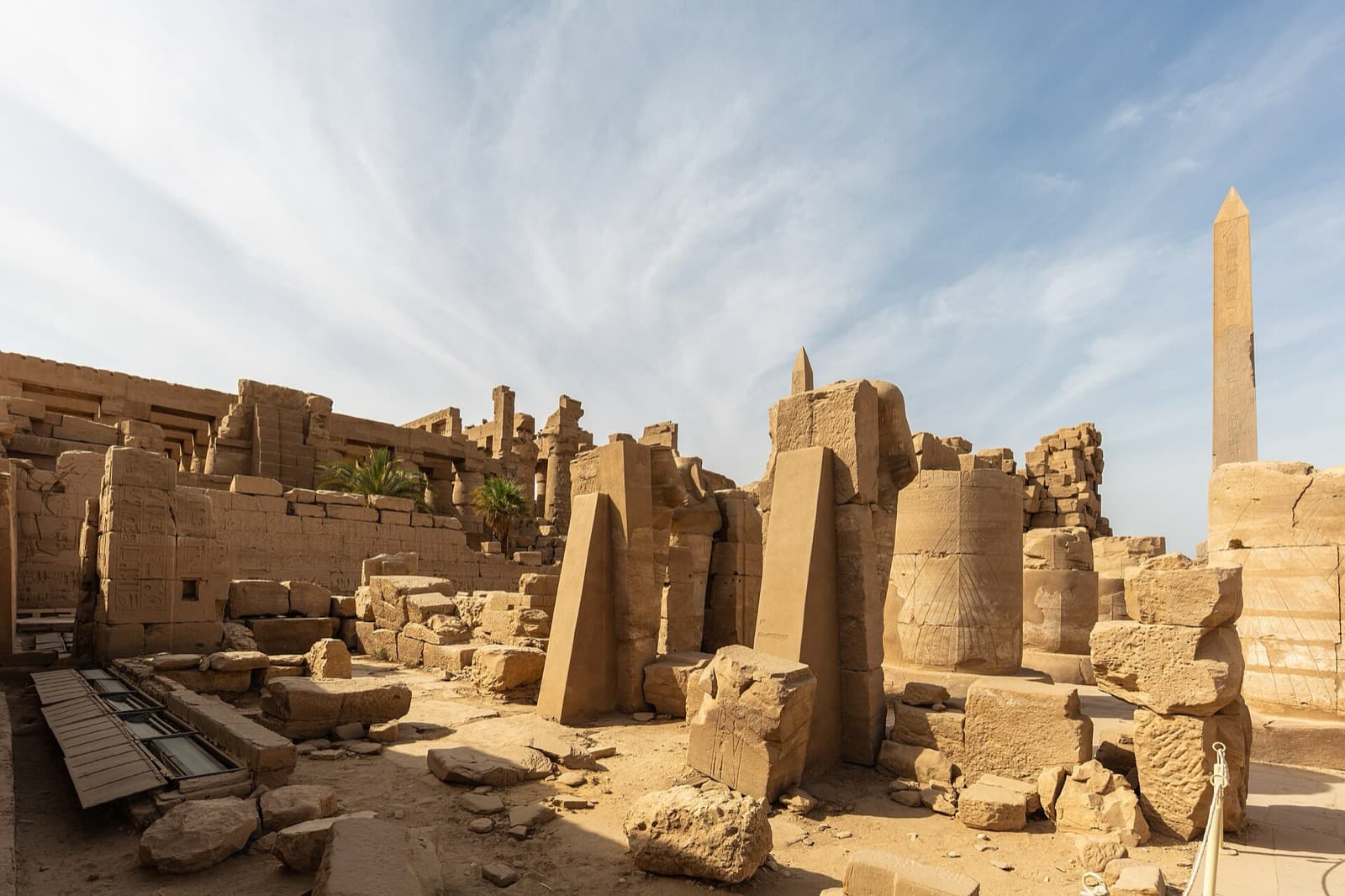
One Day in Luxor: A Walkable Morning-to-Evening Itinerary
Luxor: Ancient Thebes and the Two Banks of the Nile
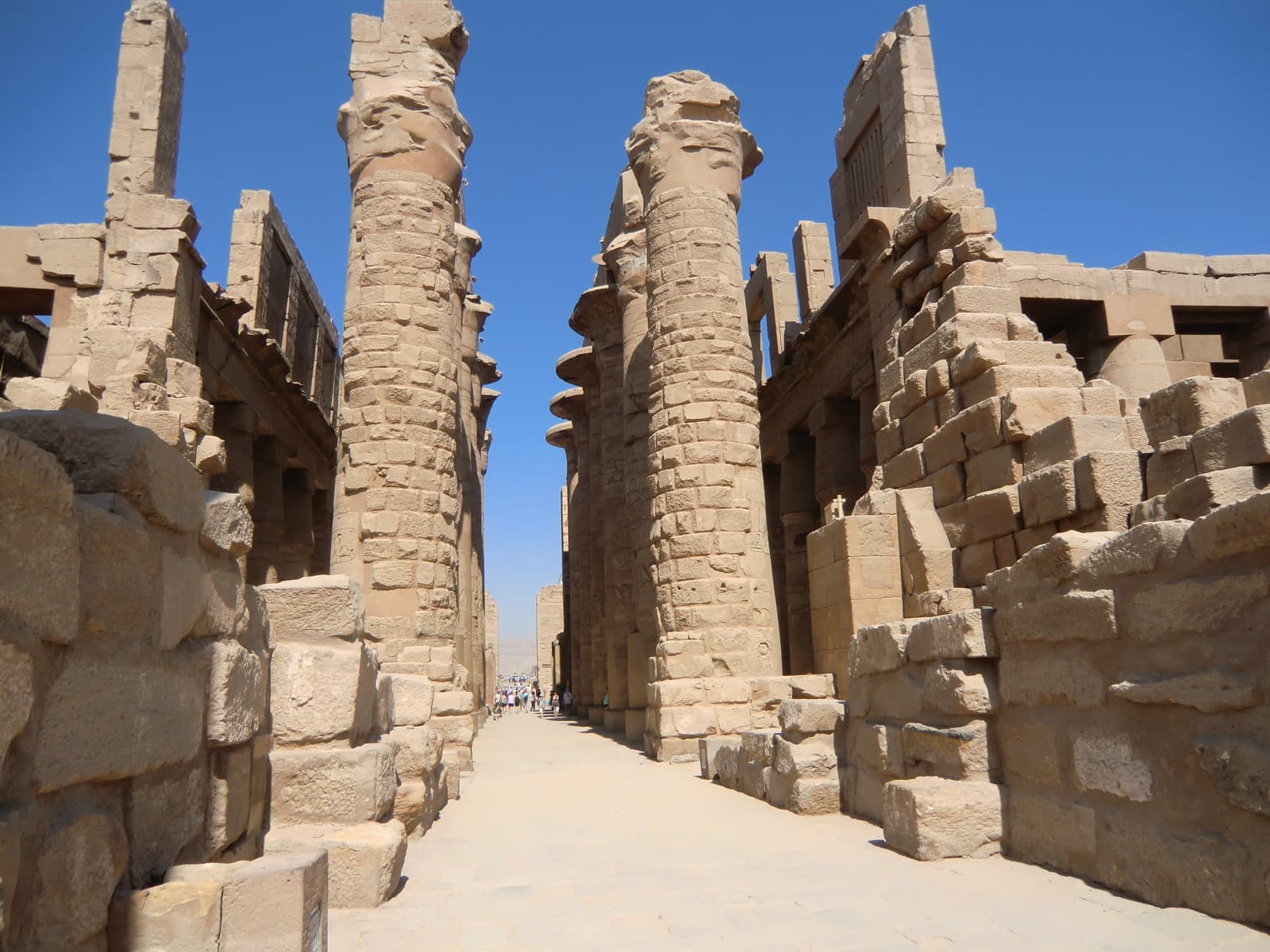
Inside Karnak's Great Hypostyle Hall: Reading a Whole Temple-City Through One Room
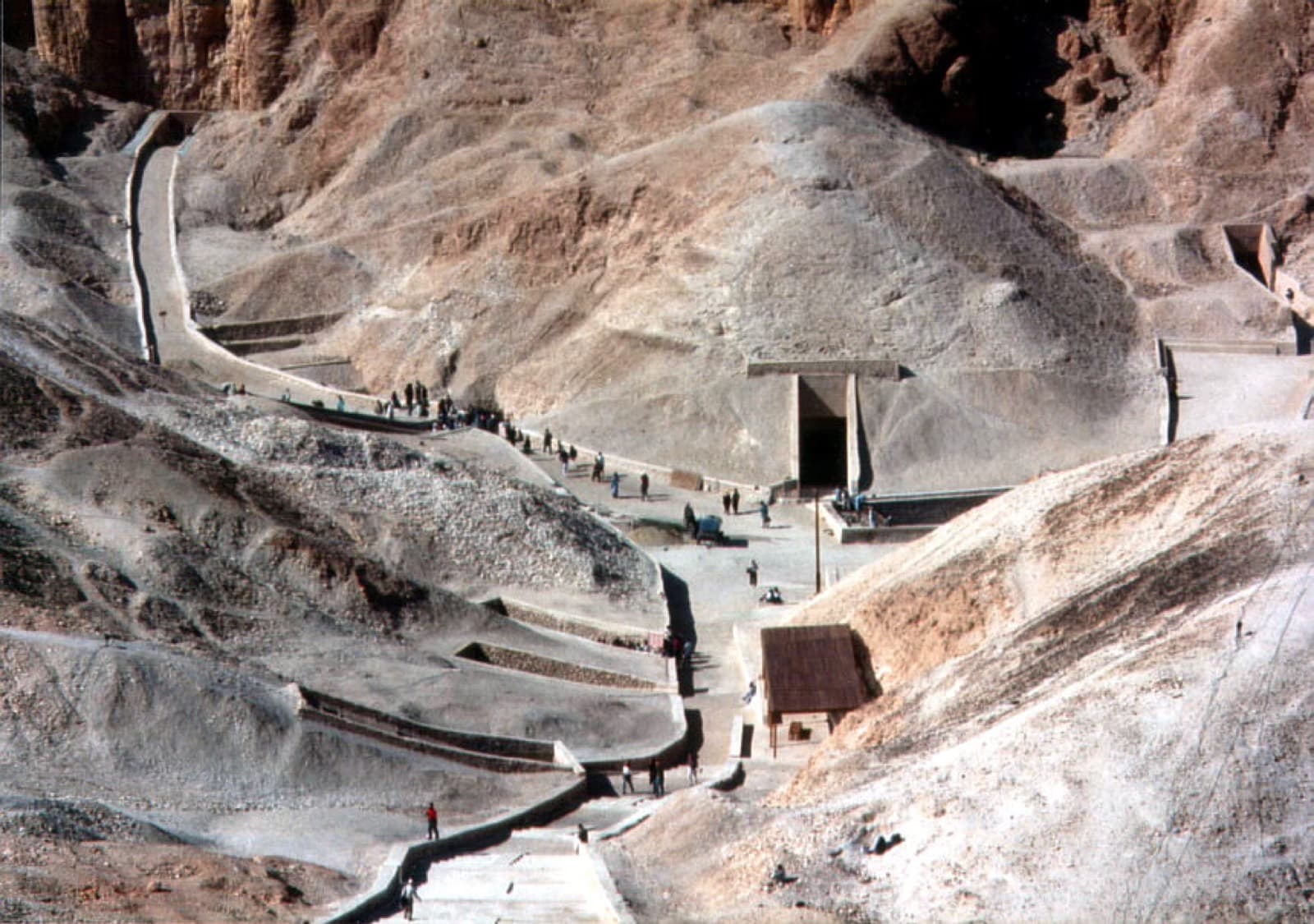
The Valley of the Kings: Reading Luxor's Hidden Tombs and the Temples They Answer