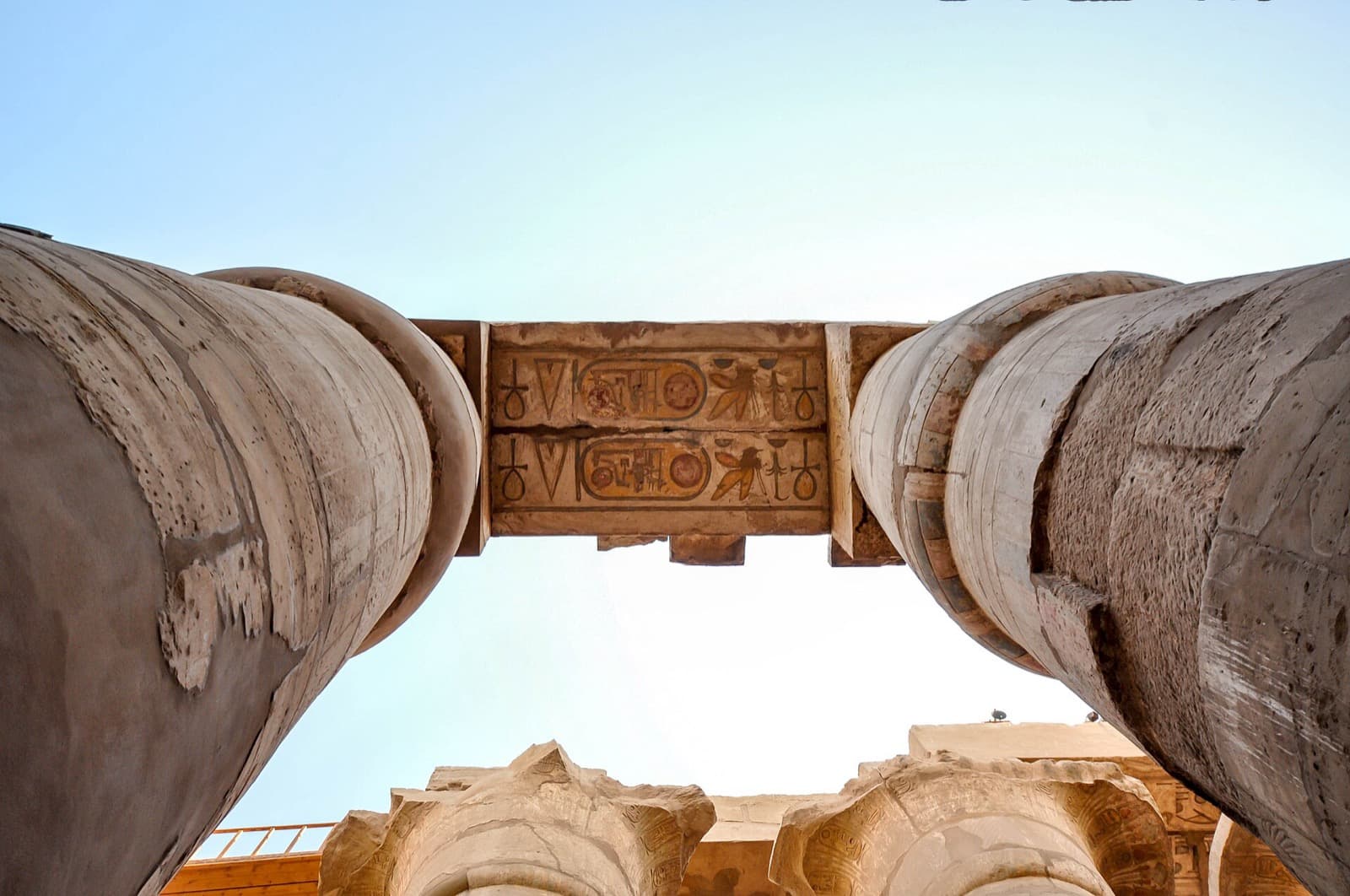
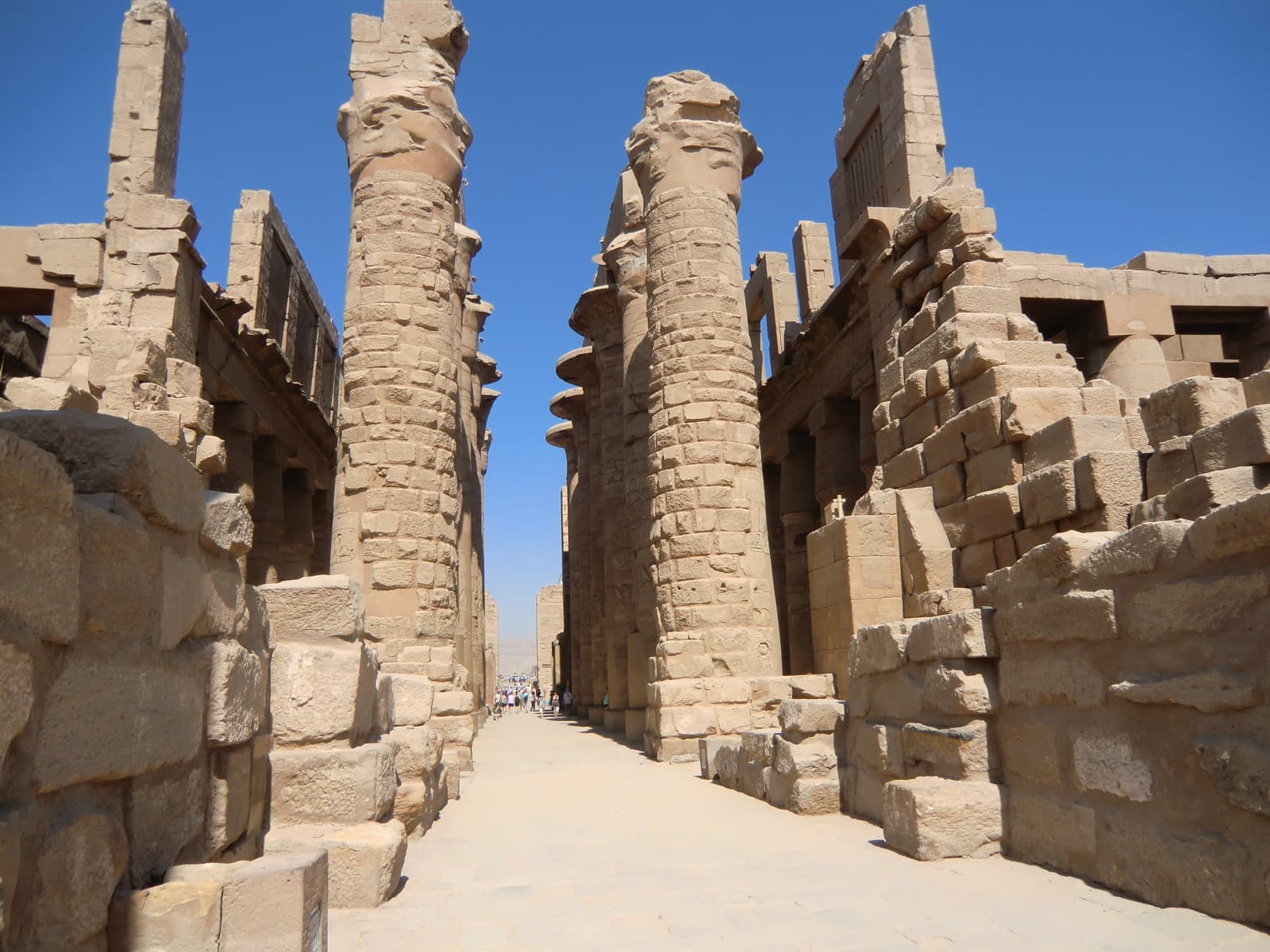
Walk into the Great Hypostyle Hall at Karnak and the architecture does something to your body before you have understood a single carving. There are 134 columns here, arranged in sixteen rows across about 5,000 square metres. The twelve down the central aisle rise some 21 metres, roughly the height of a modern apartment building, and each is more than three metres across. The remaining 122 stand about ten to twelve metres. They were engineered to make a person feel very small before the divine, and that intention is the key to the whole temple-city of ancient Thebes. Understand this one room and you understand why the pharaohs kept building here for two thousand years.
This is why the hall is the best way into the full Karnak and Luxor route rather than just another stop on it. Karnak is not a single temple. It is a city of them, and its largest section, the Precinct of Amun-Re, was built and rebuilt by roughly thirty pharaohs over about two thousand years, from the Middle Kingdom down to the age of the Ptolemies. Successive rulers did not tear down their predecessors' work. They added to it, so the complex grew outward and upward, a forest of gateway walls, obelisks, and colossal columns. The Hypostyle Hall is where that accumulating ambition reaches its densest point.
A forest of stone, half in darkness
A hypostyle hall is simply a roofed space whose ceiling rests on columns. Karnak's is among the grandest ever raised. The hall was built chiefly under Seti the First and his son Ramesses the Second, in the Nineteenth Dynasty, around the thirteenth century B C. Every column and every wall was carved in relief and once painted in strong colours. The taller central columns supported a raised clerestory roof, so light entered through stone grilles high on the walls, leaving the interior in a deliberate, sacred half-dark. This was never a bright, open space. It was designed to be dim, filtered, and heavy with incense.
Look for the seam between two hands at work. Seti the First decorated the northern half of the hall in delicate raised relief, where the figures stand out from the surrounding stone. His son Ramesses the Second finished the southern half in the faster sunk relief, where the carving is cut into the surface instead. The change of technique is still visible today, a record of a project handed from father to son. And if you tip your head back toward the tops of the columns, where direct sun has never reached, you can still find traces of original paint: blues, reds, and golds that once covered everything you now see as bare stone.
Why the scale is the whole argument
Hear a stop from this walk
The First Pylon of Karnak: Through the Gate into the City of the God
The temptation at Karnak is to treat scale as a fun fact, a number to photograph and move past. The Hypostyle Hall makes that impossible. Standing among 134 columns, a human being is reduced to almost nothing, and that was exactly the point. Egyptian temple architecture used size as theology. To feel dwarfed inside the god's house was to feel the proper relation between a mortal and Amun, the chief god of the Theban Triad. Once you have physically felt that on your own body, every other part of the walk reads differently.
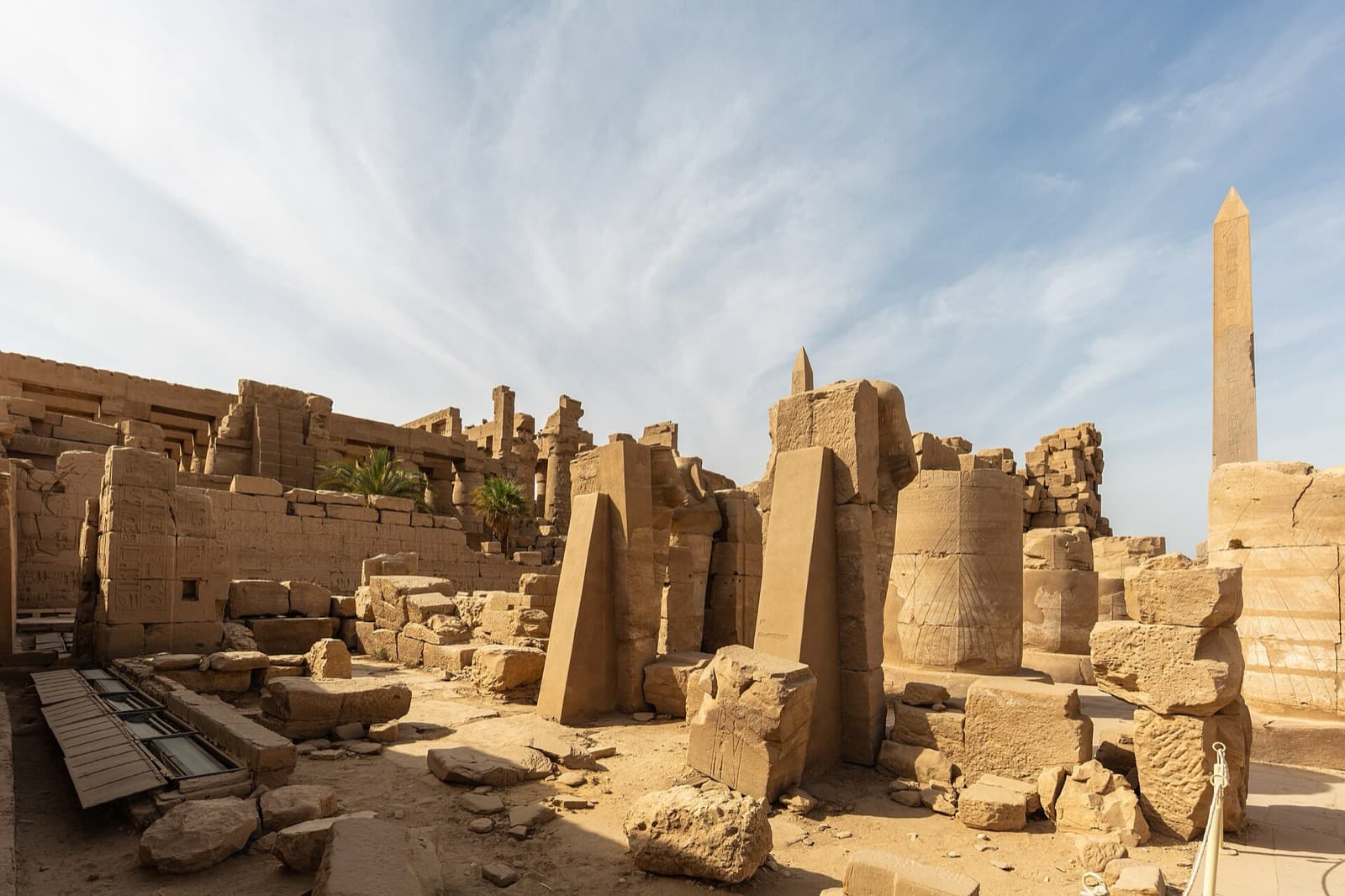
It reframes the first pylon you passed on the way in, the massive unfinished gateway wall that opens the precinct. It reframes the obelisk that comes next: the tallest surviving ancient obelisk in Egypt, about 29 and a half metres of red granite cut from a single block at Aswan and raised whole by Hatshepsut, one of the very few women who ruled Egypt as pharaoh, in the Eighteenth Dynasty. Her reign is dated to about 1473 through 1458 B C. After she died, her successor Thutmose the Third walled her obelisks in, trying to erase her from the record. The obelisk outlasted the erasure. Scale, it turns out, was also a way to reach for permanence, and the Hypostyle Hall is where you learn to read that reach.
From the god's house to the god's road
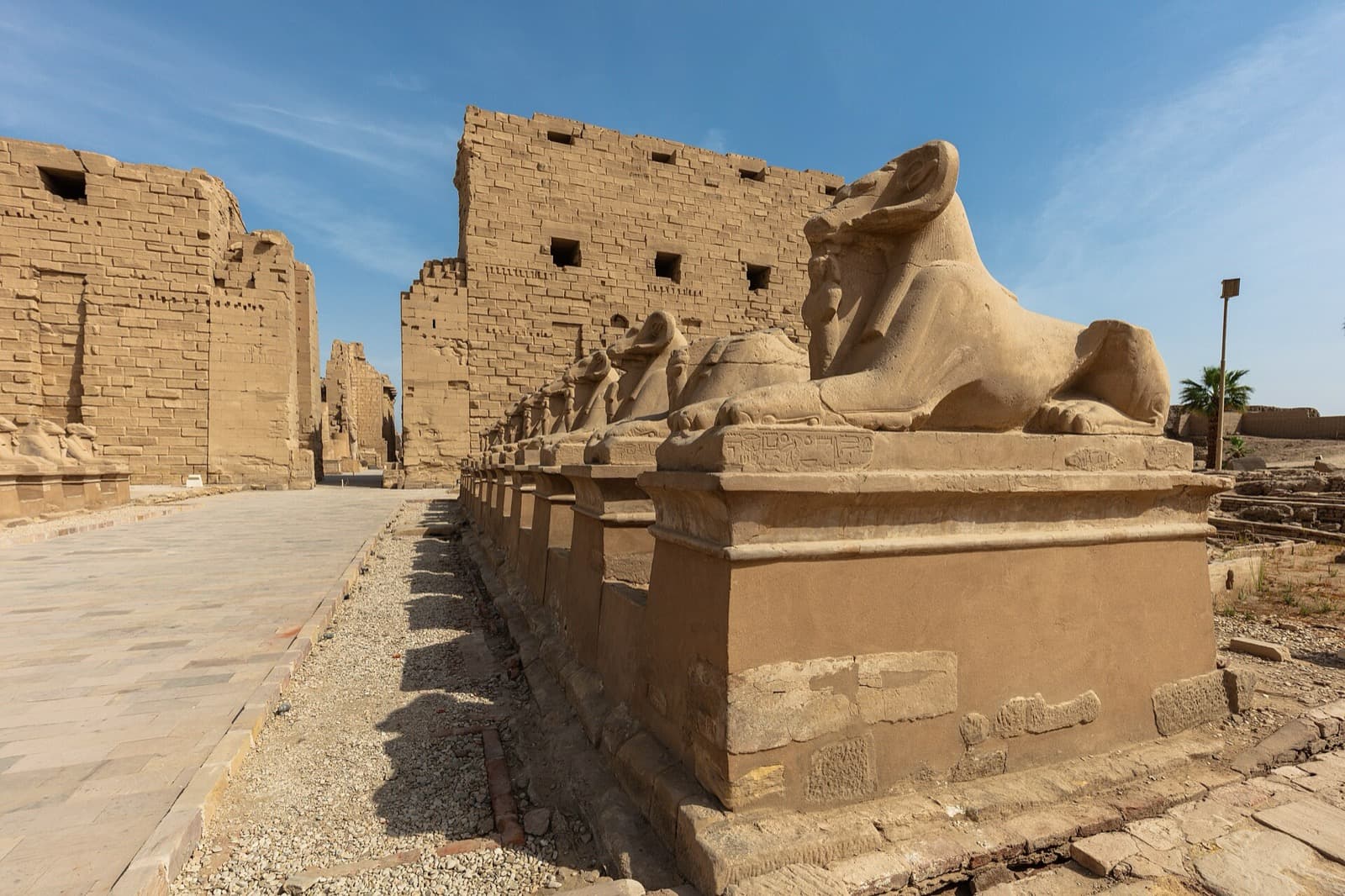
The hall also sets up the second half of the tour, which leaves Karnak entirely. Once a year, in the great Opet festival, the sacred image of Amun was carried out of these precincts and down a processional road to Luxor Temple in the heart of town. That road is the Avenue of Sphinxes, running nearly three kilometres and once lined with 1,057 statues, both sphinxes and ram-headed figures of Amun. It was buried and forgotten beneath the modern town for centuries, and it reopened only on the 25th of November, 2021, with a televised parade. You walk a road that spent centuries underground and returned to the light within living memory.
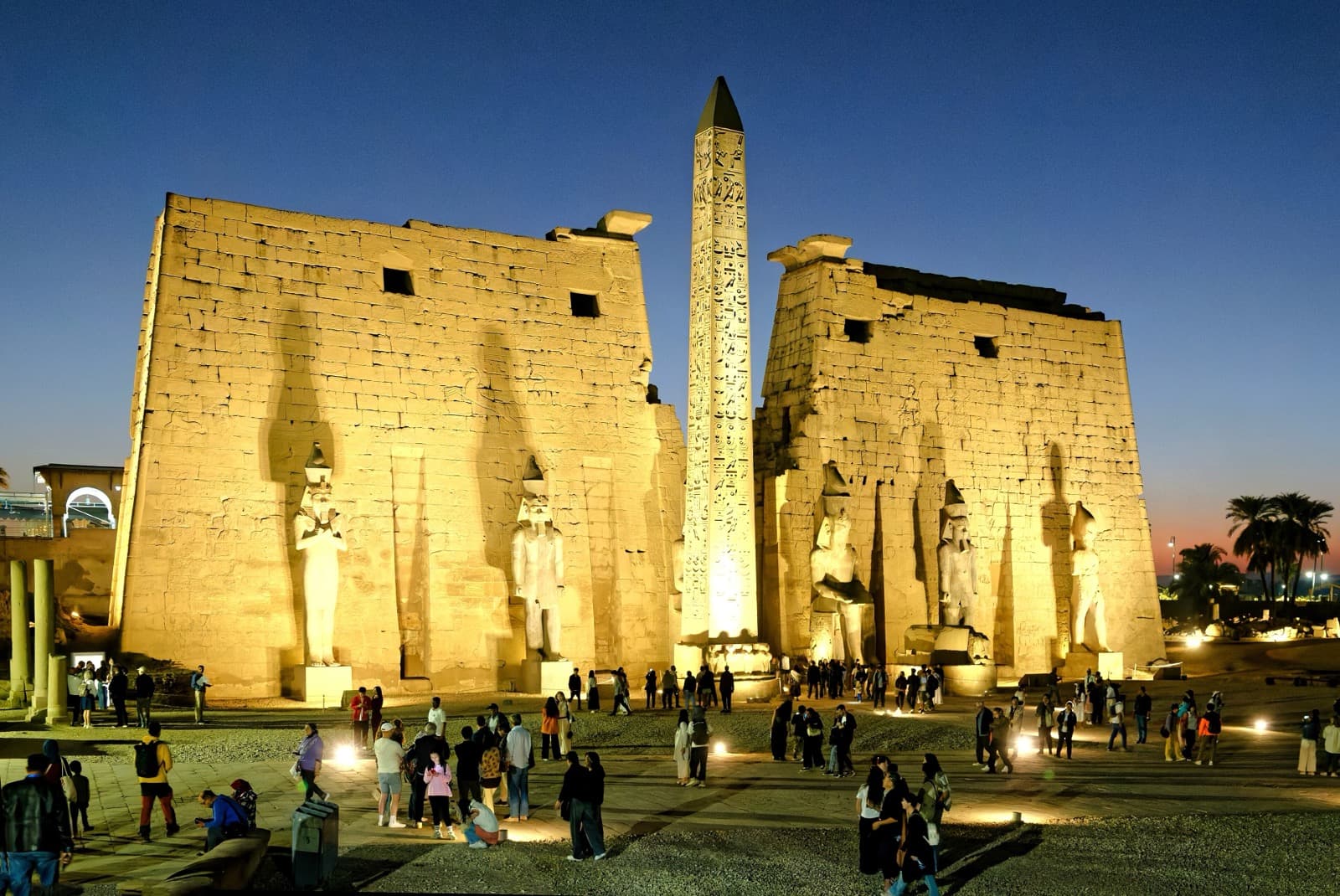
At its far end stands Luxor Temple, built chiefly by Amenhotep the Third and Ramesses the Second, with additions by the young king Tutankhamun. High on one of its walls sits the living Mosque of Abu al-Haggag, its floor marking how deep the temple once lay in sand. That ground has been sacred for more than 3,400 years, pharaonic, then Roman, then Christian, and now Islamic. In front of the temple stands a single red-granite obelisk whose twin was given to France in 1830 and raised in the Place de la Concorde in Paris in 1836. The tour closes in the quiet Luxor Museum, home to 26 New Kingdom statues found in a cache beneath the temple's Sun Court in 1989.
The Hypostyle Hall is the moment all of that becomes legible. It teaches you to read scale as intention, and once you can, the whole route from Karnak to the Seine-bound obelisk becomes a single continuous argument about how a civilization built to touch its gods.
You can walk the full route at your own pace, lingering where the light is good and moving on when you are ready. Compare it with the rest of the city's routes on our Luxor walking tours hub, or start planning your days on the ground from the Luxor city page.
Sources
- Great Hypostyle Hall Project, University of Memphis: scholarly documentation of the hall's columns, dimensions, and the Seti the First and Ramesses the Second relief programs.
- Digital Karnak, University of California (UCLA/UCSC): reconstructions and chronology of the Precinct of Amun-Re, the Hypostyle Hall, and the site's two-thousand-year building history.
- Karnak, Wikipedia: overview of the temple complex, the Precinct of Amun-Re, and its ranking among Egypt's most visited sites.
- Avenue of Sphinxes, Wikipedia and CBS News coverage: the processional way's statue count, burial, and the November 2021 ceremonial reopening.
- Luxor Temple and Luxor Museum, Wikipedia: continuity of worship, the Mosque of Abu al-Haggag, the Paris obelisk twin, and the 1989 Sun Court statue cache.
Ready to experience it?
Karnak and Luxor Temple: The Great Sanctuaries of Ancient Thebes
200 min · 4.2 km · moderate
More from Luxor
Explore more at your own pace.
Luxor Travel Guide: Days, Transport, Season, Safety, Budget
One Day in Luxor: A Walkable Morning-to-Evening Itinerary
Luxor: Ancient Thebes and the Two Banks of the Nile
The Valley of the Kings: Reading Luxor's Hidden Tombs and the Temples They Answer
Luxor Temple: The One Egyptian Sanctuary Worship Never Left