Kabuki was born not inside a grand theatre but on the dry riverbed of the Kamo, beside the building now called Minami-za, and tradition credits its invention around 1603 to a woman named Izumo no Okuni. That single fact reverses the way most visitors read this corner of Kyoto. They see a monumental theatre at the east end of the Shijo bridge and assume the art began behind its walls. It did not. It began outdoors, on open gravel, with a female entertainer improvising a new kind of dance-drama for whoever gathered to watch.
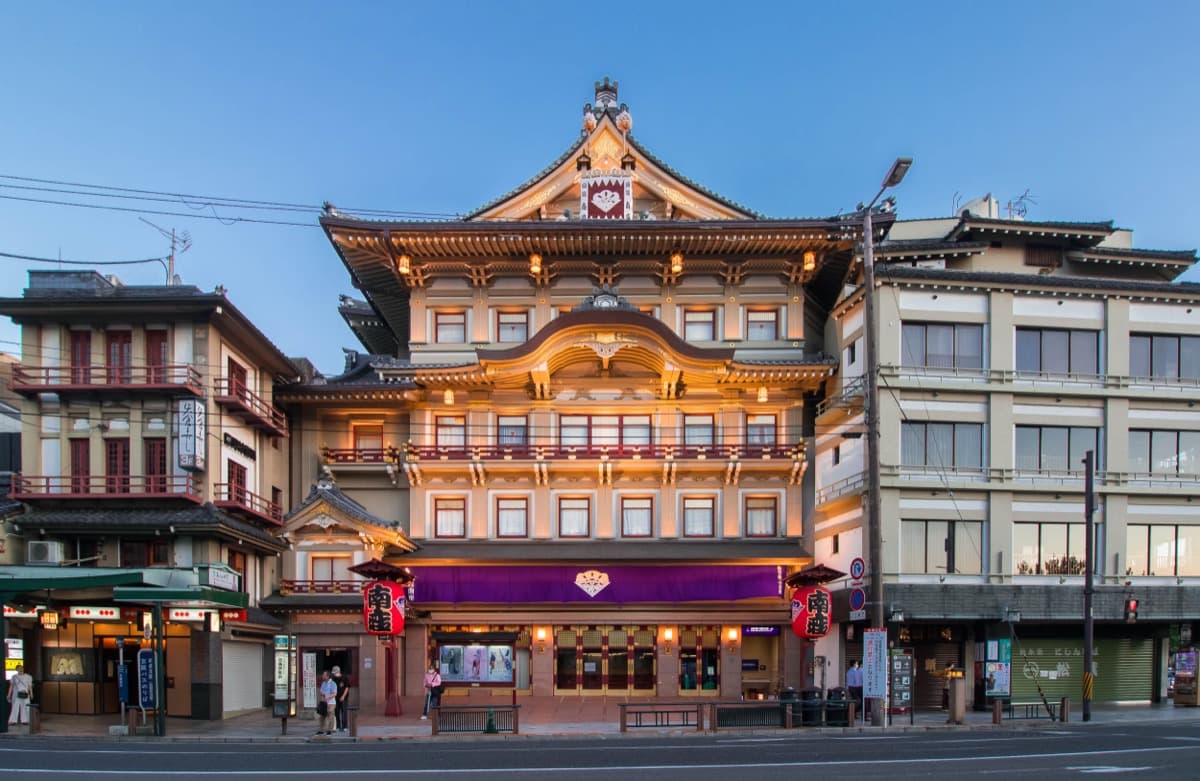
Stand at the east end of the Shijo bridge and you have both halves of the story in one glance. Behind you rises Minami-za, Kyoto's principal kabuki theatre, operated by the Shochiku company. In front of you, past the traffic, is the Kamo River and the flat expanse of gravel called the Shijogawara, the dry bed at Fourth Street. The polished theatre and the empty riverbed are the same story told at two different ages: the floating world remembering where it started.
The woman who invented an art
Izumo no Okuni lived from roughly 1578 to roughly 1613. She had served as a shrine maiden associated with the Izumo Grand Shrine, and by tradition she came to Kyoto and began performing a new, plain style of dance-drama on the dry bed of the Kamo around 1603. She gathered a troupe, staged her performances on a makeshift platform, and drew crowds with something that felt eccentric and daring for its time. One reading of the word kabuki traces it to kabukimono, people who dressed strangely and swaggered through the streets, from a verb meaning to lean or tilt. Okuni's performances leaned. They tilted away from what respectable entertainment was supposed to look like, and that was the appeal.
I want to be honest about the record, because the sources are honest about it. Concrete details of Okuni's life are scarce and partly legendary. The year 1603 is an approximation, and even her death date is disputed. What survives is not a biography so much as the shape of a beginning: a woman, a riverbed, a new form of theatre that spread fast. Everything that kabuki later became, the all-male companies, the painted faces, the revolving stages, grew out of that gravel-bed start. Early kabuki was performed by women and tangled quickly with the licensed pleasure quarters, which is precisely why later authorities banned first women and then youths from the stage, pushing the art toward the all-male tradition it is known for today. So the art most associated with masculine spectacle was, at its root, invented by a woman.
From gravel to grand theatre
Hear a stop from this walk
Minami-za: Where the Floating World Was Born
Minami-za is the survivor of that riverside world. It was founded in 1610 as Shijo Minami-za, and it counts among the earliest of the seven officially licensed kabuki theatres of the early Edo period, a cluster that once lined the Shijo riverbank. Its rivals are gone. Minami-za is the last of them still standing and still staging kabuki, which makes it one of the oldest continuously associated kabuki venues in Japan.
The building you actually see is younger than the institution. After restructuring earlier in the century, the current theatre was rebuilt in 1929 as a gabled structure in the Momoyama style, seating over one thousand people. In 1996 it was registered as a Tangible Cultural Property in recognition of its architectural and historical value to Kyoto. Look up at the tiled gables and the great signboards and you are reading a 1929 stage set for an art four centuries old.
The theatre's marquee event is the kaomise, the face-showing, held in December. This is the season when the year's leading performers are formally presented, a custom carried down from the Edo period, when theatres unveiled the troupe they had contracted for the coming year. If you want to see kabuki in the place with the strongest claim to being its birthplace, the December kaomise is the run to plan around. Tickets vary by performance, and the exterior is free to admire any time you cross the bridge.
Why this corner holds the whole district
The Gion side of the river and the theatre are not separate subjects. Okuni's early troupes and the licensed pleasure quarters were two faces of one world, the ukiyo, the floating world that gave Edo-era Japan its districts of entertainment built for a night that would never quite hold still. Gion is the last inhabited fragment of that world, and Minami-za is its theatre. When you walk the lanes of Gion Kobu and read the shut wooden doors of the teahouses, you are reading the domestic, private side of the same culture that Okuni turned outward onto a riverbed. The theatre made it public and grand. The teahouses kept it private and small. Both descend from the same source.
That is why standing here matters more than any photograph of the facade. The Shijogawara in front of you is ordinary gravel, embanked and tamed now, with people walking dogs and couples sitting at even intervals along the water. It looks like nothing. It is where an art form began. Kyoto is generous that way: it lets the most consequential ground stay plain, and asks you to bring the knowledge that makes it legible.
If you want to see the floating world as a whole, from the shrine that named Gion to the lantern-lit alley of Pontocho, this theatre and its riverbed sit at the turn of the walk through Gion. Come to Minami-za knowing that kabuki started outside, on the ground you can still stand on, and the grand theatre behind you stops looking like a beginning and starts looking like what it is: the floating world, refined indoors, remembering the gravel.
Sources
- Minami-za, Wikipedia. Founding in 1610, standing among the seven licensed early-Edo theatres, the 1929 rebuild, Shochiku management, and the 1996 Tangible Cultural Property registration.
- History of the Minamiza Theatre, Kabuki Web (Shochiku). Official history of the theatre and its December kaomise season.
- Izumo no Okuni, Wikipedia. Her dates (c. 1578 to c. 1613), her shrine-maiden background, and the c. 1603 Shijogawara riverbed performances credited as the origin of kabuki.
- Okuni, Encyclopaedia Britannica. Corroborates her role as the legendary creator of kabuki dance-drama.
- Kabuki, Wikipedia. The etymology from kabukimono and the early shift from female to all-male performance under Edo-era bans.
Ready to experience it?
Gion: The Floating World
70 min · 2 km · easy
More from Kyoto
Explore more at your own pace.
Kyoto Travel Guide: How Many Days, Getting Around, When to Go (2026)
One Day in Kyoto: A Walkable South-East Itinerary (2026)
What to Eat in Kyoto: A Food Guide (2026)
Senbon Torii: Why Ten Thousand Gates Climb the Mountain at Fushimi Inari
The Romon Gate at Fushimi Inari: A Warlord's Receipt for a Prayer