Walk a short way down the wooded Kita-Kamakura valley from Engaku-ji and you reach a small, plain nunnery called Tokei-ji. It looks like nothing much: mossy stones, a modest hall, a quiet cemetery under the trees. Its real function was legal. For nearly six centuries this convent was the one place in Japan where a wife could flee an abusive marriage and win an official divorce, a working institution disguised as a place of retreat. That contradiction, serenity on the surface and hard legal power underneath, is the whole point of Tokei-ji, and it is why this unassuming temple deserves a closer look than its size suggests.
A legal escape hatch in a system built for husbands
To understand what Tokei-ji offered, you have to understand what it offered against. In much of premodern Japan a husband could cast off a wife almost at will, often with a short letter of divorce. A wife had no equivalent power. She could not simply leave, and she certainly could not compel a divorce on her own terms. The marriage held her whether she wanted it or not.
Tokei-ji was the sanctioned exception. According to the temple's own history, a woman who ran here and completed a term of religious service could obtain an official divorce that the outside world was bound to recognize. The term was three years at first, later reduced to two. Complete the service, and you walked out legally free. That is why the temple carries two nicknames in Japanese: kakekomi-dera, the temple you run into, and enkiri-dera, the temple that severs the bond. Both names describe the act of a woman in flight arriving at the gate and crossing into a jurisdiction her husband could not follow her into.
The scale of that refuge was real, not symbolic. Temple records indicate that during the Tokugawa period alone, an estimated two thousand women sought shelter within these walls. Picture that flow across the generations: two thousand individual decisions to run, each one a woman calculating that a few years inside a convent was a price worth paying for the right to start again.
Founded by a widow, led by women for six hundred years
Hear a stop from this walk
The Kamakura Gozan: The Five Mountains
The founding fits the mission. Tokei-ji was opened in twelve eighty-five by an abbess named Kakusan-ni, the widow of the regent Hojo Tokimune, together with her son, the reigning regent Hojo Sadatoki. Tokimune was the same Hojo ruler who, three years earlier, had founded the great import monastery of Engaku-ji just up the valley to honor the dead of the Mongol invasions. His widow built something quieter and, in its own way, more radical: an institution run by women, for women, with a legal remedy at its core.
And it stayed a women's institution for an extraordinarily long time. The temple remained a nunnery for more than six hundred years. Men could not take the post of abbot until nineteen oh two, when the leadership finally passed to a man. Before that, generation after generation of abbesses governed the grounds, kept the records, and administered the refuge. Few institutions anywhere held to female leadership across six centuries.
The end of the temple's legal power
The refuge did not last forever, and its end came from the same place its power did: the state. Japan's Meiji-era modernization rebuilt the country's laws from the ground up, and in that rebuilding the old temple privileges were swept away. Tokei-ji lost its right to grant divorce in eighteen seventy-three, when a new law took effect and the ordinary courts of justice began handling divorce cases directly. From that point a woman seeking to end a marriage went to a courthouse, not a convent.
It is worth sitting with the timing. For centuries the fastest route to a divorce for a Japanese woman ran through a religious sanctuary rather than a legal one. Only in the nineteenth century did the civil courts take over the function the temple had quietly performed all along. The escape hatch closed because the front door, at last, had opened a crack.
Where modern Zen thought comes to rest
There is a second reason to linger in the cemetery, and it connects this medieval refuge to the twentieth century. Wander back among the wooded graves and you will find, in adjacent plots, two figures who shaped how the modern world understands Japanese philosophy and Zen: Kitaro Nishida, the founder of modern Japanese philosophy, and Daisetz Teitaro Suzuki, usually written as D. T. Suzuki, the scholar who did more than anyone to carry Zen thought to Western readers. It was Suzuki, a lifelong friend, who organized Nishida's funeral, and he was later buried in the plot beside him. That two of the most influential minds in modern Japanese intellectual life chose to remain at this particular small convent tells you something about how Tokei-ji is regarded. It is not only a monument to old women's history. It became a place associated with contemplation and clarity, and the people who spent their lives on those questions wanted to rest here.
Walking it yourself
Tokei-ji sits on the Kamakura temple valley walk, the second stop after Engaku-ji, with admission of only around two hundred yen (sometimes described simply as a donation). It rewards a slow visit rather than a fast one. Read the plain hall as what it once was, a legal office. Read the cemetery as a bridge between two eras of Japanese thought. Then follow the valley onward toward Meigetsu-in and the great first-ranked monastery of Kencho-ji, where the story shifts from women's refuge to the imported Zen that gave the whole valley its shape.
If you want the full thread, from the import temple at the top of the hills down to the oldest training monastery at the bottom, the self-guided route through the Zen valleys of Kamakura links Tokei-ji to its neighbors stop by stop, at your own pace and on your own schedule.
Sources
- Tokei-ji, Wikipedia. Primary reference for the divorce-temple function, the kakekomi-dera and enkiri-dera names, the three-year service term, the estimated two thousand Tokugawa-era refugees, the loss of divorce authority in eighteen seventy-three, the six-hundred-year female leadership ending in nineteen oh two, the founding by Kakusan-ni and Hojo Sadatoki in twelve eighty-five, and the adjacent graves of Nishida and Suzuki.
- Kakusan-ni, Wikipedia. Biographical detail on the founding abbess, her marriage to Hojo Tokimune, and her son Hojo Sadatoki's role as lay patron.
- Matsugaoka Tokei-ji, The Divorce Temple, Amusing Planet. Corroborates the service term being set at three years and later reduced to two.
- Tokeiji, Kamakura Guide. Practical context on admission, seasonal access, and the temple's place in the wider Kita-Kamakura route.
Ready to experience it?
The Temple Valleys: Zen in the Northern Hills
100 min · 3 km · moderate
More from Kamakura
Explore more at your own pace.
Kamakura Travel Guide: Day Trip from Tokyo, Getting Around, When to Go (2026)
One Day in Kamakura: The Perfect Day Trip from Tokyo (2026)
What to Eat in Kamakura: A Food Guide (2026)
Hase-dera: The Kamakura Temple of a Giant Kannon That Washed Ashore From the Sea
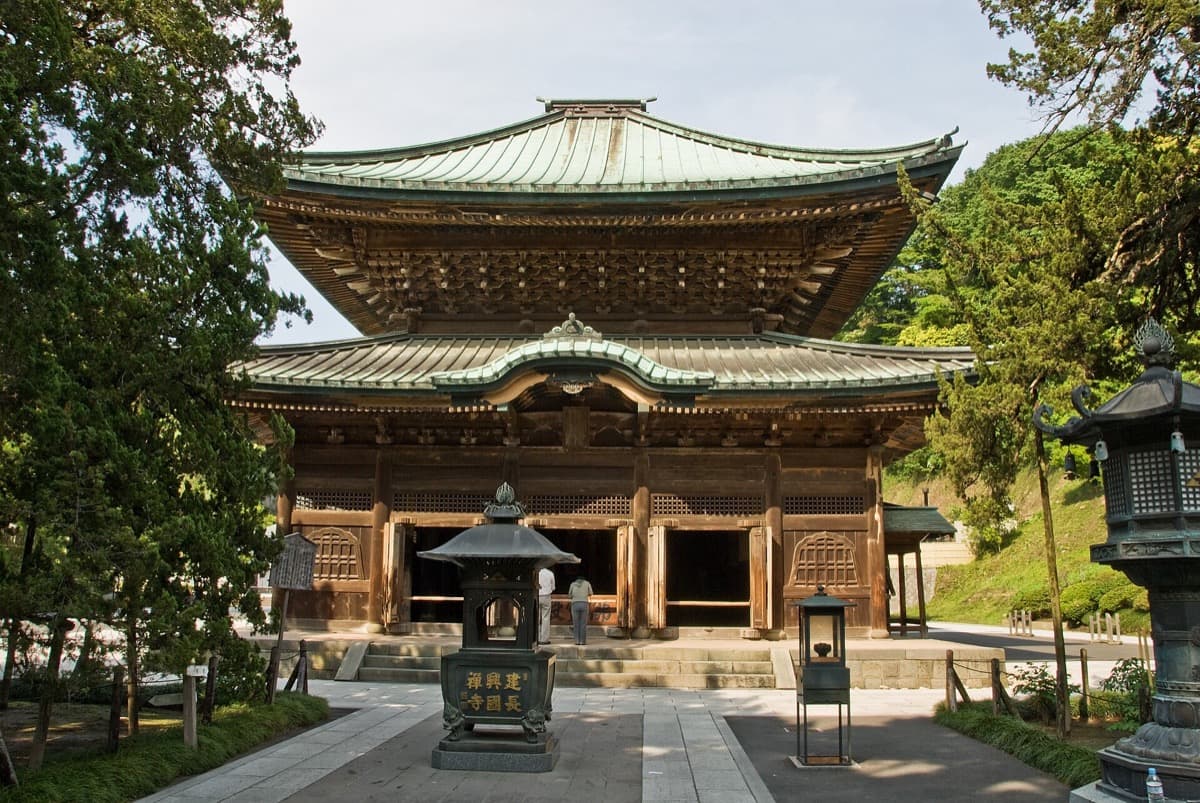
Kencho-ji: Japan's Oldest Zen Training Monastery, Founded by a Chinese Monk in 1253