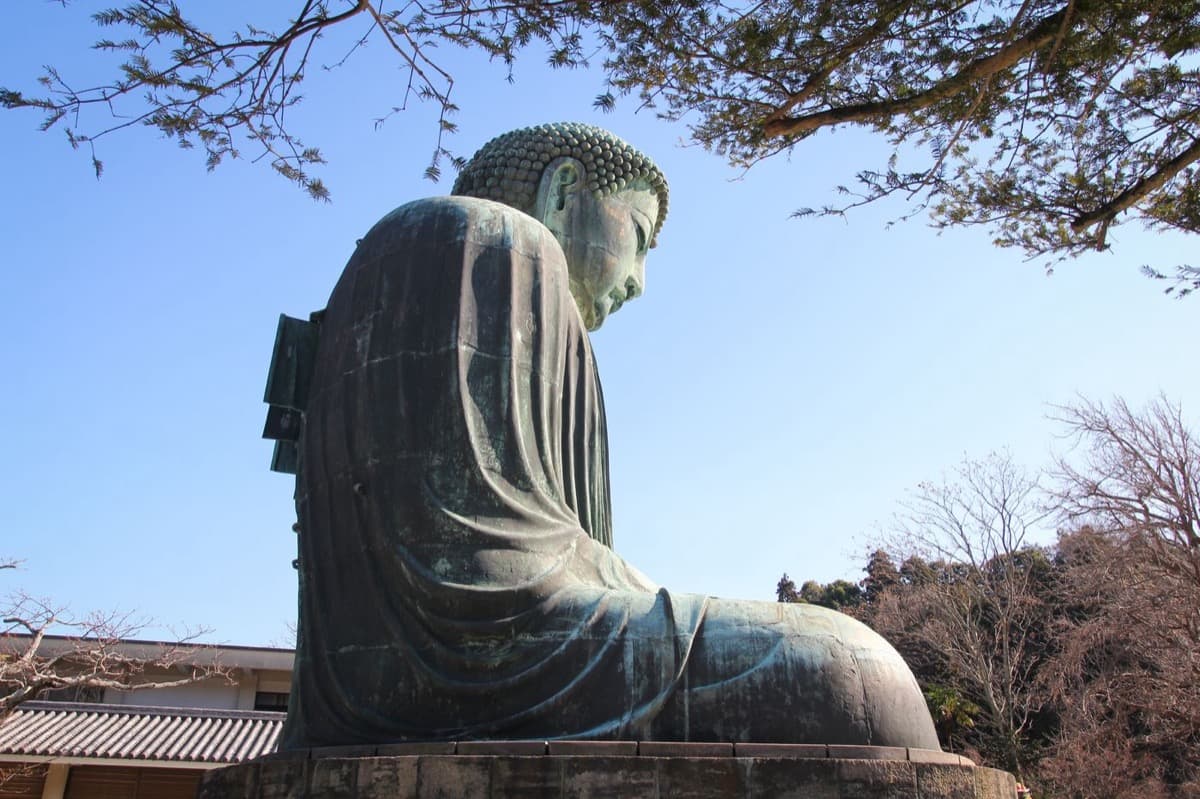
The Great Buddha of Kamakura was cast around 1252 to sit sheltered inside a wooden hall, and it faces the open sky today only because a tsunami in 1498 destroyed that hall and the town never rebuilt it. Most visitors read the exposed bronze as a deliberate statement, a serene figure at peace with the elements. The truth is quieter and stranger. The openness was never the plan. This Amida Buddha spent its first centuries as an indoor statue, and it became an outdoor one by accident, through repeated storm damage and one catastrophic wave, after which the people here simply let the sky take over the roof's job.
A bronze built to be housed
The statue sits at Kotoku-in, a temple in the Hase district of Kamakura, a coastal town about an hour south of Tokyo. Temple records date the casting of the bronze to around the year 1252, in the Kamakura period, when the town was Japan's center of government. The figure represents Amida (Amitabha), the Buddha of the Western Paradise, and it has kept its cross-legged seat here ever since.
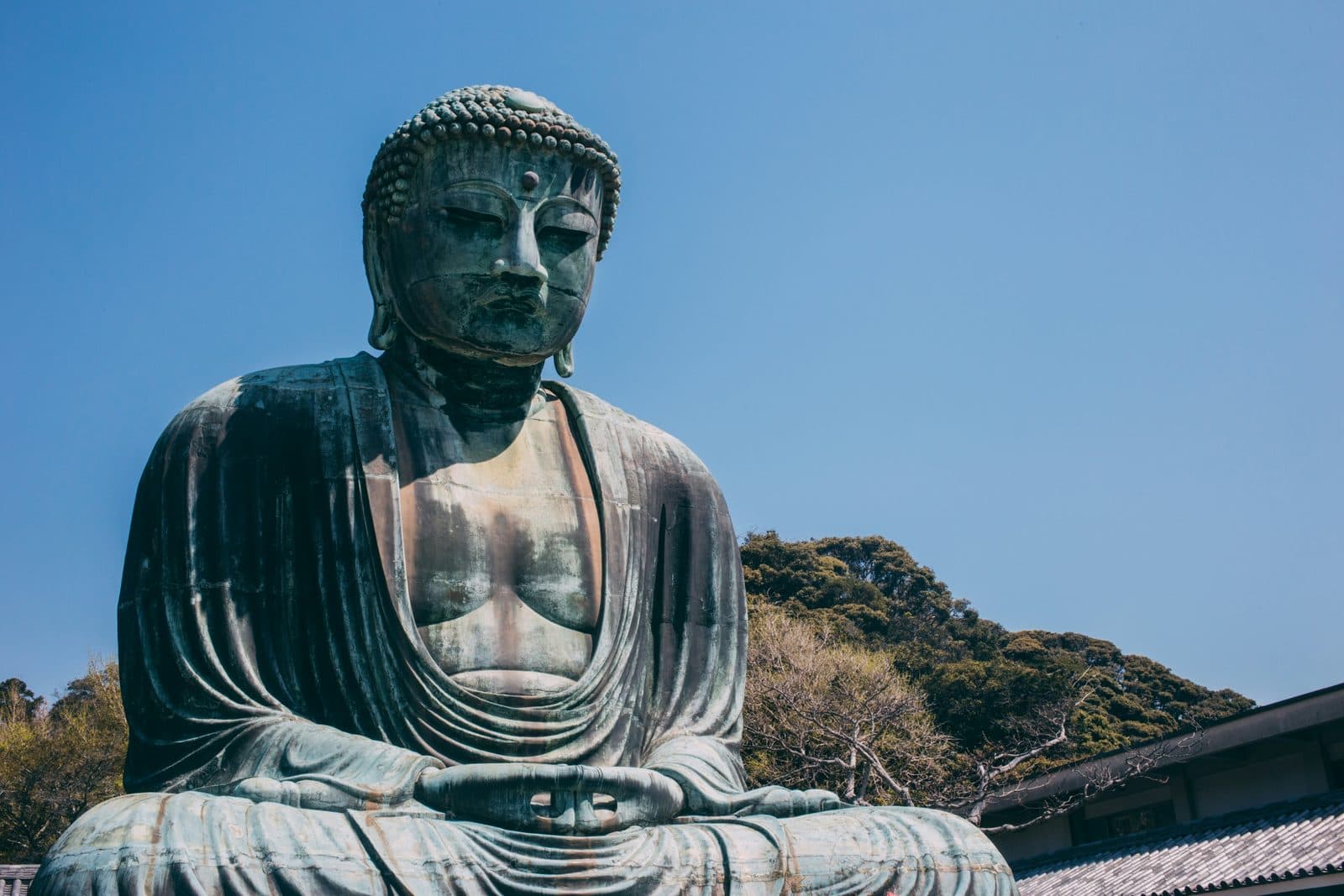
The scale rewards a slow look. Measured to the top of its base, the figure rises about 13 meters, and the body itself stands just over eleven. Its weight is usually given somewhere near 120 tonnes, though quoted figures vary, so it is best treated as an order of magnitude rather than a settled number. The face alone runs about 2.35 meters from top to bottom. Each eye is roughly a meter across, and each long ear stretches nearly two meters. The statue is a designated National Treasure of Japan.
What tends to strike people is not the size but the calm. The hands rest in the lap, the eyes are lowered, and the whole enormous mass seems perfectly at ease. That ease is easy to mistake for the point. But a bronze this large was, by convention, the centerpiece of a hall built around it. Casting a monumental Buddha and then leaving it outdoors would have been unusual, and Kotoku-in itself notes that open-air enshrinement is uncommon among Japan's great Buddha statues, most of which sit indoors.
The Buddha before the Buddha
Hear a stop from this walk
The Great Buddha: Kamakura Daibutsu
There is a detail most people walk past. The bronze you see was not the first Great Buddha on this spot. A giant wooden Buddha stood here first, completed in 1243 after roughly ten years of continuous labor. That wooden figure was the original object of devotion, and it too was meant to be housed. When the bronze replaced it around a decade later, the replacement inherited the same assumption: it was cast to be sheltered, an image kept dry and dim inside a temple building the way any sacred image would be.
So the plan, from the wooden predecessor to the bronze that survives, was consistent. Build a monumental Buddha. Build a great hall to hold it. Keep the image protected from wind, rain, and the salt air blowing in off the bay a few hundred meters downhill. For a while, that is exactly what happened. The building was called the Daibutsu-den, the Great Buddha Hall, and for its first centuries the bronze was an interior statue, seen in low light, framed by wooden pillars.
The wave that took the roof
The hall did not survive, and the record is not of a single clean loss but of repeated damage. Storms battered the structures over the years. The final chapter came with the sea itself. The last building housing the statue was washed away in the tsunami that followed the Nankai earthquake of 20 September 1498, during the Muromachi period. The same water you can glimpse from the terrace of nearby Hase-dera, out across Sagami Bay, reached inland and took the roof.
What happened next is the part worth standing still for. The people of Kamakura did not rebuild. The hall was gone, the Buddha was left sitting under the open sky, and there it has stayed for more than five centuries. Whether that was a decision, a resignation, or simply the way time settled around a town with other priorities, the record does not say. But the result is unambiguous. A bronze meant for the dim interior of a temple has now spent far longer exposed to the weather than it ever spent indoors.
You can still read the loss on the ground. Set into the earth around the statue are low, worn, square stone blocks. These are the bases that once held the wooden pillars of the Daibutsu-den. They are quiet markers of a roof that is no longer there, and they turn a serene photo opportunity into something closer to a ruin with its heart still intact.
A statue you can enter
The final surprise is that the Great Buddha is hollow, and for a small extra fee you can step inside the bronze itself. Duck through the low opening at the back and the making of the thing is laid bare. This giant was not poured in one go. It was built up in stages, cast in courses, section stacked upon section and joined as the figure rose. Modern study of the statue shows that the body alone required seven separate casting operations, and the bronze skin is not uniform, varying from roughly three centimeters thick in places to around twelve.
From within, you can still see the seams where the sections meet, the honest joints of a thing assembled by hand more than seven centuries ago. It is a fitting place to understand the statue. Outside, the Buddha is whole, timeless, and apparently unbothered by the sky above it. Inside, it is a made object, a shell of joined metal that was engineered to be housed and then outlived its house. The calm you read on its face is real. So is the accident that put that face under the open air.
If you want to walk this hillside yourself, from the sheltered Kannon at Hase-dera to the open-air bronze and the stone bases of its vanished hall, the route runs through Kamakura.
Sources
- Kotoku-in, Wikipedia. Casting date around 1252, Amida Buddha identification, dimensions and weight, National Treasure status, the 1243 wooden predecessor, and the destruction of the final hall by the tsunami from the Nankai earthquake of 20 September 1498.
- Kotoku-in official site (kotoku-in.jp). Temple's own account of the statue, its uncommon open-air setting, and interior access.
- Kamakura Guide, "Kamakura Great Buddha (Kotoku-in)." Body height of 11.31 meters, weight near 121 tonnes, and paid interior access.
- Casting analysis of the Kamakura Daibutsu (muza-chan.net and related technical accounts). Body cast in seven operations and bronze wall thickness varying from roughly three to twelve centimeters.
- Roamer tour transcript, "The Great Buddha and Hase" (fact-audited). Route context and interior-access specifics.
Ready to experience it?
Great Buddha: Hase and the Kamakura Daibutsu
80 min · 1.5 km · easy
More from Kamakura
Explore more at your own pace.
Kamakura Travel Guide: Day Trip from Tokyo, Getting Around, When to Go (2026)
One Day in Kamakura: The Perfect Day Trip from Tokyo (2026)

What to Eat in Kamakura: A Food Guide (2026)
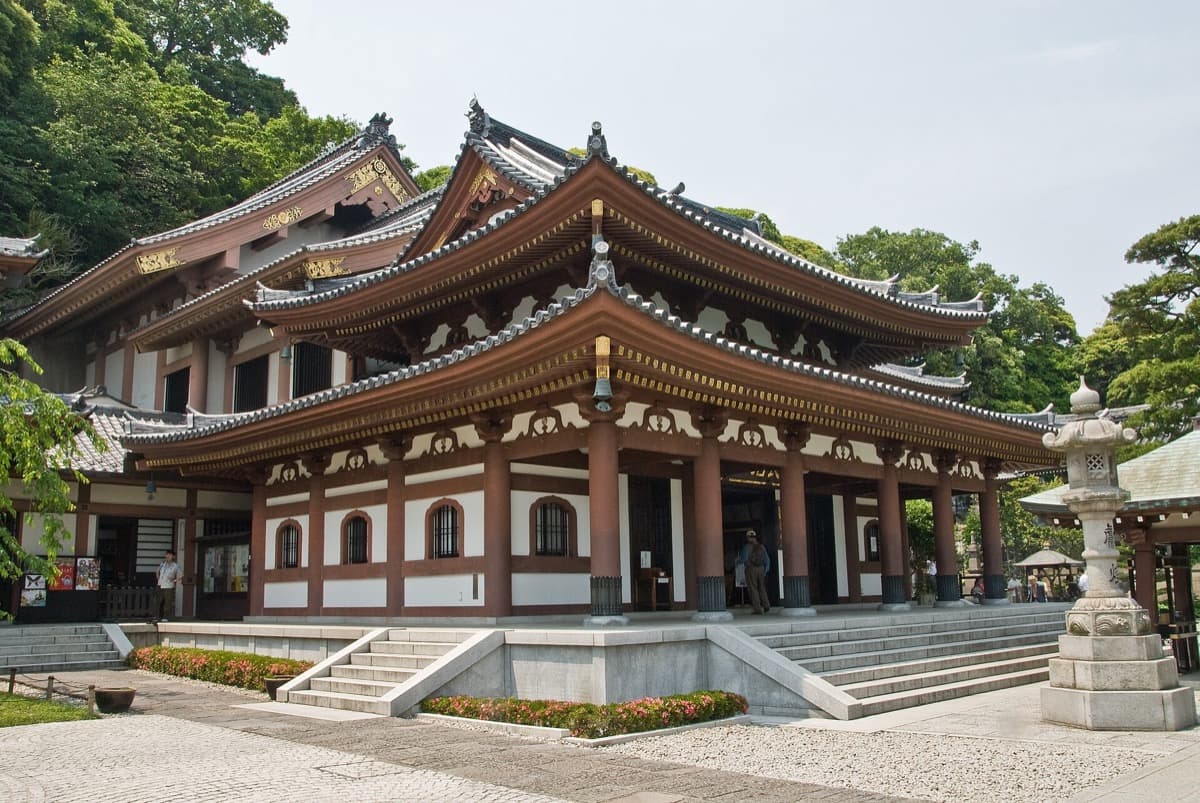
Hase-dera: The Kamakura Temple of a Giant Kannon That Washed Ashore From the Sea
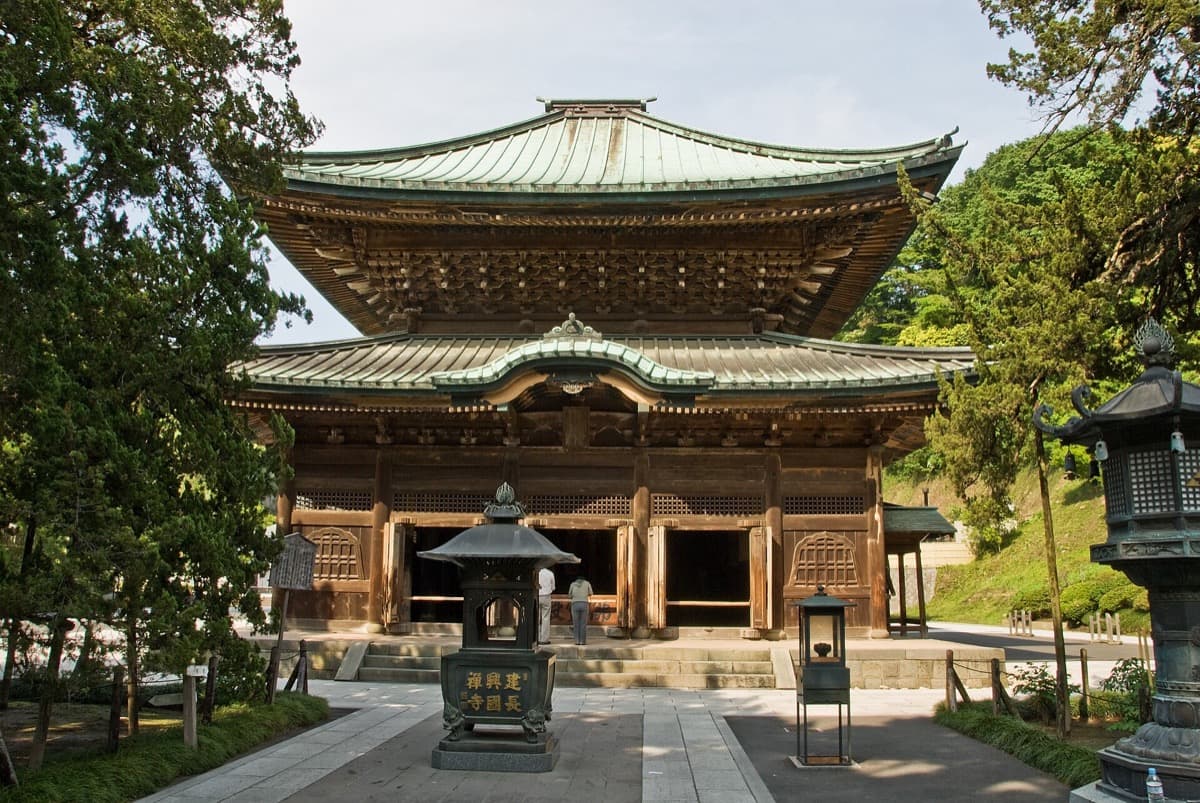
Kencho-ji: Japan's Oldest Zen Training Monastery, Founded by a Chinese Monk in 1253