There are two cities called Hue, and they face each other across a river. On the north bank stands the walled imperial capital of the Nguyen emperors, moated and gated and old, the Confucian diagram our Imperial Citadel companion reads inward wall by wall. On the south bank stands a newer Hue, the one France built after it crushed a court uprising in the 1880s and reduced the emperors to figureheads. This walk stays on the south bank, and it follows a strange thread through it: France built here to rule, and the finest of what it built helped end its own rule.
Start at the threshold. The Truong Tien Bridge is the iron span that links the two Hues, among the first bridges to cross the Perfume River and one of the first major steel bridges in Indochina. The French Resident Superior of Annam assigned the work to the engineering firm Schneider et Cie in 1897; groundbreaking came in 1899, and the bridge was inaugurated on the eighteenth of December, 1900. You will hear guides credit the design to Gustave Eiffel. It is a lovely story and it is legend. The records attribute the original construction to Schneider et Cie; the Eiffel company only carried out a major renovation beginning in 1937.
Hold onto what a bridge does, because it is the key to the whole walk. It was built to bind the colonial south bank to the imperial north, to move officials and goods and soldiers between the two Hues and make French control convenient. But a bridge carries traffic in both directions. Everything the empire sent across it, ideas, schooling, ambition, could come back the other way.
The confident face of empire
Turn onto Le Loi street, the tree-lined riverfront boulevard France laid out as the social and administrative face of its second Hue. At the south foot of the bridge stands its grandest survivor, the hotel now known as Saigon Morin. It opened in 1901 as the Grand Hotel de Hue, built by the Frenchman Henri Bogaert, who owned the local Long Tho brick and tile factory, and was later run by the Morin brothers. In its prime it was described as the first hotel in central Vietnam and one of the largest in all of Indochina, four facades wrapped around a central courtyard, the confident architecture of a power that meant to stay.
Even here the double edge shows. Between December 1946 and February 1947 the hotel became a site of fighting between Viet Minh forces and the French, and until 1957 part of it served as premises for Hue University. A French luxury became, in time, a place for the education of the Vietnamese. Durable buildings outlive the empires that raise them.
The paradox at the center
Hear a stop from this walk
Quoc Hoc National Academy: The Paradox's Heart
A few steps down Le Loi, at number seven, a riverfront museum marks the childhood of the most famous student this city ever raised: Ho Chi Minh. He was not born here. He was born Nguyen Sinh Cung in 1890 in the north-central countryside, and his father, a scholar preparing for the imperial examinations, brought the family to Hue in 1895. The boy spent two long stretches of his youth in this city and, in the second, enrolled in the French school just up this street. His preserved childhood house is not on the south bank at all; it sits across the river inside the citadel, on Mai Thuc Loan street, recognized as a national relic in 1993. The boy who would lead the movement that ended French rule grew up crossing between the two Hues, learning the old world of the examinations from his father and the new world of French schooling here. William Duiker's 2000 biography traces exactly this collision of worlds.
The collision has an address. At number twelve Le Loi stands the beating heart of this walk, the Quoc Hoc National Academy, founded on the twenty-third of October, 1896, on the site of a former Admiral's Palace. It is described as the third oldest high school in Vietnam, and it was plainly an instrument of empire, established to train young Vietnamese to serve the colonial administration, with French as the main subject. The idea was to produce loyal, capable clerks.
Read the roster and the idea collapses. Ho Chi Minh studied here, enrolled as Nguyen Tat Thanh; the school's own documents record his dismissal in 1908 for revolutionary activity. Vo Nguyen Giap, who would command the Vietnam People's Army, attended in the 1920s and was expelled after protests. Pham Van Dong, a future prime minister, studied here. So did Ngo Dinh Diem, who would become president of the Republic of Vietnam, on the other side of the coming conflict. So did Tran Phu, the first general secretary of the country's Communist Party, and the beloved poets To Huu, Xuan Dieu, and Huy Can. A colonizer built this school to make its rule permanent, and the school handed the colonized the language, the ideas, and the confidence to end that rule. The alumni list reads like the guest list at the empire's own funeral.
Faith and the dynasty's last act
The last two stops widen the paradox. Turn inland to Phuoc Qua Hill and the cathedral of Phu Cam, seat of the Archdiocese of Hue. Catholicism here is older than the French state; a church has stood on this hill since a missionary named Father Langlois acquired the land in 1684. But it is easy to misread the bold building in front of you. The colonial-era church was an earlier brick one, erected under Bishop Eugene Marie Allys and completed in 1902. The sweeping cathedral you see now was built by Vietnamese hands over nearly forty years, from 1963 to 2000, its architect Ngo Viet Thu, the same man who designed Independence Palace in Saigon. Faith, like schooling, crossed the same bridge and left men who would shape the nation's contested future, Ngo Dinh Diem among them.
The walk ends at a palace, but not one of the moated halls across the river. An Dinh Palace, on the An Cuu canal, was built in 1917 under Emperor Khai Dinh, a flamboyant hybrid of European neo-classical columns and Vietnamese decoration, listed by UNESCO as part of the Complex of Hue Monuments. Follow the thread back: Khai Dinh was the son of Dong Khanh, the very emperor France installed in 1885 after crushing the court uprising. By the time this palace rose, the throne had been hollowed out. So it is fitting that the monarchy spent its twilight not in the ancient citadel but here, in a European dream on the colonial south bank. The future emperor Bao Dai lived here as a boy and later returned with Empress Nam Phuong.
Stand in the courtyard and hold the whole walk in your mind. France built this second Hue to civilize and to rule, and its confident architecture is all around you. Just upriver sat the school whose graduates would end both the throne and the empire. Two cities, one river, and a paradox that finished them both. When you are ready, cross back over the bridge, because the third Hue, the working merchant quarter our Gia Hoi and Dong Ba companion walks, is the half of the city that kept both of these grand banks supplied all along.
Ready to experience it?
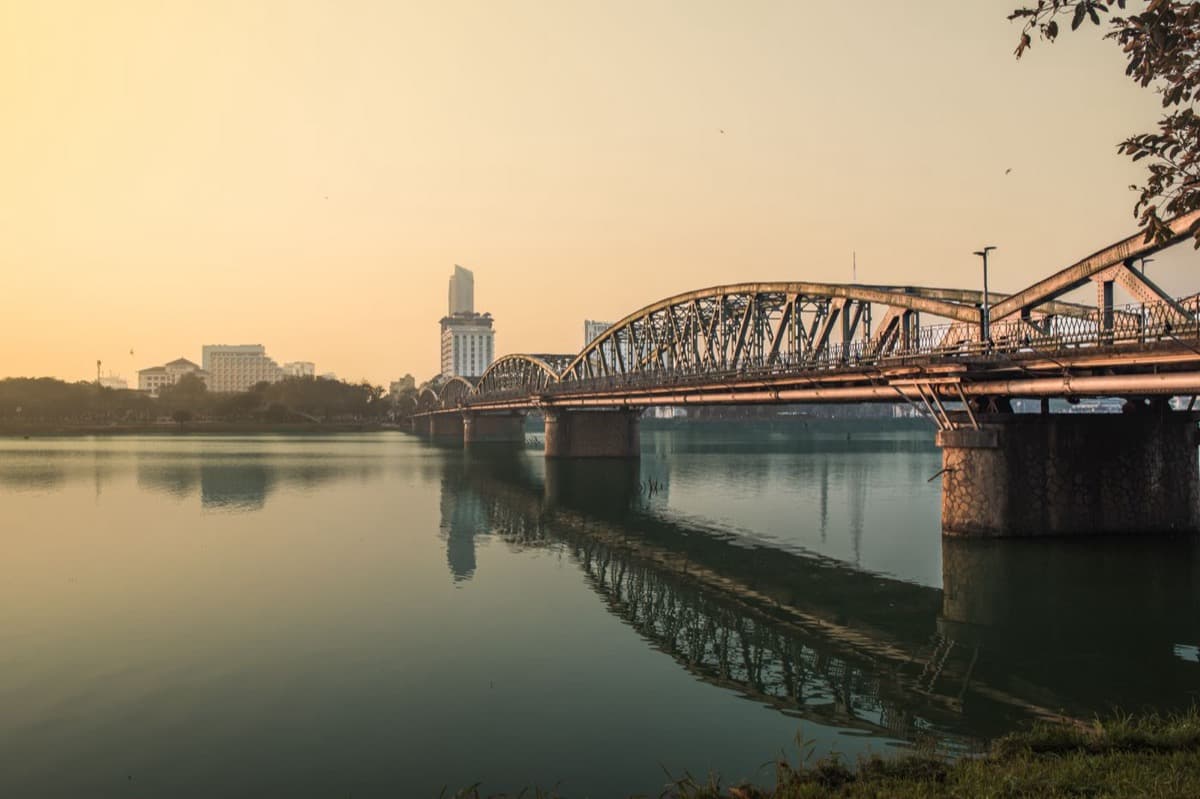
Perfume River: The Second Hue
110 min · 4 km · moderate
More from Hue
Explore more at your own pace.
How to See Hue: One City, Written Twice and Partly Erased
Hue Travel Guide: How Many Days, Getting Around, When to Go (2026)
One Day in Hue: The Imperial City in a Single Day (2026)
What to Eat in Hue: A Food Guide (2026)
Behind the Palace: The Working City That Kept Hue's Emperors Alive