Imperial City: The Cosmos in Stone
95 min · 2.6 km · moderate
Hue looks, on a first visit, like a single monument with a river running through it. The Perfume River curls past the moated walls of an imperial citadel, tour boats drift toward the royal tombs upstream, and the whole place carries the calm, slightly melancholy air of a former capital. That impression is not wrong. It is just incomplete. Hue is not one city. It is three cities written on top of one river, and the fastest way to understand it is to stop reading it as a museum and start reading it as an argument between its own halves.
Emperor Gia Long unified Vietnam in 1802 and made Hue his capital. For the next one hundred and forty-three years, until the last Nguyen emperor abdicated in 1945, this was the political, cultural, and religious center of the country. That single fact is why everything here is stacked so tightly. A Confucian imperial diagram, a French colonial quarter, and an immigrant trading district all sit within a few kilometres of each other, on the same water, because for a century and a half everyone with business in Vietnam eventually had business in Hue.
The Complex of Hue Monuments became Vietnam's first UNESCO World Heritage Site in 1993. But a heritage plaque flattens things. To see the city honestly you have to walk its seams, and there are three of them.
The city of the emperors
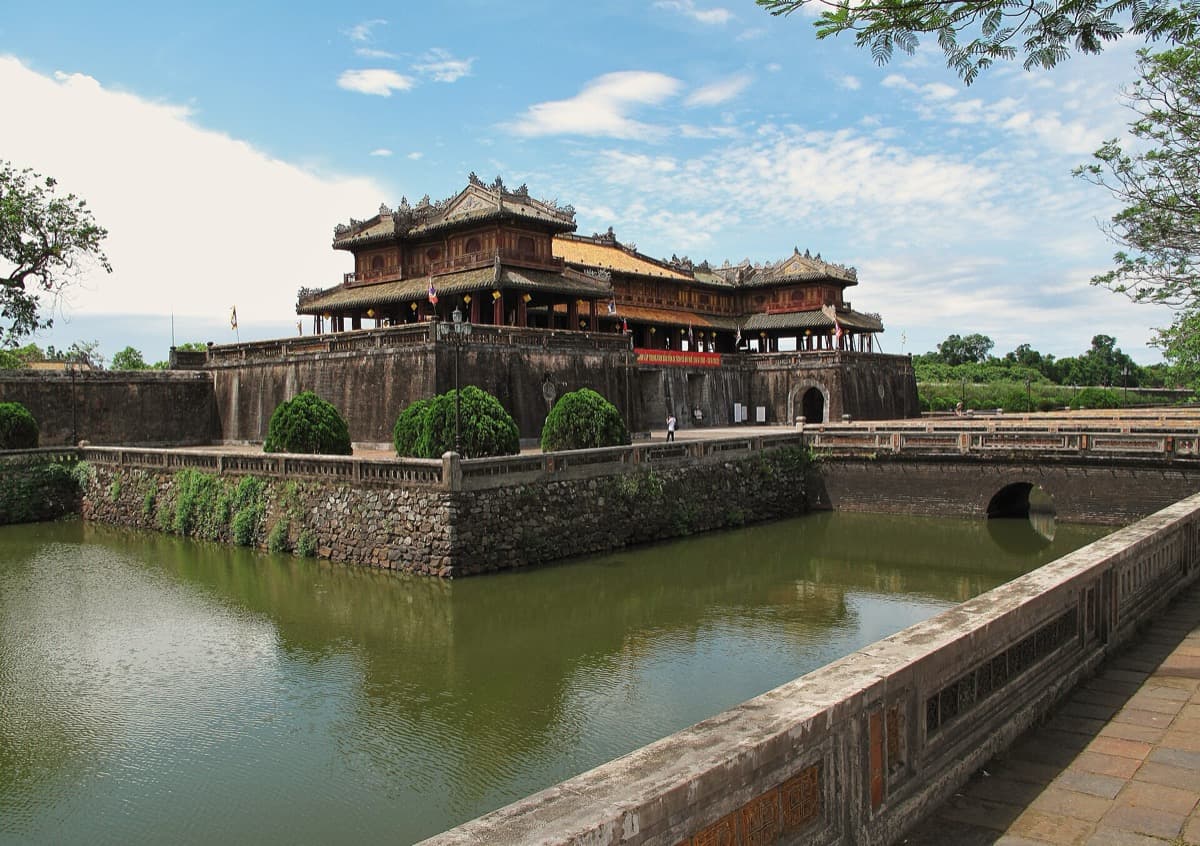
The first Hue is the one on every postcard: the walled Imperial City on the north bank, which locals call Dai Noi. It is not really a set of palaces. It is a sentence written in stone, a Confucian diagram of the cosmos laid out as three nested walls on a sacred north-south axis. Gia Long and his successor Minh Mang built it as a working model of heaven, order, and imperial power, where every gate and courtyard states your exact distance from the Son of Heaven.
You read this city by walking inward, one enclosure at a time, from the Flag Tower on the outer rampart to the throne hall at the center to the innermost sanctum beyond it. That is the walk our Imperial Citadel companion traces in full. The catch, and it is the thing that gives Hue its particular weight, is that the most sacred center of the diagram is now the emptiest part of it. The Forbidden Purple City, once more than a hundred buildings, is largely open ground today. Its core was burned in fighting in February 1947, and it became a central battlefield again during the Battle of Hue in the 1968 Tet Offensive. Of roughly one hundred and sixty buildings across the whole Imperial City, only about ten major structures survived. Reading the citadel means holding two tenses at once: the cosmos it was built to freeze in place, and the losses that rewrote it.
The city France built
Hear a stop from this walk
Tu Cam Thanh: The Empty Center
Cross the Perfume River on the iron Truong Tien Bridge and you arrive in the second Hue, the one that faces the first across the water. After France crushed a court uprising in the 1880s and reduced the emperors to figureheads, it built a new city on the south bank: a bridge, a riverfront boulevard, a grand hotel, a cathedral, and above all schools. The intent was to civilize and to rule.
The paradox is that France's proudest institution here, the Quoc Hoc National Academy founded in 1896, educated the very generation that would end both the dynasty and the empire. Ho Chi Minh studied there, as did the future general Vo Nguyen Giap, the future prime minister Pham Van Dong, and, on the other side of the coming conflict, the future president Ngo Dinh Diem. A colonizer built a school to make its rule permanent and handed the colonized the language, the ideas, and the confidence to end it. That double edge runs through every stop of our Perfume River colonial companion, and it is why the second Hue is worth as much attention as the first.
The city that fed both
The third Hue is the one the tour buses skip, and it is where daily life actually happened. One canal-crossing east of the citadel lies Gia Hoi, the old merchant quarter, anchored by Dong Ba, the great riverside market that has supplied the capital for over a century. Vietnamese cultural researchers put it neatly: the citadel across the water preserves the court life of the old capital, while Gia Hoi preserves its folk life.
This is the working city. Vietnamese and overseas-Chinese merchants settled these banks and traded in rice, salt, silk, medicine, and pottery. Along Chi Lang street, the road Hue still calls the Chinese Street, stand the assembly halls that immigrant congregations built as temple, chamber of commerce, and mutual-aid society all at once. Around thirty-nine timber houses more than a century old still survive here, some beautifully kept and some quietly falling apart. Our Gia Hoi and Dong Ba companion walks this hidden half of the imperial story, the half that clothed and fed the other half.
How to walk the three
If you have one day, walk the Imperial Citadel. It is the spine everything else hangs from, and the cosmic grammar only stacks up if you follow the axis inward in sequence. Go early: the great courtyards offer little shade, and the midday sun in Hue is fierce.
If you have a second day, split it. Spend a morning on the south bank, reading the colonial second Hue as a chain of double-edged gifts, and an afternoon in Gia Hoi, which is quietest and most atmospheric in late-afternoon light. The most comfortable window for all of this is the drier stretch from roughly February to April. Avoid the heavy rains and periodic flooding of the season that runs about September through December, when the low riverfront streets go under fast.
The three walks do not converge on a single Hue. They converge on the recognition that there is no single Hue, only a court, its colonizer, and its market, still arguing across the same water. The emperors staged power in a throne room. France staged authority in a boulevard. The merchants kept everyone alive from a grid of narrow streets. And the twentieth century ran through all of it, leaving the most sacred ground the emptiest. Hold those things together and you are no longer looking at a museum. You are reading a city.
Frequently asked questions
- How many self-guided walking tours does Roamer have in Hue?
- 3 tours: hue-gia-hoi-dong-ba, hue-imperial-city, hue-perfume-river. Every tour is free to preview.
- How much do the Hue tours cost?
- Free to preview, then $4.99 per tour for lifetime access. A 30-day pass covering every tour in every city is $19.99, and a 7-day pass is $12.99.
- Do the Hue tours work offline?
- Yes. Download a tour in the Roamer app before you go and it plays with no signal, which is ideal when travelling without mobile data.
Ready to experience it?
Imperial City: The Cosmos in Stone
95 min · 2.6 km · moderate
More from Hue
Explore more at your own pace.
Hue Travel Guide: How Many Days, Getting Around, When to Go (2026)
One Day in Hue: The Imperial City in a Single Day (2026)
What to Eat in Hue: A Food Guide (2026)
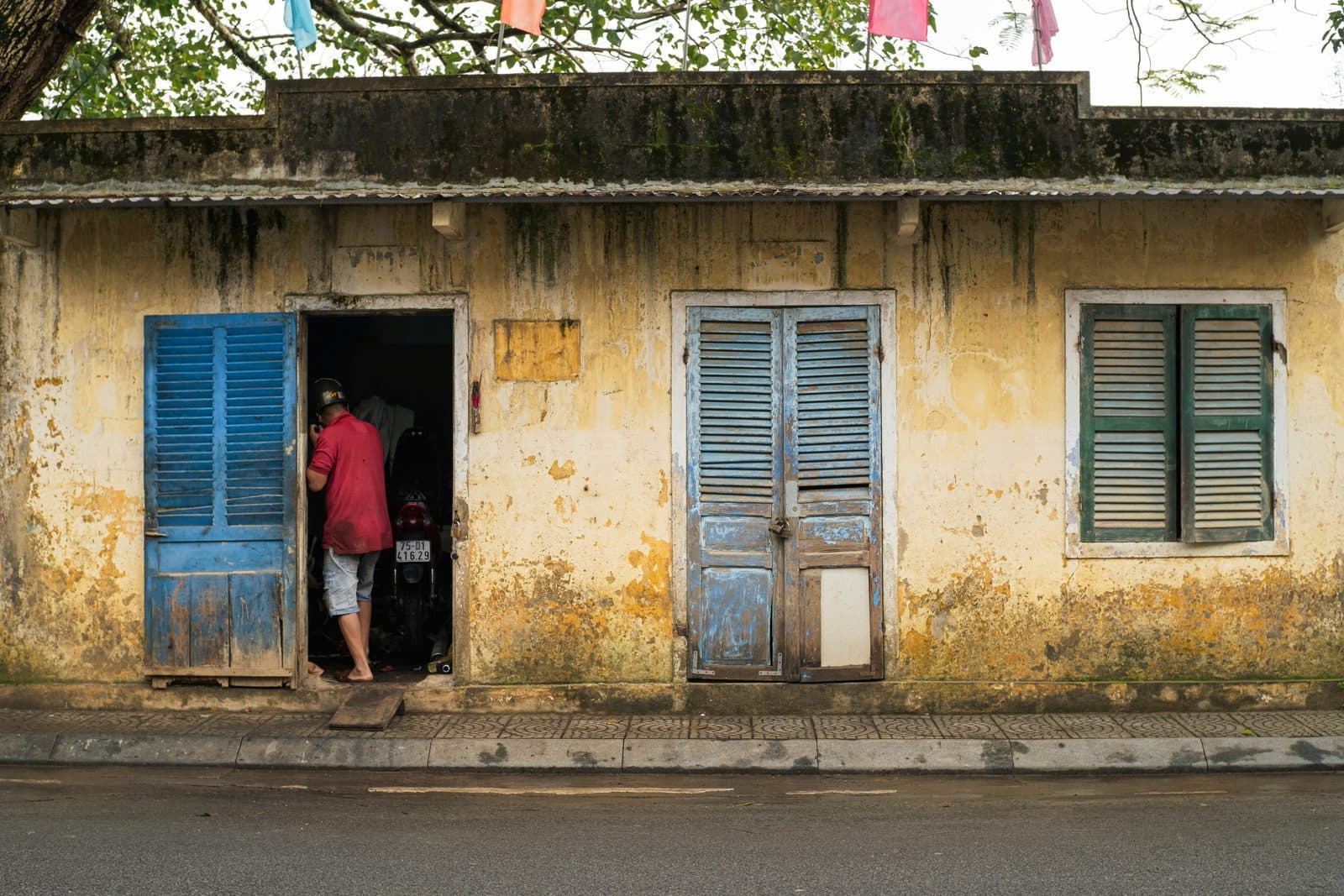
Behind the Palace: The Working City That Kept Hue's Emperors Alive
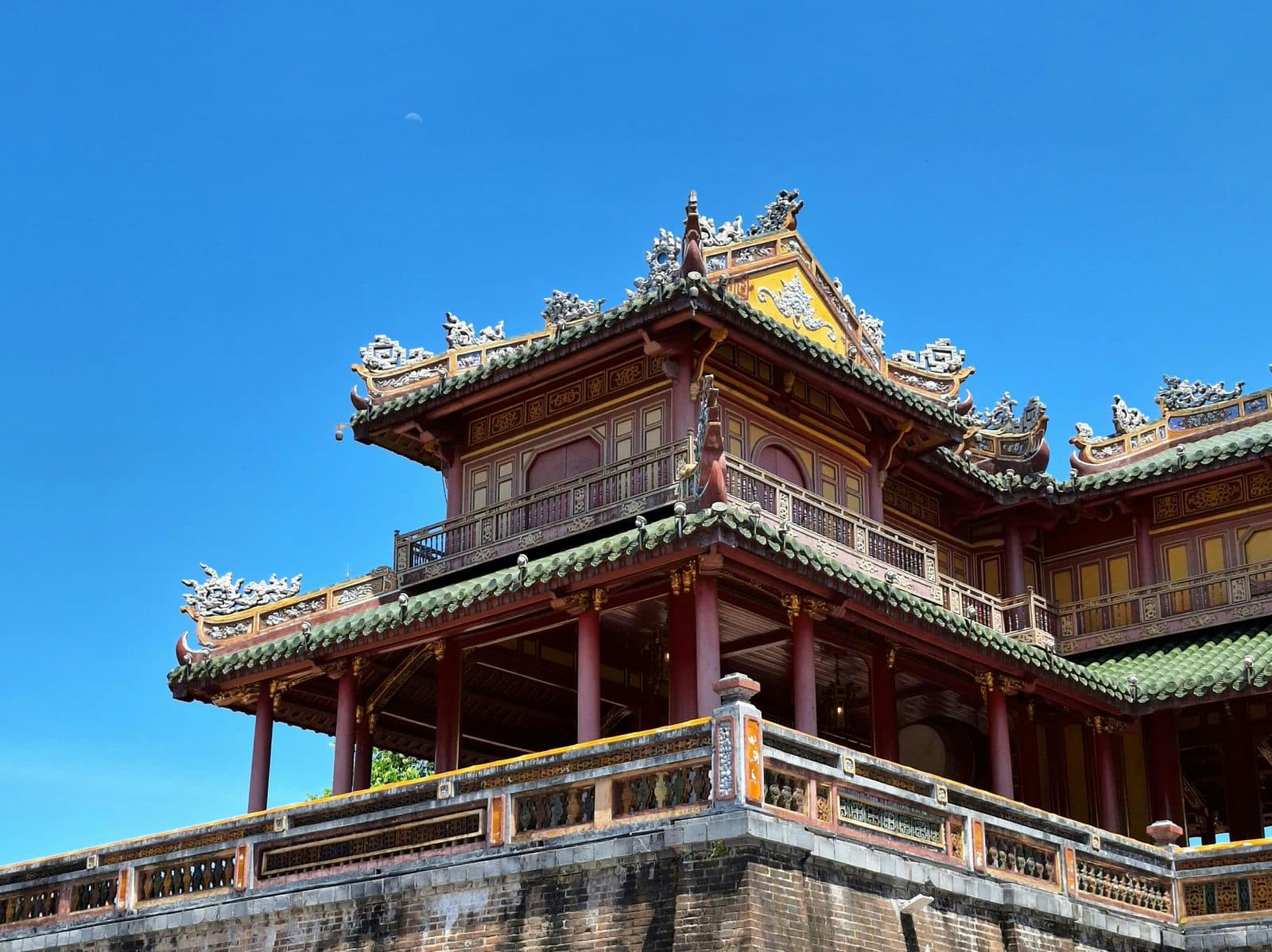
The Cosmos in Stone: How to Read the Imperial City of Hue