Salamanca Place: Hobart's Sandstone Waterfront
80 min · 3.2 km · moderate
Hobart is Australia's second-oldest city, a convict-era port founded on the twenty-first of February eighteen oh four on the River Derwent, and its whole story can be read at your own pace in the sandstone around one harbour. The town took hold at Sullivans Cove, on the Country of the muwinina, and everything that made Hobart, the warehouses, the customs house, the docks, the steps up the hill, was cut and laid by convict hands. The honey-coloured stone that looks so charming today is the physical record of a penal colony that built itself into a capital. Walk the harbour and the village above it slowly, and you can hold both truths at once: the beauty of the port, and the hard system and the Aboriginal catastrophe underneath it.
A port that took hold on the second try
Hobart nearly began somewhere else. An earlier settlement of eighteen oh three at Risdon Cove, upstream under John Bowen, was abandoned, and it was here at Sullivans Cove, settled on the twenty-first of February eighteen oh four under Lieutenant-Governor David Collins, that the town endured. Collins came ashore by way of a rocky islet then called Hunter Island, and the causeway path he used became Hunter Street. The cove itself was named for John Sullivan, Under-Secretary for the Colonies. The Sullivans Cove convict port walk starts on that exact ground, among the austere Georgian warehouses that are some of the oldest commercial building stock in the city, later home to Henry Jones and his jam works.
The clearest proof of how early all this is stands a short way around the water. The Commissariat Store, built between eighteen oh eight and eighteen ten, only about six years after settlement, is the oldest surviving building in Tasmania. It was the convict colony's government store, holding food, uniforms, alcohol and armaments, and it was used to set the alignment of Macquarie Street, so the grid of the town was surveyed from its wall. It is folded into the Tasmanian Museum and Art Gallery today, whose general admission is free.
The prison that learned to legislate for itself
Hear a stop from this walk
Salamanca Place: The Sandstone Waterfront
The through-line of the harbour is a colony founded to punish that turned into a colony that governed. You can see the pivot in one building. What is now Parliament House was designed by the colonial architect John Lee Archer as the colony's Customs House. Formal construction, carried out mostly by convict labour, began on the third of January eighteen thirty-five, its sandstone quarried in part from Salamanca Place along the waterfront. The Customs Department opened here on the first of September eighteen forty. Then, from April eighteen fifty-six, the building was renovated for a new two-chamber colonial parliament, with the first sessions held on the second of December eighteen fifty-six. A penal colony had raised a customs house by convict hands and then made it the seat of its own self-government.
The civic confidence spread up from the water. Franklin Square, laid out between eighteen sixty-three and eighteen sixty-six on the site of the demolished Old Government House, carries a bronze statue of Sir John Franklin, Lieutenant-Governor of Van Diemen's Land from eighteen thirty-seven to eighteen forty-three, whose Arctic expedition to find the Northwest Passage vanished in eighteen forty-five and cost all one hundred and twenty-nine men who remained. His epitaph on the fountain was written by Alfred, Lord Tennyson. Next door, the Hobart Town Hall, foundation stone laid on the fourteenth of April eighteen sixty-four and completed in September eighteen sixty-six to Henry Hunter's design, rose on the same former Government House ground. By the eighteen sixties the town had a parliament, a museum, a formal square and a proper sandstone town hall. In every stone, it had decided it was a city.
The moral floor beneath the handsome town
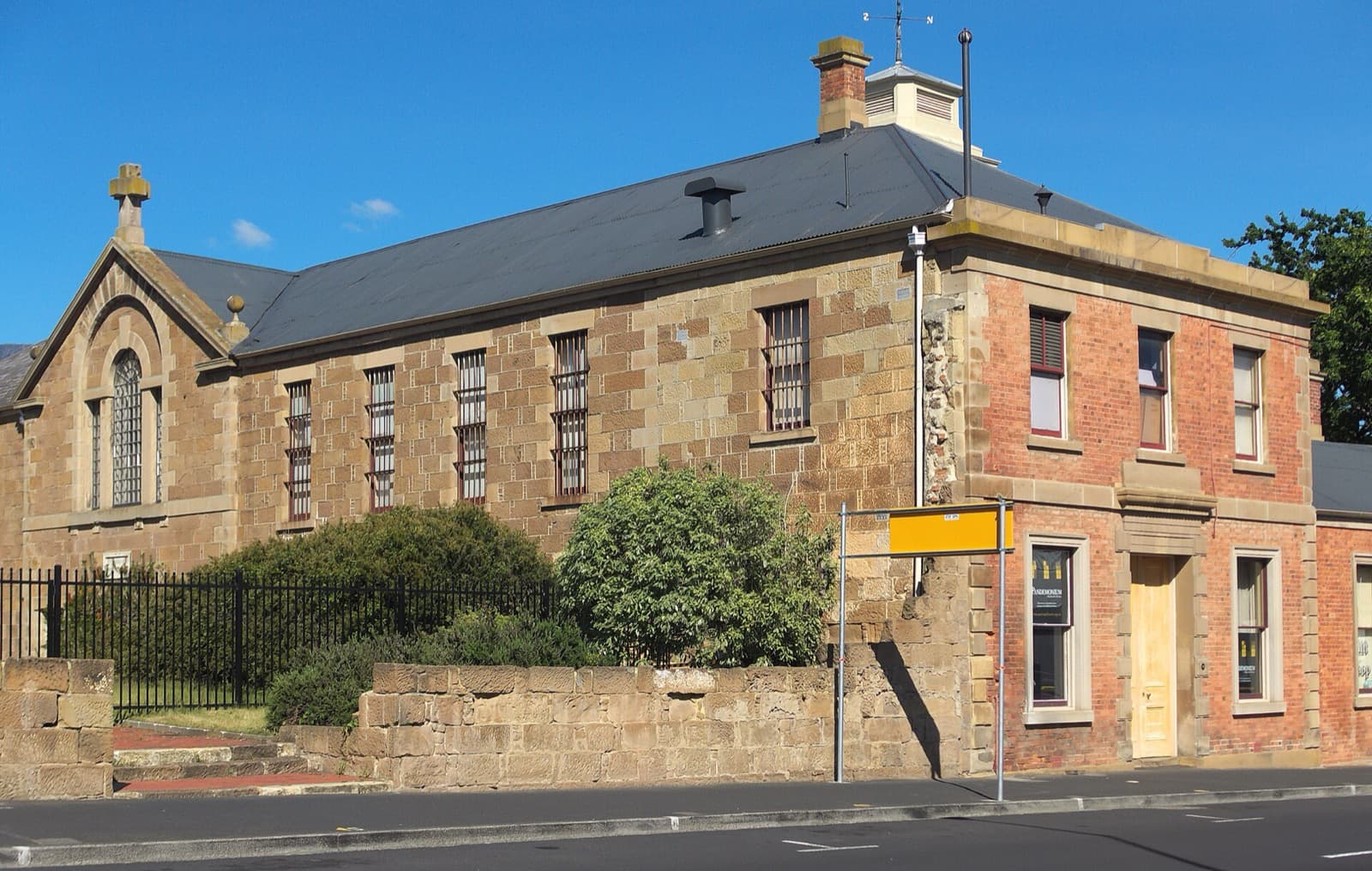
None of this reads honestly without the system that made it. The convict port walk closes at the Penitentiary Chapel, part of the former Campbell Street Gaol, and it is the grimmest, most honest building on the route. John Lee Archer, the same architect who gave the colony its customs house, dated its foundation stone to eighteen thirty-one and opened it for worship in eighteen thirty-three. Beneath the place of worship he set thirty-six solitary punishment cells, one sealed so completely it was known as the Dust Hole. Later the nave and eastern transept were converted into two criminal courtrooms, with the first cases heard on the seventeenth of April eighteen sixty, and an execution yard was added. The National Trust records thirty-two executions on the site, the last on the fourteenth of February nineteen forty-six, the final hanging in Tasmania. A chapel above cells, then a court, then a gallows: the system judging and hanging its own.
The harder memory runs deeper still. This is the Country of the muwinina and the wider home of the palawa, the Tasmanian Aboriginal people, who have lived on the island for tens of thousands of years. After British settlement the frontier conflict known as the Black War, from the mid-eighteen twenties to eighteen thirty-two, brought them close to destruction; some six hundred to nine hundred Aboriginal people and more than two hundred colonists died. Truganini, born about eighteen twelve, died in Hobart on the eighth of May eighteen seventy-six. Against her wishes her skeleton was displayed at the museum until nineteen forty-seven, and only in nineteen seventy-six were her remains cremated and returned near her birthplace as she had asked. The palawa people survive today. Their culture is living, not lost.
Salamanca, Kelly's Steps, and the village on the hill
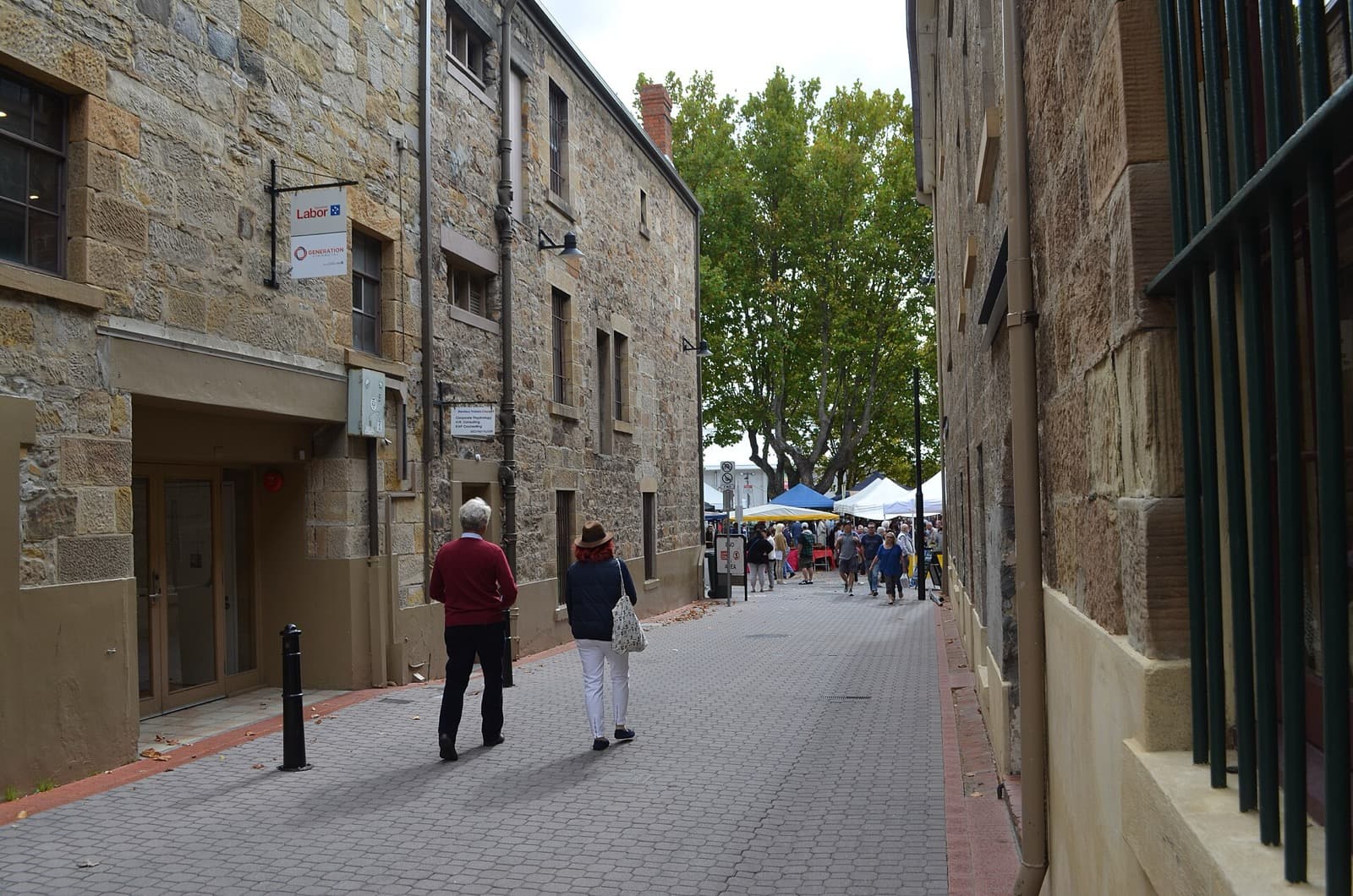
The same story climbs out of the water onto the hill. The Salamanca Place and Battery Point walk follows the long row of honey-coloured warehouses raised in the eighteen thirties and forties on ground reclaimed from the harbour by convict labour, one of the most complete rows of colonial warehouses in Australia. Threatened with demolition in the mid twentieth century, the row was saved through a campaign led by arts advocate Claudio Alcorso, and the Salamanca Arts Centre was established in the former warehouse spaces in nineteen seventy-six.
From the wharf the walk rises on Kelly's Steps, forty-eight sandstone blocks cut into the cliff in eighteen thirty-nine, named for the whaling captain James Kelly, who founded the Derwent Whaling Club in eighteen twenty-six. At the top is Battery Point, an old maritime village of sailors and shipwrights whose settlement dates to eighteen oh four and whose name comes from a battery of guns established on the point in eighteen eighteen. At its heart, Arthur Circus rings a small green with tiny single-storey Georgian cottages, first offered for sale on the eighth of March eighteen forty-seven and largely unchanged for around a hundred and seventy years. On the highest ground stands St George's, the mariners' church, whose tower, designed by the convict architect James Blackburn and added in eighteen forty-seven, once guided ships up the Derwent. The walk closes at Narryna, a merchant's sandstone house built about eighteen thirty-five to eighteen forty for Captain Andrew Haig, opened in nineteen fifty-seven as among the first folk museums in Australia. From the convict-cut stone at the water to the merchant's parlour on the hill, one city's foundation is legible in a single afternoon.
For the full set of routes through the sandstone port, see the Hobart walking tours hub.
Sources
- Tasmanian Museum and Art Gallery, history of the Commissariat Store and collections
- National Trust of Australia (Tasmania), Penitentiary Chapel Historic Site and Narryna Heritage Museum
- Tasmanian Heritage Register listings for St George's Church, Hobart Town Hall and Parliament House
- Salamanca Arts Centre, history of the Salamanca warehouses
- Cruising Yacht Club of Australia, Sydney to Hobart Yacht Race history
Frequently asked questions
- When was Hobart founded?
- Hobart was founded when Sullivans Cove was settled on the twenty-first of February eighteen oh four, under Lieutenant-Governor David Collins. An earlier settlement of eighteen oh three at Risdon Cove upstream, under John Bowen, had already been abandoned, so it was at Sullivans Cove that the town endured. It is Australia's second-oldest city.
- What is the oldest building in Tasmania?
- The Commissariat Store at Sullivans Cove is the oldest surviving building in Tasmania, built between eighteen oh eight and eighteen ten, only about six years after settlement. It was the convict colony's government store and is now part of the Tasmanian Museum and Art Gallery, whose general admission is free.
- Was Hobart's Parliament House really built as a customs house?
- Yes. What is now Parliament House was designed by colonial architect John Lee Archer as the colony's Customs House, with construction by mostly convict labour beginning on the third of January eighteen thirty-five. The Customs Department opened there in eighteen forty, and the building was converted for the colonial parliament in eighteen fifty-six, with the first sessions held on the second of December eighteen fifty-six.
- Who were the original people of the Hobart area?
- Hobart sits on the Country of the muwinina and the wider home of the palawa, the Tasmanian Aboriginal people, who have lived on the island for tens of thousands of years. After British settlement the Black War, from the mid-eighteen twenties to eighteen thirty-two, brought them close to destruction. The palawa people survive today and their culture is living, not lost.
- What can you see on a Hobart convict-history walking tour?
- Self-guided walks cover Sullivans Cove and the working docks, the Commissariat Store, the convict-built Customs House that became Parliament House, and the Penitentiary Chapel with its solitary cells and later courtrooms. A second route climbs Kelly's Steps to Battery Point, taking in the Salamanca warehouses, Arthur Circus, St George's mariners' church and the merchant house Narryna.
Ready to experience it?
Salamanca Place: Hobart's Sandstone Waterfront
80 min · 3.2 km · moderate
More from Hobart
Explore more at your own pace.
Hobart Travel Guide: How Many Days, Getting Around, Best Time and Safety
One Day in Hobart: A Walkable Morning-to-Evening Itinerary
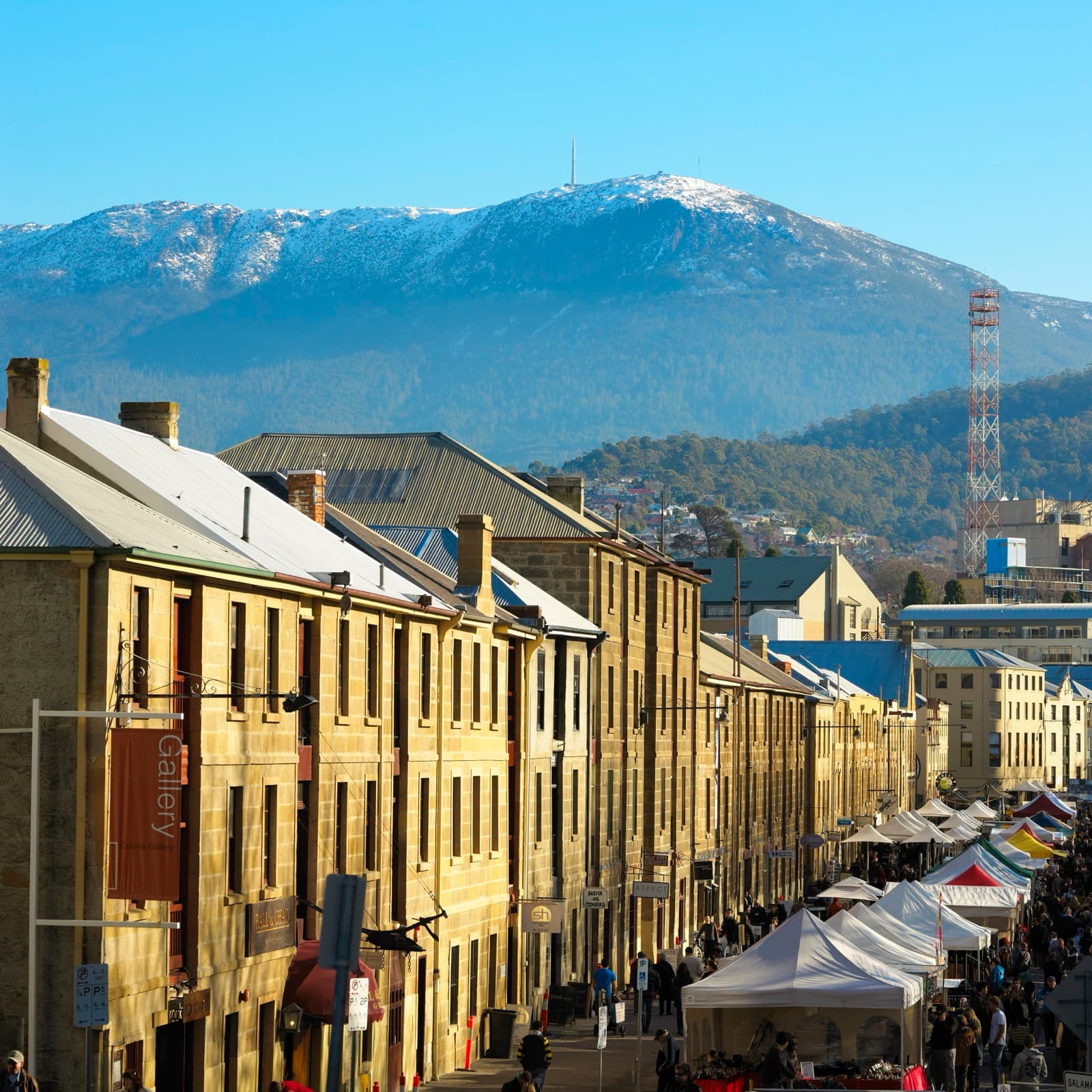
Salamanca Place: How to Read Hobart's Sandstone Waterfront
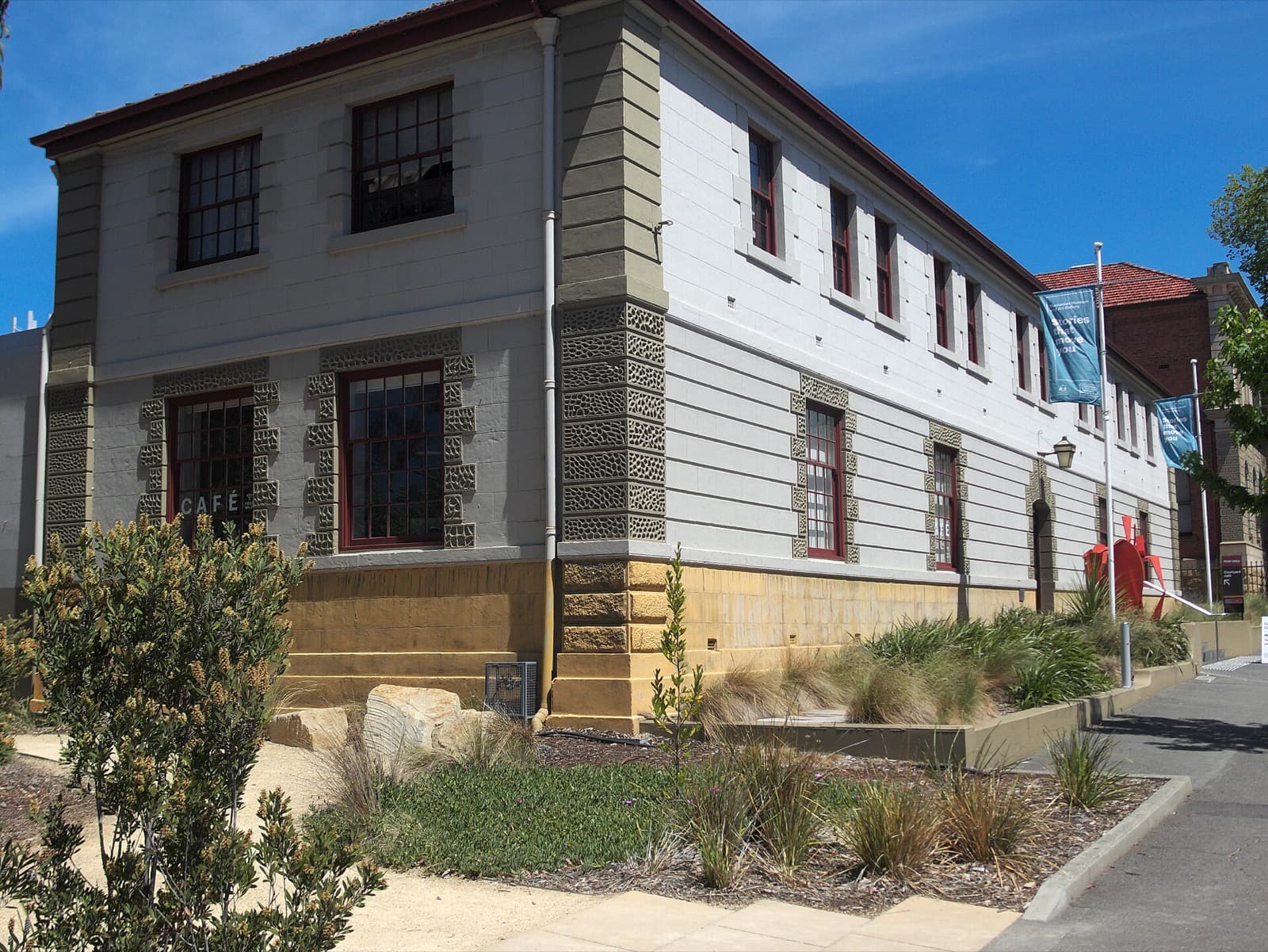
The Commissariat Store: How Tasmania's Oldest Building Reads the Whole Convict Port
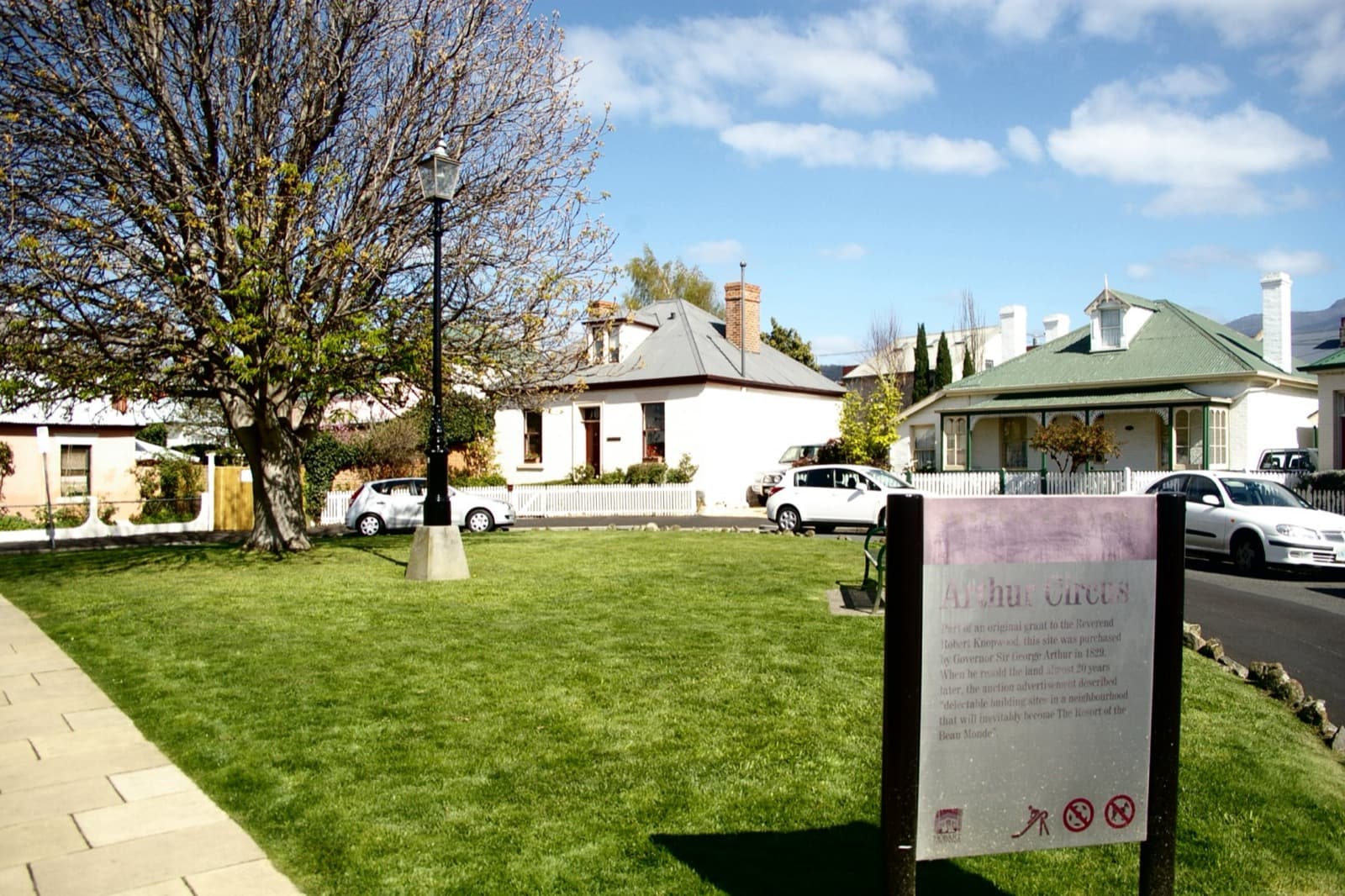
Arthur Circus: The Ring of Cottages That Time Left Alone in Battery Point