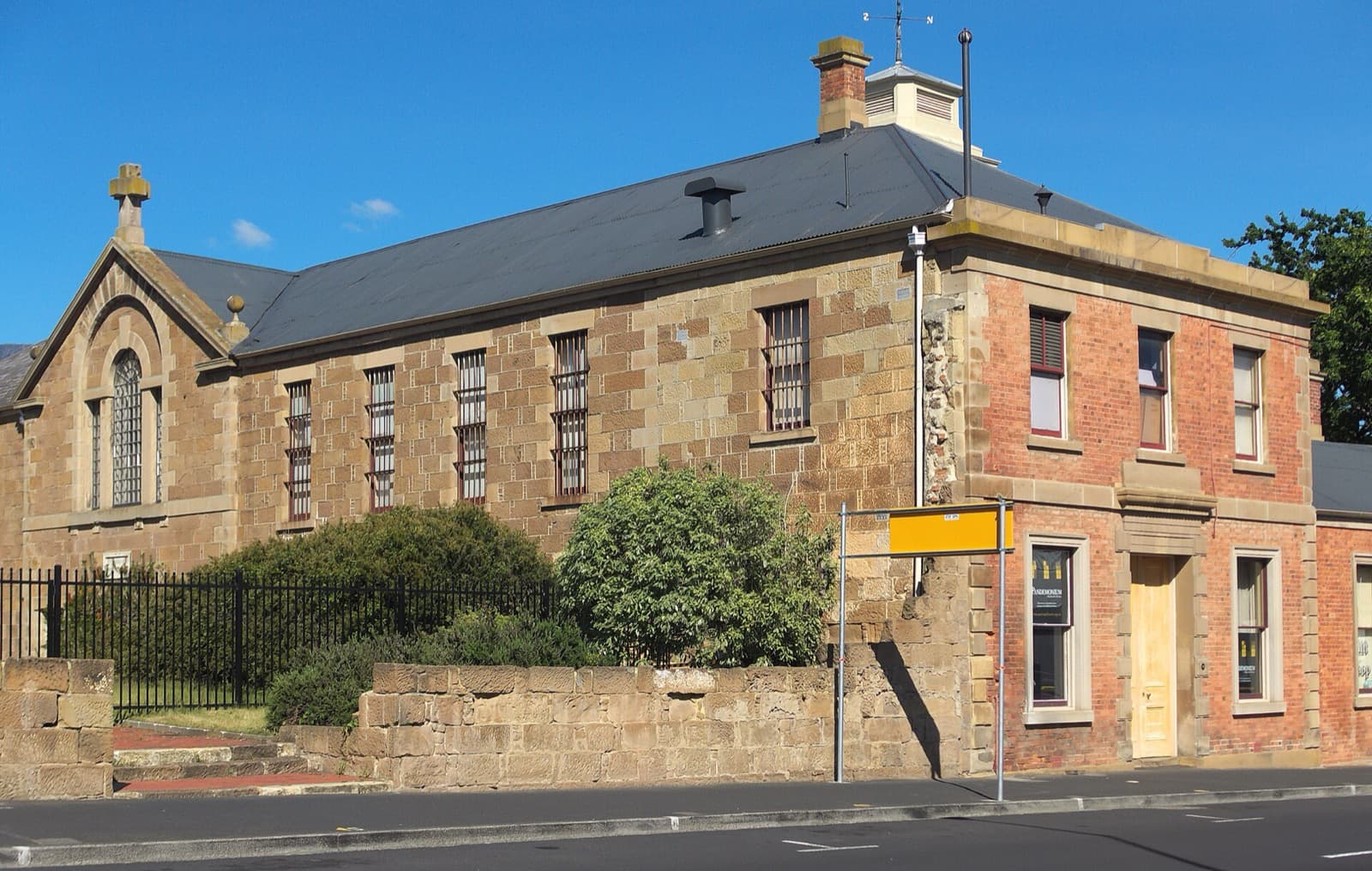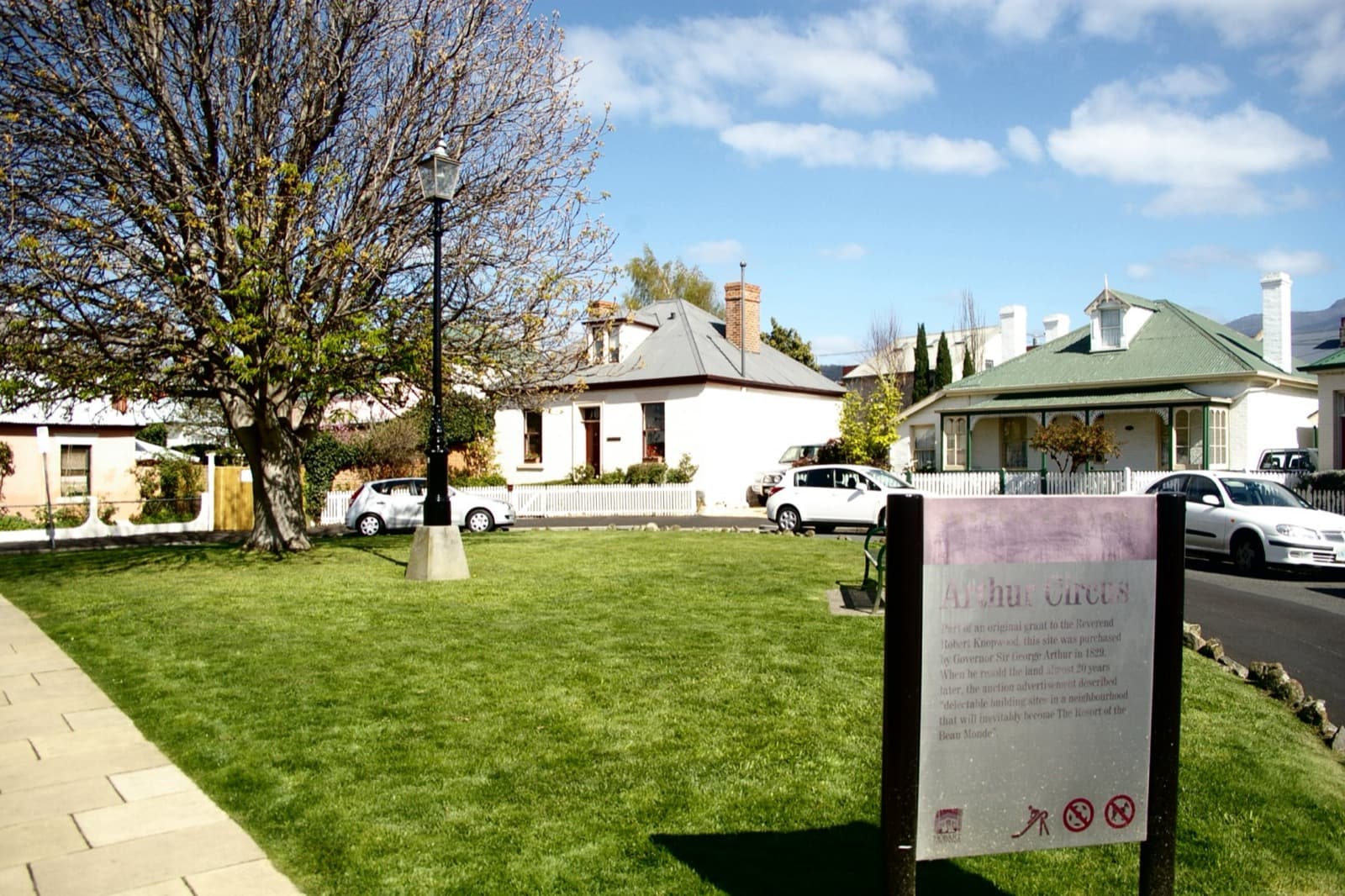
Arthur Circus is a ring of tiny single-storey Georgian cottages set around a small circular green at the heart of Hobart's Battery Point, laid out as one of the earliest subdivisions in Australia and preserved, cottages and green together, for around a hundred and seventy years. Stand at the edge of the grass and let your eye travel the full circle. The dwellings are so neat and so small they read almost like a row of doll's houses arranged for a game, and the fact that the whole arrangement still holds its shape is the single thing worth understanding here. Most colonial townscapes in Australia were built over, widened, or erased. This one survived.
What you are actually looking at
The cottages date from the eighteen forties and fifties. They were built originally for the officers of the garrison stationed in Battery Point, and each was probably just two main rooms to begin with, a modest footprint for men who did not expect to stay long. What gives the place its unusual geometry is the circular green they face. Instead of a straight terrace along a street, the allotments were pinned to a ring, so the houses turn inward toward a shared central space rather than outward toward traffic. That plan is what makes Arthur Circus feel like a small idea of a neighbourhood held under glass: a complete nineteenth-century townscape in miniature, green at the centre and modest walls all the way around.
The land was established under Lieutenant-Governor George Arthur, who gave the circus its name. By the early eighteen forties it had been laid out as the ring you see today, and its sixteen allotments were first offered for sale on the eighth of March eighteen forty-seven. That date matters more than it looks. A formal subdivision of small residential blocks, sold off individually this early in the colony's life, is genuinely rare. Arthur Circus is one of the earliest subdivisions in the country, and because the blocks were small and the buyers built modestly, the scale never grew beyond what those first officers' cottages set down. Few places in Australia hold an early colonial townscape this intact.
The one thing to understand standing here
Hear a stop from this walk
Salamanca Place: The Sandstone Waterfront
The instinct at a beautiful old place is to look for the grand gesture: the tallest tower, the richest facade, the most famous name attached to it. Arthur Circus offers none of that, and that absence is the point. What you are seeing is not a monument but an ordinary residential plan that simply never changed. The cottages are humble. The green is small. And yet the completeness of it, shape and scale surviving together, is harder to find than any single grand building, because ordinariness is exactly the thing cities tend to demolish first.
So the discipline this place asks of a visitor is restraint. These are private homes, carefully restored and privately owned, lived in today inside eighteen forties walls. This is a place to look and to feel, not to enter. Stay on the edge of the green, keep your voice down, and read the ring as a whole rather than pressing your face to any one window. The reward is not a room to walk through. It is the recognition, standing in the middle of a working suburb, that you are looking at a piece of the eighteen forties that the ordinary churn of a growing city somehow spared.
Why it sits where it does
Arthur Circus does not stand alone. It is the quiet centre of Battery Point, the old maritime village that grew on the rise above Hobart's wharves. Settlement on the point dates to eighteen oh four, when the colony's first chaplain was granted thirty acres on the northern slope, and through the early nineteenth century the hill filled with the people of the port: sailors and shipwrights, whalers and fishermen, merchants and master mariners. The district takes its name from a battery of guns established on the point in eighteen eighteen. What makes the whole quarter unusual for an Australian inner suburb is how little of it has changed. Small one and two room seamen's cottages still stand close to the lace-trimmed mansions of merchants, rich and poor side by side on the same slope, and many of the buildings are classified by the National Trust.
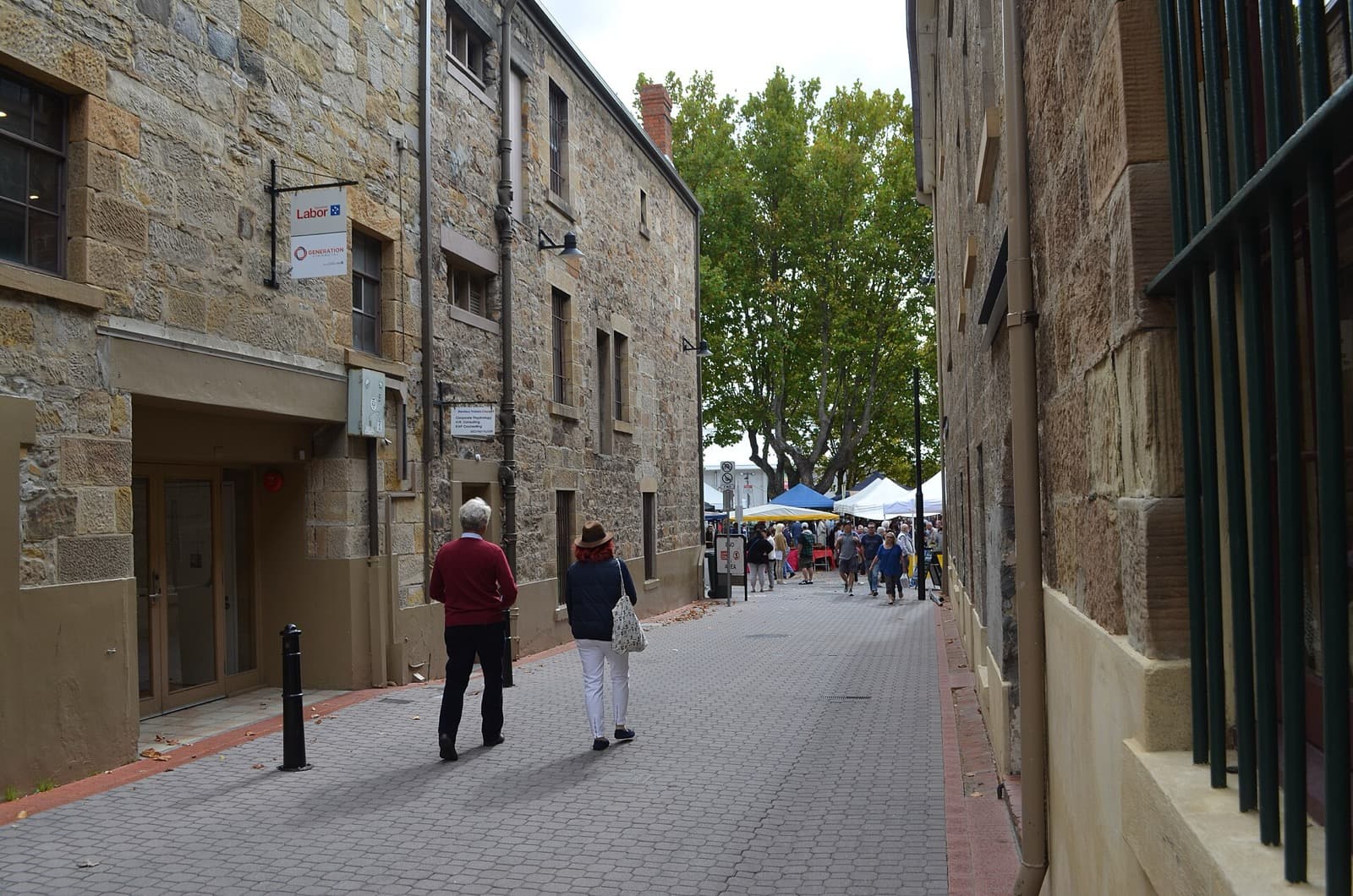
Arthur Circus is the tightest, most complete expression of that survival. Around it, the narrow streets that once carried the sound of shipwrights still run at their old width. Below, the honey-coloured sandstone warehouses of Salamanca Place, raised in the eighteen thirties and forties and cut by convict hands, hold the memory of the whaling port whose wealth paid for the hill. The officers' cottages of the circus and the merchants' houses down the street were built on the same colonial economy, and they were built by the same hard system: much of the town's early stonework was cut by convict labour. The charm of the ring rests directly on that reality, and it is worth holding both in mind at once.
Walk it, at your own pace
Arthur Circus rewards a slow visit and a wider one. It sits at the midpoint of a self-guided walk that climbs from the convict-cut warehouses of Salamanca Place, up the forty-eight stone blocks of Kelly's Steps cut into the cliff in eighteen thirty-nine, through the village streets, past the mariners' church of St George's on the highest ground, out to the harbour guns' old ground at Princes Park, and down to Narryna, a whaling captain's sandstone house on Hampden Road. Seen in that sequence, the circus stops being a pretty detour and becomes the quiet climax it was built to be: the moment where the working port turns into a preserved neighbourhood.
If you want the context that makes each stop land, our Hobart walking tours collect the routes through the city's Georgian core, and the full Hobart city page gathers everything on offer. The Salamanca and Battery Point walk runs a little over three kilometres across seven stops and asks around eighty minutes, no group, no schedule, just your own map and your own time to read the stone. Do the ring last thing before the light goes, when the green is empty, and let the doll's-house scale of it do its quiet work.
Sources
- City of Hobart, Arthur Circus park and reserve listing. Official municipal record of the reserve at the centre of the circus.
- In Bobby's Footsteps, Battery Point History Walk (batterypointwalk.au), Arthur Circus entry. Local history walk documenting the subdivision, its allotments and sale date.
- Discover Tasmania, Battery Point. State tourism body's overview of the village, its origins and heritage housing stock.
- Roamer, Salamanca Place and Battery Point self-guided audio tour. Fact-audited tour transcript covering Arthur Circus and its six neighbouring stops.
Ready to experience it?
Salamanca Place: Hobart's Sandstone Waterfront
80 min · 3.2 km · moderate
More from Hobart
Explore more at your own pace.

Hobart Travel Guide: How Many Days, Getting Around, Best Time and Safety
One Day in Hobart: A Walkable Morning-to-Evening Itinerary

Hobart: The Convict Port That Became a Capital in Sandstone
Salamanca Place: How to Read Hobart's Sandstone Waterfront
The Commissariat Store: How Tasmania's Oldest Building Reads the Whole Convict Port