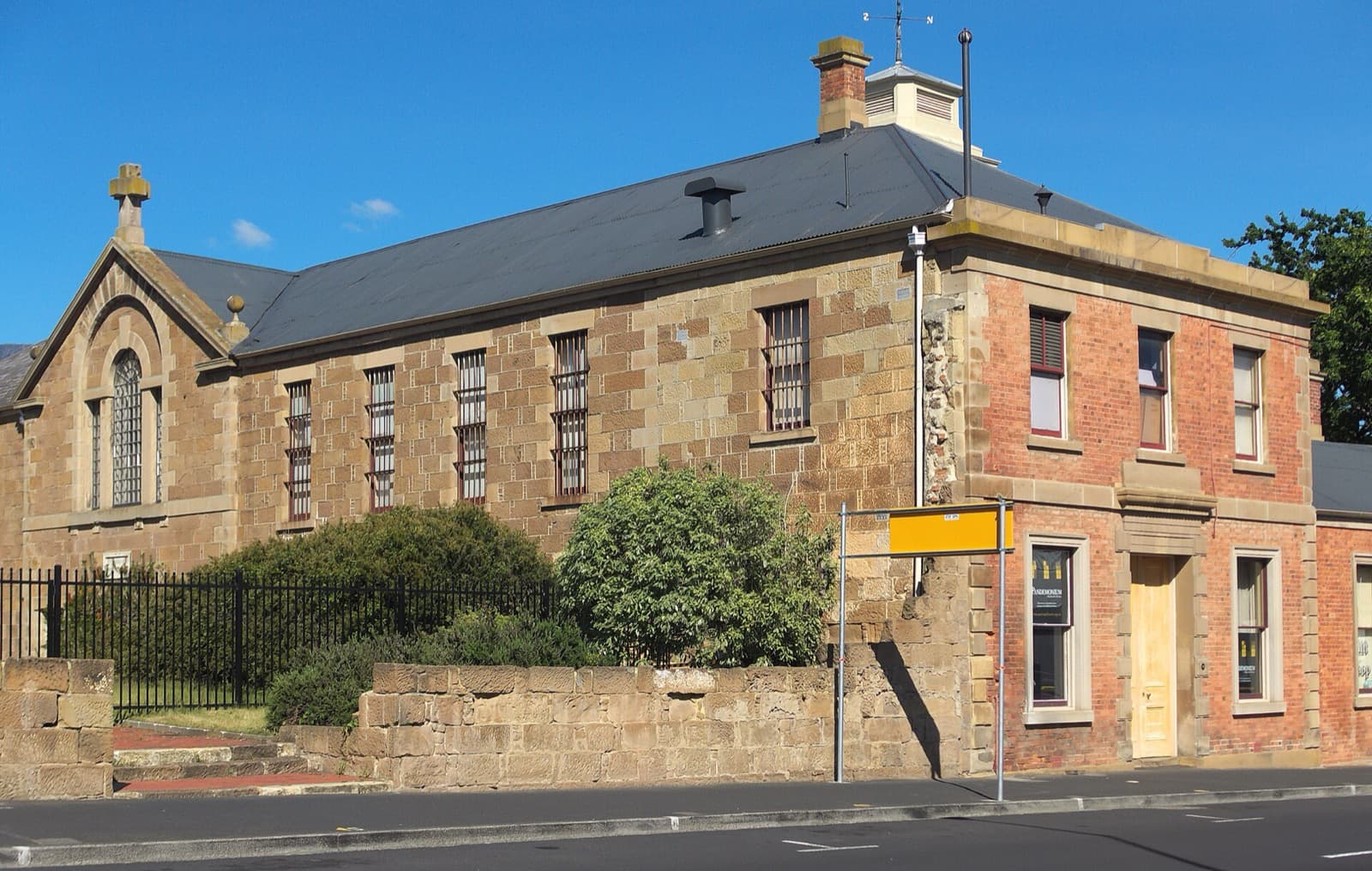
The Penitentiary Chapel in Hobart puts worship directly over punishment. On the corner of Campbell and Brisbane Streets, the colonial architect John Lee Archer built a chapel and then set thirty-six solitary cells into the ground floor beneath it, so that prisoners sang and prayed while other men were held in the dark below. Later the same rooms became criminal courtrooms and an execution yard. Reading that vertical arrangement, chapel above cells, court in the nave, gallows in the yard, is the most direct way to understand how a convict colony on the far edge of the world judged, disciplined, and eventually hanged its own.
What Archer built, and in what order
The dates matter, because they show a use that hardened over time rather than a single design intent. The foundation stone is dated 1831, and the chapel opened for worship in 1833. Archer, the same architect who gave the colony its Customs House on the waterfront, later converted into Parliament House, designed the building on a cruciform plan whose arms could seat several hundred convicts on benches for compulsory services.
The part that unsettles visitors is what sits underneath the floor. Directly below the place of worship, Archer laid out thirty-six solitary punishment cells: dark, barely ventilated, and meant to isolate. The smallest of them, sealed so completely that a man could only be pushed in through a low opening, were known among the prisoners as the Dust Hole, and were bricked shut as inhuman in 1847. The design was not accidental. Heritage descriptions of the building read it as a deliberate arrangement of moral levels, the punished soul in solitary confinement at the bottom, the convict being improved through religious instruction in the middle, and, in the vaulted space above, the realm of the Almighty. Whether or not every prisoner grasped the theology, the physical fact is plain. You worshipped on a floor laid over cells.
From chapel to court to gallows
Hear a stop from this walk
The Commissariat Store: The Oldest Building in Tasmania
The building did not stay a chapel. In the late 1850s the nave and eastern transept were rebuilt into two criminal courtrooms, first used in 1860. An execution yard was added, and the machinery of the colony completed its circuit inside one set of walls: a place that had preached to convicts now tried them, sentenced them, and put some of them to death.
The numbers are specific and worth stating plainly. The National Trust, which manages the site today, records that thirty-two people were executed here, thirty-one men and one woman. The first was Alexander Cullen, hanged on the eighteenth of August, 1857. The last was Frederick Thompson, on the fourteenth of February, 1946, and it was the final hanging carried out anywhere in Tasmania. That closing date is not distant history. A person could have watched the Sydney to Hobart yachts finish down at Constitution Dock in the same decade the last man was hanged a few streets uphill.
These were real people, not a ghost-tour attraction. The value of standing here is the opposite of a thrill. It is the plainness of it: one building holds the prayer, the punishment, and the sentence, and refuses to let a visitor separate them.
The one thing to understand standing in front of it
Everything else on the Sullivans Cove waterfront tells the story of a convict port growing handsome. The oldest surviving building on the island, the Commissariat Store of about 1808 to 1810, anchored the survey of the town. The convict-built Customs House became a parliament in 1856. The Town Hall of the 1860s, in worked sandstone, announced that a penal settlement had decided it was a city. All of that is genuine civic confidence, and it is genuinely built on convict labour and on land taken from the muwinina, the traditional owners of the Hobart area.
The Penitentiary Chapel is where that second truth stops being an abstraction. This is the floor the handsome town was built on. The same architect who dressed the port in honey-coloured sandstone also engineered the Dust Hole. Standing at the corner, the thing to hold is not horror for its own sake but the completeness of the machine: a colony that could design a customs house and a courtroom and a solitary cell with the same drafting hand, and see no contradiction. The building makes the contradiction visible again.
It is also, in heritage terms, unusually intact. Complexes that preserve the chapel, the gaol, and the courts together, rather than in fragments, are rare, which is why this one is protected and interpreted rather than demolished like so much convict-era fabric elsewhere.
Seeing it on the ground
The grounds are free to walk. The interior, including the solitary cells and the surviving courtrooms, is seen on a paid guided tour run by the National Trust of Australia (Tasmania), and the times are limited, so it is worth checking ahead if you want to go inside. If you would rather keep moving, the building reads clearly enough from Campbell Street, and the exterior alone carries the argument.
The Penitentiary Chapel is the closing stop on Roamer's self-guided Sullivans Cove: The Convict Port Where Hobart Began audio walk, and it is placed last on purpose. The route runs level around the working harbour for most of its two and a half kilometres, past the docks, the museum, the parliament, and the town hall, then makes one short rise up from the water to end here, on the moral floor beneath everything you have seen. Walking it in that order lets the town accumulate its dignity first, so that the chapel lands with full weight rather than as an isolated curiosity.
If you are planning a wider day on foot, browse the other Hobart walking tours, or start from the Hobart city page to see how the convict port, Salamanca, and Battery Point connect. However you arrive at the corner of Campbell and Brisbane Streets, give yourself a few unhurried minutes. The building does not perform. It simply holds the whole system in one place and asks you to look at it honestly.
Sources
- Campbell Street Gaol, Wikipedia Overview of the gaol and Penitentiary Chapel complex, its conversion to courts, and execution history.
- Penitentiary Chapel and Criminal Courts Complex, Tasmanian Heritage Register datasheet Official heritage listing covering Archer's design, the solitary cells, and the site's significance.
- Penitentiary Chapel Historic Site (National Trust) The site's current manager, with tour information, execution records, and interpretation.
- Open House Hobart: Hobart Penitentiary & Chapel Architectural notes on Archer's cruciform chapel and the layering of worship over punishment.
Ready to experience it?
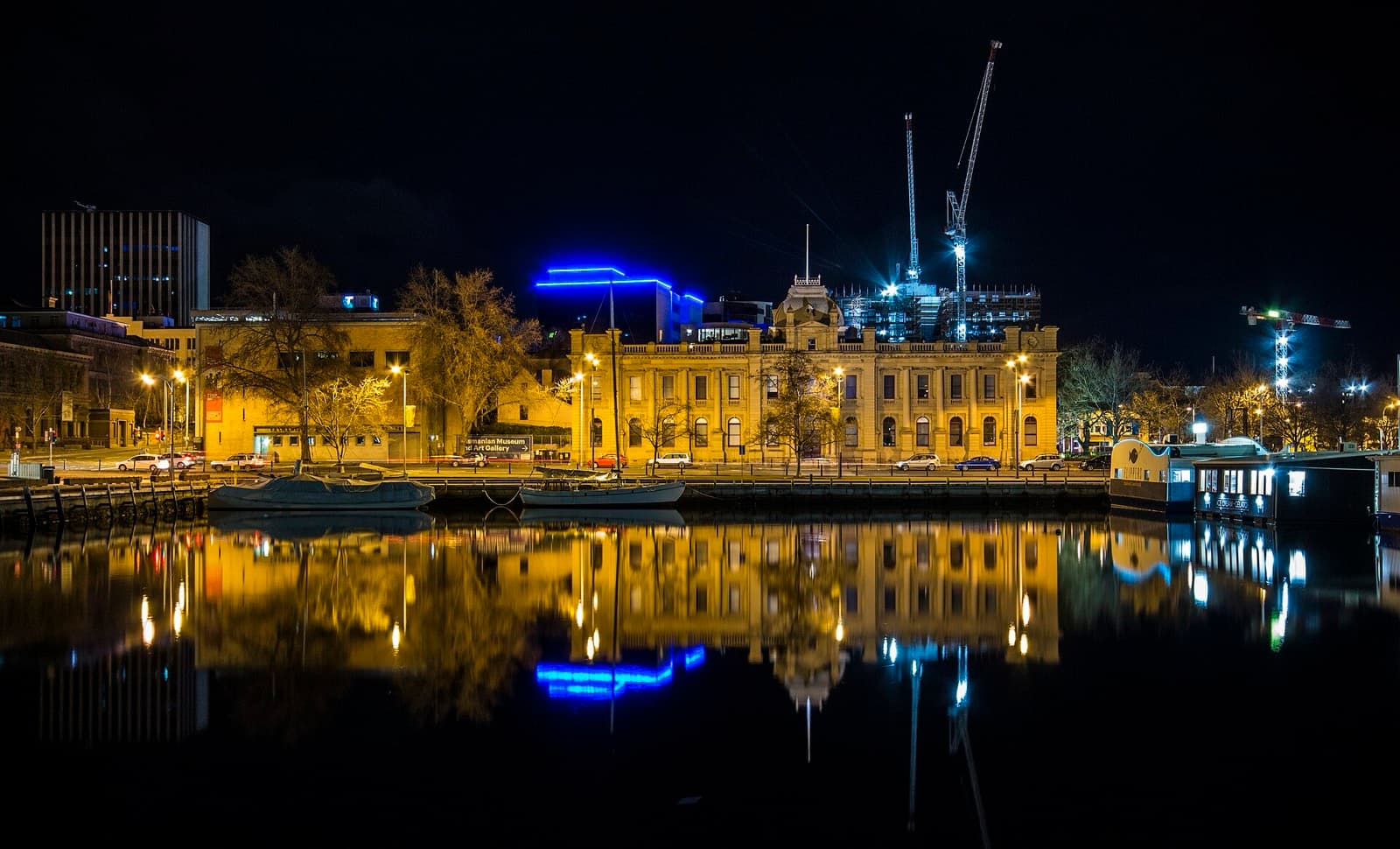
Sullivans Cove: The Convict Port Where Hobart Began
75 min · 2.6 km · easy
More from Hobart
Explore more at your own pace.
Hobart Travel Guide: How Many Days, Getting Around, Best Time and Safety
One Day in Hobart: A Walkable Morning-to-Evening Itinerary

Hobart: The Convict Port That Became a Capital in Sandstone
Salamanca Place: How to Read Hobart's Sandstone Waterfront
The Commissariat Store: How Tasmania's Oldest Building Reads the Whole Convict Port