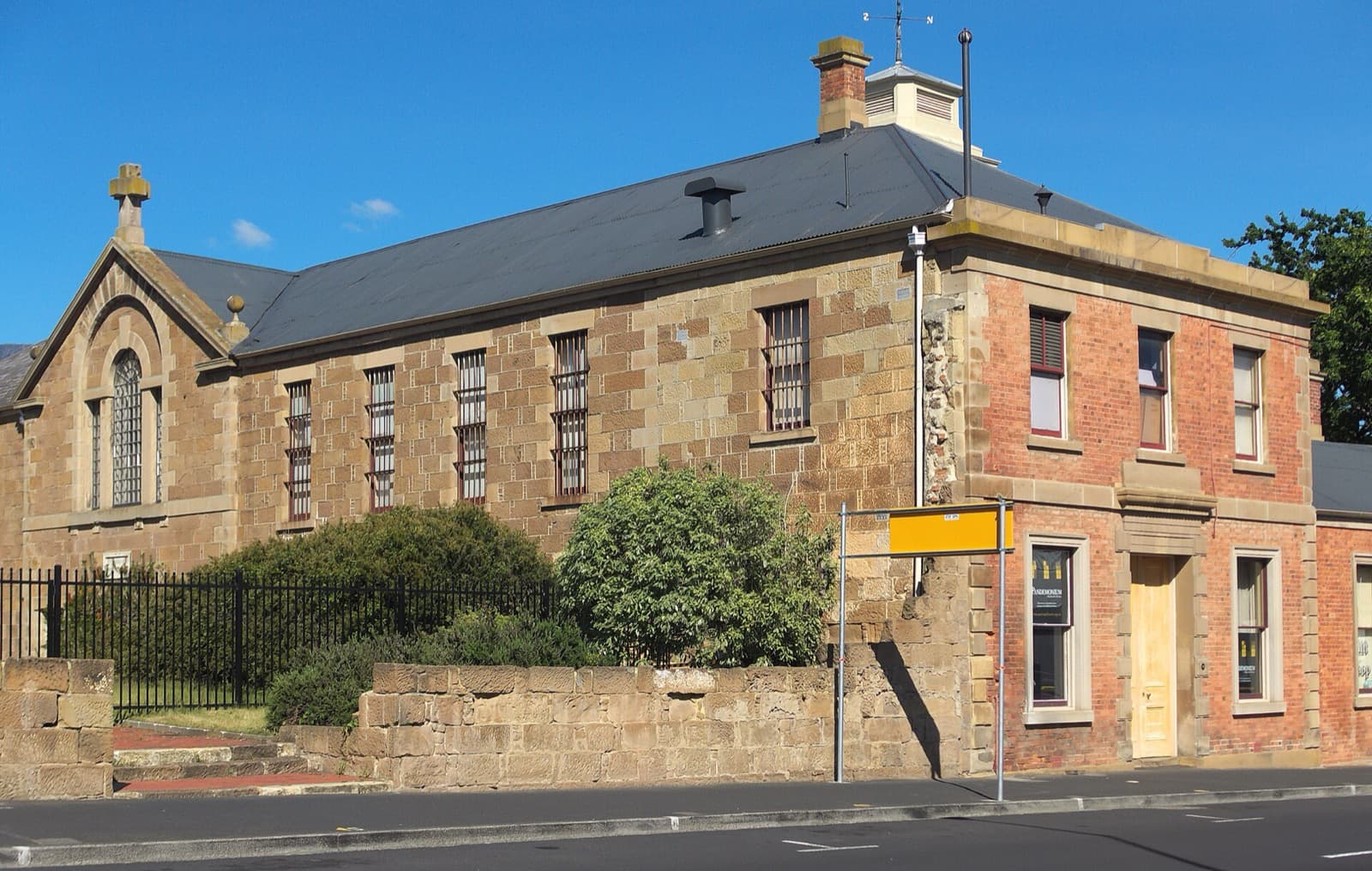
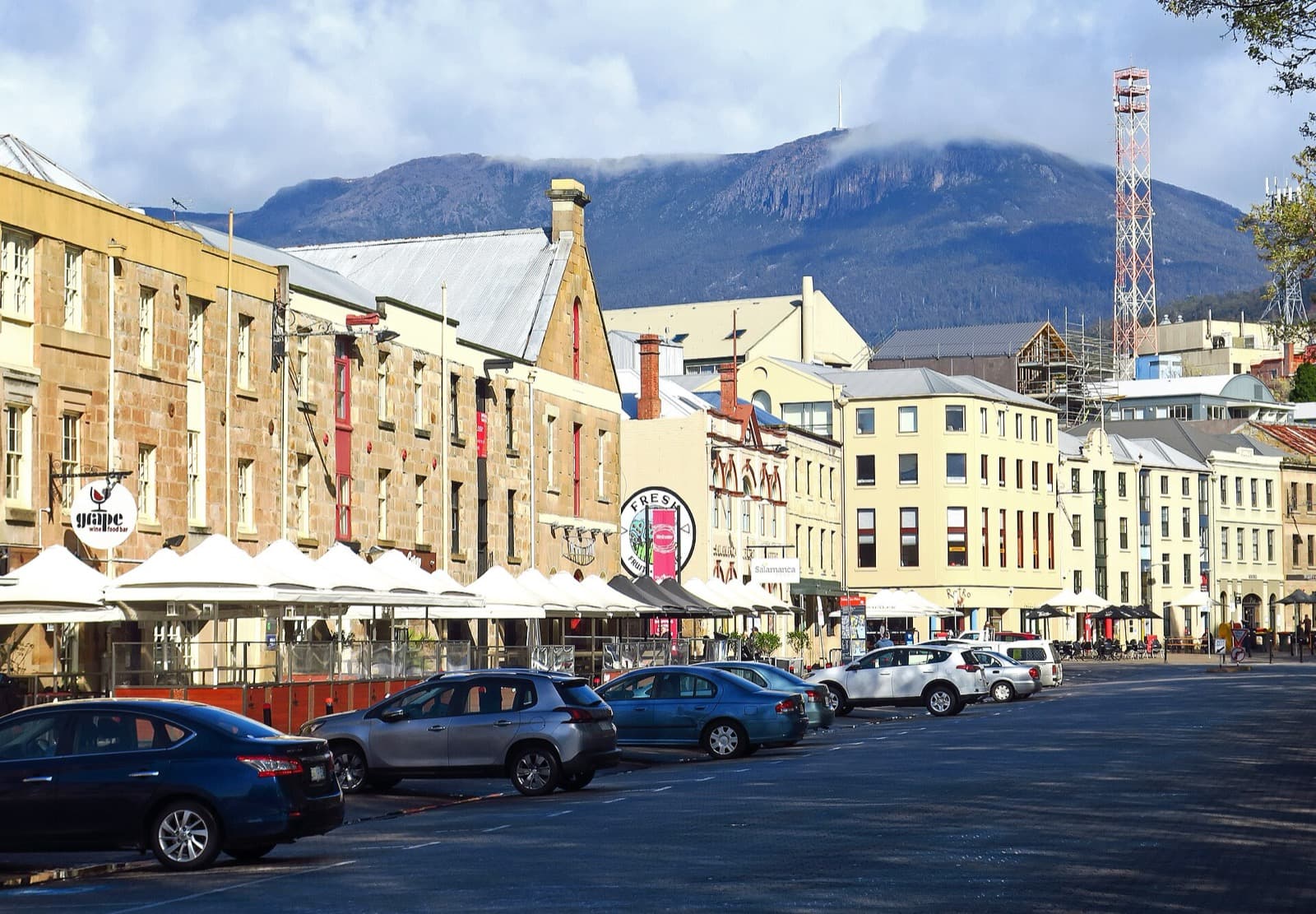
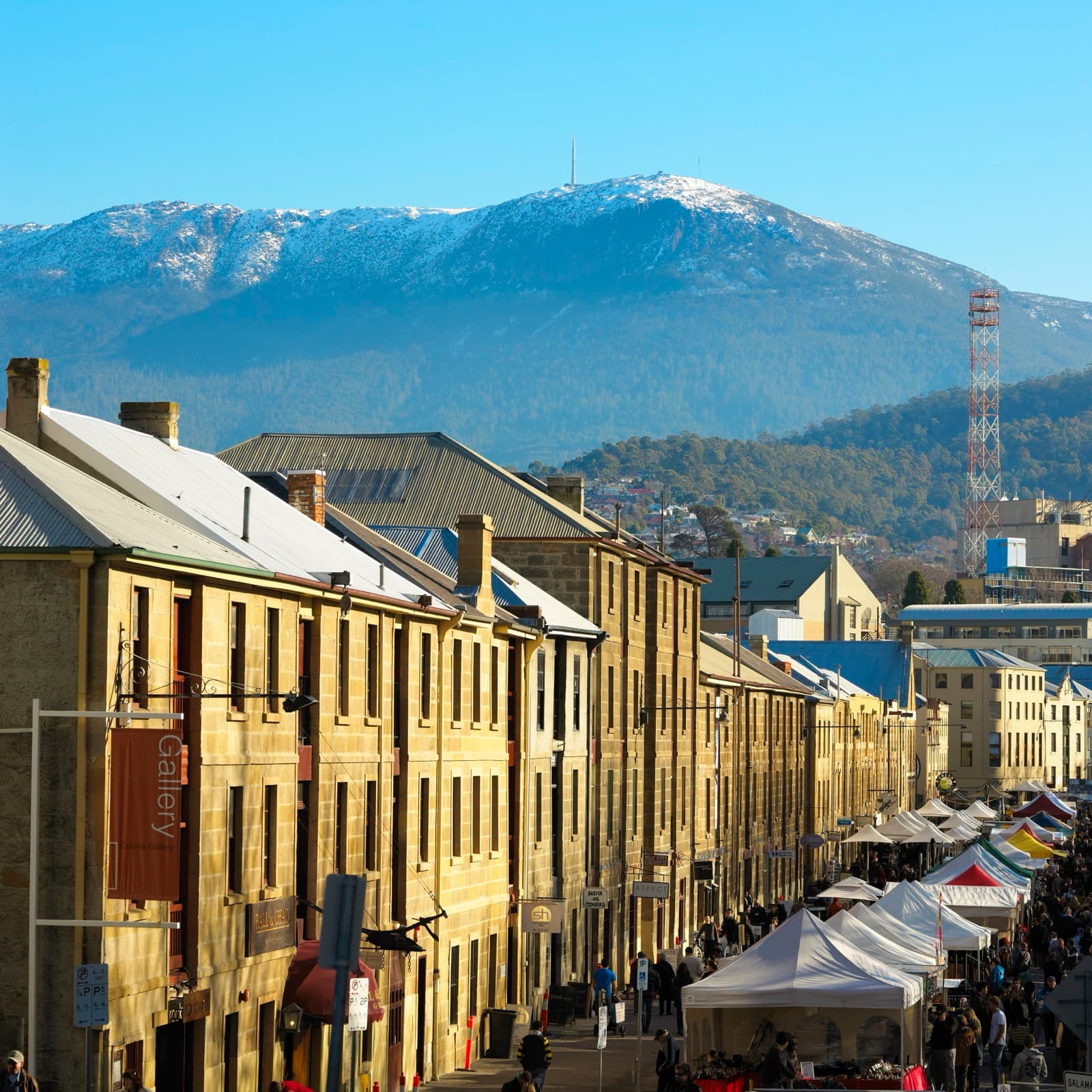
Salamanca Place is the reading-key to the whole Hobart waterfront walk. Before you climb a single one of Kelly's Steps, the long row of honey-coloured Georgian warehouses in front of you sets out the argument the rest of the route only completes: a whaling port's wealth, cut and laid from convict-quarried sandstone, rising from the wharf up into the village on the hill. Read the stone here carefully and Battery Point stops being a pretty detour and becomes the second half of one continuous sentence.
The warehouses are the whole thesis in one glance
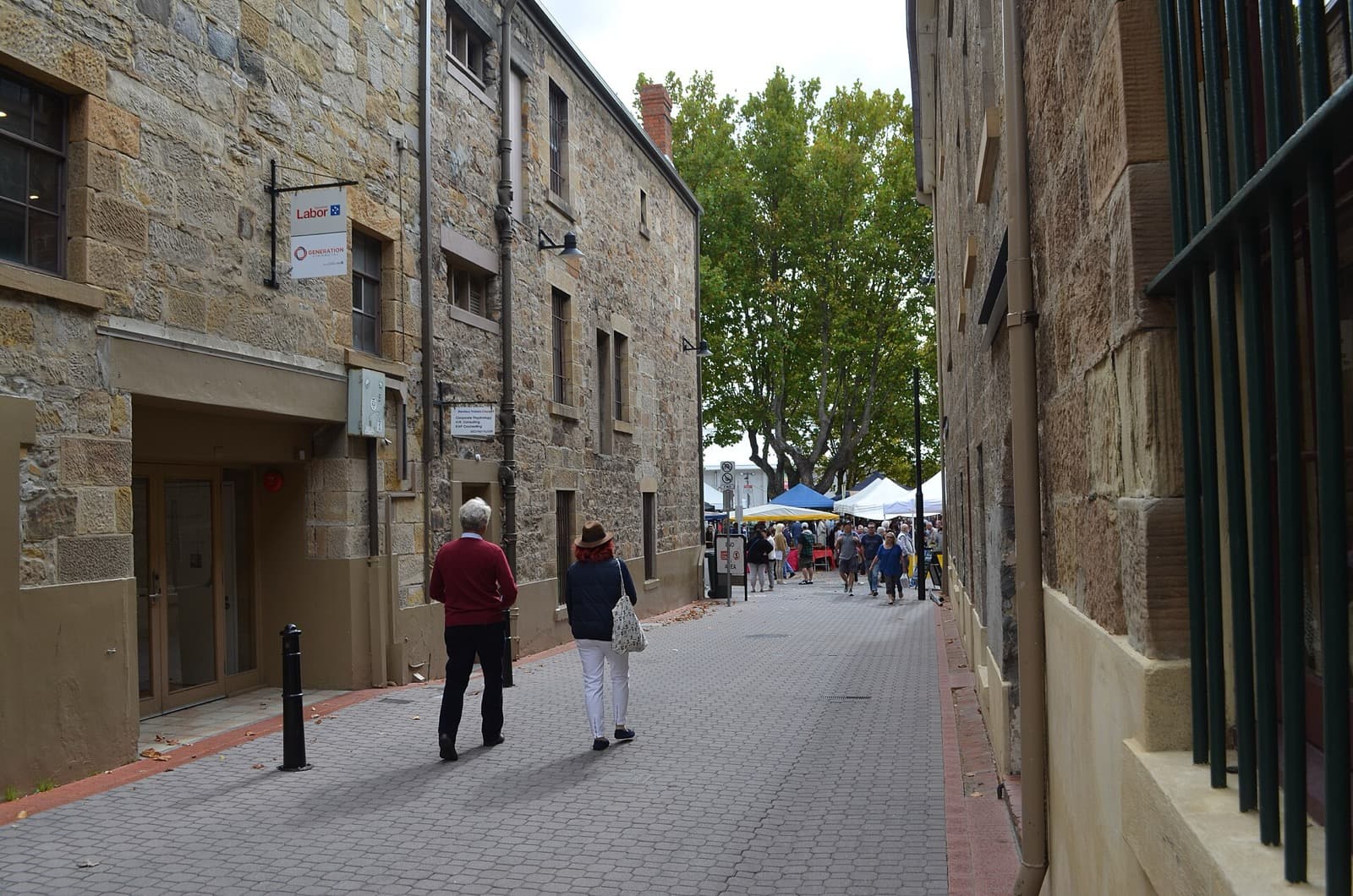
Stand at the base of the row and run your eye along it. This is one of the most complete rows of colonial warehouses in Australia, raised chiefly in the eighteen thirties and forties when a new wharf was pushed out into the harbour and lined with storage to serve the port of Hobart Town. What these buildings held tells you what the town was: grain and wool, whale oil and spirits, imported goods and timber. By around eighteen thirty the deeper harbour at Salamanca was busy with whaling ships and sailors, smugglers and traders. The beauty of the sandstone is inseparable from that trade, and inseparable, too, from who built it. The stone was quarried by convict labour, and much of the ground underfoot is not natural shoreline at all but land reclaimed from the water in the eighteen thirties, again by convict hands. Real people, bound to a hard system, made the surface you are standing on.
The name carries its own small history. The place was originally called The Cottage Green, then renamed for the Duke of Wellington's victory at the Battle of Salamanca in Spain in eighteen twelve. And the row you admire nearly did not survive. In the nineteen sixties and seventies these warehouses were threatened with demolition; the arts advocate Claudio Alcorso led the campaign to keep them, and the Salamanca Arts Centre was established in the former warehouse spaces in nineteen seventy-six. Every Saturday the Salamanca Market fills this strip with people, a living scene set against the old stone. If you want the crowd and the colour, come on a market Saturday. If you want to actually read the stone, a quiet weekday leaves the row and the steps almost to yourself.
This is also the Country of the muwinina, one band of the Tasmanian Aboriginal people, and the wider Hobart region carries the name nipaluna. The palawa are living today. The walk holds that alongside the sandstone charm rather than tidying it away, and the reflective stops later on return to it plainly.
Up the steps, and the argument keeps building
Hear a stop from this walk
Salamanca Place: The Sandstone Waterfront
The climb out of Salamanca is not a break in the story; it is the story continuing. Kelly's Steps were cut straight into the sandstone cliff in eighteen thirty-nine to link the warehouses below with the streets of Battery Point above. There are forty-eight sandstone blocks, and if you put a hand on the wall as you go you are touching the same stone the warehouses are built from, quarried from these very cliffs by the same convict labour. The honey-coloured charm of Salamanca rests directly on that work. The steps carry the name of whaling captain James Kelly, who used the line as his shortcut between his interests at Battery Point and the wharves below, and who circumnavigated Tasmania and founded the Derwent Whaling Club in eighteen twenty-six.
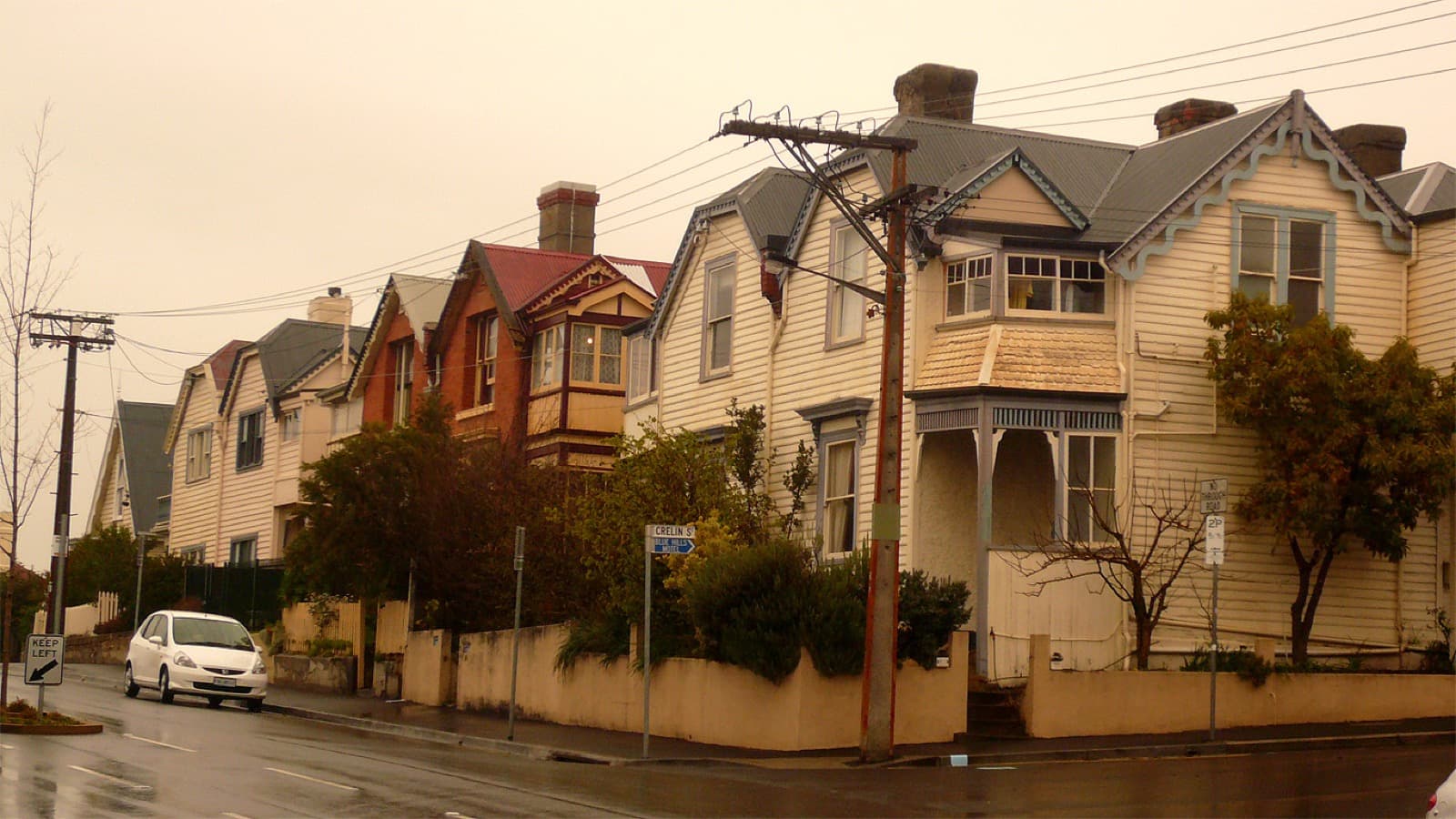
At the top you reach Battery Point, the maritime village whose settlement began as far back as eighteen oh four. Wander its narrow streets and you can read the port's whole society in the buildings: small one and two room seamen's and shipwrights' cottages standing close to the lace-trimmed mansions of merchants and ship owners, rich and poor on the same hill. Shipbuilding around Napoleon Street peaked in a tight window between eighteen forty-nine and eighteen fifty-three. What makes the place rare is how little has changed, with many homes classified by the National Trust. The district takes its name from a battery of guns established on the point in eighteen eighteen.
The village pays off what the warehouses promised
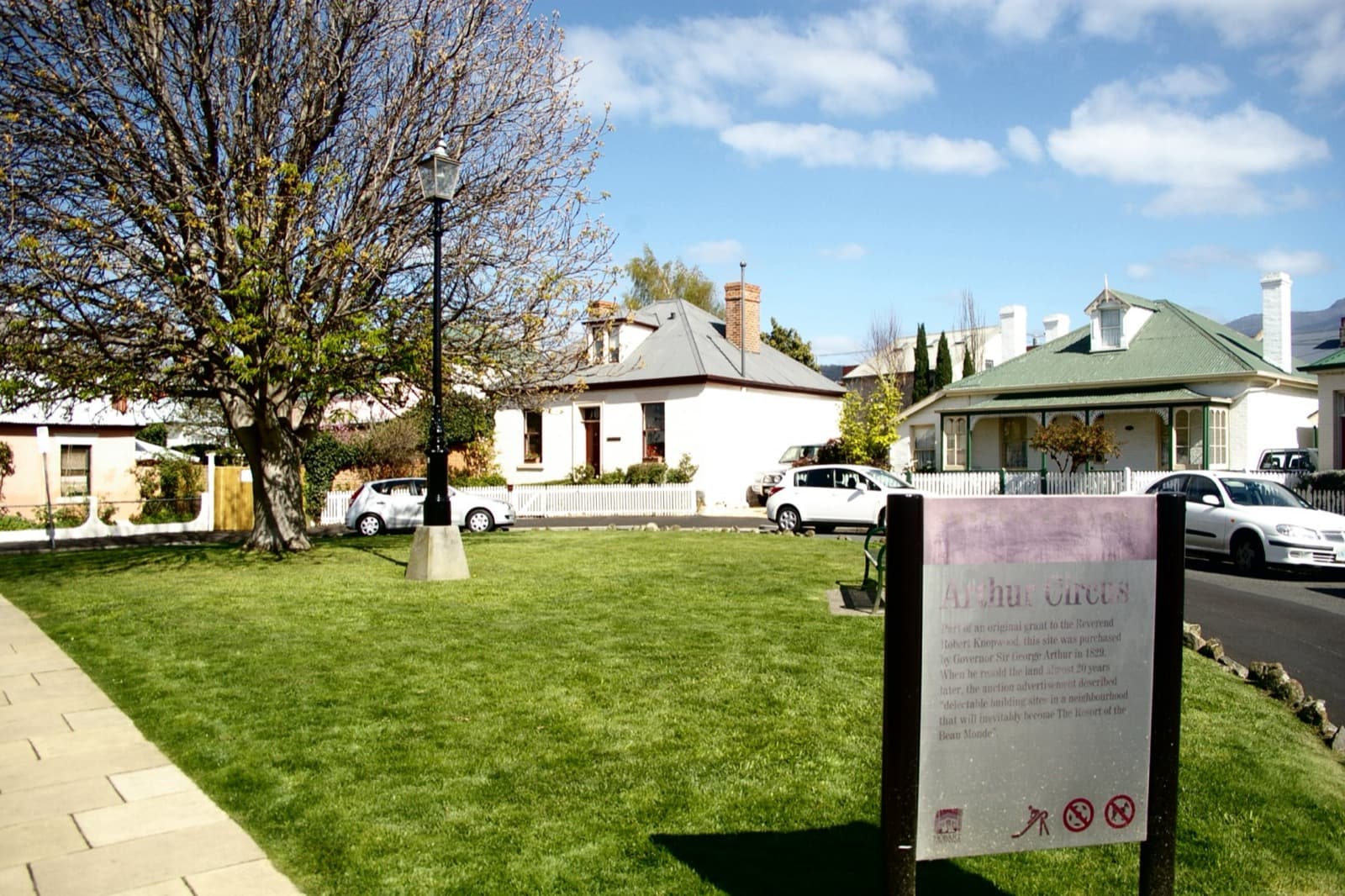
The quiet climax is Arthur Circus, a ring of tiny single-storey Georgian cottages around a small circular green, so neat they read almost like doll's houses. Built in the eighteen forties and fifties for garrison officers, this was one of the earliest subdivisions in Australia; its sixteen allotments were first offered for sale on the eighth of March eighteen forty-seven. That the shape and scale have survived for around a hundred and seventy years is the whole point. These are private homes now, so this is a place to look rather than enter.
From there the route lifts to St George's Church on the highest ground, one of the earliest Anglican churches in Tasmania. Its body was designed by government architect John Lee Archer, with services beginning on the twenty-sixth of May eighteen thirty-eight; its landmark tower, added in eighteen forty-seven, was the work of James Blackburn, a convict architect of real skill. That tower is why sailors called this the mariners' church: visible far out on the estuary, it guided ships up the River Derwent toward home.
The walk then turns reflective at Princes Park, the grassy point that named the district. Here in eighteen eighteen the colony built the Mulgrave Battery, more ceremony than defence, decommissioned after an eighteen seventy-eight review found its guns would only draw fire onto the neighbourhood. Its signal station, from eighteen twenty-nine, anchored Van Diemen's Land's semaphore telegraph, a line-of-sight chain reaching about fifty-four kilometres to Mount Nelson and beyond. This is where the tour holds both truths together: the whole colony rose on the Country of the muwinina, and after British settlement from eighteen oh three the palawa suffered a catastrophe, the frontier violence of the Black War and the Black Line of eighteen thirty.
The circle closes at Narryna, a sandstone Georgian merchant's house on Hampden Road built about eighteen thirty-five to eighteen forty for Captain Andrew Haig, a Scottish whaler and trader. Haig built warehouses facing Salamanca Place in eighteen thirty-four, the same row where the walk began, so the house is the wharf's wealth turned into a home on the hill. It opened in the nineteen fifties as the Van Diemen's Land Memorial Folk Museum, among the first of its kind in Australia.
That is why you start at Salamanca. Everything above it is the warehouse row's wealth, and the labour beneath it, carried up the hill. Walk the full route with the audio tour and read Hobart's sandstone waterfront the way it was actually built, from the water up. Plan your day with more Hobart walking tours, or see everything on offer in Hobart.
Sources
- Salamanca Arts Centre, "History" (sac.org.au): the warehouse-to-arts-centre conversion and the nineteen seventy-six founding.
- Australian Dictionary of Biography, "James Kelly" (adb.anu.edu.au): the whaling captain the steps are named for.
- City of Hobart, "Arthur Circus": the officers' cottage ring and its planned subdivision.
- Wikipedia, "St George's Anglican Church, Battery Point": John Lee Archer's design, James Blackburn's tower, and the mariners' landmark role.
- Narryna, "About" (narryna.com.au): Captain Andrew Haig's house and its later life as a folk museum.
Ready to experience it?
Salamanca Place: Hobart's Sandstone Waterfront
80 min · 3.2 km · moderate
More from Hobart
Explore more at your own pace.
Hobart Travel Guide: How Many Days, Getting Around, Best Time and Safety
One Day in Hobart: A Walkable Morning-to-Evening Itinerary
Hobart: The Convict Port That Became a Capital in Sandstone
The Commissariat Store: How Tasmania's Oldest Building Reads the Whole Convict Port
Arthur Circus: The Ring of Cottages That Time Left Alone in Battery Point