The guidebooks tend to skip it, which is the first clue that something is here. Two miles west of the French boulevards of central Ho Chi Minh City sits a district called Cho Lon, a name that means, plainly, big market. For roughly three centuries, merchants from Fujian, from Guangdong, and from the Teochew coast of southern China built temples, assembly halls, and one of the largest trading markets in the region here, and ran much of Saigon's commerce from behind their own gates. This is one of the oldest and largest overseas-Chinese quarters anywhere in the world. The community that built it is the one Vietnam calls the Hoa, its ethnic Chinese, and Cho Lon is their historic center.
If you walk Cho Lon looking only for pretty temples, you will find them and miss the point. The temples are the architecture, but the subject is civic. Every one of these halls was more than a place to burn incense. It was a hometown government in miniature: a place where people from the same corner of China organized their worship, their trade, their disputes, and their mutual aid. To walk from the great market inward through the older temples is to walk backward through the machinery of a community that governed its own affairs. The thread underneath is autonomy, and it runs the whole length of the route.
The engine, and the man who never saw it
Begin where the noise is. Binh Tay Market, with its clock tower and sweeping tiled roofs wrapped around an open courtyard, is the visible engine of Cho Lon, the big market that names the district. It is still a working public market, free to walk into, and it was financed by a single self-made merchant named Quach Dam, known by his Chinese name Guo Tan. He was born in 1863 in the Teochew community of Guangdong, arrived with nothing, and is said to have started by recycling used material and refuse before building a fortune in trade.
When Quach Dam paid to build the market, he did not simply hand it over. He negotiated: he donated the deed to local officials in exchange for a few plots of land and permission to place a statue of himself at the center of the courtyard. But here is the detail that lingers. The market opened around 1930, and Quach Dam had died in May 1927. He never saw it finished. He built a monument to his own success and did not live to walk beneath its clock tower. Everything you can hear from the entrance, the calling of prices, the movement of goods that has always fed this region, is the sound of the city he wanted his name attached to, echoing on without him. It is a fitting overture, because Cho Lon is a place where individual ambition and communal institution are the same story.
The parent hall, and the family that split
Hear a stop from this walk
Thien Hau Temple: The Sea Goddess and the Hanging Coils
Walk inward and the temples get older and quieter. The key to the whole district is the Ong Bon Pagoda, also called Nhi Phu Temple, the Temple of the Two Prefectures. It was founded around 1730 to 1740 by settlers from Fujian, specifically from two prefectures of that province, Quanzhou and Zhangzhou. That is where the name comes from: two prefectures, two hometowns, one temple. It is widely described as among the oldest Chinese temples in all of Saigon and Cho Lon, and its four ranges of rooms wrap around an open sky-well courtyard so the whole plan forms a hollow square, light and rain falling into the heart of it.
This is the parent hall, and understanding that unlocks everything else. The Fujian community that first gathered here later split by hometown. The Quanzhou group went off to found their own assembly hall around 1740. The Zhangzhou group founded another, called Ha Chuong. So the temples you visit next are not a random collection. They are the branches of a family tree, and Ong Bon is the trunk. Stand in that courtyard and picture the first undivided community, before it grew large enough to need more than one home.
Pieces of home, shipped across the sea
Ha Chuong Hoi Quan, the Zhangzhou hall, is one of those branches, founded in 1809. Its main altar honors Thien Hau, the sea goddess, the protector of anyone who trusts their life to the water, which makes sense for a community that arrived by boat. But look closely at the four stone dragon pillars. Each was carved from a single monolithic block, and each was carved in China and then loaded onto boats and shipped all the way to Vietnam. Picture the labor and the faith in that decision. A community that had already crossed the sea once decided that their new temple could not simply be built from local stone. Pieces of home had to make the same voyage they had made. That is the emotional logic of Cho Lon in a single object: not homesickness exactly, but the deliberate work of rebuilding a homeland's institutions on foreign ground.
The heart of the walk
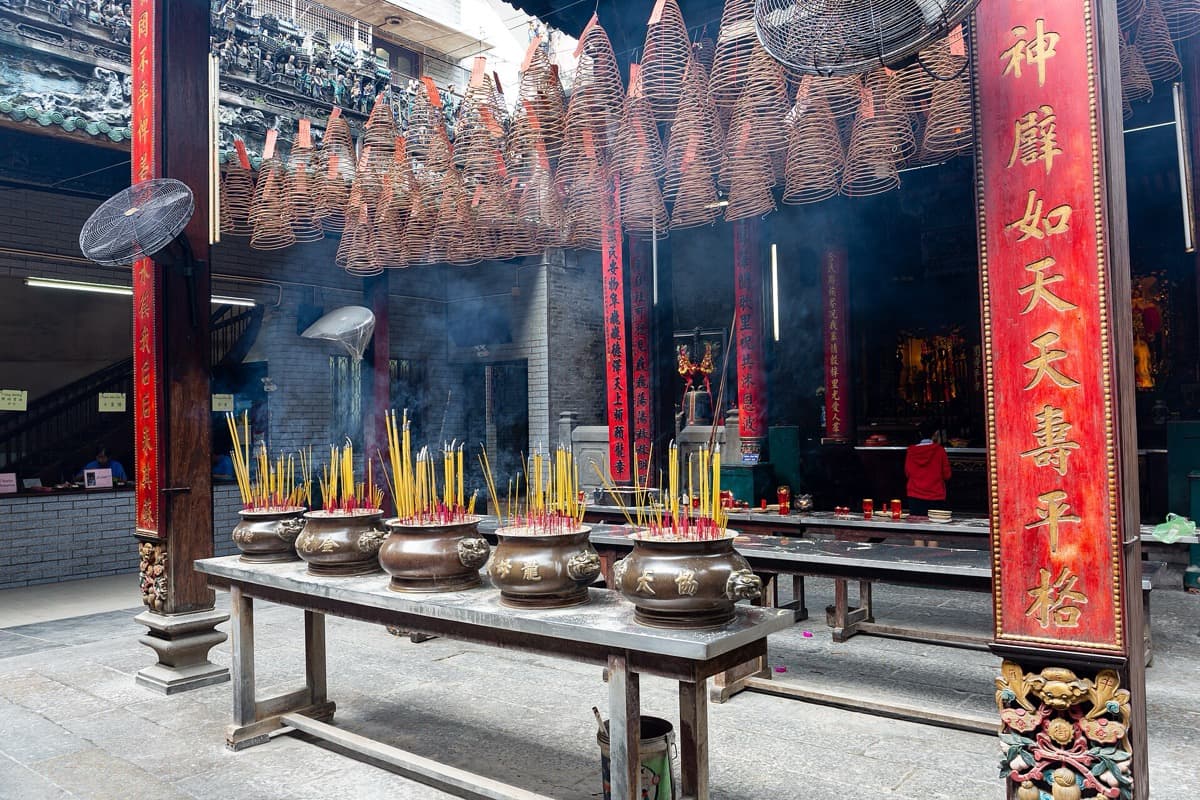
The emotional center is Thien Hau Temple, officially the Tue Thanh Assembly Hall, erected around 1760 by the Cantonese community and repaired and expanded many times since. It is dedicated to Thien Hau, the empress of heaven, goddess of the sea, and it is famous for the great spirals of incense suspended above the worship space, many of them more than a meter across, burning slowly for weeks. A visitor buys a coil, attaches a slip of paper with a name and a wish, and hangs it, so that as the smoke rises, so does the prayer. The haze you stand in is other people's hopes, physically ascending. This single temple is worth its own visit and its own reading, which you will find in The Sea Goddess of Cho Lon: Inside Thien Hau Temple.
The god of war and the ledger
The walk closes at Nghia An Hoi Quan, the Teochew assembly hall built with Hakka participation around 1819 to 1820. Its main deity is Quan Cong, the general known in Chinese history as Guan Yu, raised over the centuries into a god. Here is the detail that ties the whole district together: he is worshipped as the god of both war and commerce. For a community of merchants who built their world on trade, a god who guards both the sword and the ledger is exactly the right patron. Off to the left stands a larger-than-life statue of his red horse, and devotees ring a bell at its neck and crawl beneath the statue for a blessing. It is a small, physical act of faith, bending low under a war god's horse, and it is the right last gesture for a walk through a community that built a parallel city on trade, worship, and quiet self-rule.
Why Cho Lon is the other half of Saigon
Central Saigon is a story about power imposed from outside and then inherited. Cho Lon is the opposite: a story about a community that organized itself from the inside out, hall by hall, hometown by hometown, and asked the colonial and later national authorities mostly to leave it alone. Read together with the downtown, the two halves complete the city. If you have walked the French core, you have seen a frame that empire built and Vietnam kept, described in Empire in Stone. Cho Lon is the frame the people built for themselves. To understand how these two very different Saigons sit two miles apart on the same map, start with How to See Saigon.
Ready to experience it?
The Other City: Cholon
95 min · 2.4 km · moderate
More from Ho Chi Minh City
Explore more at your own pace.
Ho Chi Minh City Travel Guide: How Many Days, Getting Around, When to Go (2026)
One Day in Ho Chi Minh City: A Walkable Saigon Itinerary (2026)
What to Eat in Ho Chi Minh City: A Saigon Food Guide (2026)
Empire in Stone: How Saigon Kept the Buildings and Changed Their Meaning
The City That Did Not Burn: Saigon on the Last Day