Most historic buildings survive as fragments of their own past: a wing from one century, a facade from another, a plaque naming an event that happened somewhere in the rooms behind it. Independence Palace is the rare exception. It was kept almost exactly as it stood on a single morning, the morning of April 30, 1975, when the Vietnam War ended inside its gate. The war command rooms, the rooftop helipad, the 1960s furnishings, all preserved. Walking it is not walking a museum of the war. It is walking the last morning of one Vietnam, held in place.
This companion is meant to be read plainly, without triumph, honoring the dead of every side. That is the register our whole history walk keeps, laid out in The City That Did Not Burn: Saigon on the Last Day. What follows is an account of the building and the hour, and why both are still legible on the ground.
The palace before this palace
There has been a seat of power on this ground since the French built one here. The first was the Norodom Palace, designed by the French architect Achille-Antoine Hermitte and built between 1868 and 1873, in the years just after France completed its occupation of the six provinces of southern Vietnam. It was an expensive neo-Baroque building meant to impress Saigon with the weight of colonial rule, and for most of the French era it served largely as a ceremonial residence for governors when they passed through the city.
In September 1954, France handed the building to the government of the south, which renamed it Independence Palace and made it the working residence of Ngo Dinh Diem, the first president of the Republic of Vietnam. Diem's tenure ended here in a way that decided the shape of everything after. In February 1962, two dissident air force pilots bombed the palace in a failed attempt to kill him. The old building was badly damaged. Diem chose to demolish what was left and build a new palace on the same footprint. He did not live to move into it. He was killed in a coup in November 1963, three years before the new palace opened.
The architect, and what he built
Hear a stop from this walk
Former US Embassy Site: The Empty Roof
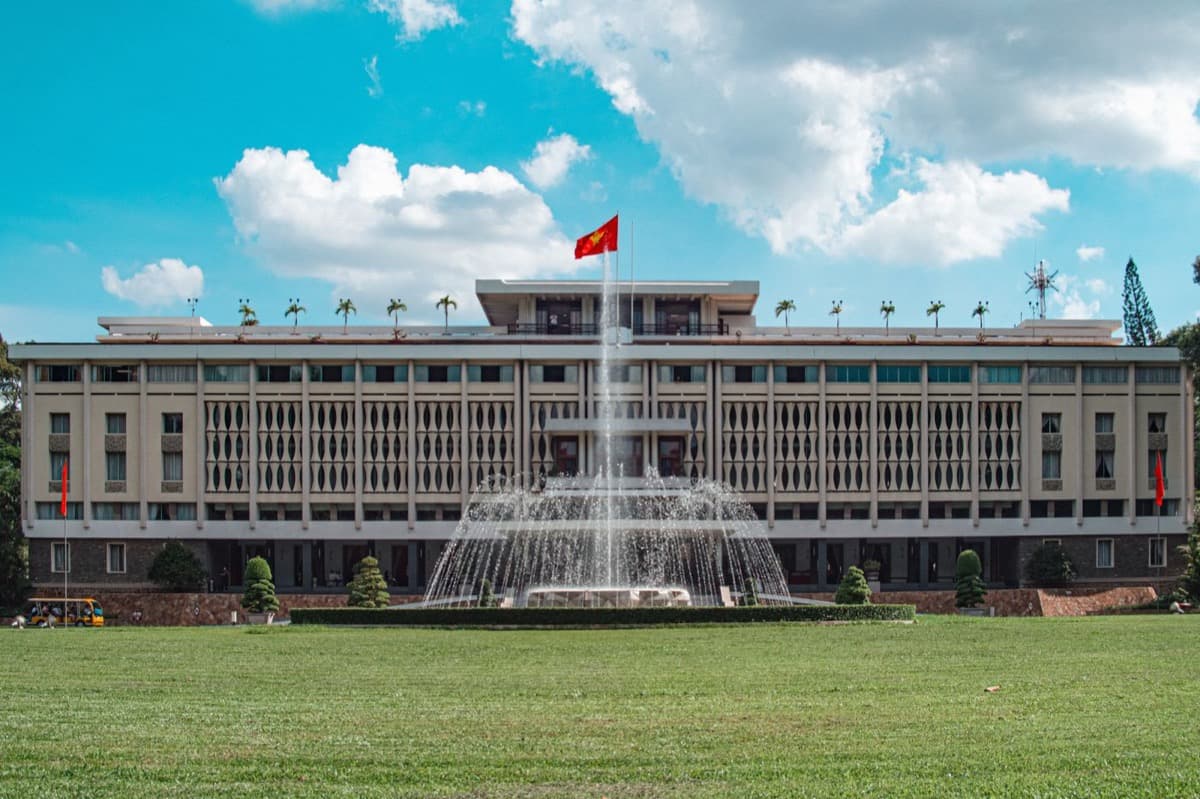
The building you walk today was designed by Ngo Viet Thu, a Vietnamese architect who had won the First Grand Prize of Rome, the Grand Prix de Rome, in 1955. That prize matters to the story. It was one of the most prestigious awards in the Western architectural world, and Ngo Viet Thu was the first Vietnamese architect to win it. The country's most powerful new building was designed by a Vietnamese laureate of the same French system that had built the palace before it. Empire trained the architect; the architect built for the republic that followed.
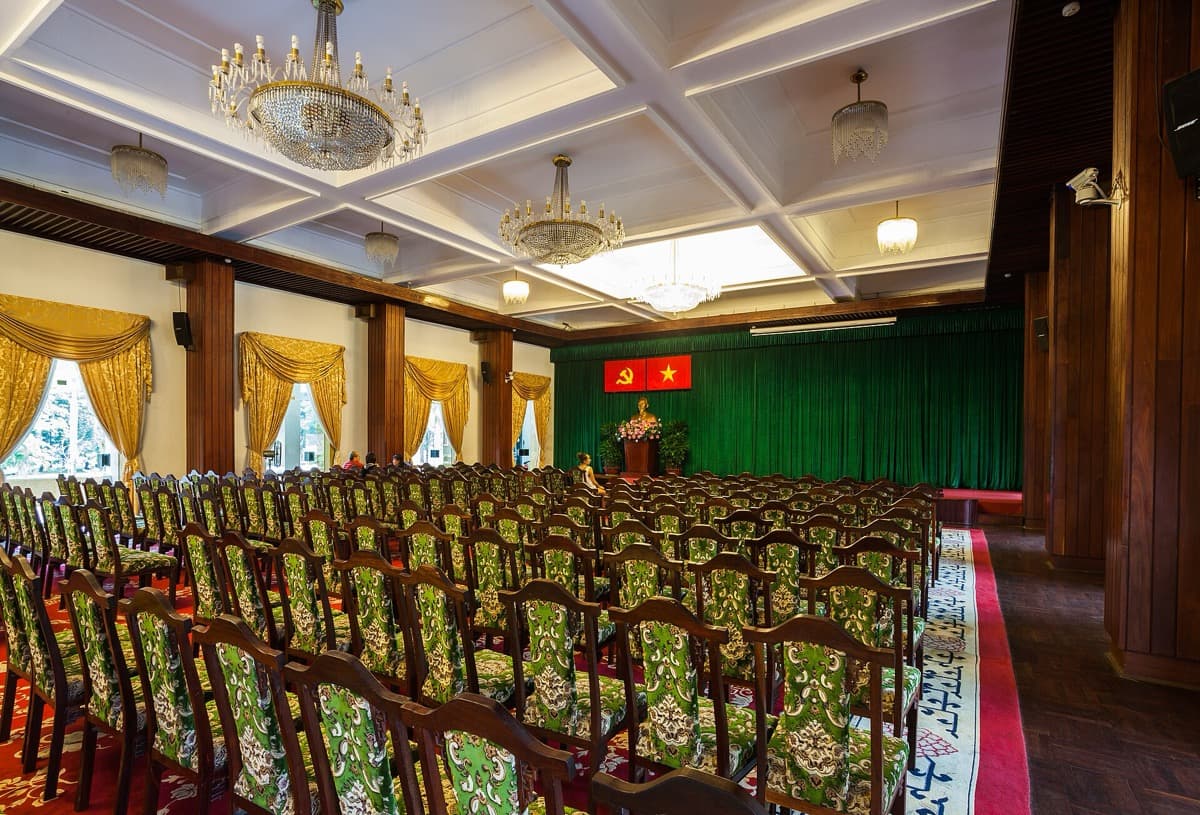
Construction started on July 1, 1962, and the completed palace was inaugurated on October 31, 1966. Ngo Viet Thu worked the whole plan as a composition of meaning rather than mere form: the building was laid out to spell, in its structure and screens, ideas the architect associated with good governance and national fortune. What reads at first as clean 1960s modernism is a design carrying a deliberate symbolic program, drawn by a man fluent in both traditions. Walk the reception halls, the private quarters, the war command rooms in the basement with their maps and radios, and you are reading one architect's argument about what a Vietnamese seat of power should be, built at the exact moment the country was tearing itself apart over the question.
The hour the war ended
By the spring of 1975 the Republic of Vietnam had days left. Its last president, Duong Van Minh, had taken office only on April 28, inheriting a government that was already collapsing. On the morning of April 30, at 10:24, Minh announced a surrender by radio and ordered his forces to lay down their arms.
Then the tanks arrived. At 10:45 that morning, a tank of the North Vietnamese army came through the gate of the palace, and with that, in the plainest possible terms, the war was over. The detail historians preserve is precise and worth keeping precise: tank number 843, of the 203rd Tank Brigade, commanded by Bui Quang Than, first rammed a side gate, and tank number 390 then broke through the main gate into the grounds. Bui Quang Than climbed to the roof and raised the flag of the National Liberation Front over the palace. Both tanks were declared national treasures in 2012.
There was no battle for the building. Duong Van Minh had already ordered the surrender before the tanks reached the gate. He waited inside and, later that day, at 2:30 in the afternoon, formally announced the unconditional surrender of the south. One government ended and another began, and the physical structure where it happened came through the morning intact. That is the fact the whole walk turns on: the ending was quiet, and because it was quiet, the palace survived to hold it.
Why the building was frozen, and how to read it
After 1975 the new government kept the palace as it was rather than clearing it or repurposing it beyond recognition. The command bunkers stayed wired. The furniture stayed where the last occupants left it. The maps stayed on the walls. Today the building serves as a state convention hall and a public museum, but the core of the experience is the preservation itself, and that plainness does more historical work than any monument could. A dated room from 1975, left as it was, lets the objects carry the weight and leaves the feeling to you. The gate the tanks came through is still the gate. The rooms where a republic spent its last hours are still furnished for a government that no longer exists.
So read it in layers. Start at the gate and picture the hour: 10:45 in the morning, a surrender already broadcast, two tanks at the fence. Then go inside and read the architecture as Ngo Viet Thu's argument, not just a backdrop. Then descend to the basement command center, where "a government at war" becomes concrete in the situation maps, the communications gear, and the low ceilings. The building holds all three readings at once, the design, the government, and the ending, stacked on the same floors.
For how this palace fits the rest of the last morning, the museum that opened months later, the plazas, and the press hotels where the world learned a republic had fallen, walk the full route in The City That Did Not Burn. For the wider frame of how empire, commerce, and war fold into the same few square miles of downtown, start with How to See Saigon.
One building, designed by a Vietnamese laureate of the French academy, built for a republic that lasted nine more years, and kept ever since at the exact hour that republic ended. There are very few places anywhere where the climax of a war is still standing, unaltered, for you to walk into. This is one of them. Walk it plainly.
Sources
- Wikipedia, "Independence Palace."
- Wikipedia, "Saigon Governor's Palace" (the Norodom Palace that stood here from 1873).
- Wikipedia, "Fall of Saigon."
- Historic Vietnam, "Saigon's Palais Norodom: A Palace Without Purpose."
- Dinh Doc Lap (Independence Palace), official history, dinhdoclap.gov.vn.
Ready to experience it?
Reunification Palace: The Last Day
140 min · 5 km · moderate
More from Ho Chi Minh City
Explore more at your own pace.
Ho Chi Minh City Travel Guide: How Many Days, Getting Around, When to Go (2026)
One Day in Ho Chi Minh City: A Walkable Saigon Itinerary (2026)
What to Eat in Ho Chi Minh City: A Saigon Food Guide (2026)
Empire in Stone: How Saigon Kept the Buildings and Changed Their Meaning
The City Beside the City: Reading Cho Lon's Assembly Halls