France set out to make central Saigon look permanent. In the half century between the cathedral's first stone in 1877 and the opening of the Hotel Majestic in 1925, it built, within a few blocks of District One, a cathedral, a post office, an opera house, a town hall and a run of grand hotels, and it laid a boulevard over a filled canal. Each made the same argument in stone: that this river port was a finished European capital, and that the people running it were not going anywhere.
France left in the 1950s. The buildings stayed, and the city kept using them. That gap, between what they were built to say and what Saigon has done with them since, is the real subject of a walk through the old French quarter. The frame is French. At every stop, the question is who the picture inside it belongs to now.
The one thing the city made for itself
The walk starts, deliberately, somewhere France never built. Duong Sach, the Book Street, is a pedestrian lane of bookshops and stalls between the post office and the cathedral grounds, opened by the city on 9 January 2016 and named for Paul Nguyen Van Binh, the first Archbishop of Saigon, who held that office from 1960 until his death in 1995. Almost everything else on this walk was put up by people who expected to stay. This lane was made long after they had gone, on the city's own terms.
The substitution you can see
Hear a stop from this walk
The Majestic and the River: Where the Quarter Ends
Around the corner is the Central Post Office, finished in 1891 as the communications hub of French Cochinchina, and still a working post office. Look up at the long iron-framed vault, then at the two painted maps on the side walls, each dated in its own title: Saigon and its surroundings, 1892, and the telegraph lines of southern Vietnam and Cambodia, 1936. This was the colony's nervous system, drawn on a wall. At the far end of the hall, a large portrait of Ho Chi Minh presides over the counters. Nothing was demolished. The hall built to wire a colony together simply runs under his portrait now.
It is also the address of Saigon's most repeated wrong fact, that Gustave Eiffel designed it. He did not. French press of 1888 and 1891 names the colony's chief architect, Marie-Alfred Foulhoux, and the Eiffel story traces back to a briefing note given to tourism agencies in 1990. The full correction is in The Eiffel Myth: Who Actually Built the Saigon Central Post Office.
The color that gives the game away
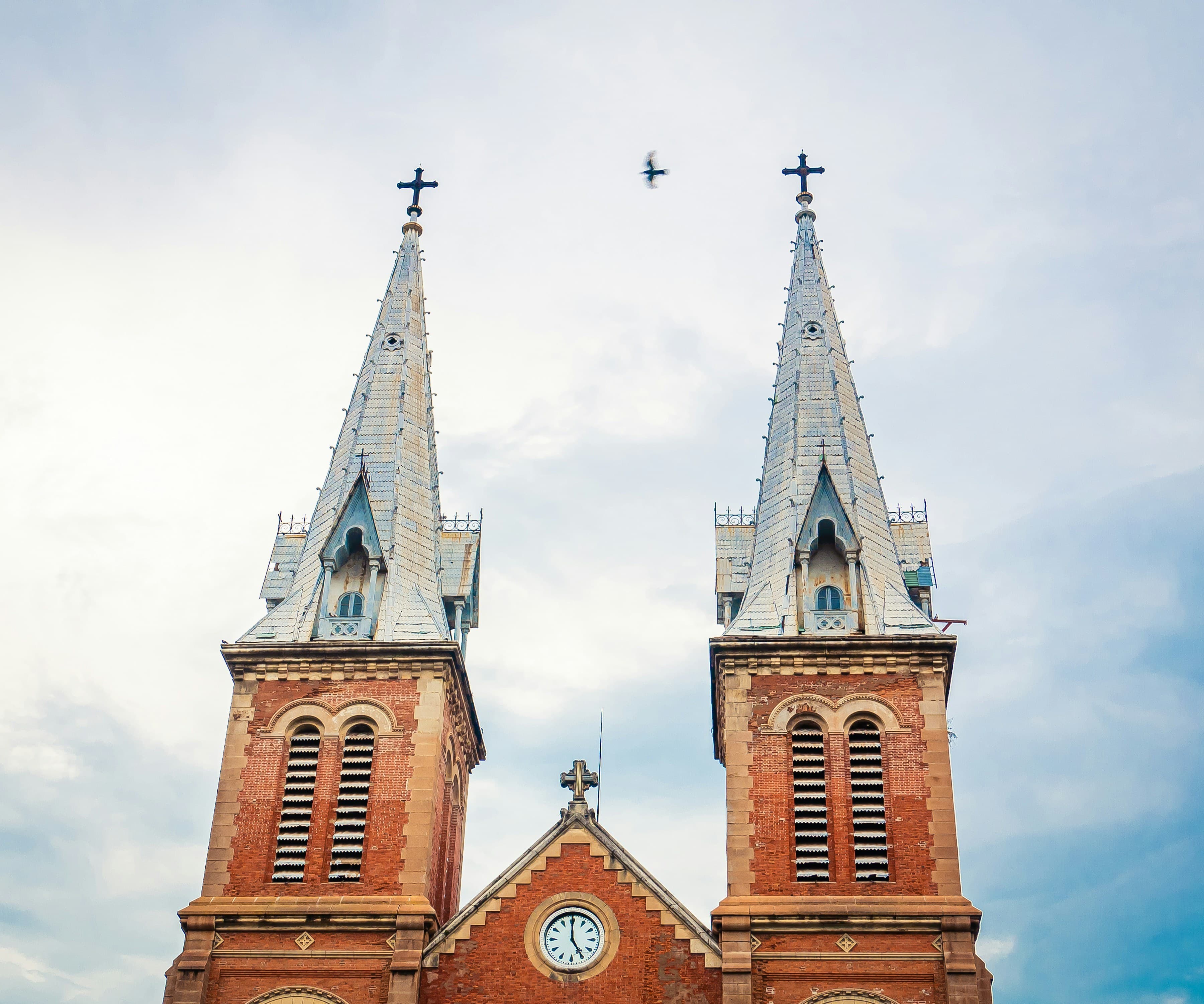
The cathedral stands across the square. Its first stone went down on 7 October 1877, and it was consecrated on Easter Sunday, 11 April 1880, at a cost of 2,500,000 francs paid by the colonial administration of Cochinchina. Not the congregation. The government. That tells you what it was for.
Its walls are bare brick, never rendered, and after nearly a century and a half they still hold their red. The brick was brought from France. Where in France is a genuine dispute: the parish says Toulouse, while the archdiocese and the city government say Marseille. The only stamped material anyone has recovered from the building is roof tile, and even that refuses to tell a tidy story. Some tiles read Guichard Carvin of Marseille. Others, replacements, were made in Saigon, in the workshops of the merchant Wang-Tai.
The silhouette that says Saigon to the whole world, the two pointed spires, was not part of the original church either. The towers were flat topped at 36.6 meters until 1895, when spires designed by the architect Gardes took them to 57.6 meters. The monument that reads as timeless is a set of edits, and the editing has not stopped. Restoration began on 1 July 2017. The gilded crosses went back onto the spires on 19 March 2026, but the 2027 completion target was publicly abandoned in December 2025 and no new date has been set. Plan on seeing it from outside.
One street, four names
Dong Khoi, running down from the cathedral, is the old rue Catinat, named on 1 February 1865 by the governor Pierre-Paul de La Grandiere. It became Tu Do, Freedom, in 1955, and Dong Khoi in 1975, after the 1960 uprising that began in Ben Tre province. A different name for each government, and the same business under all of them: the smart shops, photographers and hotels of the French street, the bars and nightclubs of Tu Do, the luxury retail of today.
Partway down is Chi Lang Park, a garden since 1924. Around 2009 it was dug out for the basement of the shopping center next door, and the park you stand in reopened in 2010 on the slab above, where the soil is too thin for big shade trees. The garden is a century old. The trees are not.
The building that changed jobs three times
The sharpest turn on the walk is the opera house on Lam Son Square. It was begun in 1898 and opened in 1900, designed by Felix Olivier with Ernest Guichard and Eugene Ferret, and modeled openly on the Palais Garnier in Paris. For all its swagger it seats just 468, not the eighteen hundred that circulates in travel copy.
Watch what happens to it. From 1955 it was the seat of the National Assembly of the Republic of Vietnam, and from 1967, when the legislature became bicameral, of its lower house. For twenty years the room built for arias was the room where the southern republic argued about its own future. After 1975 it went back to being a theater, its facade was restored in 1998 for the city's three hundredth anniversary, and opera is still staged there. Same walls, three meanings, one century.
Across the square stands the Continental, open since 1880. Graham Greene stayed there on four visits between 1952 and 1955, in room 214 by the hotel's own account, and his narrator in The Quiet American drinks his six o'clock beer on its terrace, which is glassed in and air conditioned now. The room survives. The evening does not.
Power that stayed power
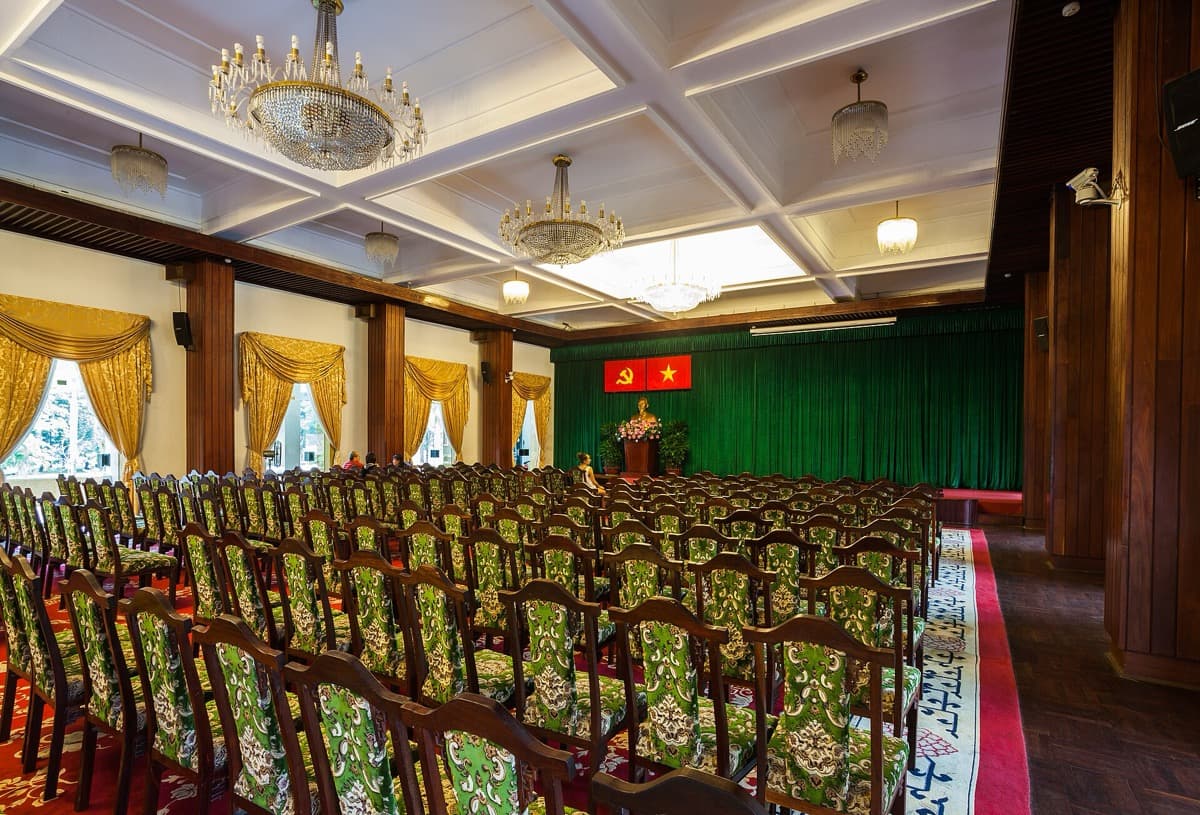
The town hall, the most theatrical facade in the city, makes the point from the opposite direction. Designed by Fernand Gardes and built from 1898 to 1909 as the Hotel de Ville, where hotel means a civic building rather than a place to stay, it closes the head of the boulevard, so the whole street leads the eye to it. It is still the seat of municipal authority. Since 1975 it has been the headquarters of the Ho Chi Minh City People's Committee, and a bronze statue of Ho Chi Minh, unveiled in 2015, stands on the plaza in front. A building designed as the local face of French power now serves as the local face of a Vietnamese government, which is also why you cannot walk in. Empire built the seat. The city kept the seat and changed who sits in it.
The ground that changed its nature
Even the ground plays the game. Nguyen Hue looks like it was always a grand avenue. It was water first: a canal cut around 1790 on the orders of Nguyen Anh to bring boats from the Saigon River to the gate of his citadel, some seventy years before the French arrived. The French called it the canal Charner and filled it in stages through the 1880s, until the new Boulevard Charner reached the river around 1890. In the mid 1950s, when the republic swapped Saigon's French street names for Vietnamese ones, Charner became Nguyen Hue, after the Tay Son leader who reigned as the Quang Trung emperor. In April 2015 the city reopened it as a granite pedestrian promenade.
Then look across at number 42, a nine-storey apartment block finished in 1960, whose residents before 1975 included senior South Vietnamese officials. After 1975 the flats went to workers. Once the boulevard became a promenade the address grew valuable, and tenants turned their flats into cafes one at a time, with no developer and no plan. Residents still live there among the coffee. Nobody designed that repurposing. The city simply did it.
Where the quarter meets the water
The walk ends at the river, at the Hotel Majestic, on the corner where rue Catinat met the quay. It opened in 1925 with four storeys and 44 rooms. You will be told it was built by chu Hoa, Hui Bon Hoa, the Fujian-born financier. He had died in 1901; his family and their property company built it. In Greene's novel, the narrator's evening runs from that beer at the Continental down to cocktails on the Majestic's roof at seven, which is the last stretch of this walk in a single paragraph.
Turn to the water. From 1881 this stretch was the river port: boats left here for Phnom Penh and the delta, and the ocean liners from Marseille tied up just downstream. This is where people and post arrived from France, and where the whole quarter was pointed. Even here nothing is fixed. The promenade was rebuilt in 2022, and in June 2026 the city approved, in principle, another and far larger remaking of the riverfront.
The empire built a quarter to prove it would stay. It did not stay. The buildings did. Walk it with Saigon's French Quarter: The Empire Left, the Buildings Stayed, eight stops and about 1.8 kilometers from the Book Street to the river. To see how the same downtown reads when you walk it for a different century, follow The City That Did Not Burn, which traces these streets on the last morning of the war, or cross town to the other city Saigon grew up beside. All three walks are the same lesson in different keys: a city becomes itself by taking possession of whatever was built to define it.
Ready to experience it?
Saigon's French Quarter: The Empire Left, the Buildings Stayed
75 min · 1.8 km · moderate
More from Ho Chi Minh City
Explore more at your own pace.
Ho Chi Minh City Travel Guide: How Many Days, Getting Around, When to Go (2026)
One Day in Ho Chi Minh City: A Walkable Saigon Itinerary (2026)

What to Eat in Ho Chi Minh City: A Saigon Food Guide (2026)
The City Beside the City: Reading Cho Lon's Assembly Halls
The City That Did Not Burn: Saigon on the Last Day