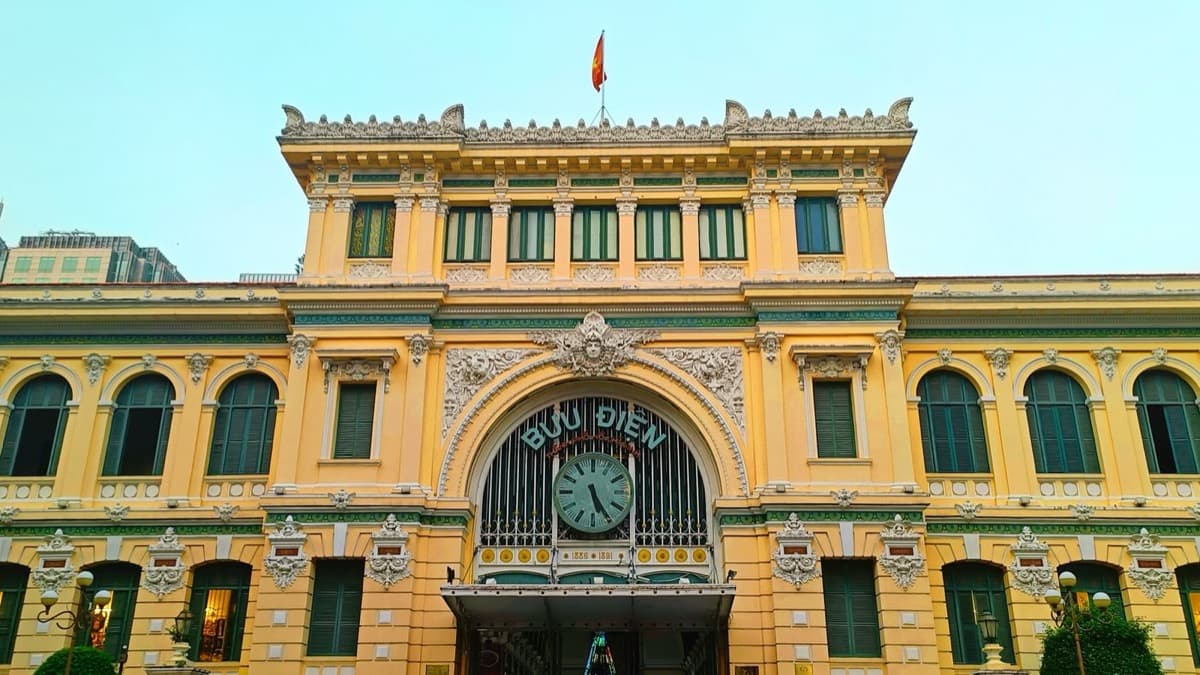
Stand inside the Saigon Central Post Office and you will hear the same sentence from half the guides on the floor: Gustave Eiffel designed this building. It is on tour scripts, travel blogs, and souvenir captions all over the city. It is one of the most repeated facts about Saigon. It is also wrong, and correcting it is worth doing carefully, because the true story is more interesting than the legend and it tells you something real about how myths attach to buildings.
This is the second stop on our self-guided walk, Saigon's French Quarter: The Empire Left, the Buildings Stayed, which begins next door on the Book Street, and it is one of the buildings described in Empire in Stone: How Saigon Kept the Buildings and Changed Their Meaning. That walk is about buildings the city kept using long after the people who built them had gone. The post office is where the myth about who built it needs to be cleared away first.
The myth, stated plainly
The claim is that Gustave Eiffel, the engineer of the Eiffel Tower in Paris, designed the Saigon Central Post Office. You will hear it said with total confidence. Some versions soften it to "Eiffel built the ironwork" or "the Eiffel company engineered the roof." Another splits the difference, claiming Eiffel designed an earlier building that someone else later rebuilt. Every version is a misattribution, and none has documentary support.
The myth is easy to understand once you stand inside. The hall is a long vault framed in metal and carried on ornamental columns, with big arched windows down both sides, and it reads more like a railway station than a post office. That is exactly the kind of room people associate with Eiffel, and his firm really did work in the colony: between 1872 and 1889 it built railway viaducts, road bridges and market halls across Cochinchina, and its Pont des Messageries maritimes of 1882 still stands. Just not this. The historian Tim Doling traces the post office story to a single source: a guidance note circulated to tourism agencies in 1990 by the city's Foreign Affairs Bureau, which asserted that Eiffel designed the building. A famous name and a plausible-looking roof did the rest, and thirty-six years of repetition later it is what most visitors believe.
Who actually designed it
Hear a stop from this walk
The Majestic and the River: Where the Quarter Ends
The architect was Marie-Alfred Foulhoux, who lived from 1840 to 1892 and was chief architect of French Cochinchina. The evidence is contemporary. In Paris, Le Temps of 28 February 1888 described Foulhoux's work on "a superb post office" while the building was going up, and the architectural review L'Architecte constructeur of 15 September 1891, the year it was finished, credited "the distinguished chief architect of the colony, M. Foulhoux" with the monument. Begun in the second half of the 1880s, the post office was completed and inaugurated in 1891. Foulhoux died on 20 January 1892. He designed the building that now carries another man's name.
There is a secondary confusion worth naming, because it shows up in sources that have already dropped Eiffel. Some accounts credit the post office to Auguste Henri Vildieu, with Foulhoux as his assistant. That reverses the real hierarchy. Vildieu, who lived from 1847 to 1926, entered the colonial service in February 1885 as an assistant architect and only became head of civil buildings in 1895, three years after Foulhoux died. According to Doling, the reversed credit entered circulation through the 1998 book Saigon 1698 to 1998, whose editors later conceded it had no archival support. It is still in use: Vietnam Post's own article about the building no longer mentions Eiffel, but it credits the architect Villedieu with his assistant Foulhoux.
So the honest attribution is simple. Not Eiffel. Not Vildieu with Foulhoux as his assistant. Marie-Alfred Foulhoux, chief architect of the colony, in the last years of his life.
What the building was for
Strip away the myth and the real function comes into focus. This was not decoration. It was infrastructure, the communications hub of French Cochinchina, and Foulhoux built it to look like the important machine it was. The vaulted hall is a working room, a great covered concourse built for the colony's post.
Look at the two large maps painted on the side walls near the entrance. Each is dated in its own title. One is Saigon and its surroundings, 1892. The other is the telegraph lines of southern Vietnam and Cambodia, 1936. Those are the dates written on the maps; when each was actually painted is not recorded. Between them they are the whole point of the building painted onto its walls: this was the place from which France wired its colony together, the nerve center of a system meant to bind distant provinces to the administration in Saigon and, beyond it, to Paris. An empire runs on communication, and this hall was where southern Vietnam's communication physically passed through.
The picture that changed
Now look to the far end of the hall, above the counters. A large portrait of Ho Chi Minh presides over the people lined up to buy stamps. The iron vault stayed. The colonial maps stayed. The counters still serve customers, 38 of them by VOV World's count. Nothing had to be gutted for the meaning of the room to turn. A monument to French communication became a working Vietnamese post office, and it still sells stamps every day.
That is the argument of the entire colonial walk, and the post office makes it as cleanly as any stop on the route. The frame stayed French. The picture inside became Vietnamese. Nothing had to be demolished for the change to be complete.
How to read it on the ground
Go in during counter hours, because the best thing about this building is that it is not a museum. It is a functioning post office, and you can walk in the way a resident would, past people mailing parcels and buying stamps. Stand under the center of the vault and look up at the ironwork the myth wants to give to Eiffel, and remember whose it actually is. Then find the two dated maps and read them as the empire's nervous system, drawn on a wall. Then look to the portrait at the end and watch the meaning of the room change under it.
One more correction while you are there. For decades the hall had a public letter writer, Duong Van Ngo, a post office employee from 1952 who retired in 1990 and then stayed on, writing and translating letters in English and French for anyone who needed them. He died on 1 August 2023, aged 94, so any guide who tells you he is still in the hall is out of date.
You will almost certainly hear someone nearby repeat the Eiffel story while you stand there. Now you know better, and you know the more interesting truth: this was the work of Marie-Alfred Foulhoux, finished the year before he died, an empire's communication hub that a city kept and made its own. For how that same move repeats across the cathedral, the opera house, the town hall, and the boulevard down the street, read Empire in Stone. For the wider frame of how Saigon takes possession of whatever was built on it, start with How to See Saigon.
A famous name is a convenient thing to hang on a beautiful building. But the beautiful building was already the work of someone real, doing real work, and it deserves his name and not a borrowed one.
Sources
- Tim Doling, "Debunking the Eiffel myth in Vietnamese tourism," Historic Vietnam, https://www.historicvietnam.com/debunking-the-eiffel-myth/. Sets out the contemporary French press credits to Foulhoux (Le Temps, 28 February 1888; L'Architecte constructeur, no. 25, 15 September 1891), traces the Eiffel attribution to the 1990 tourism guidance note, lists the Eiffel firm's real work in Cochinchina, and documents Vildieu's rank and the origin of the reversed credit.
- Vietnam Post, "Buu dien Trung tam thanh pho Ho Chi Minh, mot diem den hap dan," https://vietnampost.vn/vi/hoat-dong-nganh/buu-dien-trung-tam-thanh-pho-ho-chi-minh-mot-diem-den-hap-dan. The operator's own account: the steel-framed vault, the titles and dates of the two wall maps, and its Villedieu attribution.
- VOV World, Discovery Vietnam feature on the Saigon Central Post Office, https://vovworld.vn/discovery-vietnam/saigon-central-post-office-unique-architectural-complex-in-ho-chi-minh-city-1519812.vov5. The maps, the portrait of Ho Chi Minh and the count of 38 counters.
- Tuoi Tre, "Nguoi viet thu thue cuoi cung o Buu dien Sai Gon da qua doi," 2 August 2023, https://tuoitre.vn/nguoi-viet-thu-thue-cuoi-cung-o-buu-dien-sai-gon-da-qua-doi-20230802194143719.htm. The death of the letter writer Duong Van Ngo.
Ready to experience it?
Saigon's French Quarter: The Empire Left, the Buildings Stayed
75 min · 1.8 km · moderate
More from Ho Chi Minh City
Explore more at your own pace.
Ho Chi Minh City Travel Guide: How Many Days, Getting Around, When to Go (2026)
One Day in Ho Chi Minh City: A Walkable Saigon Itinerary (2026)

What to Eat in Ho Chi Minh City: A Saigon Food Guide (2026)
Empire in Stone: How Saigon Kept the Buildings and Changed Their Meaning
The City Beside the City: Reading Cho Lon's Assembly Halls