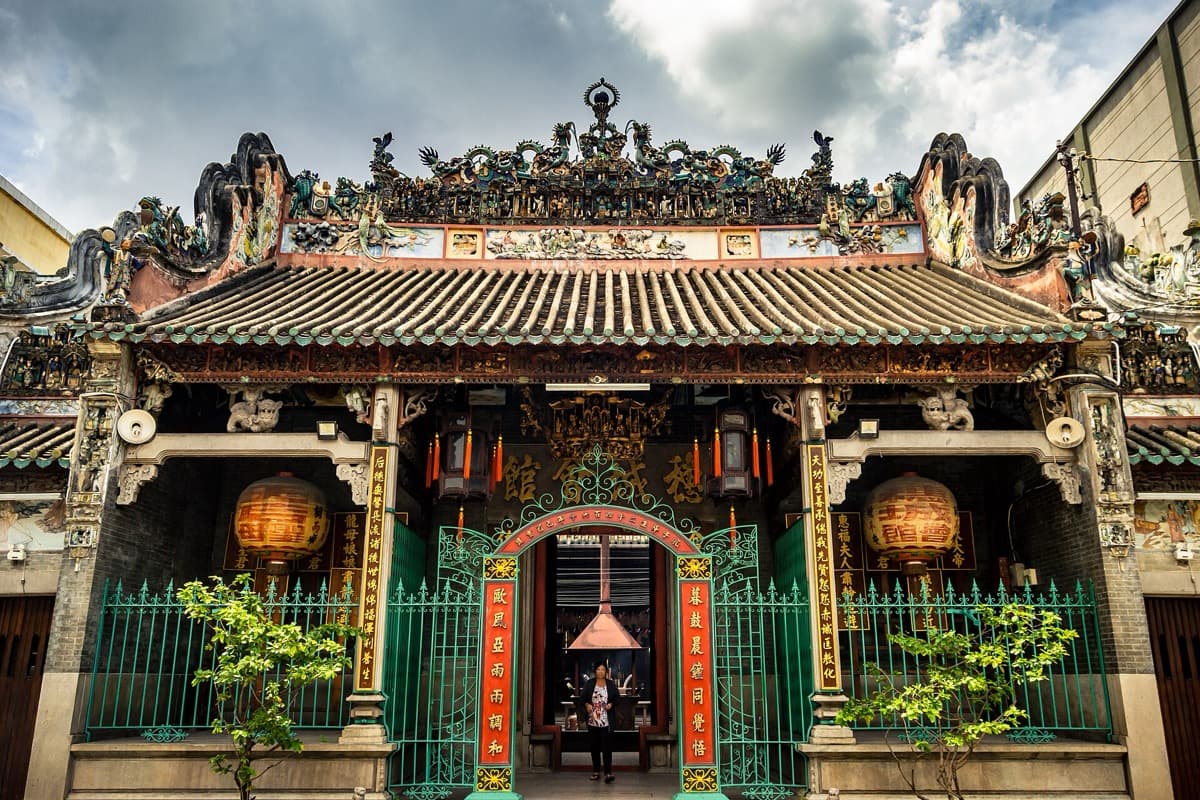
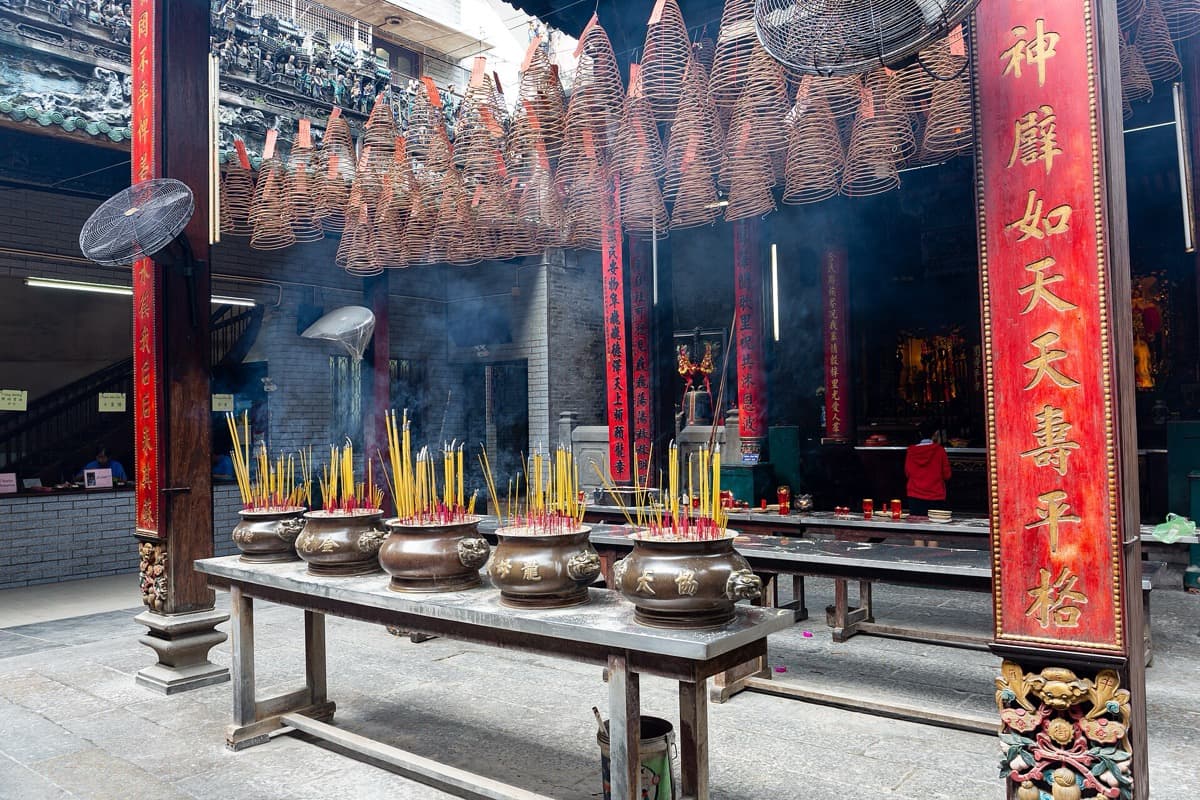
Most visitors photograph Thien Hau Temple for one thing: the great spirals of incense hanging over the courtyard, some more than a meter across, burning slowly for weeks with smoke drifting up through the open roof. It is a genuinely beautiful sight. But it is also easy to walk through this temple as a photograph and miss what it actually is. The building is a monument of gratitude for surviving a sea crossing, built by the people who made that crossing, and dedicated to the goddess they credited with getting them across alive.
This is the emotional center of our walk through Cho Lon, the district described in The City Beside the City: Reading Cho Lon's Assembly Halls. That walk reads the neighborhood's temples as civic institutions, hometown governments in miniature. Thien Hau is where the civic and the emotional meet, because the goddess it honors is the reason the community had a life to organize at all.
Who the goddess is
Thien Hau is the Vietnamese name for Tianhou, "Empress of Heaven," an epithet of the Chinese goddess of the sea more widely known as Mazu. In the tradition, she began as a real person: Lin Moniang, a girl from a fishing community in Fujian, remembered for saving members of her own family from a deadly storm at sea through her spiritual power. After her early death she was venerated, then elevated over the centuries into a full goddess, the protector of everyone who trusts their life to the water, fishermen, sailors, and above all people crossing the sea to somewhere new.
That last group is the key to this temple. The Chinese who built Cho Lon came by boat, across open water, from the ports of southern China. For them Mazu was not an abstract deity. She was the patron of the single most dangerous thing they had ever done, the voyage that brought them here. To dedicate their central hall to her was to say, in architecture, that they had crossed and survived and were grateful.
Who built it
Hear a stop from this walk
Thien Hau Temple: The Sea Goddess and the Hanging Coils
The temple's official name is the Tue Thanh Assembly Hall, and it was erected around 1760 by the Cantonese community, the immigrants from Guangdong province in southern China. That word "assembly hall" carries the whole civic meaning: this was not only a place of worship but the gathering place, mutual-aid society, and self-governing institution of the Cantonese in Saigon. People from the same corner of China pooled their resources, ran their affairs, settled their disputes, and helped their poor from a building like this one. The worship of Mazu and the running of the community were the same institution under the same roof.
The temple has been repaired and expanded many times across its long life, with major works recorded in 1800, 1842, 1882, 1890, and 1916, and a large bronze bell that dates to 1830. So while the hall was founded in the mid-eighteenth century, much of what you see was shaped through the nineteenth, the decades when Cho Lon's Chinese community was at its most prosperous and could afford to pour that prosperity back into its central temple. The building is old, and it is also layered, rebuilt by generation after generation of the community it served.
What to look for on the roof
Before you go in, stop and look up at the roofline, because it holds one of the temple's real treasures. The ridges are crowded with small, delicately made ceramic figurines arranged into whole scenes, dioramas of Chinese legends and of everyday life in nineteenth-century Canton. Miniature people, buildings, boats, and figures from myth are lined up along the roof like a frozen theater. These are not generic decoration. They are a specific art form of southern Chinese temple building, and reading them is like reading a comic strip of the world the founders came from, kept on the highest part of the building where the smoke and the sky meet it.
The coils, and what they carry
Now step into the courtyard and the incense coils make sense in a new way. The great spirals hanging overhead are not just atmosphere. A worshipper buys a coil, attaches a slip of paper with a name and a wish or a prayer, and hangs it among the others, and then it burns, slowly, for weeks. As the smoke rises, so, in the logic of the practice, does the prayer. The haze you are standing in is other people's hopes, physically ascending toward the goddess.
Think about what those prayers historically were. A community of people who had crossed the sea, dedicating a temple to the goddess of safe crossing, hanging their wishes in her smoke. Prayers for family still on the other side of the water. Prayers for children born on this side. Prayers for a good year in trade. The coils are the temple's function made visible: gratitude for one crossing, and hope carried forward into the next season. Once a year, on the twenty-third day of the third lunar month, the temple marks Thien Hau's birthday, and the building fills with the community that has kept her here for more than two and a half centuries.
How to read it on the ground
Go in the morning, when the coils are fresh and the light comes down cleanly through the open roof. Give your eyes a minute to adjust in the dim, and dress modestly, as you would at any working temple. Look up first, at the ceramic scenes on the roof, then at the coils, then at the main altar to the goddess herself. Move slowly. This is a living place of worship, not a display, and the people around you are here for the reasons the building was built.
Then place it in the district. This is one of several assembly halls in Cho Lon, each built by a different hometown group, and together they map the self-organizing structure of one of the oldest overseas-Chinese quarters in the world. To walk the full route from the great market inward through those halls, follow The City Beside the City. To understand how this Chinese city two miles west fits with the French core and the downtown where a war ended, start with How to See Saigon.
Every crossing this temple was built to remember was a real one, made by real people who did not know if they would arrive. The goddess overhead is their gratitude that they did. The smoke you are standing in is the same gratitude, still going up.
Sources
- Wikipedia, "Thien Hau Temple (Cholon)," on the c. 1760 Cantonese founding, the Tue Thanh Assembly Hall name, the 1830 bronze bell, and the repair dates.
- Wikipedia, "Mazu (goddess)," on Lin Moniang and Mazu as goddess of the sea.
- Backpack and Snorkel, "Thien Hau Temple HCMC: Cho Lon's Cantonese Assembly Hall and Mazu."
- Spectral Codex, "The Chinese Temples and Guildhalls of Cholon."
Ready to experience it?
The Other City: Cholon
95 min · 2.4 km · moderate
More from Ho Chi Minh City
Explore more at your own pace.
Ho Chi Minh City Travel Guide: How Many Days, Getting Around, When to Go (2026)
One Day in Ho Chi Minh City: A Walkable Saigon Itinerary (2026)
What to Eat in Ho Chi Minh City: A Saigon Food Guide (2026)
Empire in Stone: How Saigon Kept the Buildings and Changed Their Meaning
The City Beside the City: Reading Cho Lon's Assembly Halls