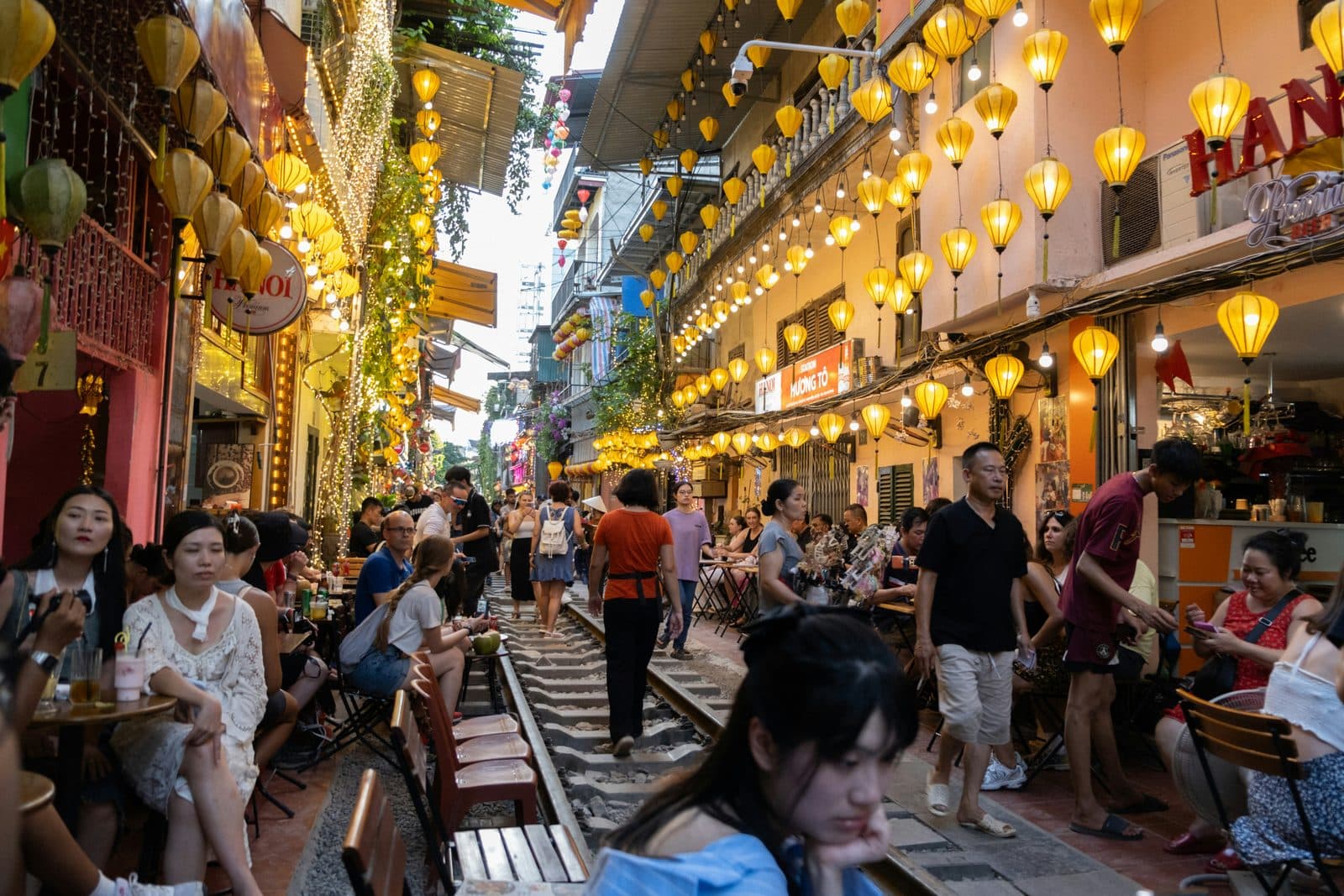
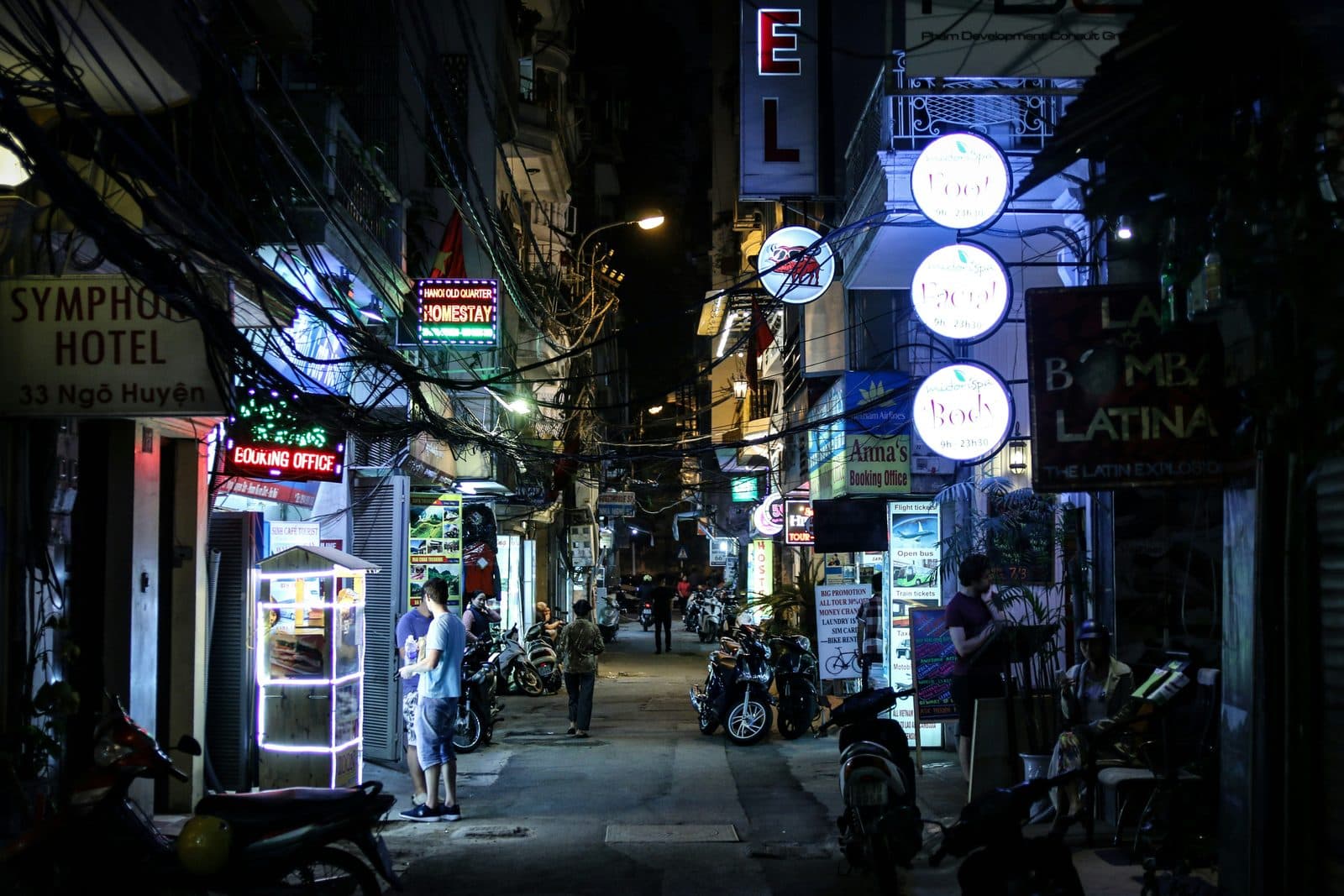
Most old neighborhoods ask you to imagine what they used to be. Hanoi's Old Quarter is different. It is still telling you, out loud, in the signs over the shopfronts. Hang Bac. Hang Ma. Hang Buom. The word Hang means goods or merchandise, and for centuries each Hang street was a single guild working one product: silver, votive paper, sails, salt, tin. The grid is a commercial code, and once you learn to read it, the whole quarter turns into a ledger you can leaf through on foot.
The walking tour this piece accompanies walks ten stops from Hoan Kiem Lake into that grid, about 2.4 km in roughly an hour and three quarters, and if you want the wider frame first, how to see Hanoi as a whole sets these streets against the city's buried and colonial layers. But the deeper pleasure is not in any single stop. It is in the mechanism, because the Old Quarter was built by one process repeated hundreds of times, and once you see the process you can read streets the tour never mentions.
First, the number in the name is not what you think
The famous thirty-six are not thirty-six streets. Under the Later Le the city was administered in thirty-six phuong, wards, and the number is exact arithmetic rather than a round figure: eighteen wards in the district of Tho Xuong and eighteen in Vinh Thuan, recorded in the 1833 gazetteer Hoang Viet du dia chi. Most of those wards were trade communities, and you can still read their names on a modern map, because the wards became the streets: Ha Khau, Dong Ha, Dong Xuan, Dong Lac, Thai Cuc, Dien Hung, Co Vu.
The phrase reached everyone else through a book, Thach Lam's Hanoi Thirty-Six Pho Phuong, and by the time he wrote it there were more than fifty streets here whose names begin with Hang. So the count was never a street count, and the streets long ago outgrew it. Do not count streets as you walk. Count trades.
The mechanism, in four moves
Hear a stop from this walk
O Quan Chuong: The Last Gate of the Rampart
The code was assembled from a single repeatable move, and you can watch each part of it on the walk.
First, a trade arrives from the countryside. The Old Quarter did not grow its crafts. It imported them. Hang Bac, Silver Street, traces its guild to 1461, when the emperor Le Thanh Tong of the Later Le dynasty authorised a royal workshop here. What it cast was not coins but silver ingots for the crown. The job went to a court minister named Luu Xuan Tin, who happened to come from a silversmithing village called Chau Khe and staffed the works with his own neighbours; craftsmen from Dinh Cong and Dong Xam followed, and the three villages did not do the same job, which is why the street ended up running three trades at once, casting, goldsmithing and money-changing. Those families came, settled, and formed one of the richest guilds in the quarter. The same thing happened on Hang Ma, the Street of Votive Papers, settled by families from a village called Tan Khai who specialized in the joss paper that Vietnamese families burn for their ancestors.
Second, the trade sorts itself onto one street. A guild that arrives together stays together, because clustering is how a single-product trade protects its prices, its standards, and its apprentices. That is why the names are so specific and so durable.
Third, the guild protects itself with its own temple. On Hang Bac the silversmiths built Kim Ngan, a communal house at numbers 42 and 44 where they gathered to worship and settle their affairs, and its dedication is the detail worth stopping for. It does not honour a patron of metalworking. It honours Hien Vien, venerated as ong To Bach Nghe, the ancestor of all hundred crafts, the one every trade claims. The richest guild on the grid built its shrine not to silver but to the whole idea of having a trade, which is the argument of the quarter carved into a doorway by the people living inside it. A block away stands Bach Ma, the White Horse Temple, widely called the oldest temple in the Old Quarter and the eastern guardian of the whole merchant quarter. Merchants paid temples like these to keep their gate and their trade safe. The sacred and the commercial were the same investment. The same city that bought temples to guard its commerce also built a temple to scholarship itself, the Temple of Literature a few kilometres west, and that reverence for learning even reaches the start of this walk, at Ngoc Son Temple, whose Pen Tower and stone ink-slab honor a deity of literature.
Fourth, the family lived in a tube house. This is the physical unit that made the whole system work, and the walk lets you step inside one. The house at 87 Ma May is a shophouse built in the nineteenth century and restored in 1998 and 1999 in a partnership between Hanoi and the French city of Toulouse: only about five metres wide at the street but twenty-eight metres deep, with small interior courtyards cut in to let light and air reach the middle, a little over one hundred fifty square metres stretched long and thin like a drawer. Shop at the front on the trading street, family stacked behind and above. Multiply that shape a thousand times down every Hang street and you have the Old Quarter. The narrow deep shophouse is the letter, the guild street is the word, and the grid is the sentence.
The ledger keeps some pages and loses others
Here is where the tour's thesis opens into something richer. A code is only interesting if it can decay, and the Old Quarter's has, unevenly. That unevenness is the real story.
Most Hang streets have drifted. Their names still promise silk or tin or salt, but the shops behind the signs long ago moved on to whatever sells today. The name is a fossil; the trade has gone. This is what usually happens to a commercial code over five or six centuries. Rents change, demand changes, the guild dissolves, and the street keeps the name out of habit.
But a few pages held, and how they held is the part worth knowing. Hang Bac still works its namesake metal, and it does so without the institution that started it. Early in the nineteenth century the Nguyen court packed the entire ingot foundry off to Hue. The state function left the street for good; the Chau Khe families stayed, turned to jewellery and money-changing, and went on working precious metal on their own account. Walk the couple of hundred metres between Hang Mam and the Hang Dao junction slowly and you may still hear the small tap of tools shaping silver and gold. The trade outlasted the crown that summoned it, which is a different and better story than an unbroken institution.
Hang Ma is the other loyalist, though you have to be honest about the terms. Under French rule the colonizers looked at this street and the copper street beside it, decided the two were one, and named the pair Rue du Cuivre, Copper Street. Hang Ma has never sold copper, and the label did not take. What the street mostly sells today is festival stock: lanterns, masks, lion heads, Tet red, and, in recent years, tinsel in December. But walk it slowly and the votive paper the street is named for is still there, the paper money and paper clothes and paper houses that families burn for their dead, peaking in the seventh lunar month and again in the run-up to Tet. The trade did not survive by staying pure. It survived by selling whatever the calendar wanted and keeping the ritual goods in the back.
So the Old Quarter is not a fossil and not a costume. It is a ledger where some entries are still being written and most have been crossed out, and the walk is a way of feeling which is which. That is a more honest picture than the postcard version of a perfectly preserved medieval market, and it is the same instinct for reading layers that shapes the rest of the city. The imperial capital covered in The Buried Capital is another version of the same reading: a place where the most important layer is often the one that has been half erased.
When the code met the industrial age
Two stops on the walk mark the moment the medieval logic broke, and both are worth reading as turning points rather than mere sights.
Dong Xuan Market is the first. Rising over the north end of the quarter, it is the largest covered market in Hanoi, and it was built by order of the French administration in 1889, replacing two older markets and pulling all that piecemeal, one-trade-per-street commerce under a single vast roof. The two it replaced are not abstractions: one stood by the pagoda on Hang Duong, the other at the gate of Bach Ma temple, so the French took a market off a temple's doorstep and put it in a shed.
Now count the arches on the facade. There are three. There were five, fronting five halls, until a 1990 rebuild demolished the two outer halls, took the three in the middle upwards, and brought the two end doorways down with them. Look at the edges of the front and you will find columns standing on their own with nothing between them, the stumps of the arches that are gone. Almost every description of this building, including the one this piece used to give, says five. The building itself says three.
That grand civic front sits over what is really a wholesale engine supplying shops across the city. This is what commerce looks like when it stops sorting itself street by street and starts consolidating under one institution instead. And the market has been rewritten again since: on the night of 14 July 1994 a fire tore through it and burned for days, the loss was put at 300 billion dong, and the rebuild kept the face and replaced everything behind it, three floors, around two thousand stalls, and fire stairs for the first time. The building looks like a proud nineteenth-century monument, and part of it genuinely is, but it has burned and been remade within living memory.
O Quan Chuong is the second, and it is the perfect last page, as long as you are careful about what it is. It is usually called the only surviving gate of the Thang Long citadel, and that is the wrong wall. The citadel was a different and grander thing about two kilometres west, and it still has gates of its own standing, Chinh Bac Mon and Doan Mon among them. What this is, is the last surviving cua o: a gate in the earthen rampart that ringed the merchant city, on its eastern side. The wall you are touching was built around a market, not around a king, and that distinction is the whole point of the quarter.
How many cua o there were depends on which document you trust, and the record genuinely disagrees. A gazetteer from early in the nineteenth century counts twenty-one. An 1831 map counts sixteen. Maps from the 1860s and 1870s count fifteen. Five are the ones Hanoi still names. The disagreement is more honest than any single number.
First built in 1749 and rebuilt in 1817, the gate originally bore the name Dong Ha Mon, the East River Gate, because this eastern edge is where goods came up from the river into the guild streets. Set into the wall is a stone tablet placed there in 1881 by the governor of Hanoi, Hoang Dieu: an order to his own guards to stop shaking down the people coming through, funeral processions in particular. Somebody had to write that down, and it is still legible. The story Hanoi tells about the gate's name is that a commander, a Quan Chuong, died here with about a hundred men when the French first attacked in 1873. Nobody recorded his name, and other explanations exist, but that is the one the city kept. Vietnam recognized the gate as a national relic in 1995. Every other cua o is gone. This single arch is the last physical clasp on the whole book.
How to walk it well
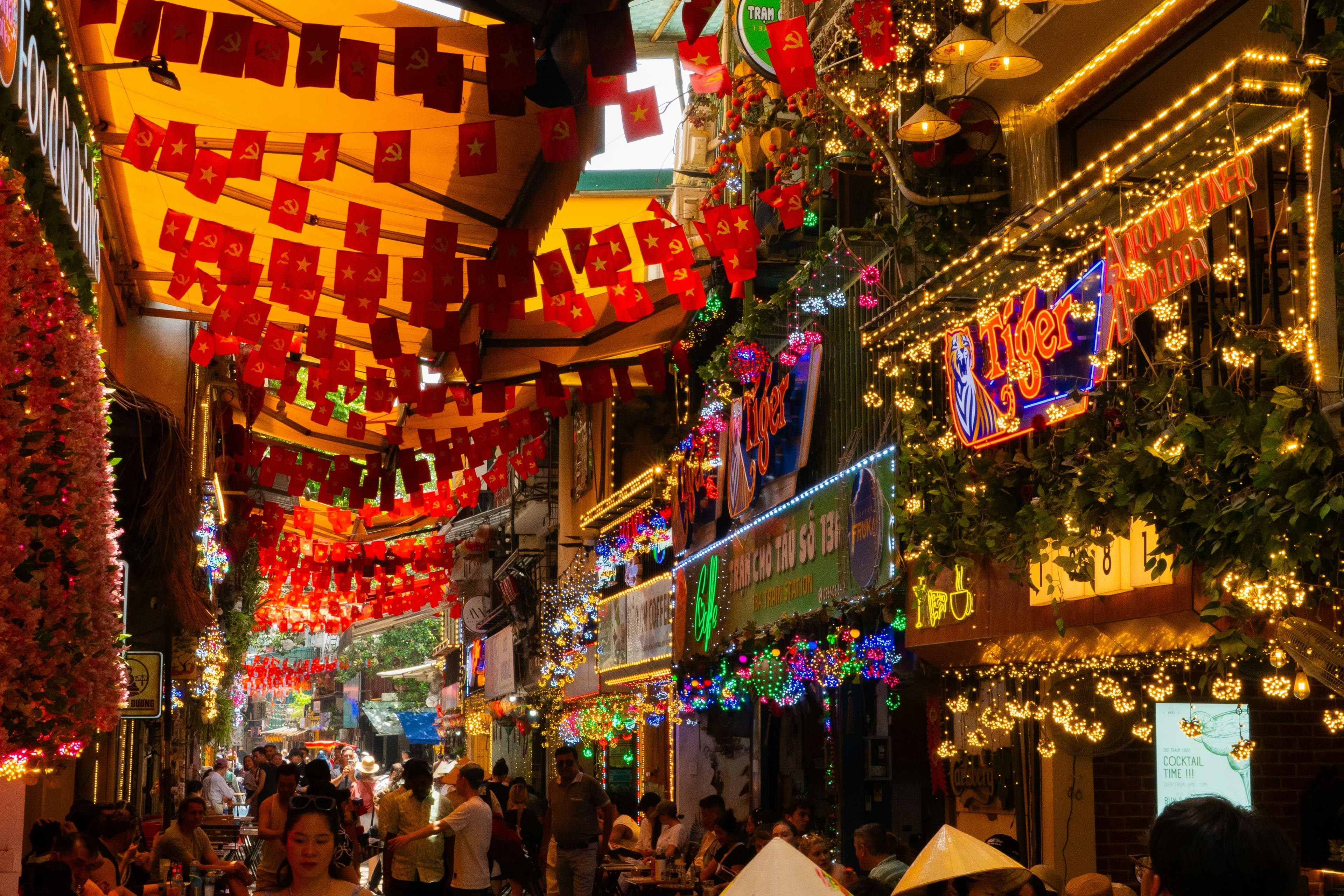
Go early, from about seven to nine, when the quarter is cool and busy with local life but not yet packed, or come at dusk when Hang Ma glows. Look up as you walk, because the real archive is in the narrow tube-house facades above the shopfronts, not at street level. Do not feel you must enter every temple or shop; the pattern of the streets is the attraction, and short stops are the point. And when you cross a road, step off slowly and keep a predictable pace so the motorbikes can flow around you. That is technique, not policy, and it is the only thing that works outside the hours below.
Since 1 July 2026 there is a better option. A low-emission zone now closes the Old Quarter core to all road vehicles, electric ones included, from seven in the evening to midnight on Friday, Saturday and Sunday, enforced at physical checkpoints on the streets that form its boundary rather than by hopeful signage. On those evenings the grid is genuinely quiet under your feet, which is not a thing it has been in living memory. The pilot phase is scheduled to run to 31 December 2026, so check before you plan a trip around it.
Two practical notes on going inside. The Old Quarter's ticketed heritage sites, Dinh Kim Ngan at 42 Hang Bac, the house at 87 Ma May, Bach Ma temple at 76 Hang Buom and the assembly hall at 22 Hang Buom, each charge 20,000 dong by e-ticket, and all of them close from noon until half past one, which is exactly when a late-starting walk arrives. Ngoc Son Temple, out on the lake, is 50,000 dong; the lakeside view of the red bridge, which is the photograph everyone wants, costs nothing. And be aware that the lake's entire eastern shore between Dinh Tien Hoang and Ly Thai To is currently a hoarded 2.14 hectare building site, the East Hoan Kiem square and park project, so keep your lake walking to the west and north shores.
Above all, read rather than just look. A city that names its streets after what they sold is inviting you to check whether the promise still holds. Sometimes it does, gloriously. More often the trade has moved on and only the word remains. Both are true, and the walk is the act of telling them apart.
Ready to experience it?
Old Quarter: The Thirty-Six Streets
90 min · 2.4 km · easy
More from Hanoi
Explore more at your own pace.
Hanoi Travel Guide: How Many Days, Getting Around, When to Go (2026)
How to See Hanoi: A Capital Built on Top of Itself
One Day in Hanoi: A Walkable Old-Quarter-to-Lake Itinerary (2026)
What to Eat in Hanoi: A Food Guide (2026)
The Seized Stage: How Hanoi Turned Colonial Stone Against the Empire That Built It