In the 1880s, France set out to build a European capital on top of an Asian one. It filled lakes to make boulevards, raised a Gothic cathedral where a Buddhist site had stood, and lined the streets south and east of Hoan Kiem Lake with the confident architecture of an empire that intended to stay. The buildings were an argument, and the argument was permanence. Within a single lifetime, the Vietnamese people won the argument by turning the empire's own stones into the stage for their independence.
That is the paradox this walk reads, and it is worth stating precisely, because the mechanism is stranger than a simple story of conquest and liberation. In most of these cases the building did not change. The meaning changed. A stage built to overawe the colonized became the stage from which they announced they would rule themselves, and it happened, more than once, without a single wall being moved.
Empire in four materials
The genius of the walk is that it shows you empire expressed in four different materials, each one a different claim of permanence, and each one answered.
Empire in sacred stone comes first. St Joseph's Cathedral, consecrated on Christmas Eve, December 24, 1886, was among the earliest major structures the colonial government raised in Hanoi. Its twin neo-Gothic bell towers were deliberately shaped to recall Notre-Dame de Paris, and it stands on the cleared ground of the Bao Thien pagoda, a Ly-dynasty Buddhist monument whose tower had collapsed in 1542. The message was written in the very choice of site: a European sacred form set directly over the memory of a Vietnamese one. More than a century of monsoon damp has darkened the stone, which only makes it look older and more permanent, exactly as intended.
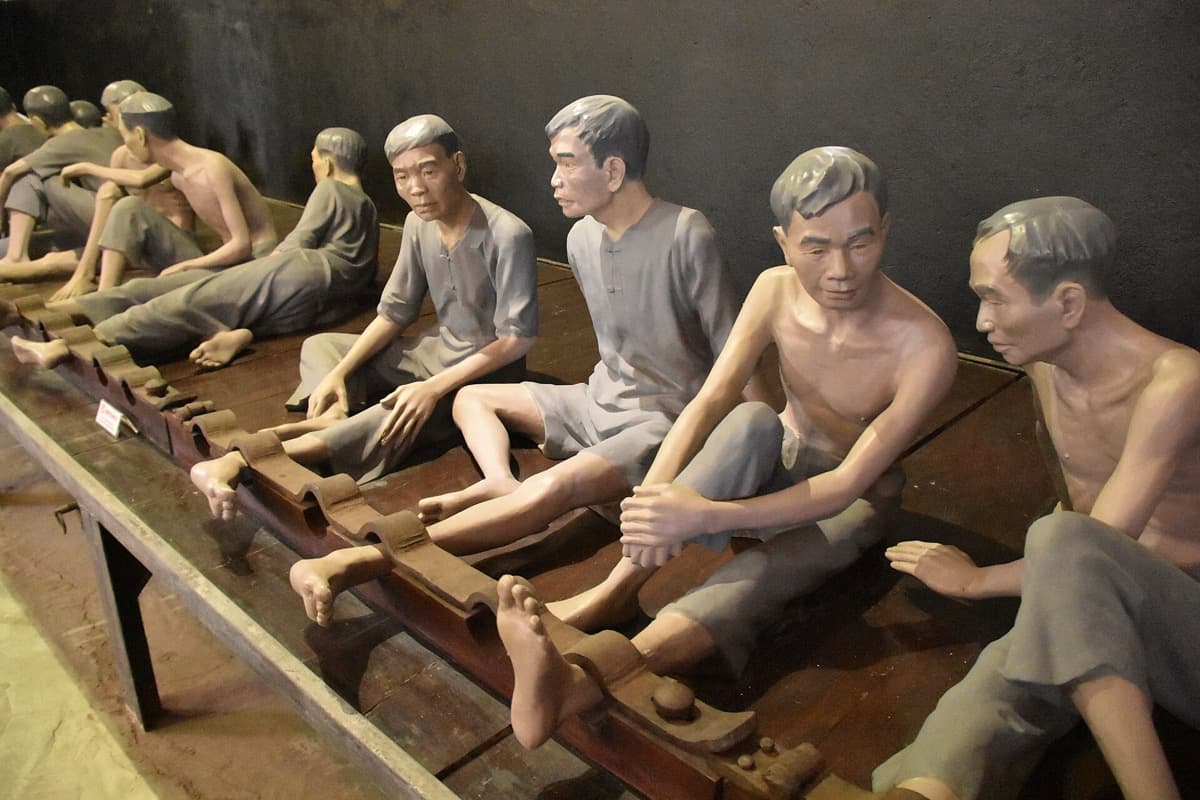
Empire in iron comes next, and here the paradox first bares its teeth. Hoa Lo Prison, the Maison Centrale, was built between 1896 and 1901 for a single purpose: to hold the Vietnamese men and women who agitated for independence. Empire built it to break the revolutionary movement. Instead it concentrated it, cell by cell, into a kind of school where political prisoners passed lessons and organization between them, and many who entered as detainees left as leaders. The machine of control manufactured the very thing it was built to destroy. That story is dense enough to deserve its own reading, which is why it has one: the full history of Hoa Lo Prison traces both the colonial and the later American chapters of the building.
Empire in money is the quietest and, arguably, the most powerful claim of all. The pink Art Deco building at 49 Ly Thai To, ceremonially opened on March 30, 1931, was the Hanoi headquarters of the Banque de l'Indochine, the Bank of Indochina. This institution issued the French Indochinese piastre, the currency in which every price, wage, tax, and debt across the colony was counted. Control of the piastre was control of the economy, and the economy was the quiet engine of the whole colonial project. The solid geometry and the expensive pink concrete were architecture speaking the language of trust. It did not last: the building passed into Vietnamese hands in 1954 and has served as the head office of the central bank of Vietnam ever since. Even the currency of empire, in the end, changed owners.
Empire in social ritual is the fourth material, and you find it at the Sofitel Metropole, the grand colonial hotel that opened in 1901 as the center of French social life. Its guest book reads like a slow parade through the twentieth century: Somerset Maugham in 1923, Charlie Chaplin on part of his honeymoon in 1936, Graham Greene in 1951, and, during the war in 1972, both Jane Fonda and Joan Baez. That last pairing is the tell, because in 2011, during renovations, staff rediscovered a sealed and forgotten wartime air-raid bomb shelter buried beneath the grounds near what is now the Bamboo Bar. Guests who came for the champagne had been walking above a concrete room built to survive falling bombs. Two histories, one building, stacked directly on top of each other.
The stop where the whole thing turns
Hear a stop from this walk
National Museum of Vietnamese History: The Former Louis Finot Museum
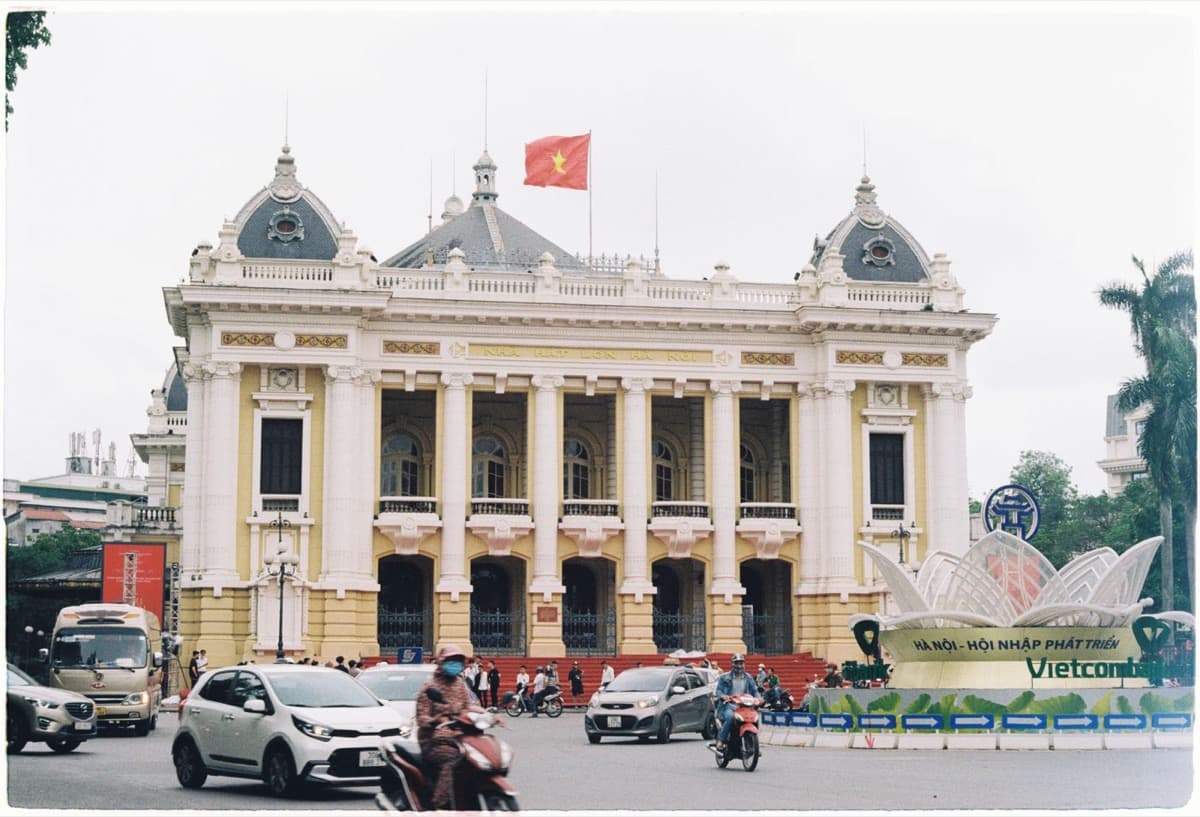
The Hanoi Opera House is where the paradox stops being an idea and becomes an event. Completed on December 9, 1911, and modeled on the Palais Garnier in Paris at a smaller scale, it was the social crown of the colonial city, a place of chandeliers and evening gowns built to display French culture at the far edge of empire.
Then look at the square in front of it. On August 19, 1945, a crowd of roughly two hundred thousand people filled that space, and the Viet Minh Uprising Committee read out the call to insurrection from here before the crowd moved to seize the Tonkin Governor's Palace nearby. That day launched the August Revolution in Hanoi. The square today is officially named August Revolution Square, so the ground itself remembers.
Be precise about the dates, because the precision is the point. The famous Declaration of Independence, read by Ho Chi Minh, came two weeks later, on September 2, 1945, and it was delivered at Ba Dinh Square, not here. Ho Chi Minh, born on May 19, 1890, would die on that same September 2 date in 1969, a coincidence of the calendar that Vietnam has never stopped noticing. What happened on the opera square was the rally that set everything in motion, and it happened on the emperor's-box architecture of the colonizer. The building did not change. Its meaning was seized whole.
The bridge that outlived the empire
The walk ends at the river, and it should, because the Long Bien Bridge is the entire thesis compressed into a single iron spine. Built between 1899 and 1902 by the Paris firm Dayde and Pille with the labor of more than three thousand Vietnamese workers, it was named the Paul Doumer Bridge after the governor-general of Indochina who later became president of France and was assassinated in Paris in 1932. It was renamed Long Bien after 1954.
This was infrastructure as extraction, built to move coal, rice, and troops efficiently across the Red River and out of the colony, the circulatory system of an economy designed to flow toward France. Then it became a target. The first major United States air strike hit it on August 11, 1967, knocking out a center span, and further precision attacks followed in 1972. Vietnamese crews repaired it under fire, over and over, and you can still read the seam of two histories in the metal: roughly half the bridge keeps its original French structure, and the rest is patched from those wartime mends.
And it still stands, and it still works. Every day trains, mopeds, bicycles, and people on foot cross it. The empire that built this bridge is gone; the bridge is not, carrying Vietnamese commuters over the river each morning. The colony outlived the colonizer.
The demolition on the other side of the ledger
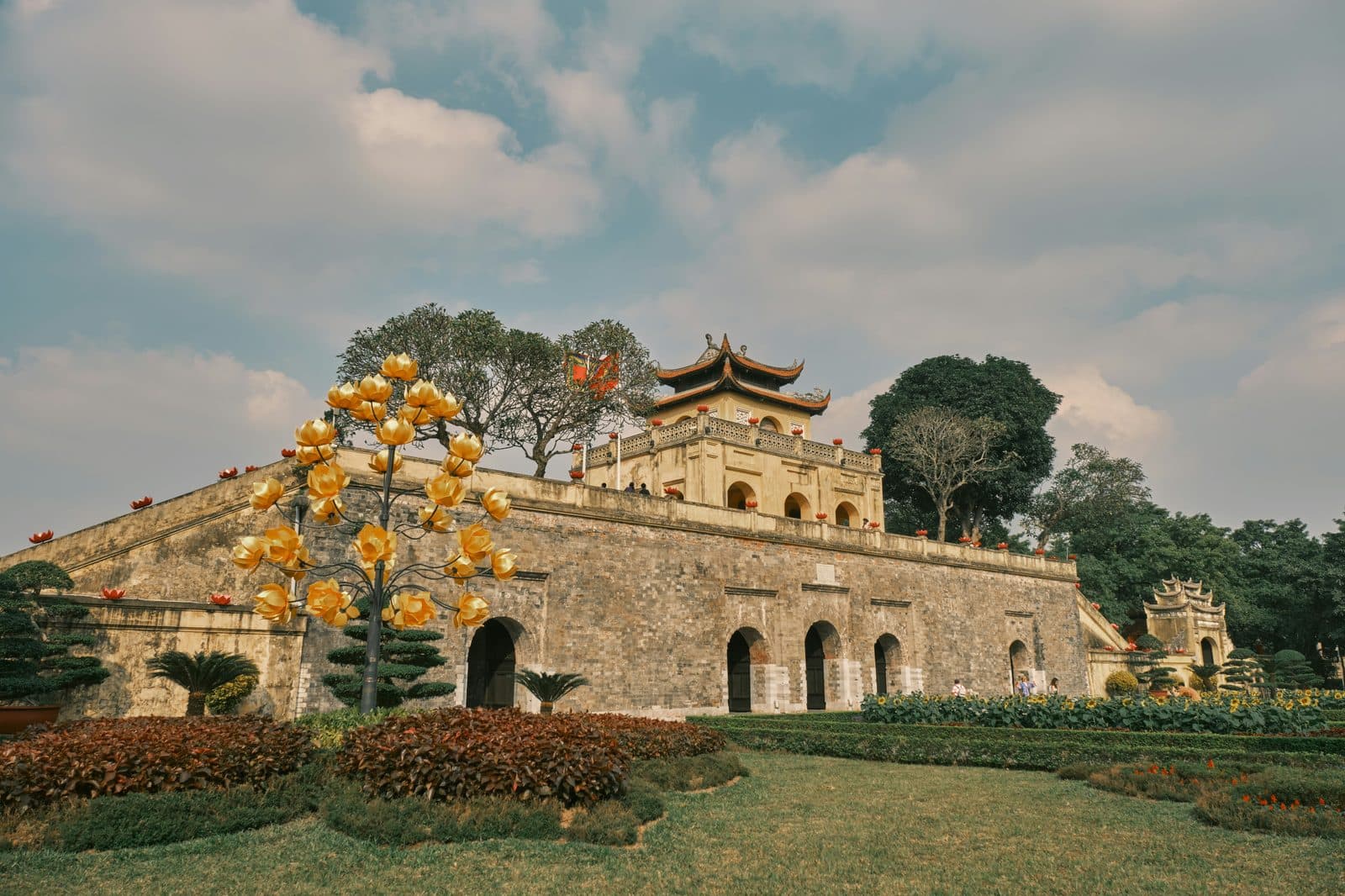
There is a shadow to this walk worth carrying with you. The same colonial administration that raised these boulevards also demolished most of the thousand-year imperial citadel to the west in the nineteenth century, an act of erasure that the buried-capital walk reads directly. If the French quarter shows empire building, The Buried Capital shows what empire tore down to make room, and the two walks are the two halves of the same colonial century. For the frame that holds all three Hanoi walks together, start with how to see Hanoi as a capital built on top of itself.
Walk the French quarter slowly, treat every stop as skippable, and stop for a Vietnamese coffee at the lake's edge whenever a building holds you. The irony is in the stone, and it rewards a walker who notices. Each of these beautiful objects was built to say the empire would last forever. Each of them, in its own material, is now evidence that it did not.
Ready to experience it?
French Quarter: The Paris of the East
150 min · 6 km · moderate
More from Hanoi
Explore more at your own pace.
Hanoi Travel Guide: How Many Days, Getting Around, When to Go (2026)
How to See Hanoi: A Capital Built on Top of Itself
One Day in Hanoi: A Walkable Old-Quarter-to-Lake Itinerary (2026)
What to Eat in Hanoi: A Food Guide (2026)
The Thirty-Six Streets: How to Read Hanoi's Old Quarter Like a Ledger