Stand almost anywhere in the government district of central Hanoi and you are standing on a lie of omission. The parks look like parks, the ministries look like ministries, the boulevards look modern and settled. What none of it advertises is that a thousand-year imperial capital lies directly underfoot, and that for most of the twentieth century a visitor to this ground would have found no obvious sign it was there at all. The most important layer of Hanoi is the one you cannot see.
The walk this piece accompanies climbs that buried capital in order, oldest layer first, and the discipline of doing it in sequence is what makes the idea land. This is not a tour of monuments. It is a section cut down through a thousand years of a city that kept building on top of itself, and the through-line is loss: at almost every stop, the grandest thing is gone, and what remains survives by accident, by usefulness, or by rediscovery. For the way this vertical reading fits alongside the city's other two readings, how to see Hanoi as a whole sets the frame.
The foundation layer: a state that gave scholarship a temple
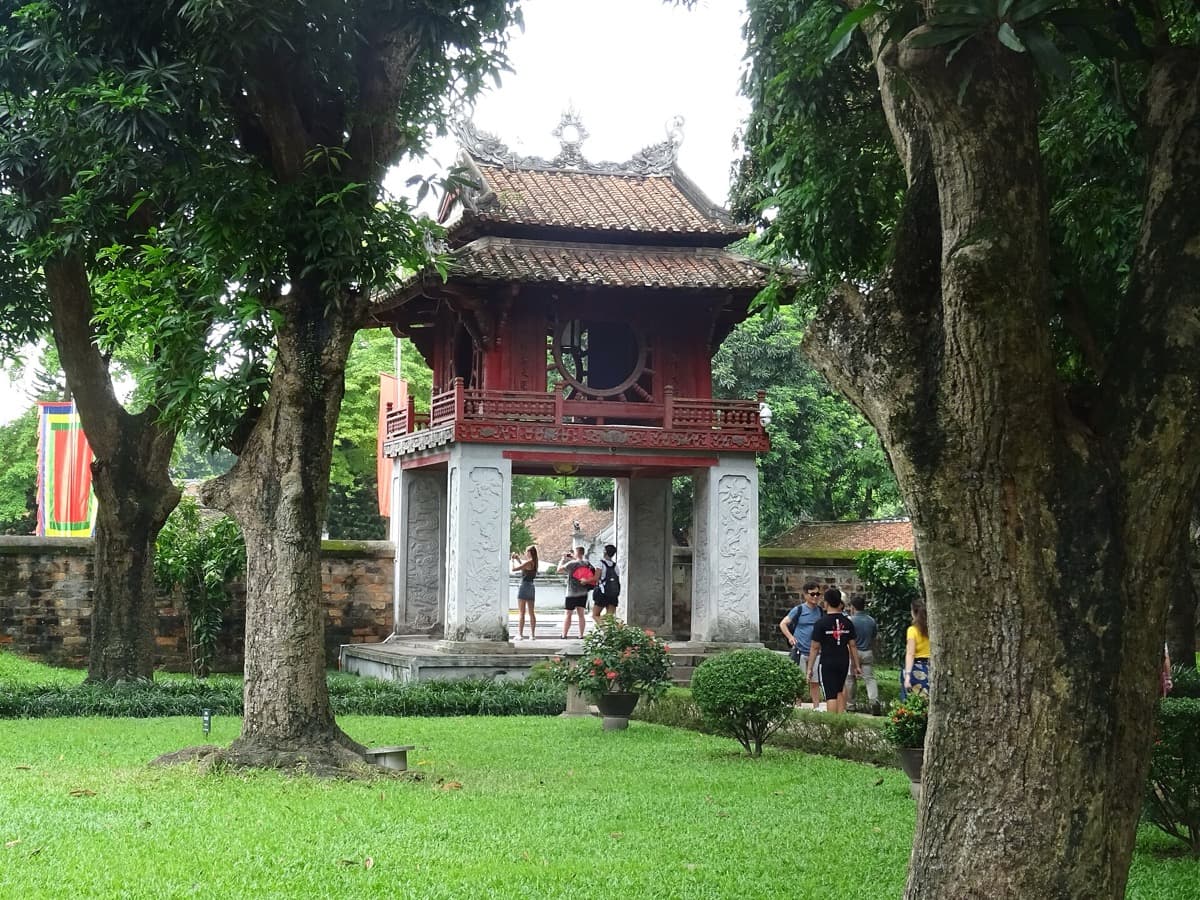
The walk begins at the deepest and, in a sense, the most consequential layer, because it is the intellectual bedrock the whole state was built on. The Temple of Literature, Van Mieu, was founded in 1070 under Emperor Ly Thanh Tong and, six years later, became home to the Imperial Academy, described as Vietnam's first national university. For roughly seven centuries, until 1779, this is where the country made its scholars and its officials.
The single most extraordinary object here is a field of stone. In the third courtyard sit rows of doctoral stelae, each tablet resting on the carved back of a stone turtle, recording the names and home villages of men who passed the royal examinations. Their carving began in 1484 under Le Thanh Tong, and eighty-two of the original one hundred sixteen tablets survive, together holding the names of one thousand three hundred seven graduates across eighty-two triennial exams. UNESCO added these stelae to its Memory of the World Register in 2011. This is a state that took scholarship so seriously it cut its scholars' names into stone and gave learning a temple. Because that foundation deserves a closer look, the full story of the Temple of Literature and its stone scholars reads it in detail.
The survivor's paradox
Hear a stop from this walk
Temple of Literature: Van Mieu
Move to the Flag Tower of Hanoi, Cot Co, and the walk delivers its sharpest lesson about how the past survives. Built early in the Nguyen dynasty, between roughly 1805 and 1812 under Emperor Gia Long, the three-tiered brick tower rises about thirty-three metres, pierced by thirty-six flower-shaped windows and six fan-shaped ones lighting a spiral staircase.
Here is the paradox it holds. When the French took control of Hanoi in the late nineteenth century, they demolished most of the old imperial citadel. The palaces, the halls, the walls: leveled. But the flag tower they kept, because a tall tower with a view is useful to an occupying army as a lookout. So the single most visible piece of the old capital survives not because it was sacred, but because it was practical. Everything grander around it vanished. What you can see here is the exception. The rule is absence. That French demolition is the same act of erasure the colonial-quarter walk answers from the other side; if this walk shows you what was torn down, The Seized Stage shows you what was built in its place.
The accident that woke the capital
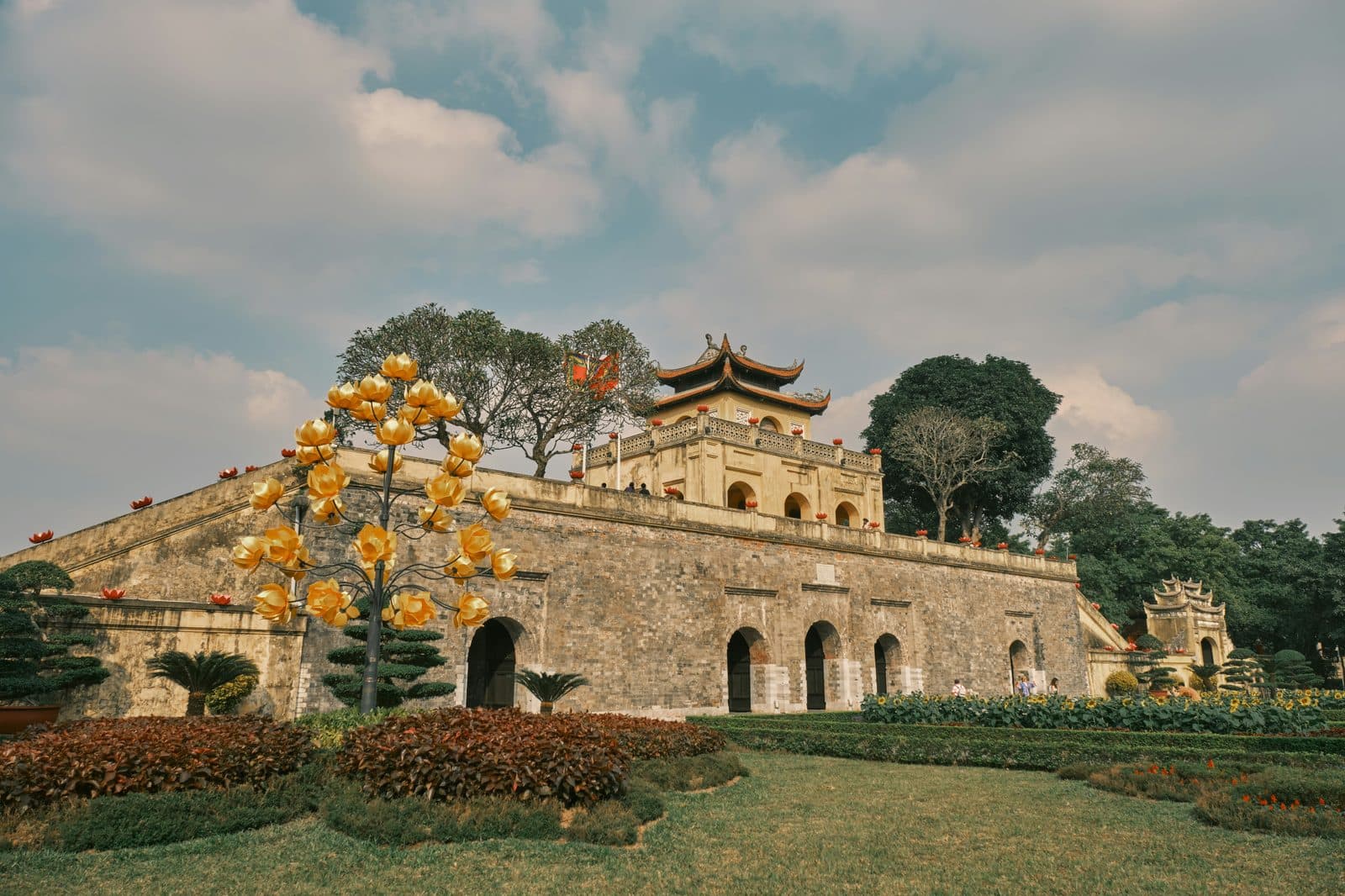
The walk turns at Doan Mon, the main southern gate into the inner royal city, a broad U of brick with five arched gateways, the central one historically reserved for the emperor. The citadel's story begins in 1010, when Emperor Ly Thai To moved the capital here and named it Thang Long, ascending dragon. Hanoi celebrated the thousandth anniversary of that founding with ten days of ceremony in October 2010. And yet, for a long stretch of modern history, most of that thousand years was simply gone from view.
Then, in 2002, during construction connected to a new National Assembly building at 18 Hoang Dieu Street, just west of the gate, workers began to dig. What they uncovered was not expected: buried palace foundations and artifacts layered through the Ly, Tran, Le, and Nguyen periods, roughly the eleventh century through the nineteenth. The lost capital had been lying underground the whole time. That accidental discovery is why Hanoi remembered what it was sitting on, and it is why UNESCO could inscribe the central sector as a World Heritage Site in 2010, citing a continuous record of power across more than a thousand years. The gates and the tower were always visible. The dig revealed the deeper layer, the palaces that had sunk out of sight.
The throne hall reduced to a staircase
No stop makes the buried-capital idea more physical than the Kinh Thien Palace steps. Ahead of you a wide stone staircase climbs to a raised platform and then to nothing. This is all that remains above ground of the throne hall that was the ceremonial heart of the entire citadel, where the Later Le emperors held their most solemn ceremonies and received foreign envoys.
The palace was begun in 1428 under Le Thai To, the emperor who had just driven out an occupying army and founded a new dynasty. The staircase you can still touch was carved in 1467 under Le Thanh Tong: ten steps in three lanes, divided by great carved stone dragons that flow down the center, the middle lane reserved for the emperor. In December 2020 these carvings were recognized as a National Treasure. And here is the image the whole walk has been building toward: the throne hall itself was destroyed in 1886, during the French demolition. The most important room in the kingdom is now a staircase climbing to open air. The ceremony is gone, the walls are gone, and the dragons remain, still guarding the ascent to a hall that is no longer there.
Destroyed and raised again
The One Pillar Pagoda, Chua Mot Cot, carries the same pattern in miniature. Founded in 1049 by Emperor Ly Thai Tong, it is a small wooden shrine on a single stone pillar rising from a square pond, built to read as a single lotus blooming from the water, a Buddhist symbol of purity rising clean out of the mud. Legend holds the emperor built it in gratitude after dreaming that the bodhisattva Quan Am, seated on a lotus, handed him a baby son. What you see today is not quite the original: the pagoda was destroyed in 1954 as French forces withdrew from Hanoi, leaving only the stone pillar, and rebuilt the following year on the older form. Even this delicate thing carries a layer of loss and rebuilding, the same pattern as everything else: destroyed, then raised again on its own foundation.
The newest layer, over the oldest ground
The walk ends in the open, at Ba Dinh Square, where the buried strata finally surface. Here, on September 2, 1945, Ho Chi Minh read the Declaration of Independence that established the Democratic Republic of Vietnam. The oldest ground in the country became the stage for its newest beginning. The square is named not for a person but for the Ba Dinh Uprising of 1886 to 1887, an anti-French rebellion, so even the name carries resistance. At its center stands the Ho Chi Minh Mausoleum, a severe block of grey granite whose construction began on September 2, 1973, exactly twenty-eight years to the day after the declaration, and which was inaugurated on August 29, 1975.
Stand here and hold the whole climb at once. Beneath and around this square lie the layers you have read all morning: the temple that made scholars, the tower the French kept for its view, the gate above the accidental dig, the throne hall reduced to dragon steps, the lotus destroyed and rebuilt. Laid directly over that thousand-year stack is the newest layer, a modern nation declared on the bones of the imperial one.
Do the walk south to north, oldest to newest, so the chronology and the sense of climbing through buried layers lands the way it is meant to. Start early, both for the cooler air and because the mausoleum opens only in the mornings and closes on Mondays and Fridays. And read the ground the whole way as a stack of centuries rather than a flat park. That is the one instruction the buried capital of Thang Long really asks of you.
Ready to experience it?
Imperial Citadel of Thang Long: The Buried Capital
120 min · 3.5 km · moderate
More from Hanoi
Explore more at your own pace.

Hanoi Travel Guide: How Many Days, Getting Around, When to Go (2026)
How to See Hanoi: A Capital Built on Top of Itself
One Day in Hanoi: A Walkable Old-Quarter-to-Lake Itinerary (2026)

What to Eat in Hanoi: A Food Guide (2026)
The Seized Stage: How Hanoi Turned Colonial Stone Against the Empire That Built It