Before the Vietnamese built almost anything else that lasted a thousand years, they built a temple to learning. The Temple of Literature, Van Mieu, sits inside a walled compound west of Hoan Kiem Lake, a rectangle of gates, courtyards, and ponds set slightly apart from the noise of the streets around it. It was founded in 1070 under Emperor Ly Thanh Tong as a Confucian temple, and six years later, in 1076, under his successor Ly Nhan Tong, it took on a second life as the home of the Imperial Academy, the Quoc Tu Giam, described as Vietnam's first national university. For roughly seven centuries, until 1779, this is where the country made its scholars and its officials.
That single fact is the reason this piece exists. This is the first stop on Roamer's citadel walk, The Buried Capital, which climbs the imperial strata of Thang Long oldest layer first. The temple is the deepest and most consequential of those layers, the intellectual bedrock the whole state was built on. For the frame that holds all three Hanoi walks together, start with how to see Hanoi as a capital built on top of itself.
A state that governed by examination
To understand why a temple to learning belongs at the foundation of a capital, you have to understand what the academy inside it produced.
The Quoc Tu Giam trained the sons of the elite, and later a wider pool of talented students, in the Confucian classics, and fed them toward the royal examinations that decided who would administer the kingdom. This was Vietnam's version of a system it had adapted from imperial China, in which government posts were filled not by inheritance alone but by men who had proven their command of a demanding body of text. The historian Alexander Woodside, in his study of how Vietnam adapted the Chinese model, showed how central the examination system became to the machinery of the state.
The consequence, walked slowly, is remarkable. A boy from a modest village who mastered the classics could, in principle, rise into the administration of the empire. Birth still mattered enormously, and the system was never a clean meritocracy. But the country came to be run in significant part by men chosen for what they knew rather than only for whom they were born to, and the place that certified that knowledge was this compound. The academy operated for roughly seven hundred years, until the Nguyen dynasty moved the imperial academy south to the new capital at Hue in 1803, ending this site's role as an active university.
The field of stone tortoises
Hear a stop from this walk
Temple of Literature: Van Mieu
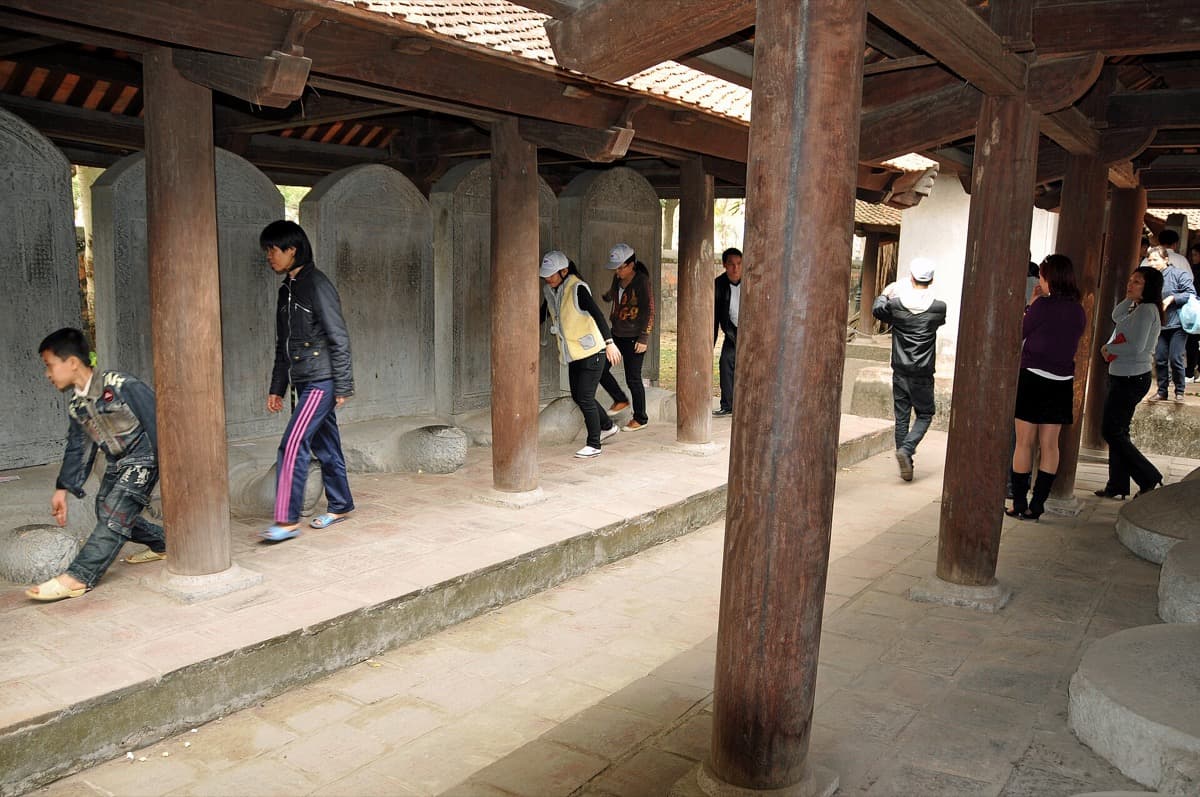
Walk inward through the courtyards, past the ornamental pavilion of Khue Van Cac, and you reach the object that makes the whole idea physical. In the third courtyard, arranged in rows on either side of a central pond, sit tablets of stone, and each tablet rests on the carved back of a stone tortoise.
These are the doctoral stelae. Their carving began in 1484 under Emperor Le Thanh Tong, the ruler who did the most to develop the examination system, and each tablet records the names and home villages of the men who passed a given royal examination. The tortoise beneath each one is not decorative filler. The tortoise is one of the four holy creatures of Vietnamese tradition, alongside the dragon, the phoenix, and the unicorn, and it stands for longevity and wisdom, which is exactly the claim the stelae are making: that these names should endure.
Read the numbers slowly, because the numbers are the argument. Of an original 116 tablets, 82 survive today. Together they hold the names of 1,307 graduates across 82 triennial examinations, meaning examinations held once every three years across centuries. Thirteen hundred people, over the course of the imperial era, whose achievement was thought worth cutting into stone and carrying on the back of a creature chosen to outlast them. A modern university publishes a graduation program that is recycled by the following week. This state carved its honor roll into rock.
Memory of the world
The stelae are not only extraordinary as objects. They are extraordinary as a record.
In 2011, UNESCO inscribed the doctoral stelae on its Memory of the World Register, the program that recognizes documentary heritage of global significance, formally as the stone stele records of royal examinations of the Le and Mac dynasties. The recognition is a mark of just how unusual a continuous, dated, named record of an examination system across centuries actually is. Very few societies produced anything comparable, and fewer still kept it standing in the open air for five hundred years. The tablets are a database in stone, and they are one of the oldest continuous meritocratic records anywhere in the world.
There is a shadow of loss here too, in keeping with the rest of the citadel walk, where at nearly every stop the grandest thing is gone and what remains survives by accident or by care. Thirty-four of the original tablets did not survive the centuries. What you see is the majority that did, protected now under tiled shelters, worn smooth in places by generations of hands that have touched the tortoises for luck before examinations of their own.
What to look for
Enter through the main gate and slow down, because the compound is built to be read as a sequence: five walled courtyards laid out along a single axis, each one a step further into the sacred and scholarly heart of the place. The full complex spans more than fifty-four thousand square metres, so there is no need to rush any of it.
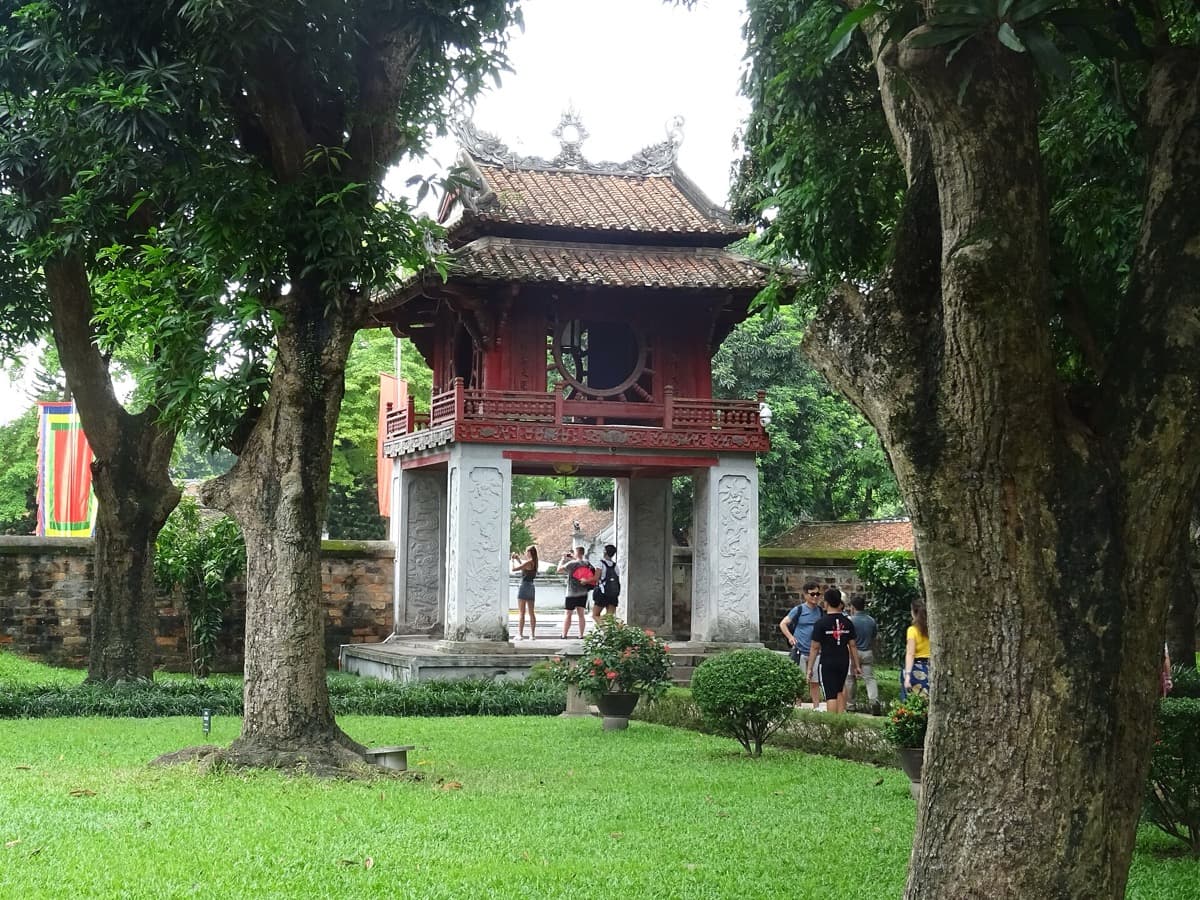
Look for the pavilion of Khue Van Cac, the Constellation of Literature pavilion, an elegant wooden structure on stone pillars built in 1805 that has become one of the visual symbols of modern Hanoi. Then reach the third courtyard and give the stelae the time they ask for. Walk the rows. Notice that no two tortoises are carved quite alike, and that many of their heads are polished to a shine by the hopeful hands of students.
Finally, hold the thought the whole compound is built to leave you with. This is the intellectual foundation stone of everything the rest of the citadel walk uncovers, a state that took scholarship so seriously it gave it a temple and cut its scholars' names into stone. Carry that idea north into the buried capital on The Buried Capital, and take your time here first. The courtyards reward an unhurried pace, and nobody is waiting on you.
Ready to experience it?
Imperial Citadel of Thang Long: The Buried Capital
120 min · 3.5 km · moderate
More from Hanoi
Explore more at your own pace.

Hanoi Travel Guide: How Many Days, Getting Around, When to Go (2026)
How to See Hanoi: A Capital Built on Top of Itself
One Day in Hanoi: A Walkable Old-Quarter-to-Lake Itinerary (2026)

What to Eat in Hanoi: A Food Guide (2026)
The Seized Stage: How Hanoi Turned Colonial Stone Against the Empire That Built It