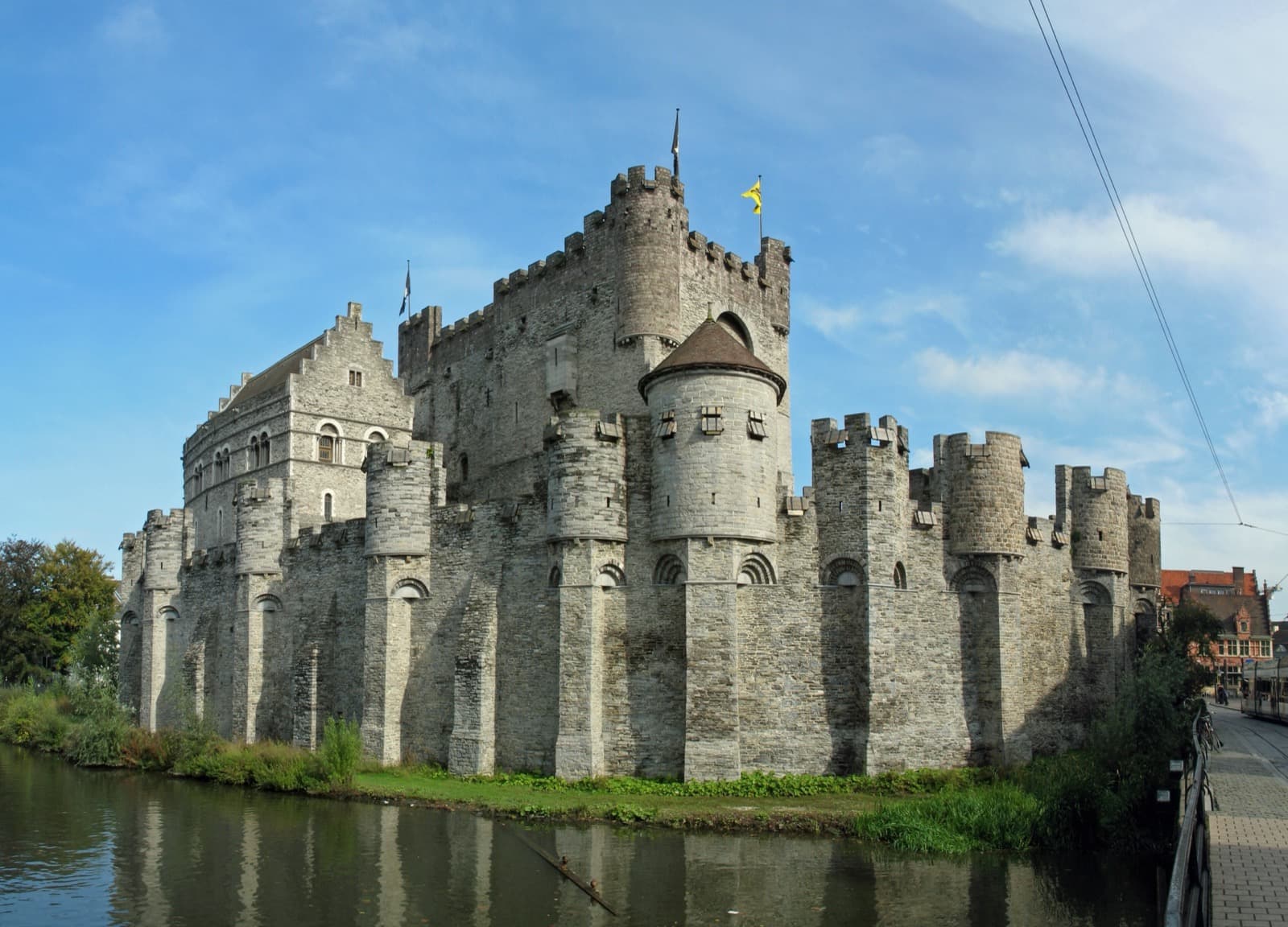
A stone castle planted inside a city, rather than out on its frontier, is not really about defense. It is about watching. The Gravensteen, the Castle of the Counts, is the grey, moated fortress the counts of Flanders set down in the middle of Ghent, and its position tells you almost everything you need to know about the town below it. The counts crowded their keep among the weavers and craftsmen not to guard a border but to overawe the people they ruled. Read the castle that way and the rest of this walk stops being a list of monuments and becomes a single argument: about one of the proudest and most rebellious cities of medieval Europe, and about the counts, kings, and one emperor who kept trying, and mostly failing, to make it obey.
A fortress aimed inward
The present stone castle was built in eleven eighty by Philip of Alsace, count of Flanders, out of sandstone and pale Tournai limestone, with a large central keep, an oval ring wall, and a moat fed by the River Leie. It replaced an older stronghold: around the year one thousand, Arnulf the First of Flanders had raised a wooden fort on this site, and that earlier structure burned around eleven seventy-six. What Philip built to succeed it was meant to last, and to be seen.
That visibility was the point. A frontier castle faces an enemy. This one faced its own citizens, the weavers and craftsmen packed into the lanes below, and the message was simple: the count is here, and he is watching. Over the centuries the building's role shifted with the city's fortunes. It served as the counts' residence until the middle of the fourteenth century, then as Ghent's mint, striking Flemish coin for well over a century. Later it became a court and a prison, and in the nineteenth century, during the Industrial Revolution, part of the medieval castle was put to work as a cotton mill. The silhouette most visitors recognize today came from a heavy restoration between eighteen ninety-three and nineteen oh seven under the architect Joseph De Waele. The city of Ghent now runs it as a museum, and you can climb its walls and dungeons on your own time. From the exterior the shape reads clearly enough: a fortress of power, planted among people who spent centuries pushing back against it.
The square where the punishment landed
Hear a stop from this walk
The Castle of the Counts: The Fortress Planted Among the Rebels
Walk a few steps to Sint-Veerleplein, the square directly before the castle gate, and the abstraction of "power" gets specific. This was the old heart of the counts' quarter and, for centuries, a place of public justice and execution carried out in full view of the walls. City records place executions here from fourteen oh seven into the late eighteenth century, one of three such sites in old Ghent. One date belongs to the larger story. On the seventeenth of March, fifteen forty, nine leaders of the Ghent revolt were beheaded on this square by order of the Emperor Charles the Fifth, with more executions following that spring. The gentler feature is later and quieter: the old fish market moved here in sixteen eighty-nine, and its ornate gateway once carried three sea gods, until a fire in eighteen seventy-two destroyed two of them and left only Neptune, still looking out over the meeting of the Scheldt and the Leie.
The counterweight in the lanes
Behind the castle the streets tighten into the Patershol, a knot of narrow cobbled lanes and step-gabled houses whose name means something close to Monk's Hollow. This is one of Ghent's oldest surviving residential quarters, its closed medieval street pattern still largely intact, so the maze you move through traces roughly the same layout it had in the Middle Ages. It was settled by the working city: leather tanners above all, along with stonemasons, carpenters, and blacksmiths who served the castle and valued being close to the water of the Leie for their trades. Here is the counterweight to the fortress. The count's authority stood in stone on the height; the people who fed, clothed, built, and armed the city lived in its shadow. The quarter later declined into a slum by around nineteen hundred, was protected as a historic townscape in nineteen eighty-one, and has been restored since the early nineteen eighties into a lived-in cultural district.
Where the city did its politics out loud
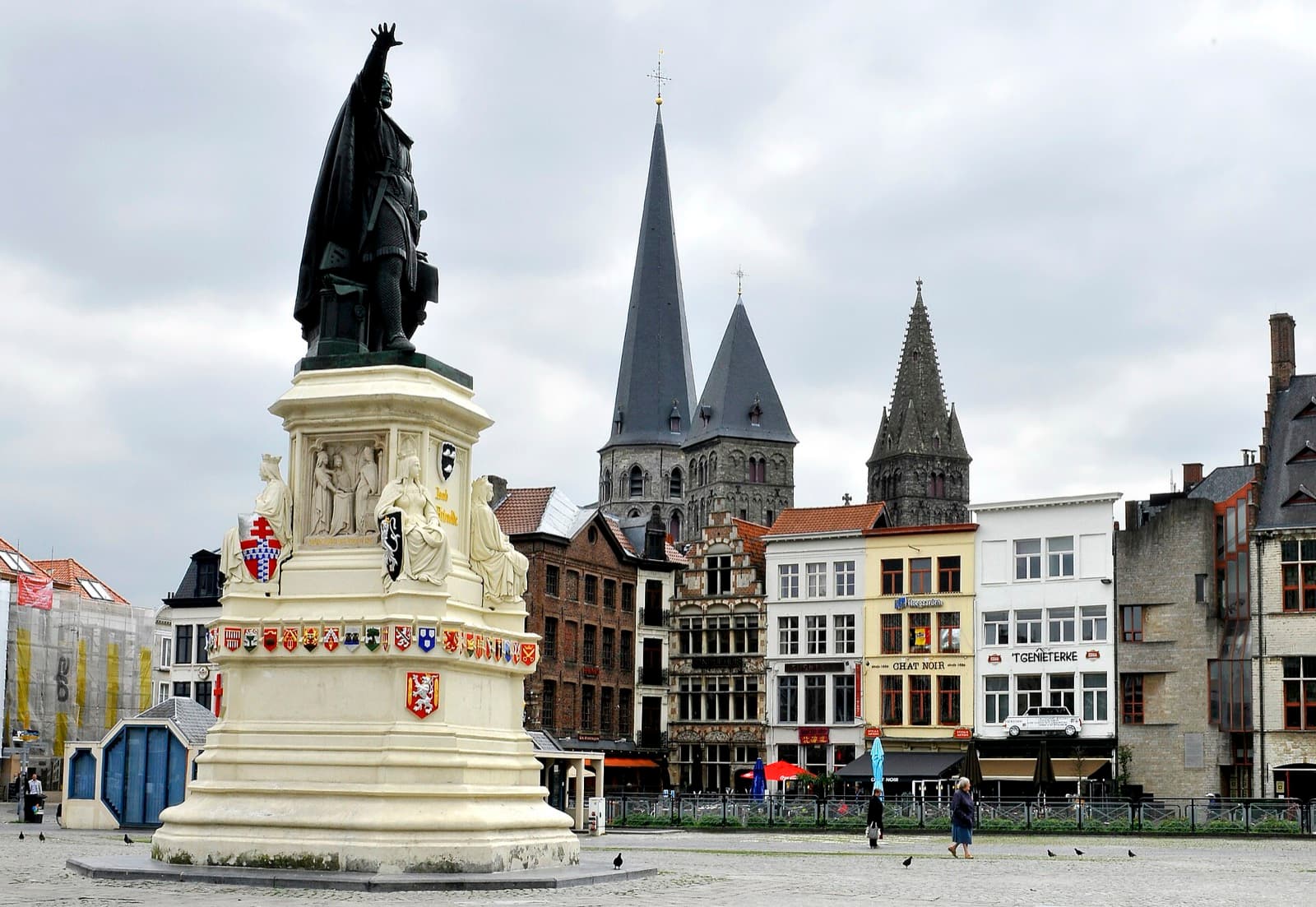
The Vrijdagmarkt, the Friday Market, is where Ghent's defiance turned into policy. A market has been held here every Friday since eleven ninety-nine, but this square, about one hundred metres on a side, was the great civic and political arena of the medieval town. Guilds mustered under their banners, new counts were sworn allegiance, and crowds rioted. The fifteenth-century guildhall of the tanners, the Toreken, still stands on the square. The bronze figure at the center honors Jacob van Artevelde, born around twelve ninety, who became captain-general of Ghent in the late thirteen thirties, when the Hundred Years' War threatened the English wool the Flemish weavers depended on. He allied the Flemish towns with England to keep that wool flowing, and on the twenty-sixth of January, thirteen forty, on this square, he proclaimed Edward the Third of England king of France. It was a calculated gamble by a city that lived and died by its cloth. His end showed the square's darker face: in July of thirteen forty-five, he was killed by an angry mob in Ghent.
The monster, and the man born here
Just off the Friday Market sits the Dulle Griet, Mad Meg, a giant wrought-iron bombard made in the first half of the fifteenth century from thirty-two long iron bars bound by sixty-one iron rings. It runs about five metres long and weighs around sixteen and a half tonnes, almost certainly too large to have been a practical weapon. That is the honest reading: it was a statement, a way for a defiant city to make its martial pride visible in iron. Ghent hauled it to the siege of Oudenaarde in fourteen fifty-two, lost it to the defenders during the retreat, and did not recover it until fifteen seventy-eight.
The sharpest irony waits at the Prinsenhof. Here stood a palace of some three hundred rooms where the future Emperor Charles the Fifth was born, on the twenty-fourth of February, fifteen hundred. Only one gate survives, the Donkere Poort, the Dark Gate, named in the nineteenth century after nearby factories blackened its stone. When Ghent revolted against his taxation in fifteen thirty-nine and forty, Charles the Fifth crushed the revolt in fifteen forty, abolished the city's ancient privileges, executed leaders, and forced its notables to process in penance with hangman's nooses around their necks. Ghent's answer was to keep the insult: from that day its citizens have called themselves the Stroppendragers, the Noose-bearers, worn with pride.
The walk ends at the Rabot, a twin-towered fortified water-gate built between fourteen eighty-nine and fourteen ninety-one after Ghent withstood the fourteen eighty-eight siege by Maximilian of Austria, whose army withdrew after about forty days. You begin at a castle the counts raised to overawe their citizens and end at a gate the citizens raised to remember beating off an emperor's army. To walk the full route yourself, start with the Ghent walking tours hub or explore more of Ghent.
Sources
- Gravensteen, Wikipedia: build date, materials, and the sequence from comital residence to mint, court, prison, and cotton mill.
- Castle of the Counts, Historische Huizen Gent (official city museum site): the castle's history and stories, including the De Waele restoration.
- Jacob van Artevelde, Britannica: his role as captain-general and the thirteen forty alliance with England.
- Dulle Griet, Wikipedia: construction, dimensions, and the Oudenaarde siege history distinct from the Mad Meg legend.
- Prinsenhof and Rabot, Visit Gent (official tourism site): Charles the Fifth's birthplace, the Dark Gate, and the fifteenth-century water-gate.
Ready to experience it?
Gravensteen: The Castle and the Rebel City
70 min · 2.4 km · easy
More from Ghent
Explore more at your own pace.
Ghent Travel Guide: How Many Days, Getting Around, and When to Go
One Day in Ghent: A Walkable Morning-to-Evening Itinerary
Ghent: The Medieval Giant of Three Towers and Endless Revolts
Sint-Baafskathedraal and the Mystic Lamb: The Last Word in Ghent's Skyline
Graslei and Korenlei: The Harbour That Paid for Ghent