Old Town: The Royal Way the Merchants Built
60 min · 0.7 km · easy
Gdansk was the great Baltic port of Poland, one of the richest cities of the Hanseatic trading world, and it is also where a shipyard strike helped bring down communism across half a continent. Read the city as two connected stories and it comes clear: down on the Motlawa River, trade built a merchant showpiece where Polish kings, German-speaking merchants, and Dutch-trained builders all left their mark; a short walk north, at a shipyard gate, workers refused to go home in August 1980 and gave birth to Solidarity. Walk the Hanseatic Main Town and the birthplace of a movement, and you read the whole arc of Gdansk at your own pace.
The port that made a merchant city rich
For centuries Gdansk was one of the great ports of the Baltic and of the Hanseatic world: around 1600, about three quarters of Poland's trade with other countries passed through it. Its Main Town became a showcase of that prosperity, and the ceremonial spine that runs through it is the Royal Way, the route by which Polish kings once rode into the city. The Old Town: The Royal Way the Merchants Built walk follows that spine from the landward gates down to the Green Gate by the river, seven stops and about 700 metres of gables, bronze, and brick, in around an hour.
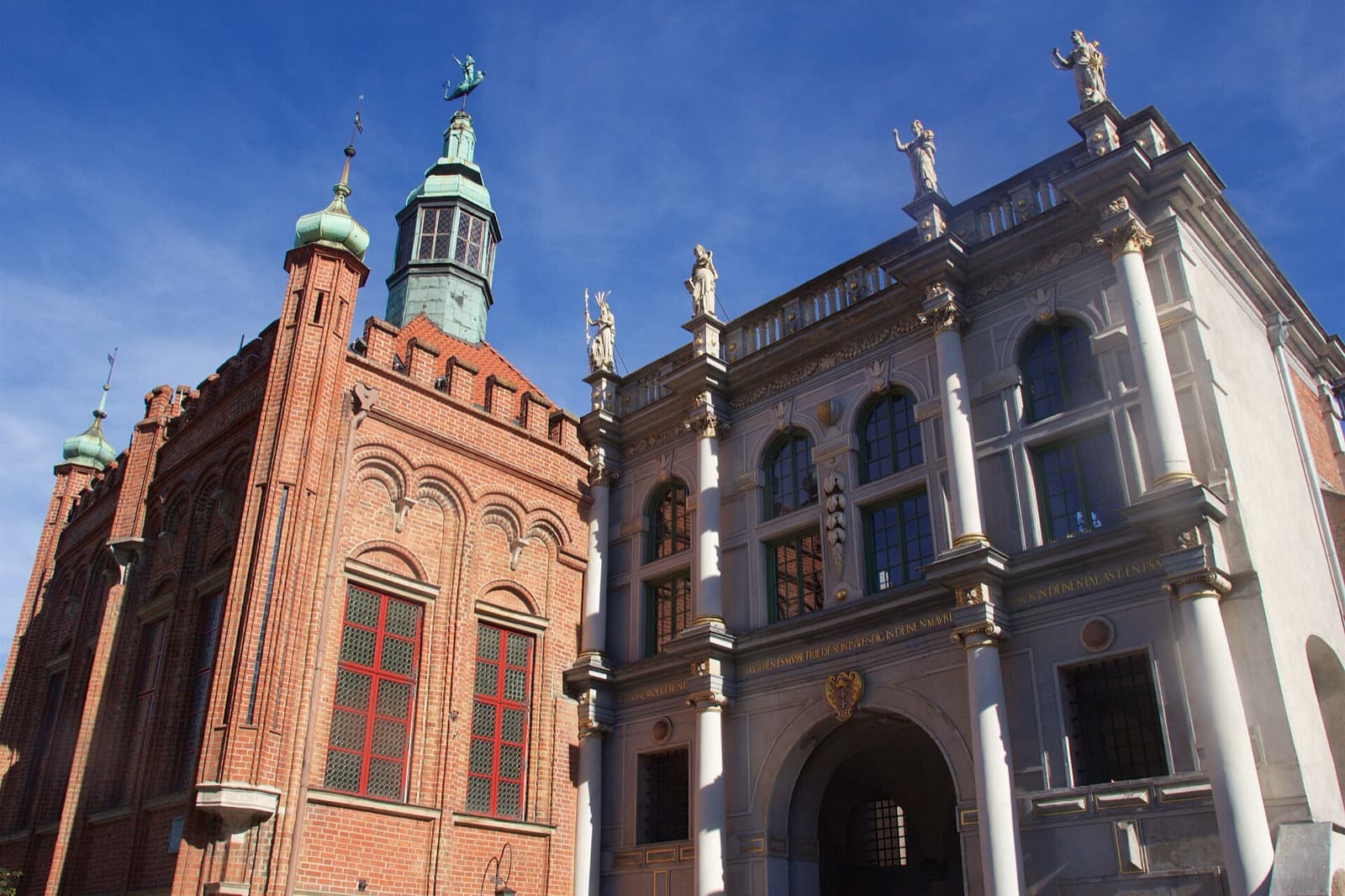
The route opens with two gates. The Upland Gate, the Brama Wyzynna, was built in 1574 and 1575 and carried the world outside into the fortified merchant town. A few steps east stands the Golden Gate, the Zlota Brama, built between 1612 and 1614 to a design by Abraham van den Blocke in an elegant Mannerist style, shaped like a Roman triumphal arch. Above it, first added in 1647 and 1648, stand eight allegorical figures that face two directions on purpose: Peace, Freedom, Wealth, and Fame look outward, while Concord, Justice, Piety, and Prudence face the citizens walking into town. The originals were replaced as early as 1878, and the stone figures you see were carved again in 1995 to 1998.
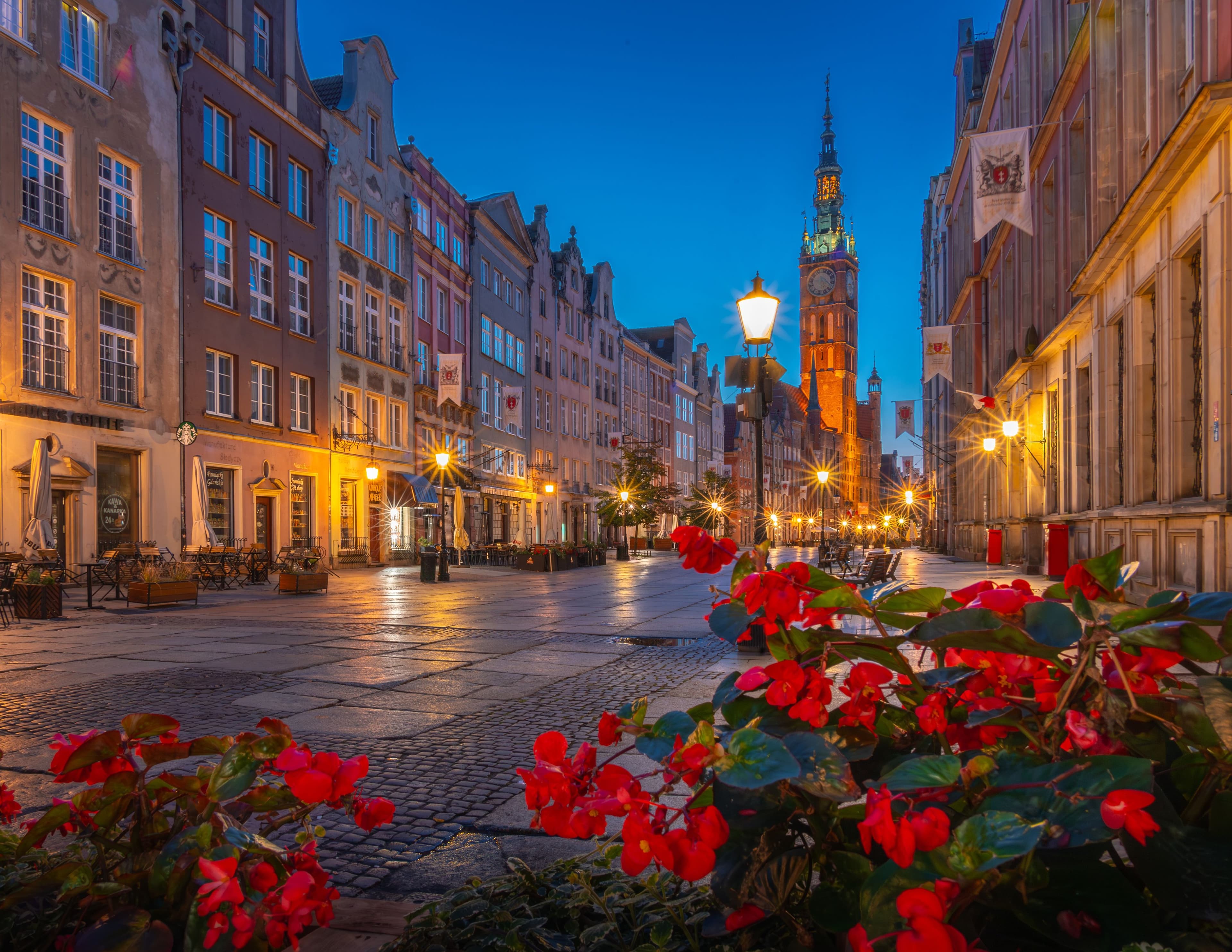
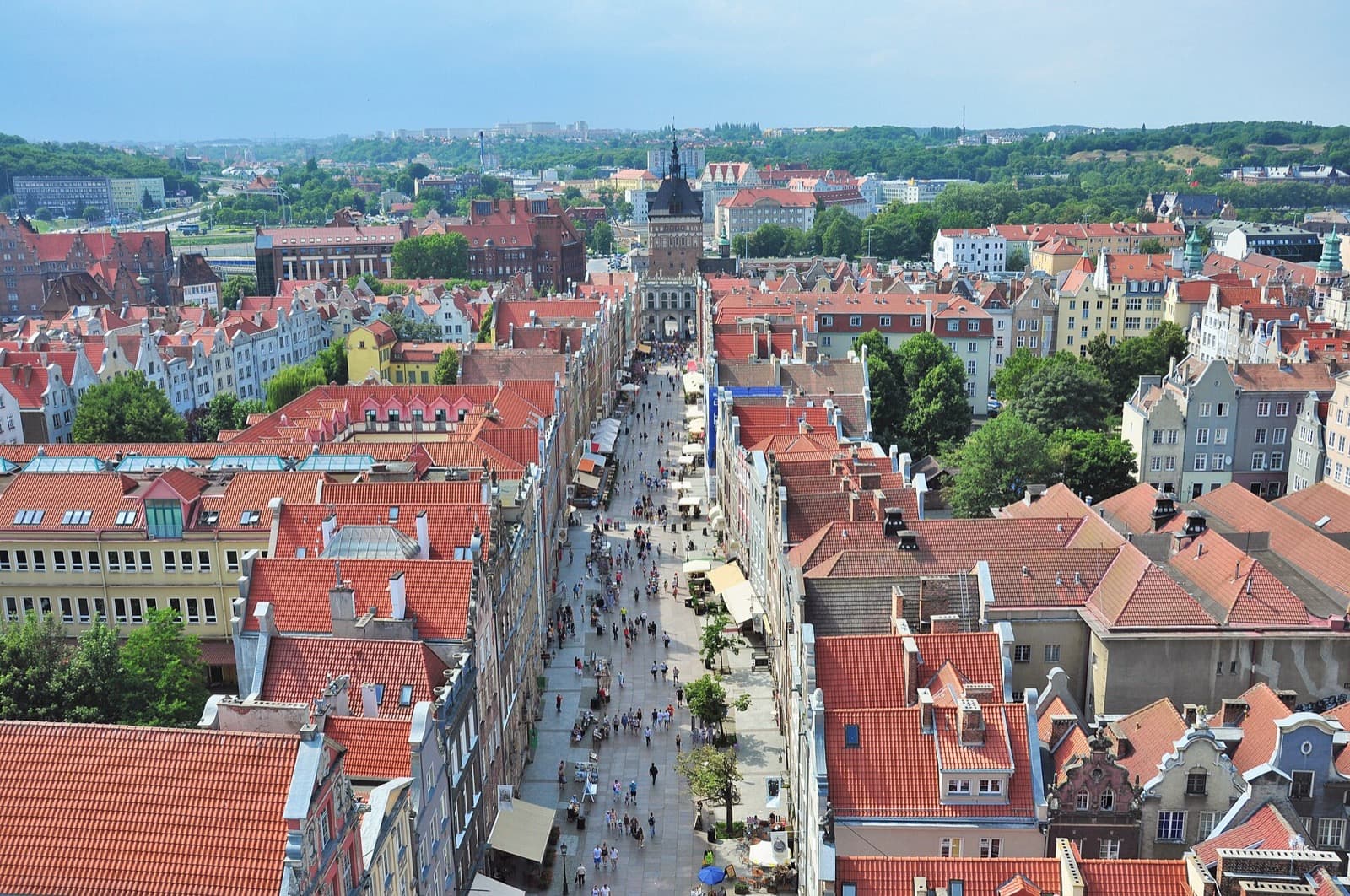
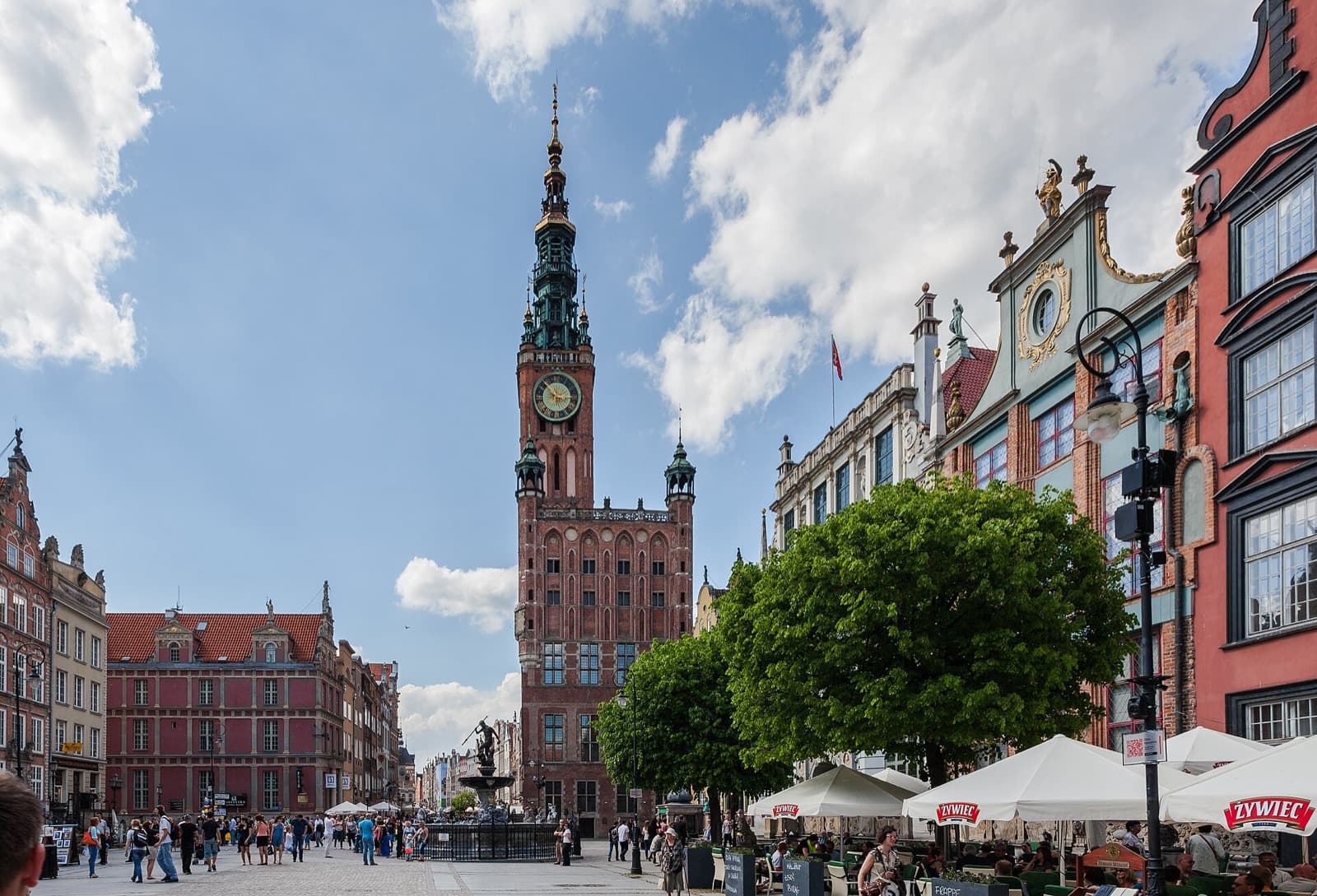
Past the gates runs Long Street, the Ulica Dluga, about 300 metres of tall, narrow houses standing shoulder to shoulder, each crowned with ornamented gables that step and curl against the sky. These were the homes of the Hanseatic burghers, the merchant families who made their fortunes above all from the grain trade and Baltic shipping. A house here was a public statement of standing, and the competition between neighbours is written across the frontages in stone reliefs and carved portals. In 1994 the whole historic city inside its seventeenth-century fortifications, Long Street included, was declared a Historic Monument of Poland.
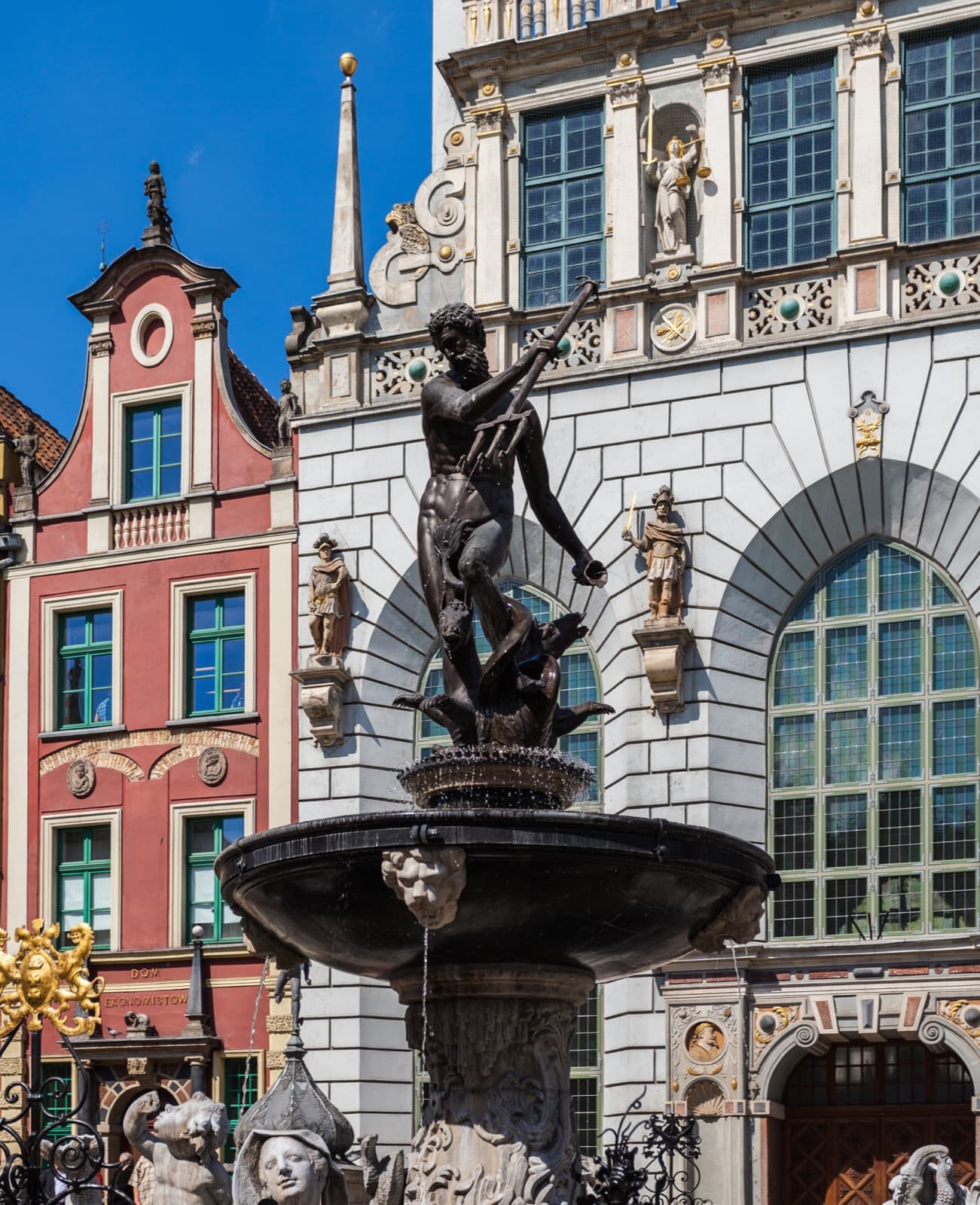
Where Long Street opens into the Long Market, the Main Town Hall's tower rises about 80 metres. The first town hall here was built in 1327 to 1336 and enlarged from 1379, and since 1561 a gilded figure traditionally identified as King Sigismund Augustus has crowned the tower as a weathervane, so the town hall of this proud merchant city is literally topped with a golden king. Just beyond, on the Long Market, stands the emblem of Gdansk itself: Neptune's Fountain, the Fontanna Neptuna. The bronze sea god was designed by Abraham van den Blocke and cast around 1615. Work had begun in 1606, but delays including the Thirty Years' War and the death of the designer meant the water first ran only in October 1633, and the fountain was inaugurated in March 1634. A bronze god of the sea presiding over the merchants' square says exactly what this city was.
Behind Neptune stands Artus Court, the Dwor Artusa, the grand meeting hall of the city's merchants, named for the legend of King Arthur and his Round Table. The round table was a romance, not a rule: members sat on separate benches by origin and trade, and craftsmen, small traders, and poorer merchants were kept out. The Long Market closes at the water with the Green Gate, the Zielona Brama, built between 1564 and 1568. It was nominally the lodging of Polish kings on their visits, and yet the kings preferred the townhouses on the Long Market; the one royal stay recorded in the gate is a queen's, Marie Louise Gonzaga, in 1646.
Brick, amber, and the machinery of trade
Hear a stop from this walk
Green Gate: A Royal Lodging on the City's Scales
The Waterfront: The Crane, the Shipyards, and Solidarity walk begins where the last one ended, at the Green Gate and the Motlawa quay, then reads the river as the city itself did, as a road paved with water. Behind the gate runs the Long Bridge waterfront, the Dlugie Pobrzeze, which sounds decorative but was the working quay of the port. From the fourteenth century, wooden loading platforms passed cargo to and from ships, merging into one continuous embankment by the seventeenth century.
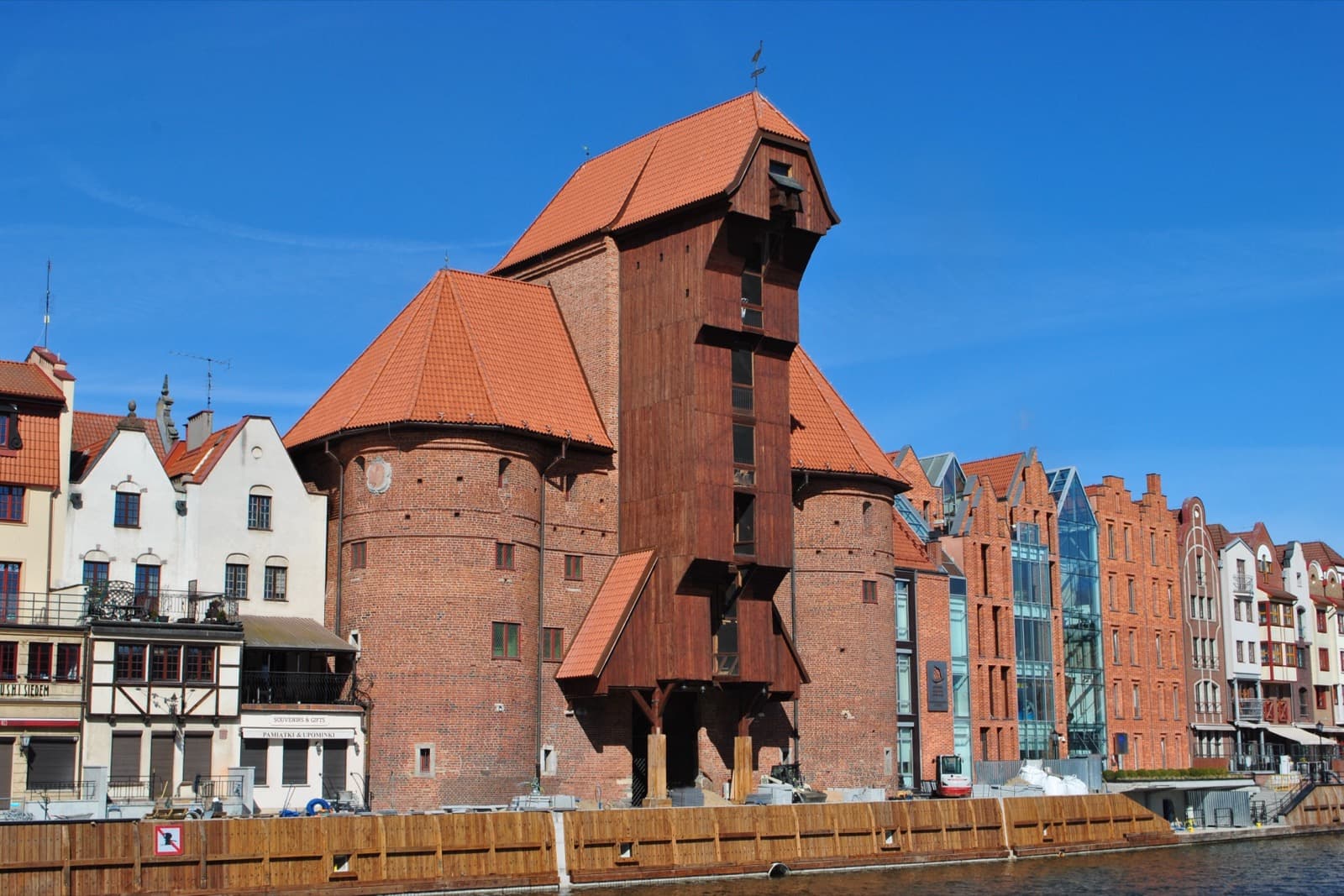
The great survivor of that working port is the Crane, the Zuraw. After a fire, the structure you see was built between 1442 and 1444, and in its day it was the largest port crane in medieval Europe. The detail that stays with you is how it worked: men climbed inside great wooden treadwheels and walked, the way a hamster turns a wheel, turning a shaft that could lift up to about two tons. It loaded cargo and stepped the masts of ships. The whole structure stands about 30 metres high and is the only surviving twin-tower gate in the city. Destroyed in 1945, it was restored between 1956 and 1959 and reopened after renovation in the spring of 2024.
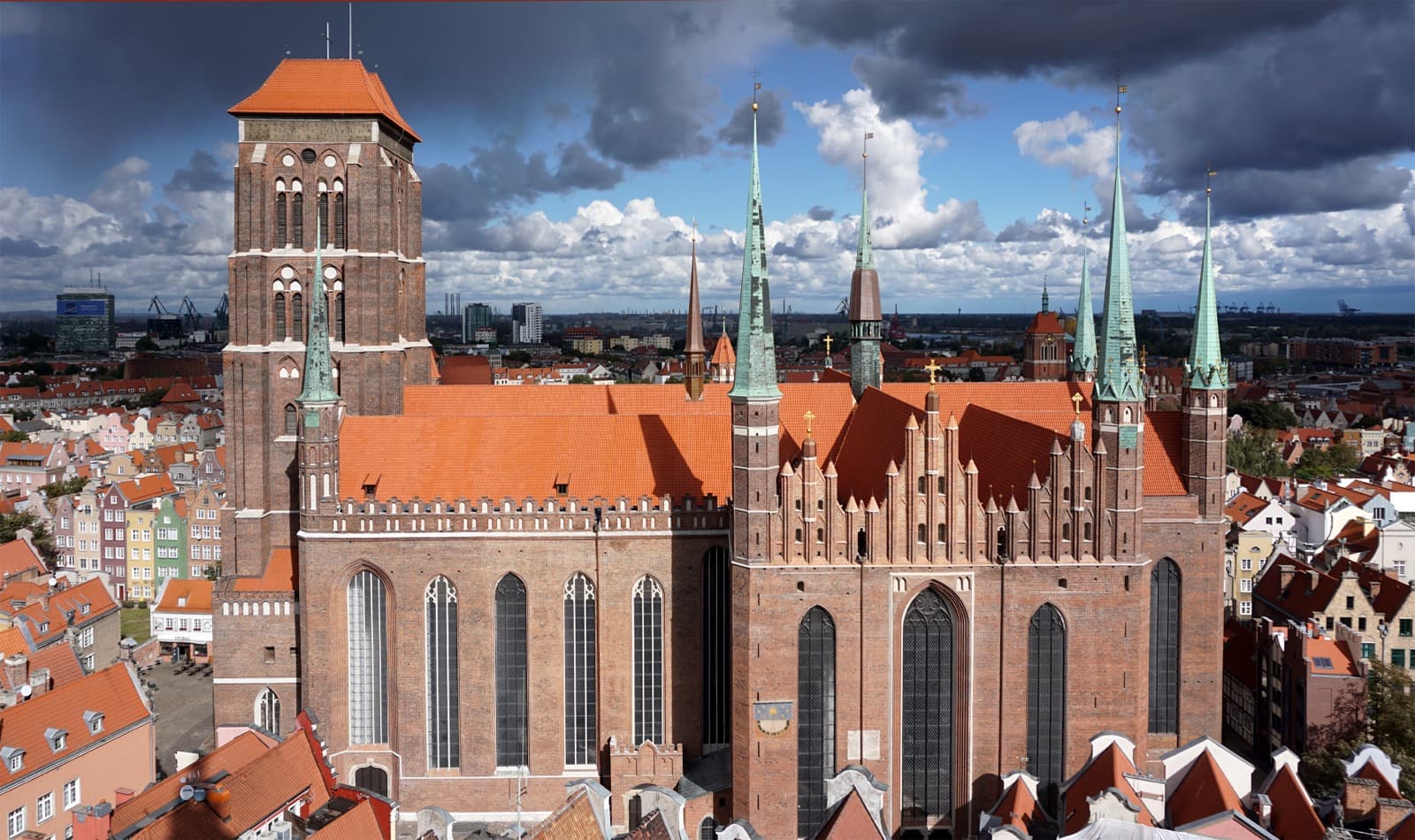
Nearby, Mariacka Street, the Ulica Mariacka, is often called the most beautiful street in Gdansk. Its houses front onto raised stone terraces called przedproza, edged with ironwork and carved stone rain-spouts shaped like gargoyles that locals nickname Rzygacze, the spewers, because they spit rainwater over the street in a downpour. This was long the street of goldsmiths and amber craftsmen, and it is still nicknamed the Amber Street. At its head rises St Mary's, the Bazylika Mariacka, a colossal work of Brick Gothic built between 1379 and 1502. It is one of the largest brick churches in the world, running about 105 metres in length. Across the water lies Granary Island, the Wyspa Spichrzow, where at its peak about 300 granaries stored the grain that Poland's harvests floated down the Vistula. This modest patch of ground was the engine room of the city's wealth.
The gate where freedom began
Almost everything on these walks carries the same wound. In the Red Army's assault on the city in March 1945, the Main Town was nearly obliterated. St Mary's lost its roofs to fire and about half of its vaults fell in; it was reconsecrated on the seventeenth of November 1955. Long Street, the Crane, the granaries: all were flattened or damaged and patiently raised again, while Neptune had been taken apart and hidden inland, returning to the square in 1954. Long Street itself was rebuilt between 1950 and 1953 from old plans and engravings, its facades deliberately given the look they had before their nineteenth-century makeovers, so what you see is both old in design and new in stone.
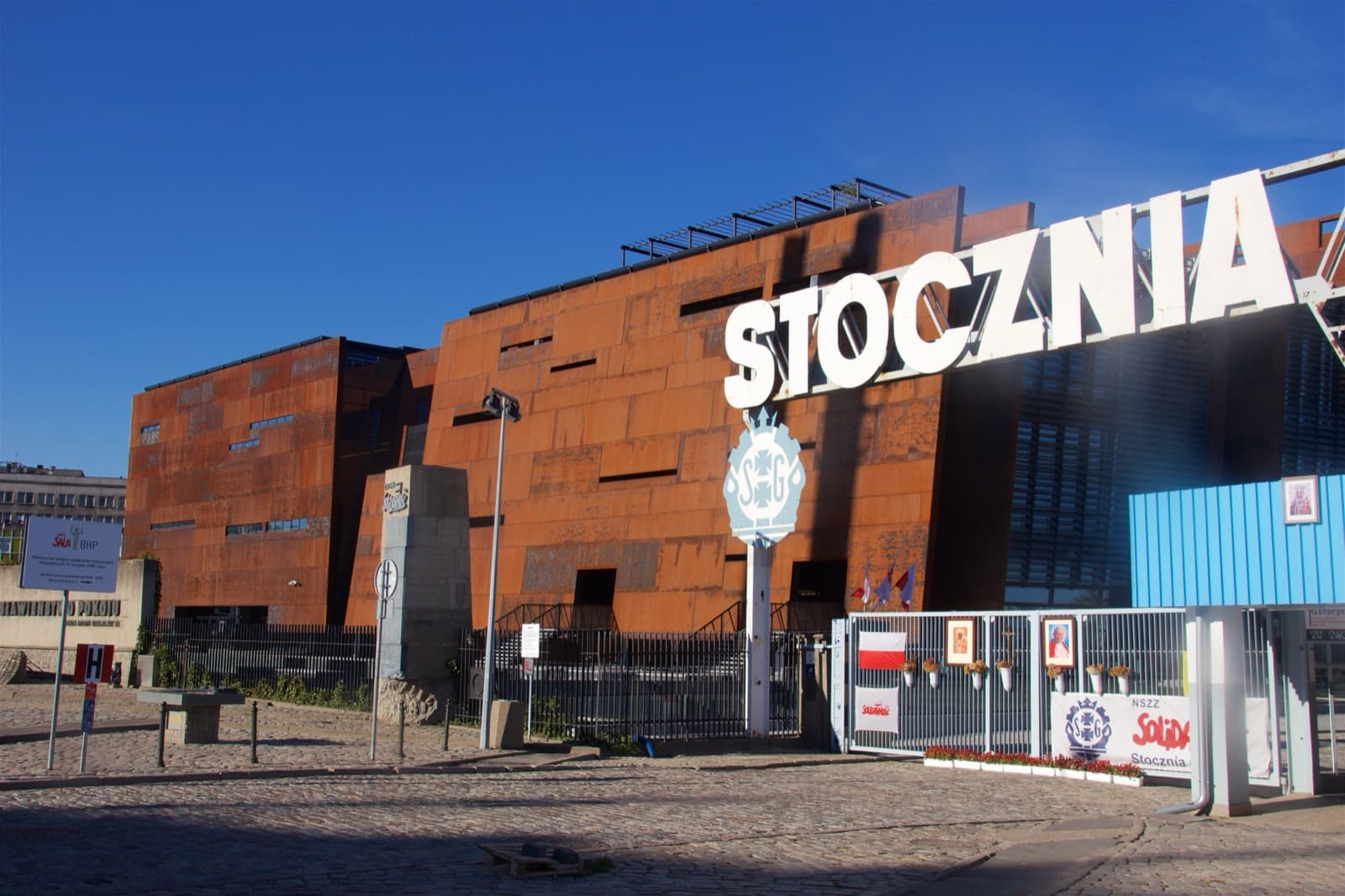
Then the waterfront walk turns north, out of the mercantile old town and into the industrial city, to the historic Gdansk Shipyard, once known as the Lenin Shipyard, founded in 1946. In front of Gate Number Two, the Brama nr 2, a strike broke out in August 1980, led by an electrician named Lech Walesa. Out of it came Solidarnosc, Solidarity, the first free, mass, independent trade union anywhere in the Soviet bloc, a movement eventually joined by around ten million Poles. The strike was settled by the August 1980 Gdansk Agreement, negotiated between the workers and the communist state. This was an ordinary industrial gate until a group of workers stood behind it and refused to go home.
Just outside the gate, on Solidarity Square, three enormous steel crosses rise together, each 42 metres high and weighing about 36 tonnes. The Monument to the Fallen Shipyard Workers of 1970 was unveiled on the sixteenth of December 1980, its construction one of the conditions the workers won in the Gdansk Agreement, and it is described as the first monument to victims of communist oppression ever erected in a communist country. It remembers workers killed when the state put down the coastal protests of December 1970.
Beside the monument stands the European Solidarity Centre, the Europejskie Centrum Solidarnosci, which opened on the thirty-first of August 2014 with Lech Walesa present. Its walls are made of weathering steel designed to evoke the hulls of the ships built at this shipyard. By the Centre's own account, Poland's bloodless transition of 1989 helped bring down the Berlin Wall and the dictatorships across Central and Eastern Europe. Down at the river, trade. Up here, freedom. To plan your visit across both threads, start with the full list of Gdansk walking tours and take each at the pace that suits you.
Sources
- Museum of Gdansk (Muzeum Gdanska), official pages on the Main Town Hall, Artus Court, and the Uphagen House
- National Maritime Museum in Gdansk, official information on the Crane (Zuraw)
- European Solidarity Centre (Europejskie Centrum Solidarnosci), official history of the August 1980 strike and the Gdansk Agreement
- St Mary's Basilica in Gdansk (Bazylika Mariacka), parish and heritage information on the church's construction and post-war reconstruction
- Poland's register of Historic Monuments (Pomnik Historii), listing for Gdansk, the city within its seventeenth-century fortifications
- Gedanopedia (Gdansk Encyclopedia), entries on Dluga, the Main Town Hall, Neptune's Fountain, Artus Court, the Green Gate, the Golden Gate, and the Vistula trade
Frequently asked questions
- Why was Gdansk so wealthy in the Hanseatic period?
- Gdansk was one of the great ports of the Baltic and of the Hanseatic trading world. Poland's grain harvests floated down the Vistula River to Gdansk, where Granary Island held about 300 storehouses at its peak, and around 1600 about three quarters of Poland's trade with other countries passed through the city, with grain making up 70 to 80 percent of its exports by value. The fortunes of the merchant families built the gabled houses of Long Street.
- What is the Royal Way in Gdansk?
- The Royal Way is the ceremonial route by which Polish kings once entered Gdansk. It runs from the landward Upland and Golden Gates down Long Street to the Long Market, past Neptune's Fountain and Artus Court, and ends at the Green Gate on the Motlawa River. St Mary's Church rises over the whole Main Town just off the route. Our self-guided walk covers it in seven stops, about 700 metres, in around an hour, with a short loop to St Mary's.
- Where was Solidarity born in Gdansk?
- Solidarity was born at Gate Number Two of the Gdansk Shipyard, once known as the Lenin Shipyard, founded in 1946. In August 1980 a strike led by electrician Lech Walesa produced Solidarnosc, the first free, mass, independent trade union in the Soviet bloc. The strike was settled by the August 1980 Gdansk Agreement, and the union was eventually joined by around ten million Poles.
- How big is St Mary's Church in Gdansk?
- St Mary's, the Bazylika Mariacka, is a Brick Gothic church built between 1379 and 1502 and runs about 105 metres in length. It is one of the largest brick churches in the world. Its roofs burned and about half of its vaults fell in in March 1945, and it was reconsecrated on the seventeenth of November 1955.
- What are the three crosses at the Gdansk shipyard?
- They are the Monument to the Fallen Shipyard Workers of 1970, on Solidarity Square just outside Gate Number Two. Each steel cross stands 42 metres high and weighs about 36 tonnes. Unveiled on the sixteenth of December 1980 as a condition won in the Gdansk Agreement, it is described as the first monument to victims of communist oppression erected in a communist country.
Ready to experience it?
Old Town: The Royal Way the Merchants Built
60 min · 0.7 km · easy
More from Gdansk
Explore more at your own pace.
Gdansk Travel Guide: Days Needed, Getting Around, Safety, and Budget
One Day in Gdansk: A Walkable Morning-to-Evening Itinerary
Neptune's Fountain and the Long Market: The Heart of Gdansk's Royal Way
The European Solidarity Centre: Where a Shipyard Gate Reads Like the End of a Sentence
St Mary's Church in Gdansk: The Brick Giant That Was Protestant for Four Centuries