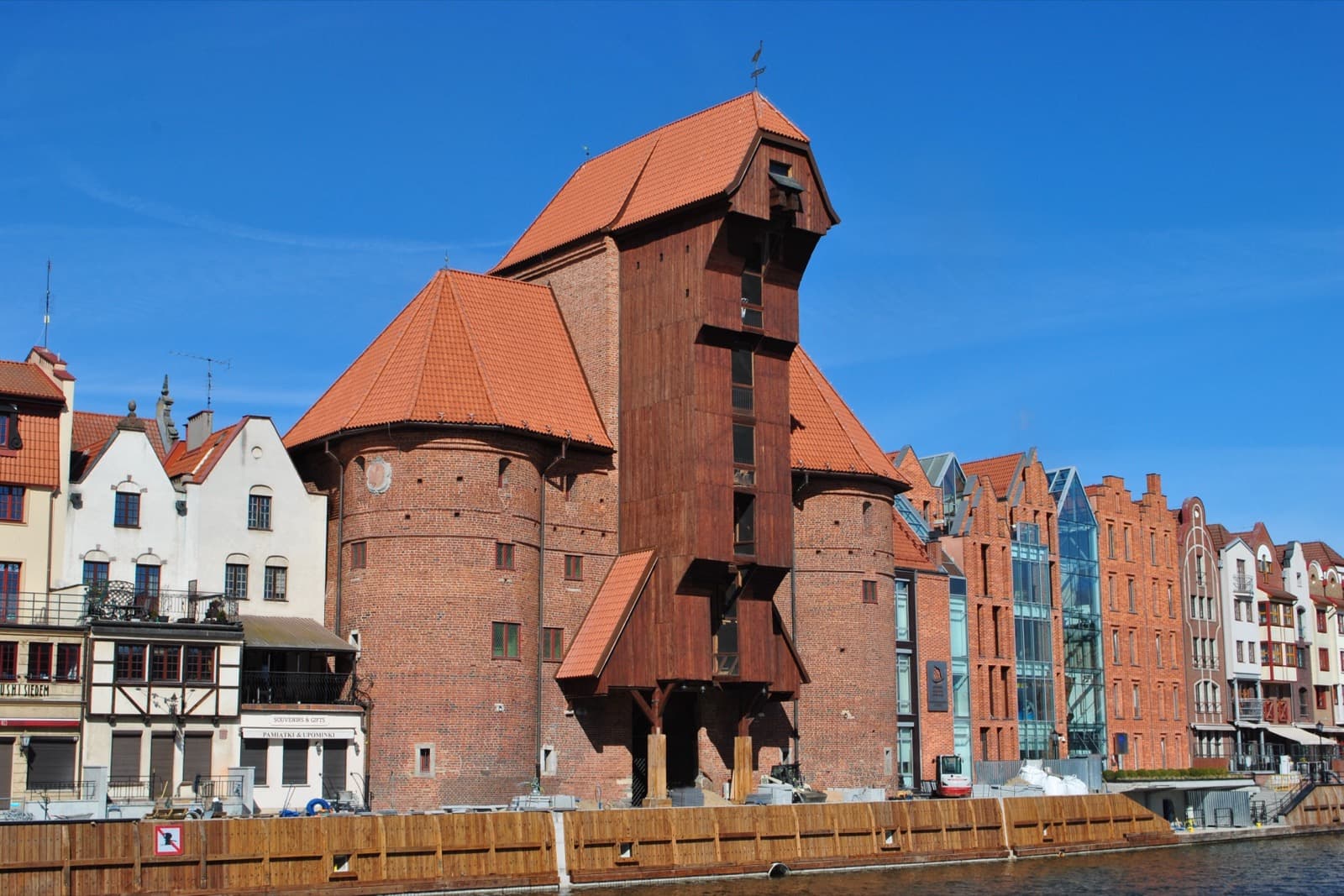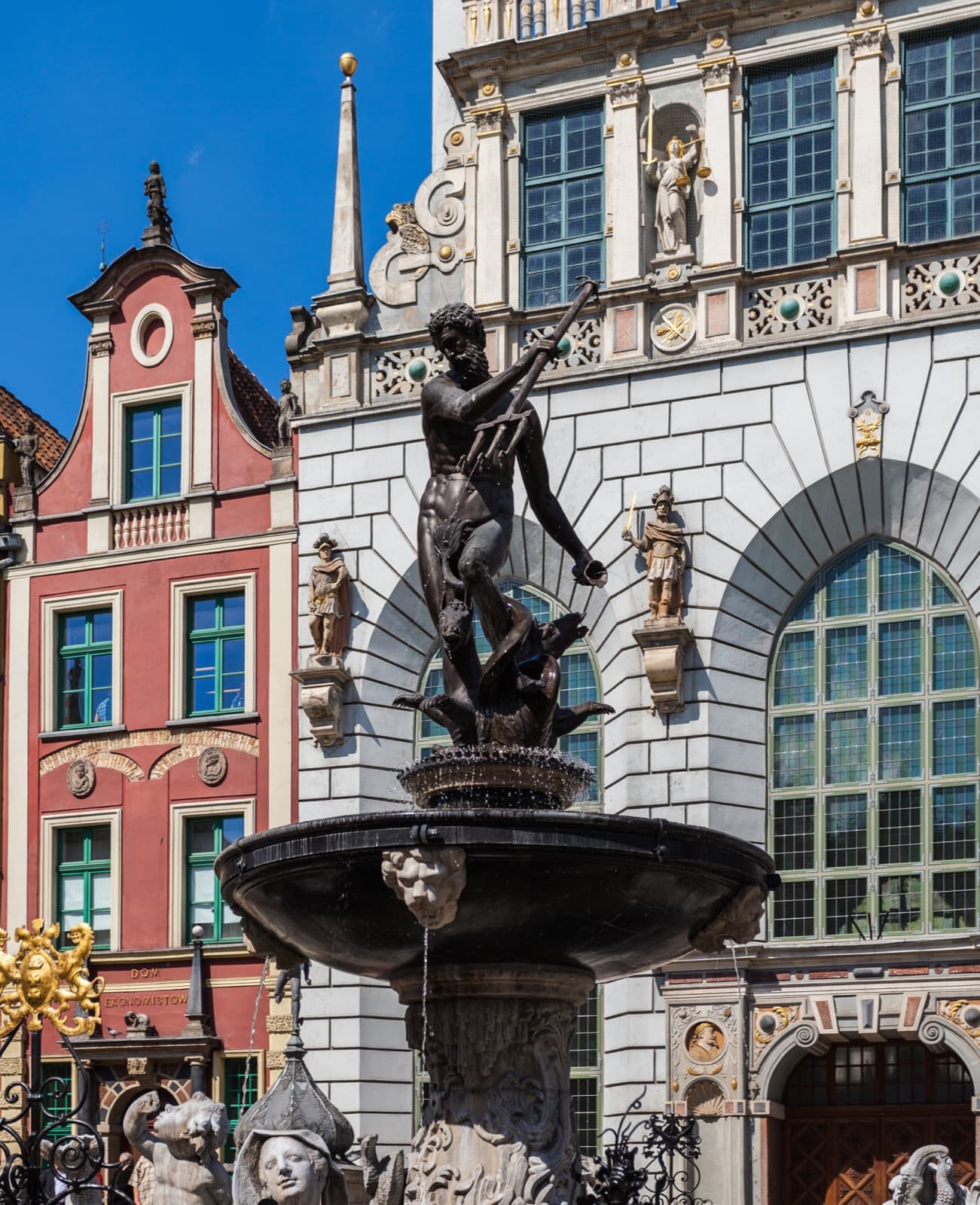
The bronze Neptune on Gdansk's Long Market is the emblem of a resurrected Hanseatic port, and reading his fountain opens up the whole Royal Way, the ceremonial route by which Polish kings once entered the merchant city. Stand in front of the sea god on the wide square called Dlugi Targ and you are standing at the theatrical center of a walk that runs from the landward gates on the western edge of the Main Town straight down to the river Motlawa and the Baltic beyond. The fountain is not decoration. It is an argument, cast in bronze, about what this city was and how it survived.
A god who took nearly three decades to arrive
Look at the figure first. The bronze Neptune was designed by Abraham van den Blocke and cast around sixteen fifteen in the city foundry run by Gerdt Benning. It is a heavy thing, roughly six hundred and fifty kilograms, raised on a stem in the middle of the grandest square in the city. What the crowds around it rarely know is how long it took to appear.
Work on the fountain began in sixteen oh six, on the initiative of the mayor Bartholomaus Schachmann. Then came delay after delay. There was the rebuilding of the neighboring Artus Court, leaks in the water pipes, the Thirty Years' War, and the death of the designer himself before the project was done. The water finally ran in October sixteen thirty-three, some twenty-seven years after the first work began, and the fountain was formally inaugurated the following March. A merchant city that made its fortune on speed and shipping took a generation to raise a single fountain, and then kept it standing for centuries.
That patience is worth holding onto, because it repeats at a far larger scale later on this walk.
Why a sea god presides over a merchants' square
Hear a stop from this walk
Green Gate: A Royal Lodging on the City's Scales
Neptune stands here for a reason that explains the entire route. This was one of the great ports of the Baltic and of the Hanseatic trading world, the gateway between the sea and the grain fields of Poland: around sixteen hundred, about three quarters of Poland's trade with other countries passed through Gdansk, and grain made up most of what it shipped. A bronze god of the sea, trident raised over the merchants who bought and sold below him, says exactly what Gdansk was. He is the single most recognizable image of the city, and he earned it.
The square he presides over continues Long Street toward the water, framed by ornate frontages and closed at its far end by a gate that opens on the river. To understand why the fountain sits precisely here, you have to walk the spine that leads to it. That is what the full tour does, and Neptune is the hinge on which the whole thing turns. If you are planning your visit, the full set of Gdansk walking tours lays out the routes through the Main Town and beyond.
The Royal Way, gate by gate
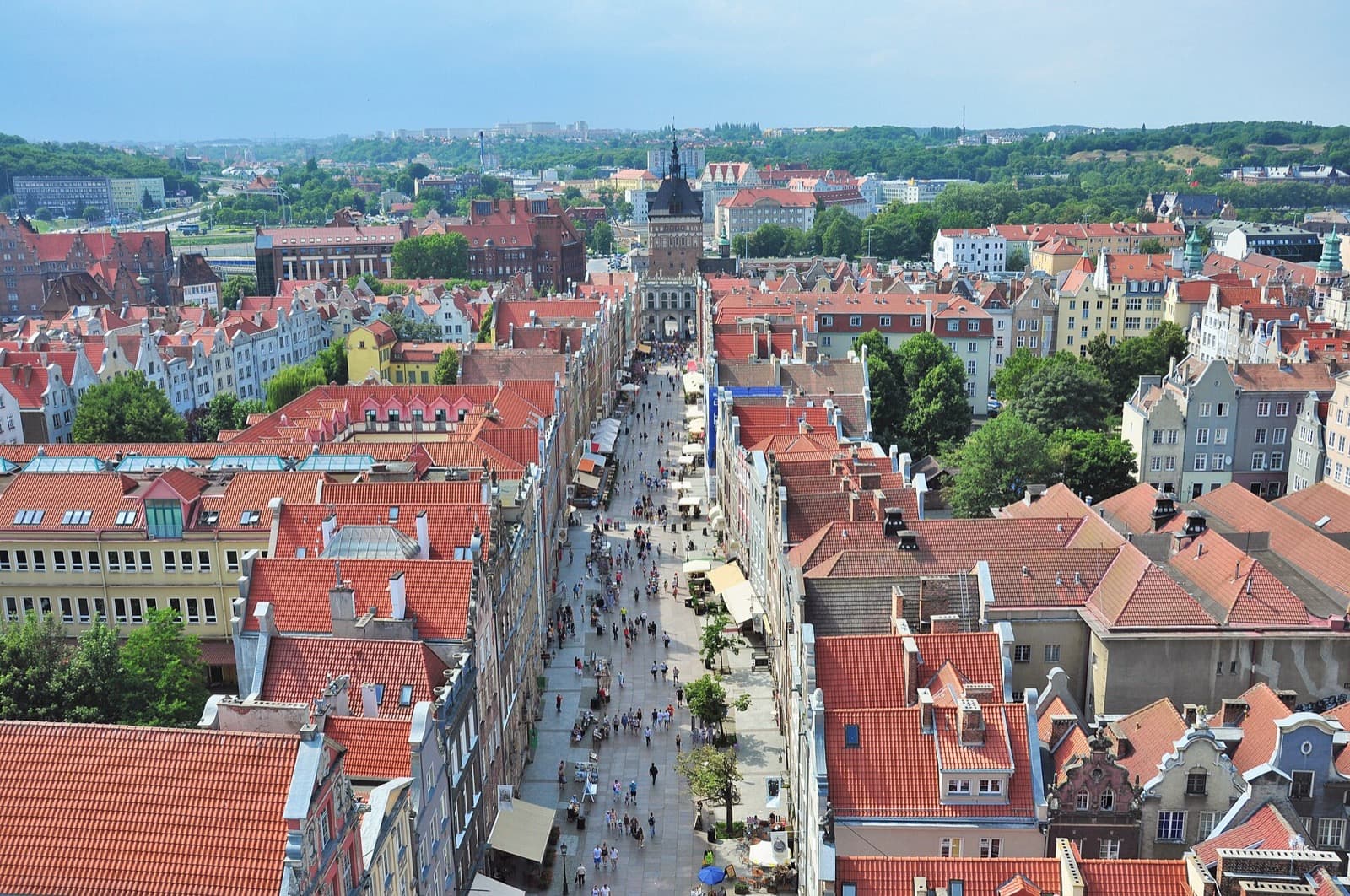
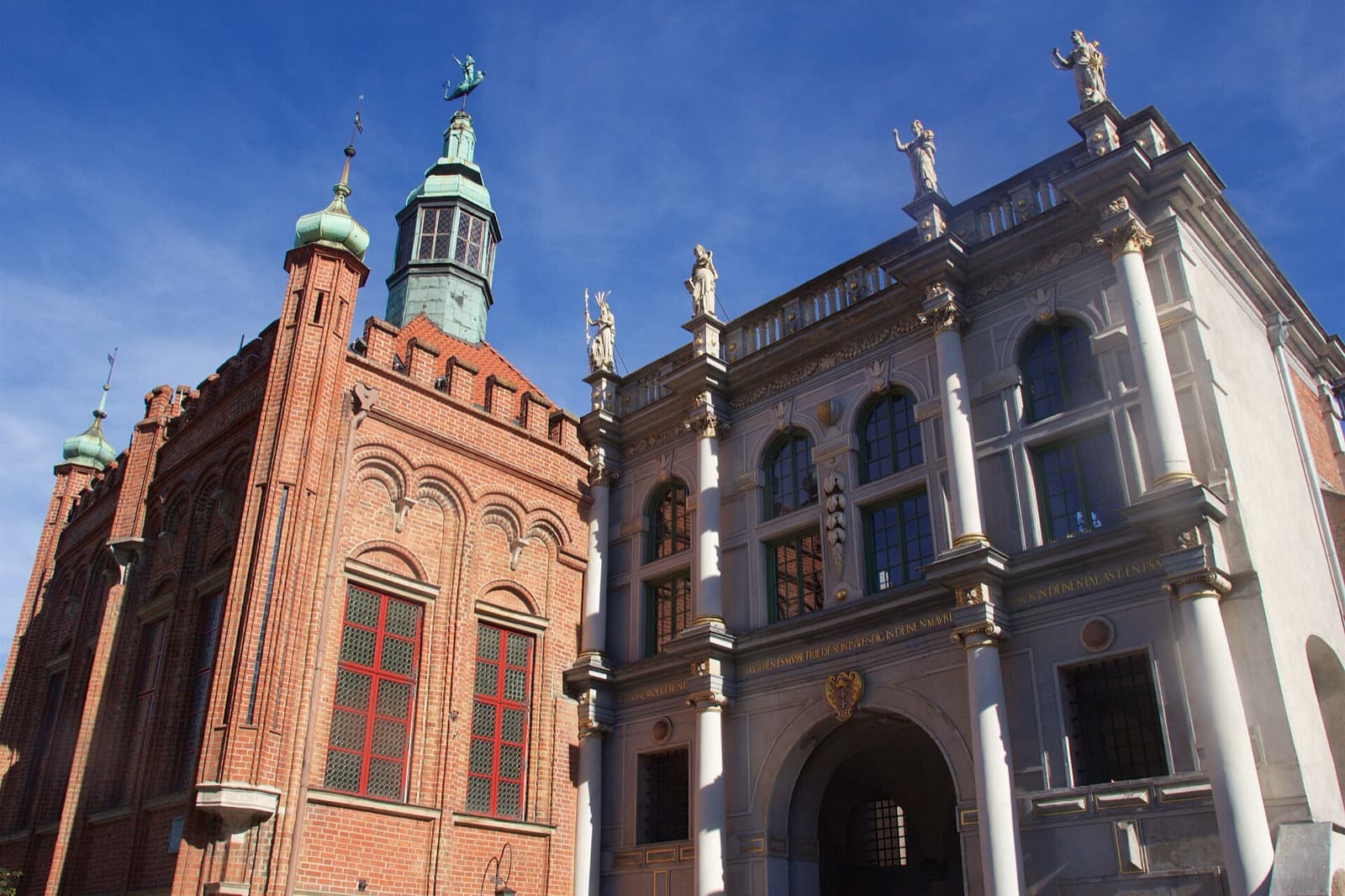
The walk opens where the kings rode in. At the western edge of the Main Town stand two landward gates. The Upland Gate, the Brama Wyzynna, was built in fifteen seventy-four and fifteen seventy-five, its stone exterior decorated in fifteen eighty-eight by Willem van den Blocke, and on its outer face three Latin mottoes greet whoever arrives, one of them declaring that justice and piety are the foundations of all kingdoms. A few steps east stands the Golden Gate, built between sixteen twelve and sixteen fourteen to a design by Abraham van den Blocke, crowned with eight allegorical figures that face two directions on purpose. Peace, Freedom, Wealth and Fame look outward. Concord, Justice, Piety and Prudence face the citizens walking into town. The originals were replaced as early as eighteen seventy-eight, and the stone figures you see were carved again in the nineteen nineties.
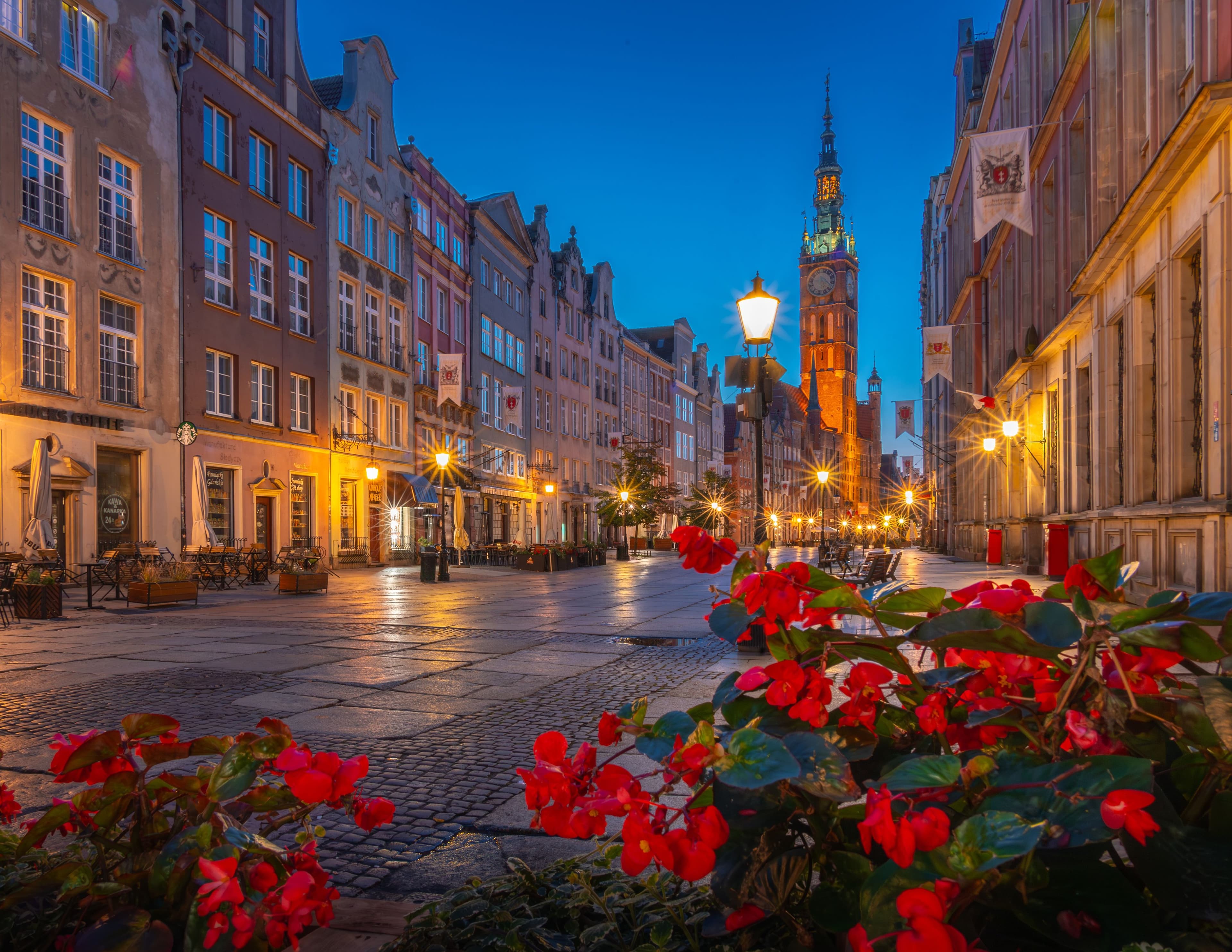
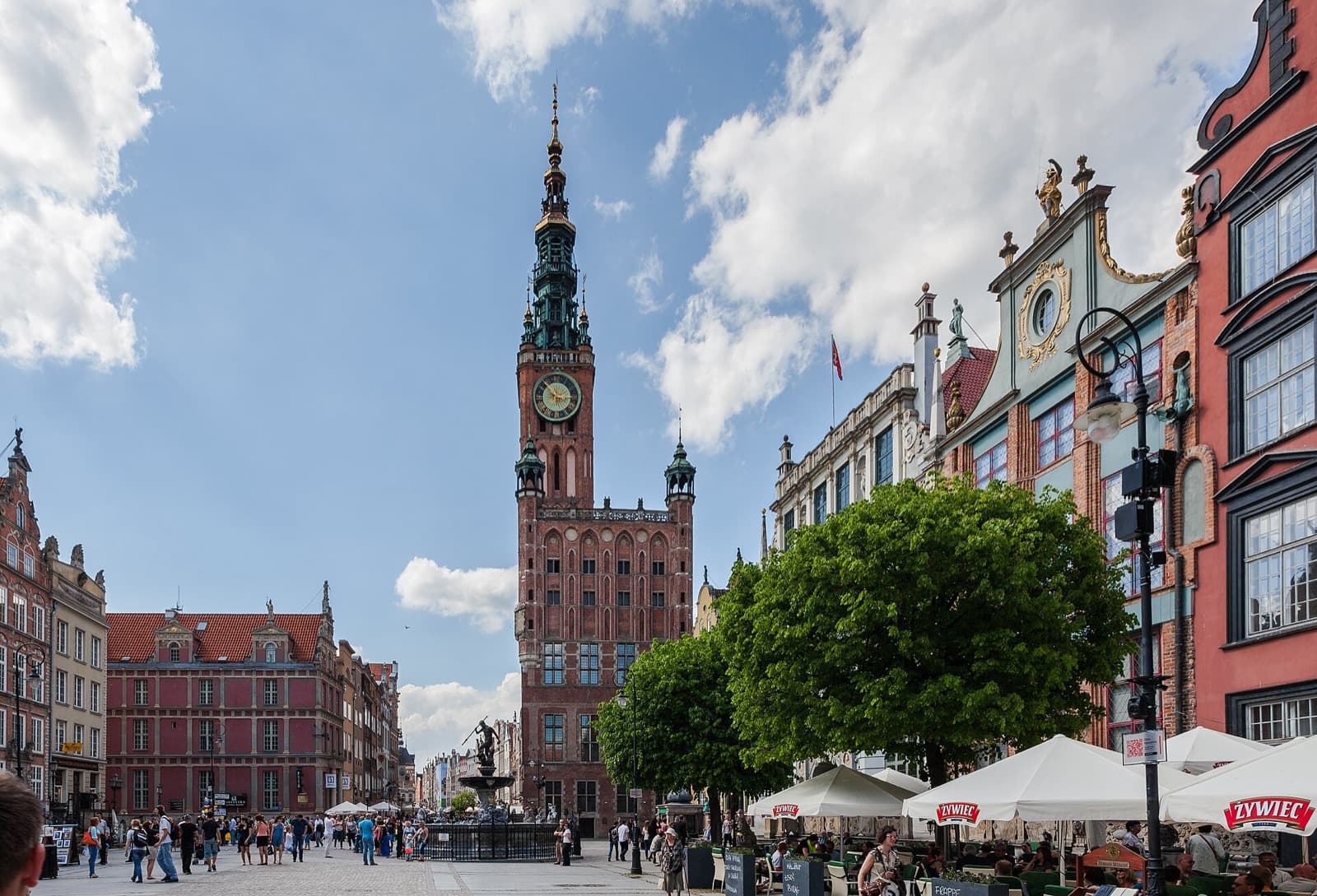
Through those gates runs Long Street, the Ulica Dluga, about three hundred meters of tall, narrow merchant houses standing shoulder to shoulder, their gables climbing and curling against the sky. These were the homes of wealthy Hanseatic burghers, and the competition between neighbors is written in stone reliefs and carved portals across every frontage. Where the street opens into the square rises the Main Town Hall, the Ratusz Glownego Miasta, its tower climbing to about eighty meters and topped since fifteen sixty-one by a gilded figure traditionally identified as King Sigismund Augustus, a merchant city literally crowned with a Polish king.
Then comes Neptune, and behind him the story keeps going. Artus Court, the Dwor Artusa, is the merchants' grand meeting hall, named for the legend of King Arthur and his Round Table. The name borrowed a romance of equals, but the hall was no such thing: members sat on separate benches by origin and trade, and craftsmen, small traders and poorer merchants were kept out. Inside stands a tiled stove nearly eleven meters tall built from five hundred and twenty tiles. A few doors along, the Golden House, built between sixteen oh nine and sixteen eighteen for the mayor Johann Speimann to a design by Abraham van den Blocke, has a stone facade picked out in gold. At the far end of the square, the Green Gate, the Zielona Brama, was built between fifteen sixty-four and fifteen sixty-eight and was nominally the lodging of Polish kings on their visits. The kings preferred the townhouses on the Long Market itself, and the one royal stay recorded in the gate is a queen's: Marie Louise Gonzaga, in sixteen forty-six.
The wound and the resurrection
Here is the fact that binds the whole route together, and Neptune is where you first feel it. In nineteen forty-five the bronze figure was taken apart and hidden in a village inland, and in nineteen fifty-four he came back to this square. The god you see survived the destruction that flattened the buildings around him. Almost everything on this walk was nearly obliterated in the fighting of nineteen forty-five and rebuilt in the years after; Long Street rose again between nineteen fifty and nineteen fifty-three from old plans and engravings, its facades deliberately given the look they had before their nineteenth-century makeovers.
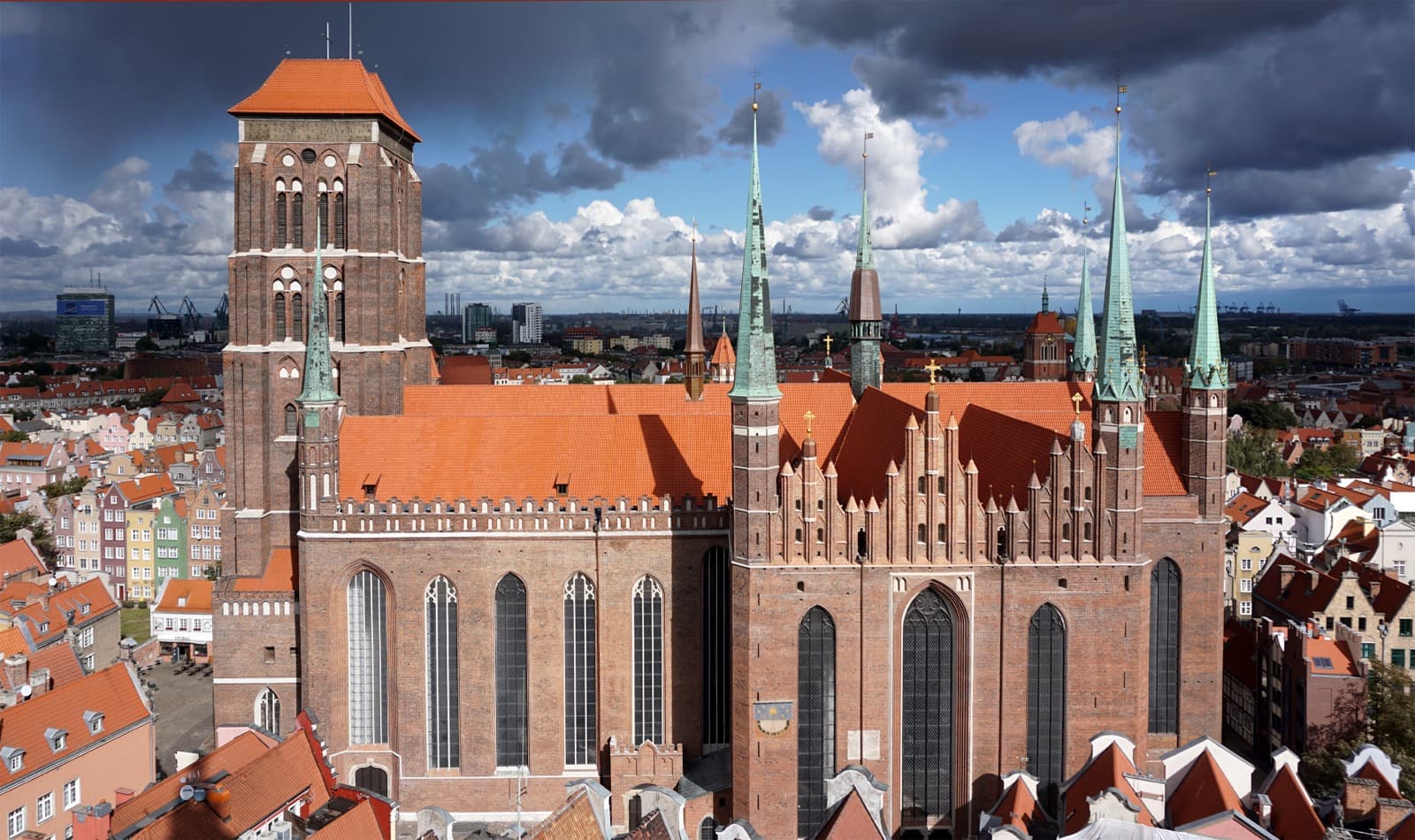
The deepest wound and the fullest recovery stand just off the square, on a short loop the walk takes from the Town Hall before it reaches Neptune. St Mary's Church, the Bazylika Mariacka, is a colossal work of Brick Gothic, one of the largest brick churches in the world. In March of nineteen forty-five its roofs burned away and about half of its vaults fell in. Reconstruction began the very next year, and the church was reconsecrated on the seventeenth of November nineteen fifty-five. That is the same patience Neptune's builders showed across nearly three decades, applied to an entire city.
So when you stand at the fountain, you are reading the tour in miniature: a maritime fortune, a ceremonial route, a catastrophe, and a resurrection. Walk the spine from the gates to the river to see all of it. Our walk "Old Town: The Royal Way the Merchants Built" covers it in seven stops over about seven hundred meters, in around an hour, and ends at the Green Gate. Start with the city page for Gdansk, then follow the Royal Way at your own pace, lingering under a gable or sitting by the water as long as you like. There is no group and no schedule. Just the god, the square, and the long story that made both.
Sources
- Tour transcript, "Old Town: The Royal Way the Merchants Built" (Roamer): fact-checked narration for every stop, rebuilt September 2026.
- History of the Gdansk fountains, Gdanskie Wody (city water company): the sixteen oh six start, the causes of delay, the first running of the water in October sixteen thirty-three and the inauguration in March sixteen thirty-four.
- Fontanna Neptuna, Gedanopedia (Gdansk Encyclopedia): casting in the city foundry, the wartime evacuation and the return in nineteen fifty-four.
- The Fountain of Neptune, Zabytek.pl (Polish heritage registry): official monument record for the Long Market fountain.
- Kosciol Mariacki, Gedanopedia: Brick Gothic scale, wartime damage of nineteen forty-five, and post-war reconsecration.
- Golden Gate and Upland Gate entries, Zabytek.pl and Gedanopedia: construction dates, the mottoes and figures, and the van den Blocke family's role along the Royal Way.
- Brama Zielona, Gedanopedia and Dwor Artusa, Gedanopedia: the Green Gate as nominal royal lodging, and the benches and exclusions of Artus Court.
Ready to experience it?
Old Town: The Royal Way the Merchants Built
60 min · 0.7 km · easy
More from Gdansk
Explore more at your own pace.
Gdansk Travel Guide: Days Needed, Getting Around, Safety, and Budget
One Day in Gdansk: A Walkable Morning-to-Evening Itinerary
Gdansk: The Hanseatic Port Where Solidarity Was Born
The European Solidarity Centre: Where a Shipyard Gate Reads Like the End of a Sentence
St Mary's Church in Gdansk: The Brick Giant That Was Protestant for Four Centuries