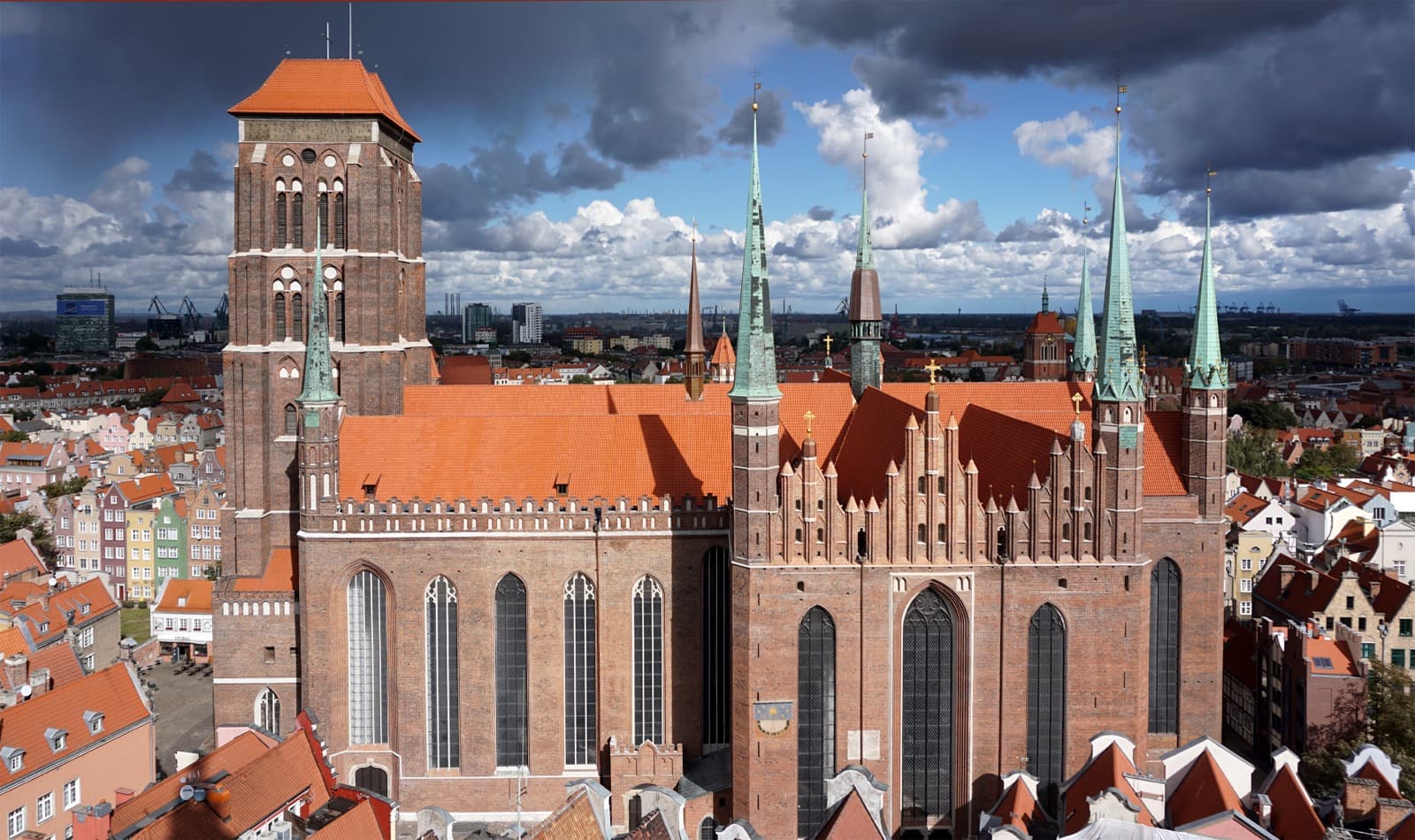
Stand at the foot of St Mary's Church in Gdansk and the first fact to hold onto is scale: this is one of the largest brick churches in the world, a Brick Gothic hall roughly one hundred and five metres long, built by generations of masons between 1343 and 1502, gutted in 1945, and raised again from its own rubble. The second fact is quieter and harder to see, and it is the one that actually explains what you are looking at. For close to four centuries, from the Reformation until the end of the Second World War, this was not a Catholic church at all. It was Protestant. Everything about the vast, pale, near-empty interior follows from that.
The church that could swallow a small city
The numbers do the persuading here. The foundation stone was laid in 1343, and the last brick of the vaults went in in 1502, which means it took roughly one hundred and fifty-nine years to finish, longer than most nations survive intact. It runs about one hundred and five metres in length, and it is often said to hold more than twenty thousand people, a church big enough for a small city. Gedanopedia, the Gdansk city encyclopedia, counts it the third-largest brick church in the world and the largest historic church in Poland, though rankings like this vary from source to source.
Brick matters. Northern Poland had no great quarries of building stone, so the masons built upward in fired clay, course after course, until the walls carried star vaults and the tower reached about seventy-eight metres. If you have the legs, the tower climb is four hundred and nine steps to a viewing platform near the top (20 zloty, checked September 2026, and closed in bad weather), and on a clear day the reward is the whole Main Town below you: the gabled merchant houses of Long Street, the golden king on the town hall spire, and the Motlawa River bending toward the Baltic.
Why the inside looks empty
Hear a stop from this walk
Green Gate: A Royal Lodging on the City's Scales
Walk in and the interior can feel almost startling. It is bright, whitewashed, and bare in a way that most great medieval churches are not. There are no dense banks of gilded Baroque altarpieces crowding every chapel. That emptiness is not neglect. It is theology, and it is history.
Two decades after the church was completed, the Reformation reached Gdansk, with Lutheran preaching in the city from 1522. After a wave of religious and political turmoil in 1525 and 1526 that overturned the city council, the first Lutheran sermon was preached in St Mary's in 1529. For a time the building was shared: from 1536 a Lutheran cleric served here alongside continuing Catholic masses. In 1557 King Sigismund Augustus gave the city council a written freedom of worship. Then in 1572 the Protestants took over the high altar, and from that point the church remained in Protestant hands until 1945, as the main Lutheran church of a city that was about 85 percent Lutheran by around 1640. In line with Lutheran practice, the medieval wall paintings were covered over and the interior was whitened. So the calm, luminous, uncluttered space you stand in is a Protestant space, the physical memory of a merchant city that ran its own affairs and chose its own confession while remaining loyal to the Polish crown. When King Stefan Batory made peace with Gdansk in 1577, after a siege that failed to take it, he confirmed that freedom of worship along with the city's other privileges.
The church only became Catholic again after the Second World War, when it was handed to the Catholic Church in 1946, during reconstruction. It was reconsecrated on 17 November 1955, with its first Catholic service in almost four hundred years, and on 20 November 1965 Pope Paul the Sixth elevated it to the rank of minor basilica, which is why its formal Polish name is the Bazylika Mariacka. Its dedication is to the Assumption of the Virgin Mary. Understand that one turn, from Catholic to Lutheran to Catholic again, and the whole building reads differently. The bareness is not a lack of something. It is the visible record of who prayed here for nearly four hundred years.
The clock, the vaults, and the wound of 1945
Two things reward a slow look inside. The first is the astronomical clock, a towering medieval timepiece about fourteen metres tall that tracks far more than the hour, built between 1464 and 1470 by Hans Düringer, a clockmaker probably from Torun. It stopped working in the sixteenth century and stood silent for centuries; volunteers began rebuilding it in 1983, it ran again in 1990, and its calendar dial turned again at the end of 2025. The second is simply the ceiling: rank upon rank of brick vaults, held up on slender piers, the engineering that let a hall church enclose so much space.
That roof is where the deepest wound of this walk lives. In the Red Army's assault on the city in March 1945, the roofs of St Mary's burned away and about half of the vaults fell in. The church was very nearly lost. Reconstruction began the very next year, in 1946. The roofs were rebuilt, the vaults were closed again, and after nearly a decade of work the church was reconsecrated in 1955. What you stand under, then, is both authentically medieval and painstakingly rebuilt, the same double truth that runs through every stop on the Royal Way outside these walls. Almost the entire Main Town was flattened in 1945 and resurrected brick by brick in the decades after, and St Mary's is the largest and most moving example of that resurrection.
Standing in front of it
If you take one idea away before you walk on, make it this: St Mary's is not a single monument but a stack of decisions made visible. The medieval city decided to build in brick on a scale that bordered on defiance. The Reformation-era city decided to whitewash its walls and hold its own altar for nearly four centuries. The postwar city, having watched the roofs burn and the vaults fall, decided that raising it again mattered enough to spend a decade on it while the country around it was rebuilding from nothing. All three decisions are still legible from where you are standing.
The church is stop four on Roamer's self-paced audio walk of the Main Town, "Old Town: The Royal Way the Merchants Built", seven stops over about seven hundred metres in around an hour, and it is placed where it is on purpose. The tour begins at the landward gates where Polish kings once rode into the city, follows the ceremonial Royal Way down Long Street to the Main Town Hall, where a king granted the city its Great Privilege in 1457, then takes a short loop up to this church before returning to Neptune's Fountain, the merchants' hall named for King Arthur, and the Green Gate by the river, where the Royal Way ends. Walking it in order lets the meaning build, so that by the time you reach these vaults you already understand the bargain between the city and its kings, and here you see it tested. You can browse the full route and the other stops among the Gdansk walking tours, or start from the city page for Gdansk and set your own pace. There is no group and no schedule. Stand under the brick as long as you like.
Sources
- St. Mary's Church, Gdansk (Wikipedia): construction dates, dimensions, 1945 damage, 1946 to 1955 reconstruction, 1965 basilica elevation, dedication to the Assumption.
- St Mary's Church, Gdansk (Medieval Heritage): Reformation timeline (1529 first Lutheran sermon, 1572 takeover of the high altar), and the whitewashing of the interior under Lutheran practice.
- Roamer tour transcript, "Old Town: The Royal Way the Merchants Built" (rebuilt September 2026): fact-checked stop text for St Mary's, including the 1557 freedom of worship and its confirmation in 1577.
- Kosciol Mariacki, Gedanopedia (Gdansk Encyclopedia): the brick-church ranking, tower height, and the 1945 damage to the roofs and vaults.
- Zegar astronomiczny and Hans Düringer, Gedanopedia: the clockmaker, the silent centuries and the rebuilding from 1983.
- Reformacja and Luteranie, Gedanopedia: Lutheran preaching from 1522, the 1557 freedom of worship, and the Lutheran share of the city around 1640.
- St Mary's Basilica, information for tourists (parish): tower ticket and bad-weather closures (checked September 2026). The 409 steps: gdansk.pl.
Ready to experience it?
Old Town: The Royal Way the Merchants Built
60 min · 0.7 km · easy
More from Gdansk
Explore more at your own pace.
Gdansk Travel Guide: Days Needed, Getting Around, Safety, and Budget
One Day in Gdansk: A Walkable Morning-to-Evening Itinerary
Gdansk: The Hanseatic Port Where Solidarity Was Born
Neptune's Fountain and the Long Market: The Heart of Gdansk's Royal Way
The European Solidarity Centre: Where a Shipyard Gate Reads Like the End of a Sentence