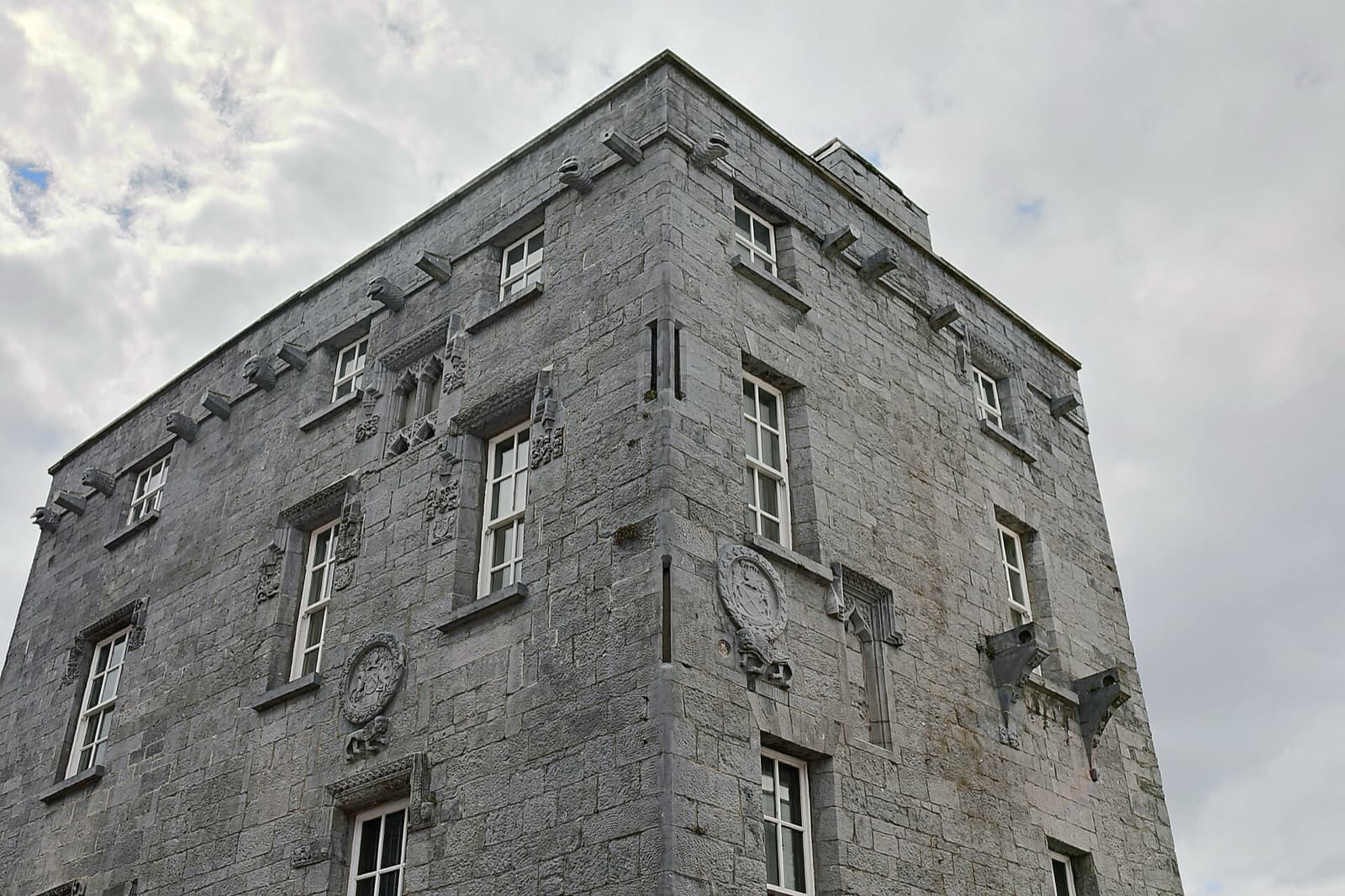
Lynch's Castle is not a castle. It is a merchant family's account book carved into limestone, and if you read its walls carefully you have already understood the argument of Galway's whole medieval core: a walled town run by fourteen merchant families who grew rich facing the Atlantic, traded across the water to Spain, and kept the native Irish of the surrounding country deliberately outside their gates. The building stands on the corner of Shop Street and Abbeygate Street Upper, dated to about the early fifteen hundreds, and it is commonly described as one of the best-preserved medieval townhouses in Ireland. Start here, read the front of it slowly, and the rest of Galway falls into place.
A fortified house, not a fortress
The word "castle" misleads. What you are looking at is a fortified stone merchant's townhouse: four storeys of worked limestone, defensible enough to protect a wealthy family and their goods, but built inside the walls of a trading town rather than out on some frontier. This was the form the Galway elite chose because it combined the three things they cared about most, wealth, defence, and status, in a single street-facing wall.
It belonged to the Lynch family, the most powerful and the most numerous of the fourteen tribes, who supplied a very large number of Galway's mayors across the centuries. That word "tribes" is the key to the entire town. The nickname Galway carries, the City of the Tribes, points to fourteen merchant families who ran the place for centuries, twelve of Anglo-Norman origin and two of Normanised Gaelic Irish stock. They were not a romantic clan society. They were a closed commercial oligarchy. A town bye-law even recorded that neither O nor Mac should strut or swagger through the streets without leave, a line that tells you exactly how prosperity and exclusion were the same story here. If you want more context on how the whole route reads this town, the hub of Galway walking tours lays out the loop.
Reading the wall
Hear a stop from this walk
Saint Nicholas' Collegiate Church: The Sailors' Church of the Tribes
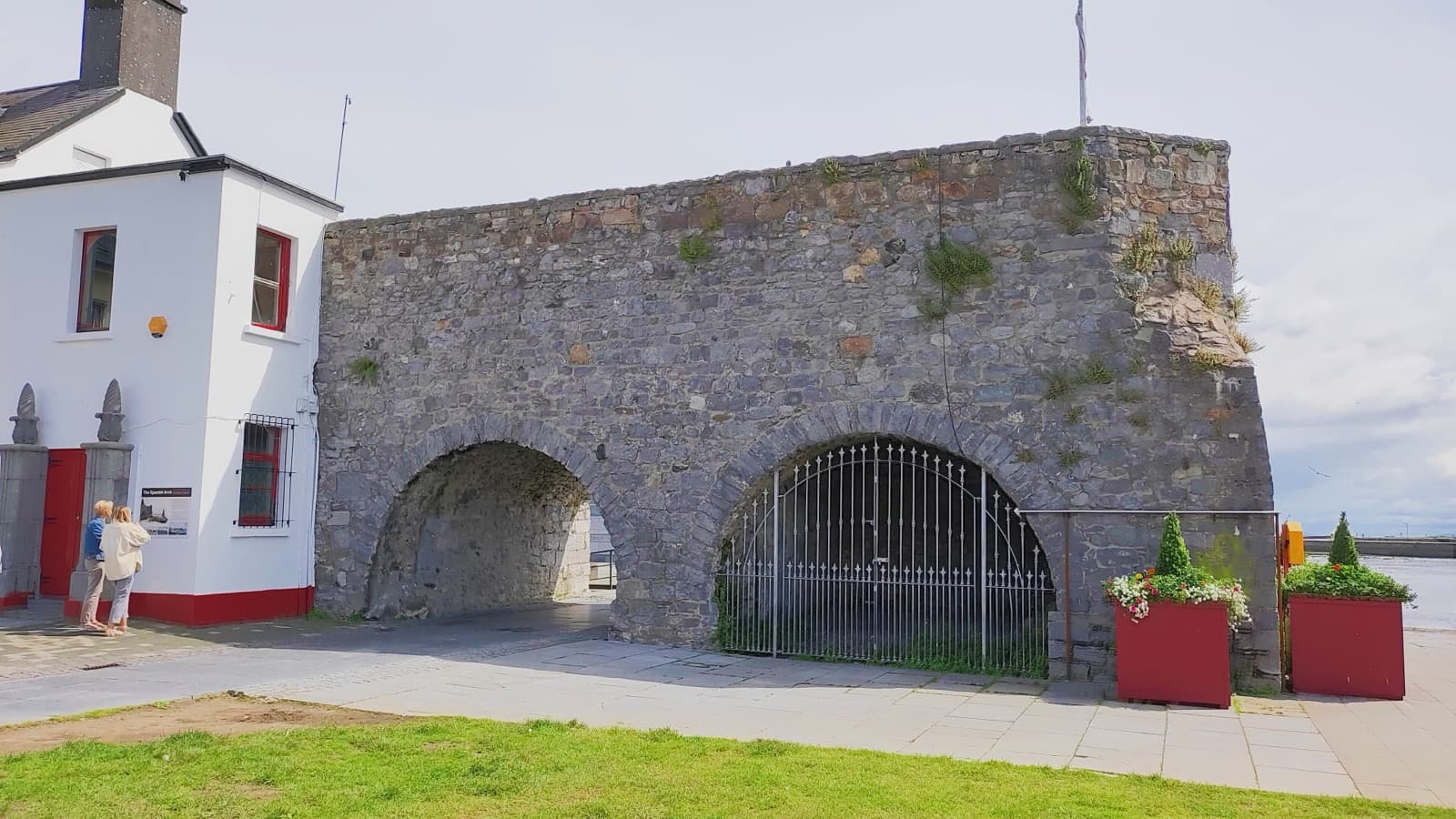
Now look up, and read the coats of arms set into the stone. The facade is worked with gargoyles, ornamental mouldings, cornices, and carved windows, and the record at Buildings of Ireland highlights the unusually rich carving around those windows as a standout feature of the house. But the arms are the sentence you want to read.
Among them you can find the arms of the Lynch family themselves, the arms of King Henry the Seventh of England, and the arms of the Fitzgeralds of Kildare. Consider what that combination is actually saying. A merchant family carved its loyalties and its connections directly into the wall of its own home: the English crown, the great Anglo-Norman dynasty of Kildare, and their own name, all in public stone at eye level on the main street. This is not decoration. It is a declaration of alignment, a statement about who the Lynches were tied to and who they served. In a town that traded across the sea but drew its authority from English and Anglo-Norman power, this wall was a way of announcing that you belonged to the right side of it.
There is a neat modern coda too. Since nineteen thirty-three the site has belonged to Allied Irish Bank, which acquired the building and restored it, and it has housed a bank for roughly a century. A working bank sits inside late-medieval Galway stone, which is oddly fitting for the house of a family that made its name in trade and money. You can view the exterior freely at any hour; the carved detail rewards a slow eye, and there is no guided group at your shoulder rushing you along.
Why one wall opens a whole tour
Lynch's Castle sits second on the Latin Quarter loop for a reason. It is the town's argument in miniature, and everything else on the route either sets it up or pays it off. The loop begins a few minutes uphill at Eyre Square, the old market green in front of the town gate where the surrounding Gaelic country came in to trade on the town's terms. It was formally presented to the town in seventeen ten by Mayor Edward Eyre, and it still carries fragments of tribal wealth, including the Browne Doorway, a carved stone doorway dated sixteen twenty-seven lifted from another tribe family's mansion.
From the castle, the route follows Shop Street down through the Latin Quarter, the living medieval spine whose narrow lanes still trace the original street layout of the Anglo-Norman walled town founded in the thirteenth century. It passes Saint Nicholas' Collegiate Church, founded about thirteen twenty, described as the largest medieval parish church in Ireland still in continuous use, dedicated to Saint Nicholas of Myra, the patron saint of sailors. A merchant port that lived by the sea chose that patron deliberately. Local legend even sends Christopher Columbus to pray here on a visit in fourteen seventy-seven, though that rests on the church's own tradition rather than any independent record, and it is worth holding the story apart from the fact.
Then the ground goes deeper, literally. Down Druid Lane lies the Hall of the Red Earl, the excavated footings of a late thirteenth-century hall built by Richard de Burgo, the Red Earl, second Earl of Ulster, of the Anglo-Norman de Burgo lords who founded Galway. His father Walter de Burgo secured the town's wall charter about twelve seventy. The hall was where taxes were collected and justice dispensed, then it was abandoned by the late fifteenth century and buried, rediscovered only in nineteen ninety-seven when archaeologists working ahead of an extension to the Revenue offices found it, along with over eleven thousand artefacts. Stand there and the sequence completes: the Norman earls founded the town, and the fourteen tribes, the Lynches chief among them, inherited and displaced their power. The carved wall on Shop Street is the tribes at their height; the buried hall is the founders they replaced.
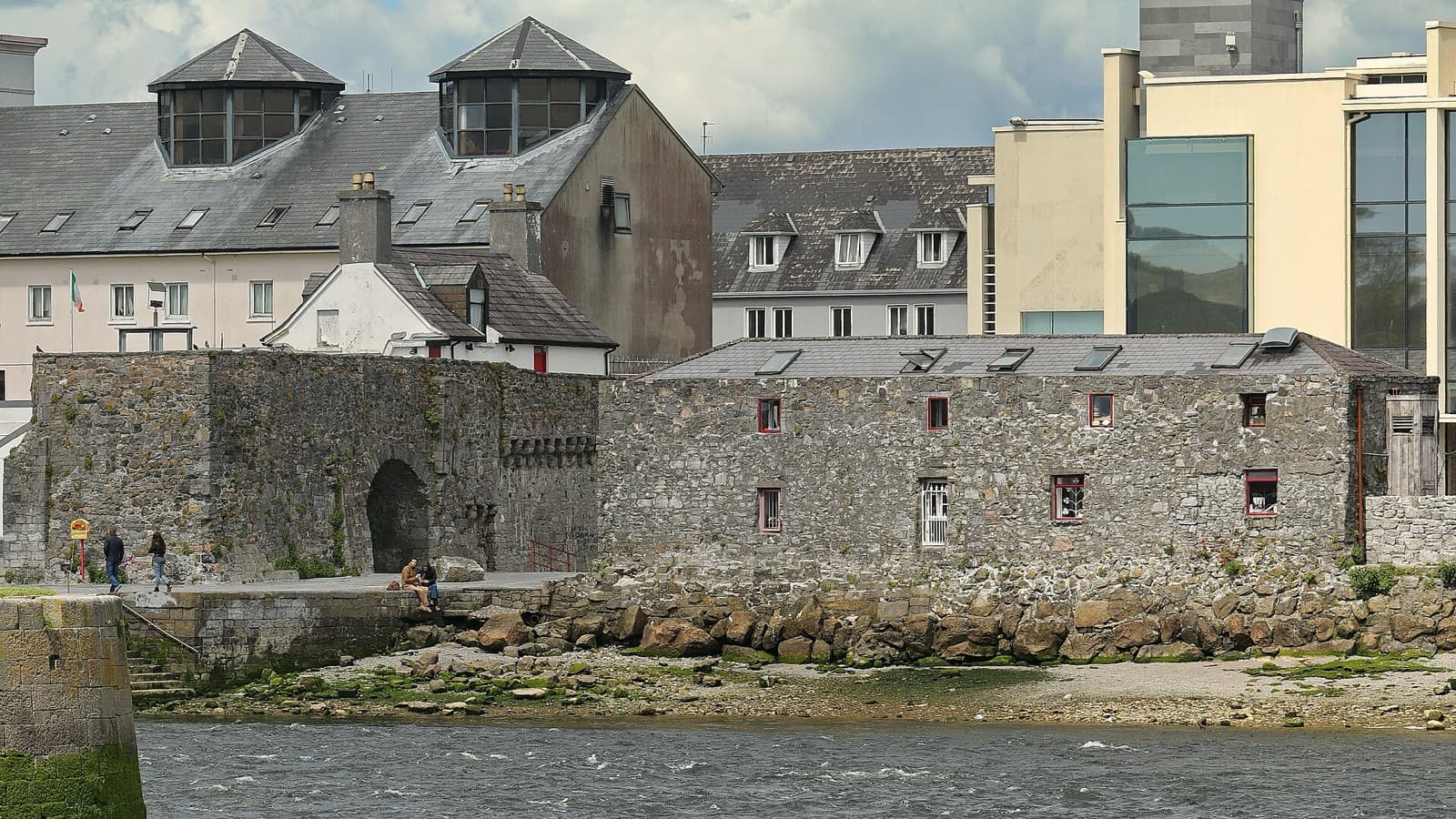
The loop closes at the Spanish Arch, a section of the town wall built in fifteen eighty-four under Mayor Wylliam Martin to protect the ships and quays, and the Long Walk, where the River Corrib, one of the shortest and fastest-flowing rivers in Ireland, rushes to Galway Bay. It is a deliberate waterfront finish. Walk it at your own pace, with no schedule and no lanyard, and the whole town reads as one continuous merchant story from the market green to the fast water. Plan the visit from the Galway city page.
Sources
- Buildings of Ireland, entry for Lynch's Castle, 40 Shop Street: the national heritage register, source for the building's date, form, and carved ornament.
- Visit Galway, Lynch's Castle and Spanish Arch pages: the city tourism board's account of the townhouse, the town wall, and the merchant tribes.
- Wikipedia, "Galway" and "St. Nicholas' Collegiate Church": overview of the walled town's medieval layout, the fourteen tribes, and the church's founding and dedication.
- Galway Civic Trust, Hall of the Red Earl: the site operator's history of the de Burgo hall, its nineteen ninety-seven rediscovery, and the excavated finds.
Ready to experience it?
Latin Quarter: The City of the Tribes
90 min · 1.7 km · easy
More from Galway
Explore more at your own pace.
Galway Travel Guide: Days, Transport, Timing, Safety, and Budget
One Day in Galway: A Walkable Itinerary From the Latin Quarter to the Sea
The City of the Tribes: How Galway's Two Banks Explain the Whole Town
The Claddagh: Galway's Fishing Village That Kept Its Own King
The Claddagh Ring: What Two Hands and a Crowned Heart Really Mean