Latin Quarter: The City of the Tribes
90 min · 1.7 km · easy
Galway is the City of the Tribes, a walled Anglo-Norman merchant town planted on the edge of Gaelic Ireland that grew rich by facing the Atlantic and trading with Spain, with an Irish-speaking fishing village that kept its own elected king sitting just across the fast river at its edge. Read the whole city from that single tension: a closed merchant town behind stone walls on one bank, and the open water, the sailors, and the Claddagh on the other. Fourteen merchant families ran a compact medieval core that still survives as the Latin Quarter. The native community across the mouth of the River Corrib governed itself apart. Walk both, at your own pace, and the town explains itself.
A closed town that lived by the open sea
The nickname carries the argument. The City of the Tribes points to fourteen merchant families, twelve of Anglo-Norman origin and two of Normanised Gaelic Irish stock, who ran Galway for centuries. They grew rich facing the Atlantic and trading with Spain, and they kept the native Irish of the surrounding country deliberately at arm's length. A town bye-law even recorded that neither O nor Mac should strut or swagger through the streets without leave. Prosperity and exclusion here are the same story, and you can read it stop by stop on the Latin Quarter walk.
That walk begins at Eyre Square, the old market green in front of the town gate, where the surrounding Gaelic country came in to trade with a town that let the world in only on its own terms. The square still holds the physical fragments of the tribes' wealth. The Browne Doorway, a carved stone doorway dated 1627, was lifted from a tribe family's town mansion and moved here in 1905, a merchant family's front door set up as a public monument. The rust-brown Quincentennial Fountain, raised in 1984, marks 500 years since Galway was incorporated as a borough in 1484, and its shapes suggest the brown sails of the Galway hooker, the traditional boat of this coast.
The account book carved in stone
Hear a stop from this walk
Saint Nicholas' Collegiate Church: The Sailors' Church of the Tribes
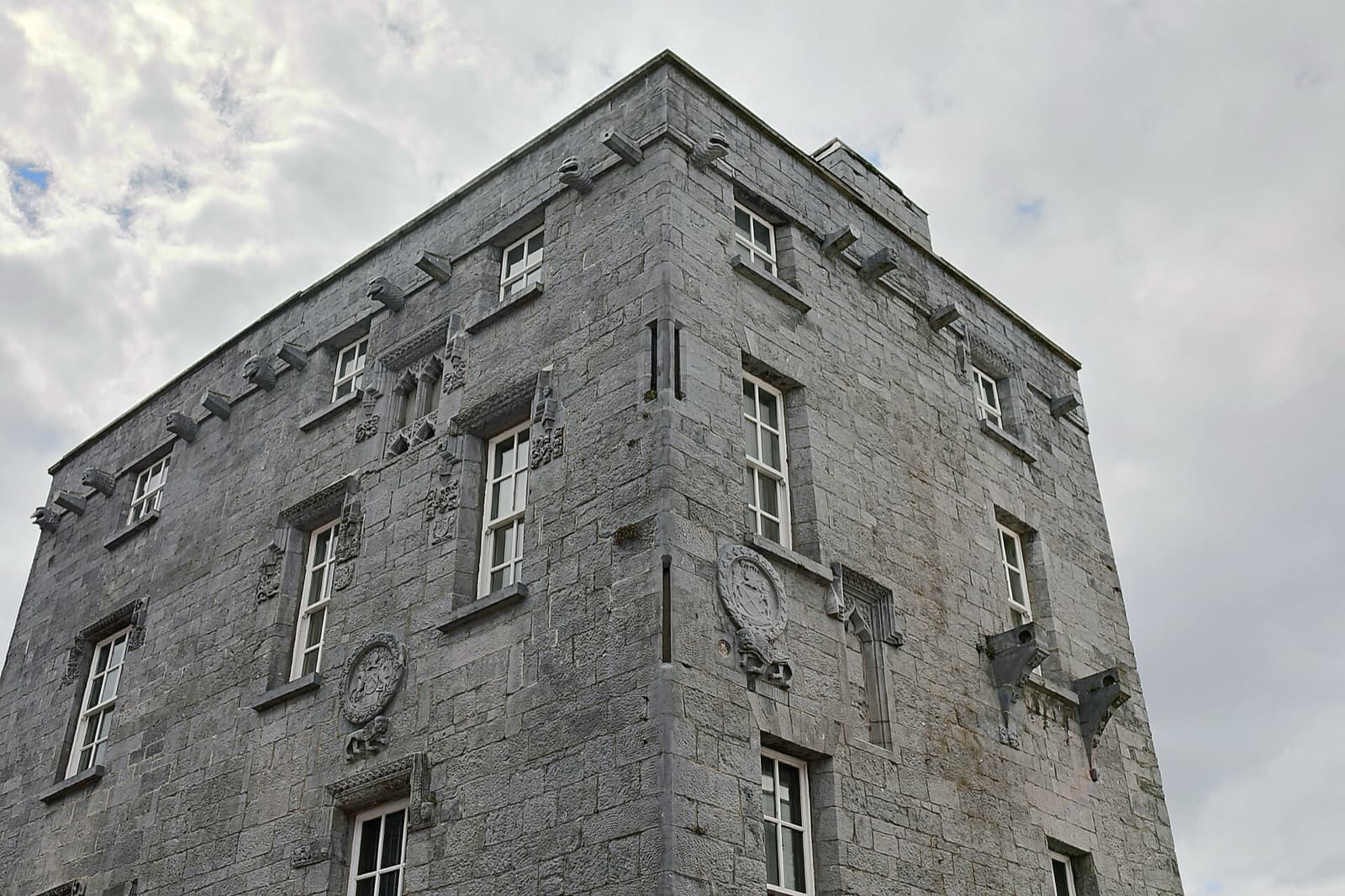
The single clearest object in the whole town is Lynch's Castle, on the corner of Shop Street and Abbeygate Street Upper. It is not a military castle but a fortified stone merchant's townhouse from about the early 1500s, commonly described as one of the best-preserved medieval townhouses in Ireland. The Lynch family were the most powerful and most numerous of the fourteen tribes and supplied many of Galway's mayors. Read the front of it slowly. The limestone rises four storeys of gargoyles, mouldings and carved windows, and set into the wall are coats of arms: the Lynch family's own, those of King Henry the Seventh of England, and those of the Fitzgeralds of Kildare. A merchant family carved its loyalties and connections straight into the wall of its home. Since 1933 the building has belonged to Allied Irish Bank, which acquired and restored it, so a working bank now sits inside late-medieval stone, fitting for the house of a family that made its name in trade and money.
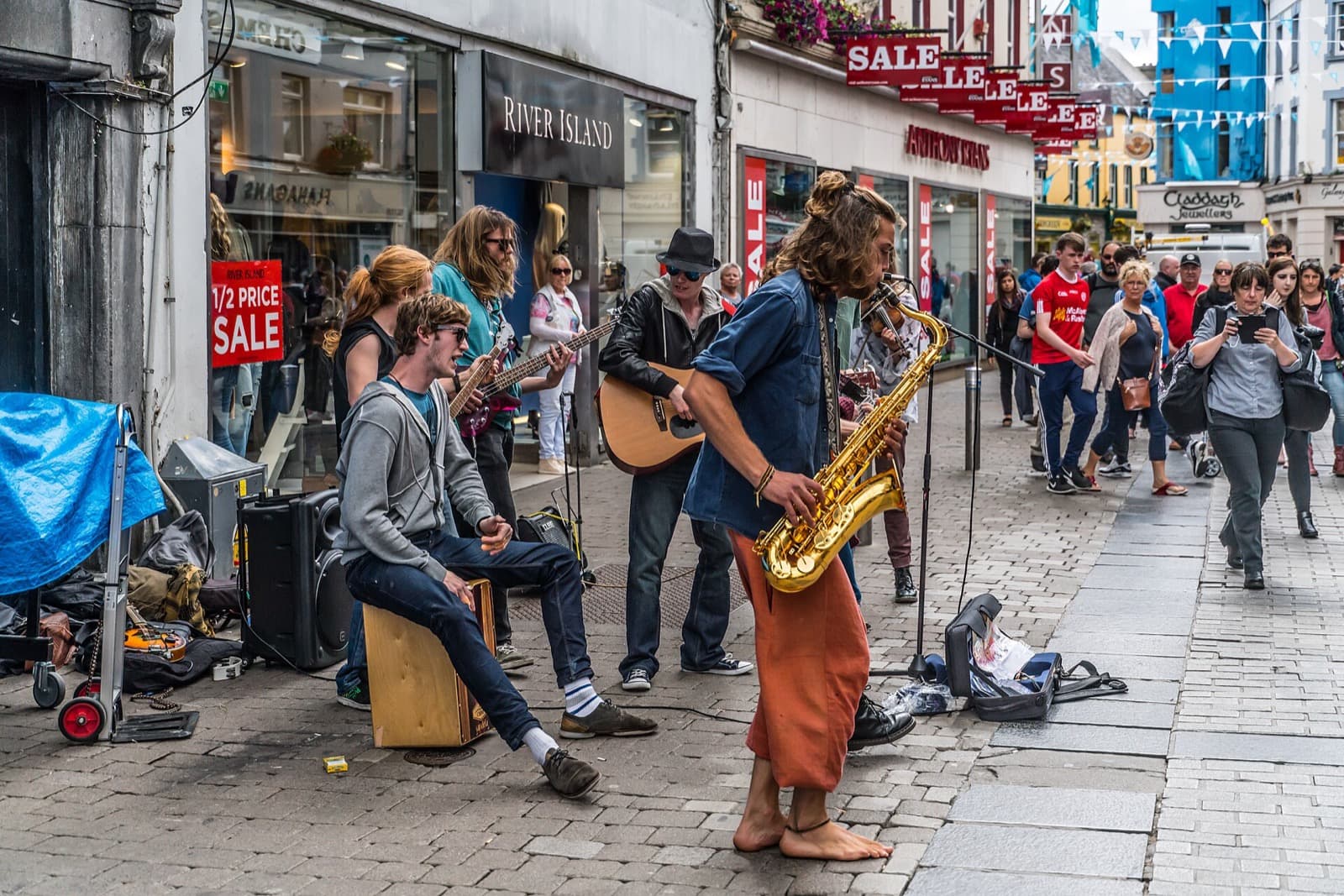
The Latin Quarter around it is the artifact itself. Shop Street, High Street, Cross Street, Quay Street and old lanes like Kirwan's Lane grew up inside the medieval walled town the Anglo-Normans founded in the thirteenth century, and the narrow streets still follow the original medieval layout. The pattern of the walking is the record. This is Gaillimh, the Irish name of Galway, and the everyday life of buskers and traditional-music sessions plays out over stone thresholds worn smooth by centuries of feet.
The sailors' church and the buried founders
A port that lived by the sea built its faith around it. Saint Nicholas' Collegiate Church was founded about 1320 and enlarged by the tribes, and it is described as the largest medieval parish church in Ireland still in continuous use as a place of worship. The dedication is the point: Saint Nicholas of Myra is the patron saint of sailors and of children, chosen deliberately by a merchant port that blessed its sailors here and sent ships toward Spain. Local legend, recorded by the church's own account, holds that Christopher Columbus prayed here on a visit in 1477. That is cherished tradition rather than documented history, and the honest telling holds the two apart while the deeper truth, a seafaring town's great church, stays real.
Beneath the modern street lies the deepest layer. The Hall of the Red Earl, off Quay Street down Druid Lane, is the excavated stone footing of a hall built in the late 1200s by Richard de Burgo, the Red Earl and second Earl of Ulster, whose Anglo-Norman de Burgo family founded Galway. His father Walter secured the town-wall charter about 1270. This was the early administrative hall where taxes were collected and justice dispensed, and it is the oldest excavated building in medieval Galway. As the tribes rose the de Burgos declined, the hall was abandoned by the late fifteenth century and buried, and it was rediscovered only in 1997 during works near the Revenue offices, a dig that yielded over 11,000 artefacts. The founding family the tribes eventually displaced lies literally under the town they started.
The seam at the water
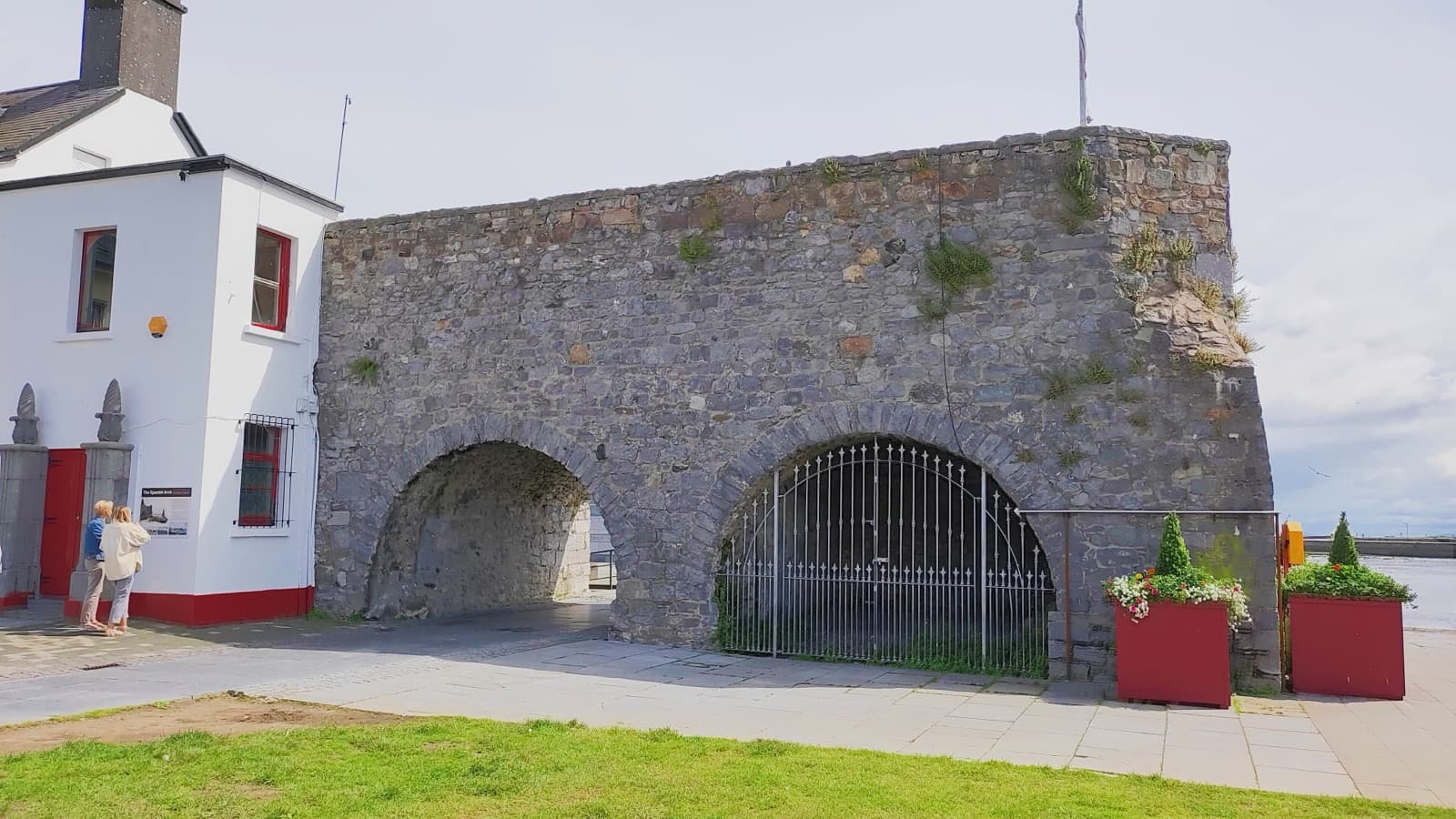
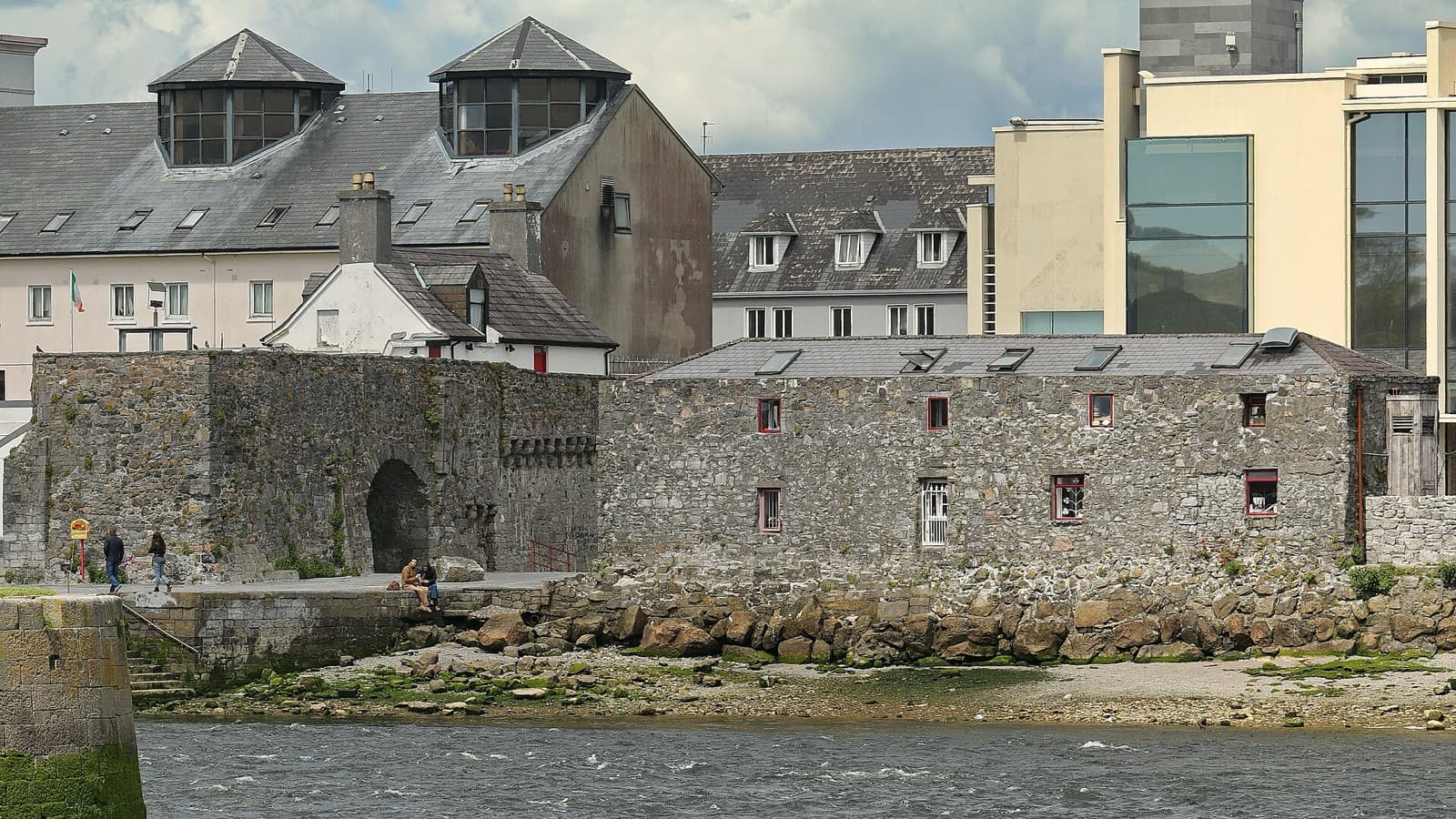
The merchant town ends at the Spanish Arch, a surviving section of the town wall built in 1584 under Mayor Wylliam Martin of the Martin tribe, extending the wall to the Corrib to protect the ships, quays and fish market. Its Irish name, Ceann an Bhalla, means the head of the wall. The familiar Spanish name is a later popular tradition of uncertain origin, but it remembers something real: Galway's long, prosperous trade with Spain. In 1755 the arch was partly damaged by the tsunami that followed the Lisbon earthquake, a distant catastrophe felt on this quay.
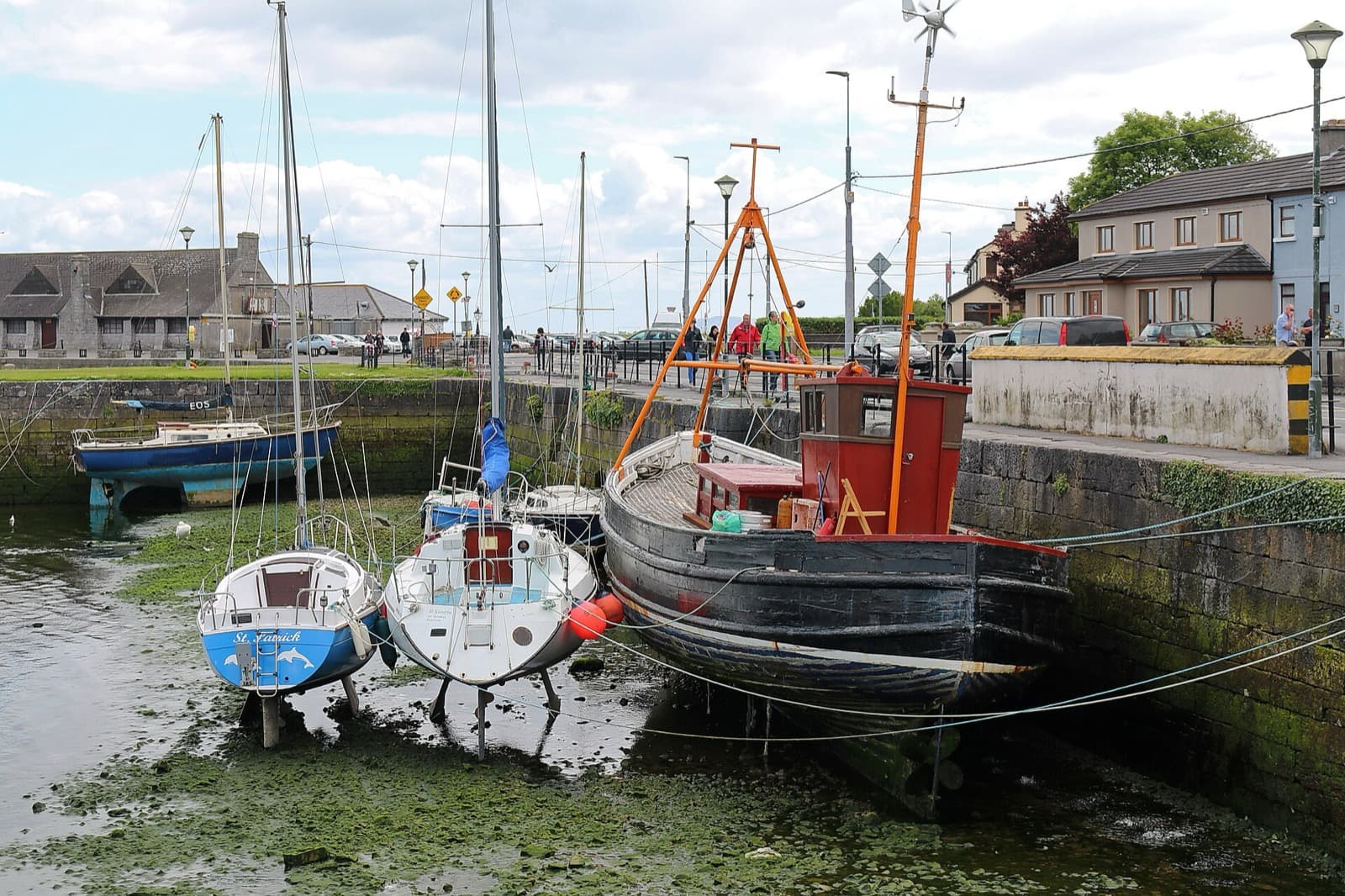
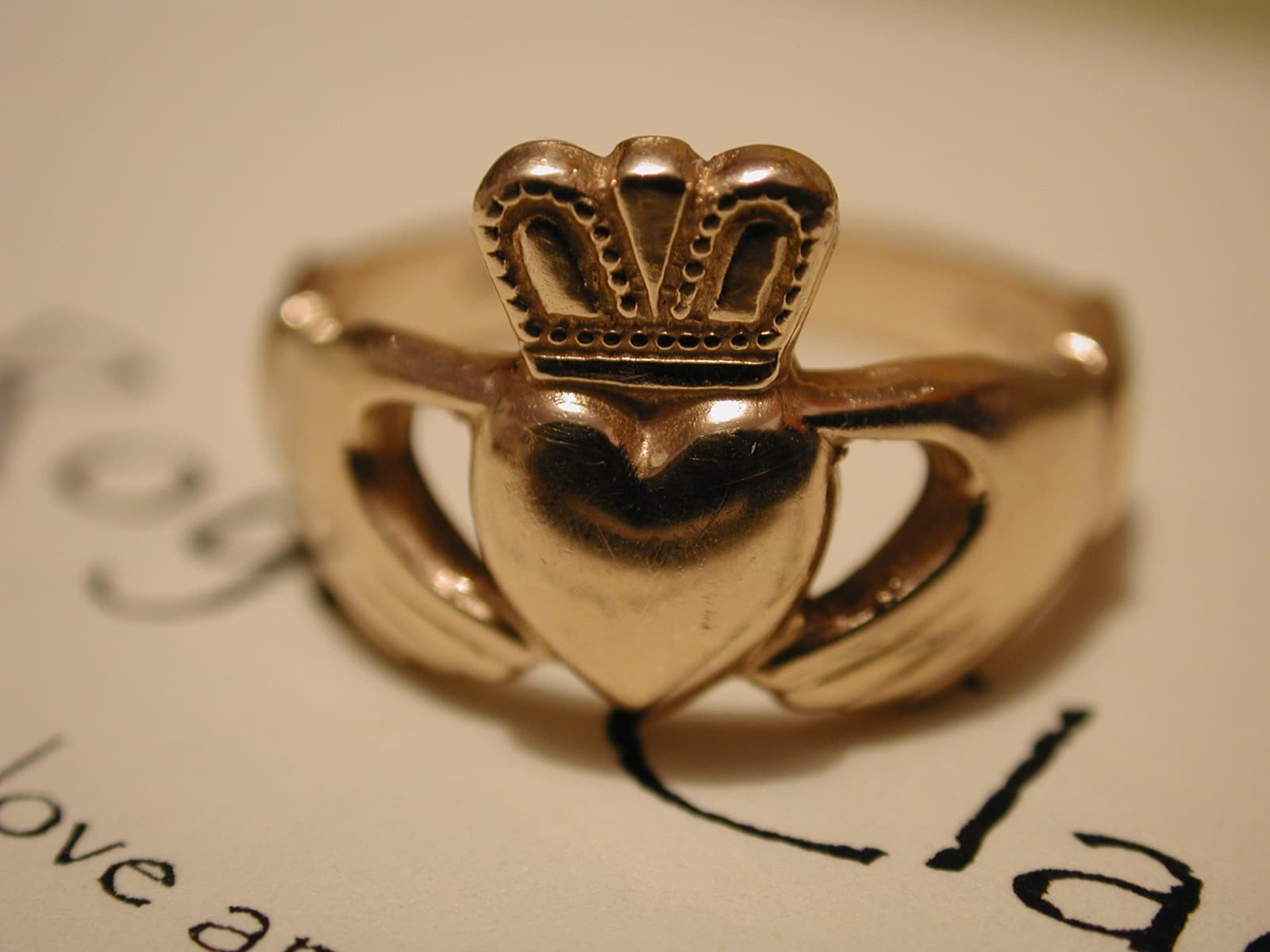
Here the two Galways face each other, and the Claddagh and waterfront walk reads the other bank. Across the fast water sat An Cladach, the Claddagh, the stony shore, an ancient Irish-speaking fishing village of thatched cottages outside the merchant walls that kept its own customs and governed itself. It was led by one of its own people, periodically elected. The historian James Hardiman wrote in 1820 that the village had from time immemorial been ruled by one of their own body, dignified with the title of mayor, and the office is popularly remembered as the King of the Claddagh. The last king, Martin Oliver, died in 1972. The village itself is gone: from 1927 the authorities deemed the cottages unhealthy, and through the 1930s the whole village was demolished and replaced by council housing. What endures is the name, the memory, and the Claddagh ring, whose clasped hands mean friendship, heart means love, and crown means loyalty. The ring descends from the wider European family of fede rings and has been made in Galway since around 1700, though the name Claddagh ring does not appear before the 1830s.
Out to the edge of the Atlantic
The water ties it together. The River Corrib is one of the shortest rivers in Ireland, about six kilometres long, yet among the fastest-flowing, the sole outlet draining Lough Corrib to Galway Bay, and second in Ireland only to the Shannon in volume. It reaches the sea by the Wolfe Tone Bridge at the Claddagh. Upstream, the Salmon Weir Bridge of 1818 is the oldest surviving bridge over the Corrib in the city, where in May and June the whole city leans over the rail to watch Atlantic salmon hold in the current before running up to spawn. Over the river rises Galway Cathedral, built between 1958 and 1965 on the site of the former town jail, dedicated in part to Saint Nicholas and often called the last great stone cathedral built in Europe. At the Claddagh basin, Nimmo's Pier, completed around 1823 by the Scottish engineer Alexander Nimmo, sheltered the russet-sailed Galway hookers of the fishing fleet. From there the Salthill Promenade runs about three kilometres west, where Galway walks to the open ocean and, by tradition, kicks the wall to be sure of coming back.
Two banks, one river, one bay. Walk both the Latin Quarter and the Claddagh waterfront and the whole town reads clearly. For the full set, see all Galway walking tours.
Sources
- Galway City Museum, exhibitions on the walled town, the Claddagh, and Spanish trade (referenced in both tour transcripts)
- James Hardiman, History of the Town and County of the Town of Galway (1820), on the elected leader of the Claddagh
- Buildings of Ireland (National Inventory of Architectural Heritage), records for Lynch's Castle and Nimmo's Pier
- Hall of the Red Earl, Galway Civic Trust, on the 1997 excavation and the de Burgo founders
- Galway Cathedral, official history of its 1958 to 1965 construction and 1965 dedication
Frequently asked questions
- Why is Galway called the City of the Tribes?
- The nickname refers to fourteen merchant families who ran the walled town for centuries, twelve of Anglo-Norman origin and two of Normanised Gaelic Irish stock. They grew rich facing the Atlantic and trading with Spain, and a town bye-law even recorded that neither O nor Mac should strut through the streets without leave. The most powerful family, the Lynches, supplied many of Galway's mayors.
- What is the Claddagh and why did it have a king?
- The Claddagh, from the Irish An Cladach meaning the stony shore, was an ancient Irish-speaking fishing village on the west bank of the Corrib's mouth, sitting outside the merchant walls with its own customs. It governed itself under a periodically elected leader popularly remembered as the King of the Claddagh. The historian James Hardiman recorded the office in 1820, and the last king, Martin Oliver, died in 1972.
- Is the Spanish Arch actually Spanish?
- No. The Spanish Arch is a section of Galway's town wall built in 1584 under Mayor Wylliam Martin, and its Irish name Ceann an Bhalla simply means the head of the wall. The familiar Spanish name is a later popular tradition of uncertain origin, though it remembers Galway's real, long, and prosperous trade with Spain. The arch was partly damaged in 1755 by the tsunami from the Lisbon earthquake.
- How old is Galway Cathedral?
- Galway Cathedral looks centuries old but was built between 1958 and 1965, well within living memory, on the site of the former town jail on Nun's Island. It is built of local limestone in Renaissance Revival style and is often called the last great stone cathedral built in Europe. It is dedicated in part to Saint Nicholas, patron saint of seafarers and merchants.
- What does the Claddagh ring mean?
- The Claddagh ring shows two hands clasping a heart with a crown above it: the hands mean friendship, the heart means love, and the crown means loyalty. It takes its name from the Claddagh village and descends from the wider European family of fede rings, whose clasped-hands motif traces back to ancient Rome. Rings of this kind have been made in Galway since around 1700, though the name Claddagh ring does not appear before the 1830s.
Ready to experience it?
Latin Quarter: The City of the Tribes
90 min · 1.7 km · easy
More from Galway
Explore more at your own pace.
Galway Travel Guide: Days, Transport, Timing, Safety, and Budget
One Day in Galway: A Walkable Itinerary From the Latin Quarter to the Sea
Lynch's Castle: Reading Galway's Merchant Power in Carved Stone
The Claddagh: Galway's Fishing Village That Kept Its Own King
The Claddagh Ring: What Two Hands and a Crowned Heart Really Mean