Most colonial architecture is an architecture of power. It announces who is in charge. The government house is bigger than everything around it, the barracks are visible from the road, the church tower is taller than the mosque or the pagoda. Da Lat is not built that way. The colonial core of Da Lat is an architecture of homesickness, and once you see it as longing rather than dominance, the whole town reads differently.
The Empire's Escape walk moves through six of these buildings in sequence, but the argument holds whether you walk them or not. Da Lat was imagined by the French as a refuge from the heat of the lowlands they governed. The point was never to impress the Vietnamese. The point was to build a place where the French could stop feeling like they were in Vietnam at all.
A school named for a note about the weather
Start where the town starts, at the Lycee Yersin, because the building carries the founder's name and the founder is the reason any of this exists. The school honors Alexandre Yersin, the bacteriologist who climbed this plateau in 1893 and urged the colonial administration to build a mountain sanatorium on it. The town grew from that suggestion. The school came later: created by decree on July 16, 1927, opened that September as the Petit Lycee de Dalat, and renamed the Lycee Yersin on May 10, 1935.
Look at the shape of it. The French architect Paul Moncet gave the school a long crescent of red brick, imported all the way from Europe rather than made locally, with a bell tower rising some fifty-four metres. If you look closely at the brickwork you can still find the faint traces where a large clock once sat. This is the first tell. A school on a Vietnamese mountain did not need European brick. It wanted it. The building's classrooms taught the last emperor of Vietnam, Bao Dai, and a future king of Cambodia, and today it serves as a teachers' college with interior access restricted to visitors, so the exterior is the landmark. But the material is the message: a piece of France, shipped up a mountain, curved against the pines.
A railway built to deliver comfort
Hear a stop from this walk
Hoa Binh Square: The City That Kept the Stage
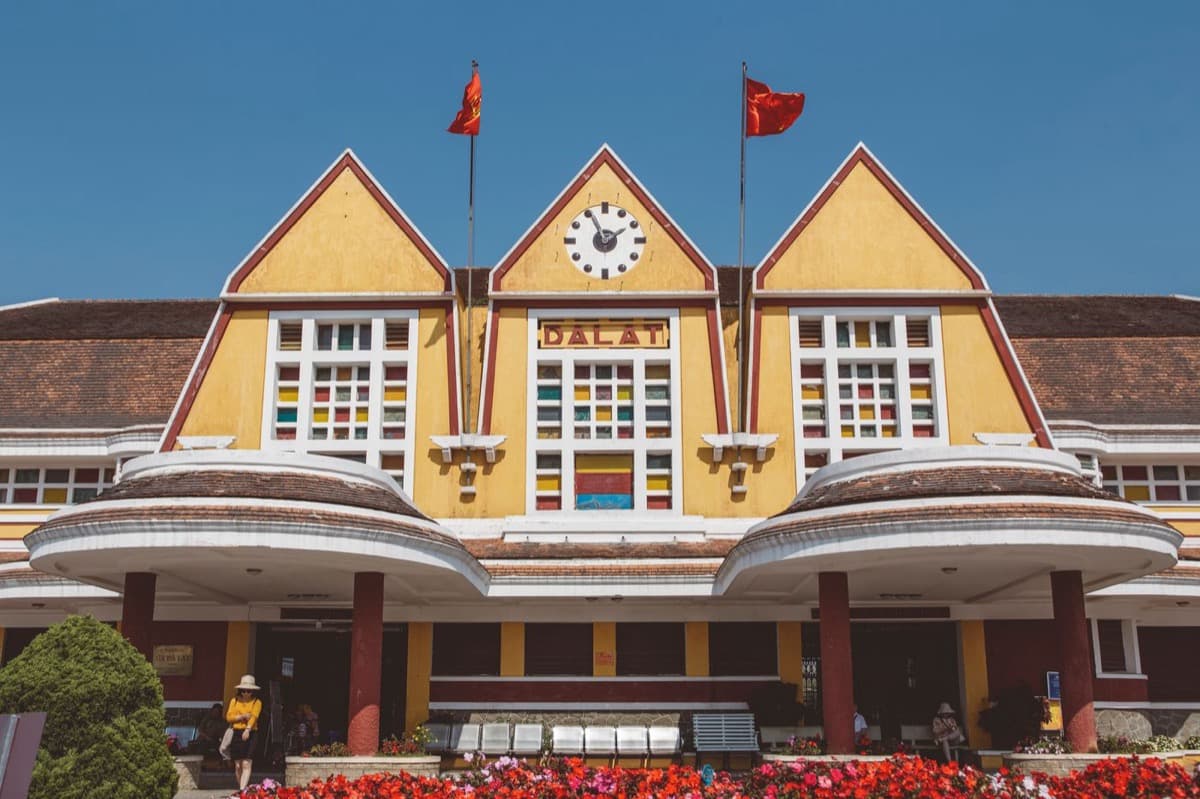
The station is the reason the whole illusion could work. To turn a cool plateau into a working refuge, the French had to haul themselves up out of the delta heat, and that meant a railway that could climb a mountain. The Da Lat to Thap Cham line ran about eighty-four kilometres from the coastal plain to this ridge, rising roughly fourteen hundred metres along the way. Ordinary rails cannot grip a slope that steep, so the engineers built three rack sections, a toothed cog rail down the center that a locomotive's gear could bite into, and cut five tunnels through the highlands.
That is an extraordinary amount of engineering to spend on comfort. The station itself was designed in 1932 and opened in 1938, the work of the architects Moncet and Reveron, and its three steep Art Deco roofs are said to stand for the three summits of Lang Biang mountain while echoing the tall communal houses of the Central Highlands peoples. Some travelers have seen in them a memory of a seaside station in Normandy. Either reading serves the same homesickness. If the station is where you want to slow down, the Art Deco terminus and its cog railway reward a longer look at exactly how much the French were willing to build to feel cool.
Villas as letters home
The clearest expression of the whole impulse is the quietest. Leave the grand public buildings and walk into the streets where the French actually lived. Da Lat still holds well over one thousand villas from the colonial era, and what strikes you first is how little they belong to the tropics. Steep gabled roofs, tall chimneys, wooden shutters, stone porches in gardens of pine and hydrangea. These are the rooflines of Normandy, of the Basque country, of Savoy, transplanted onto a Vietnamese hillside by people who missed home and had the power to rebuild it.
The villas along Tran Hung Dao street were considered fine enough to be ranked by the International Union of Architects, and they housed French colonial administrators and their families right up until 1975. Nearby on Le Lai street, a cluster of fifteen villas went up between 1929 and 1938. Read them as letters home. Each house is a small argument that this ridge was really somewhere in provincial France, and the argument was addressed not to the Vietnamese but to the homesick people who lived inside.
The reward at the top
Above Xuan Huong Lake stands the payoff of the whole climb: the palace hotel, opened in 1922 as the Lang-Bian Palace Hotel. Its design predates the First World War, but the war and an unfinished mountain road delayed it for the better part of a decade. When it opened it was conceived to rival the great hotels of the region, Raffles in Singapore, the Oriental in Bangkok. Guests arriving from the heat and dust of the lowlands found an orchestra, a cinema, tennis courts, a dance hall, and horses to ride, all of it above a lake the French had shaped into the view they wanted. This was what the cog railway was for. For a few days you could pretend you were taking the mountain air at a resort somewhere in Europe.
Even the town's worship faced homeward. The cathedral dedicated to Saint Nicholas was built slowly between 1931 and 1942, its stained glass shipped from France, but nobody in Da Lat calls it Saint Nicholas. They call it Con Ga, the Chicken Church, because a rooster weathervane was set atop its spire, with its cross, on November 14, 1934. The diocese reads the rooster as the Gospel cock that called Peter to repentance. But a rooster is also the Gallic cock, the old emblem of France. On the highest point of the church, France quite literally set its own symbol to turn above the pines, facing home.
The city that kept the stage
The walk ends where the argument turns. Hoa Binh Square was the French Place du Marche, the commercial heart of the hill station. But between 1958 and 1960 a new and larger market building went up just below it, and it was drawn not by a French architect but by a Vietnamese one, Nguyen Duy Duc, who shaped it into one of the country's first multi-storey markets. The grand connecting staircase was the work of Ngo Viet Thu, who had just won the First Grand Prix de Rome in 1955 and would later design Independence Palace in Saigon. The square lost its French name in 1953 and became Hoa Binh, which means Peace.
That is the quiet answer to the whole question. An empire built a stage set on this mountain to look like somewhere else. But a stage set only matters if people keep living on it, and the people who live on it now are Vietnamese. They inherited the ridge, kept the beautiful bones, and filled them with their own days. The same reclamation runs through the manufactured lake and the garden city on the other side of town, where a colonial dam became the most beloved feature in Da Lat. The homesickness built the town. The city that inherited it is not homesick at all. It is home.
Ready to experience it?
Hill Station: The Empire's Escape
180 min · 8 km · hard
More from Dalat
Explore more at your own pace.
Da Lat Travel Guide: How Many Days, Getting Around, When to Go (2026)
How to See Da Lat: A Borrowed France That Vietnam Kept
One Day in Da Lat: A Walkable Hill-Station Itinerary (2026)

What to Eat in Da Lat: A Food Guide (2026)
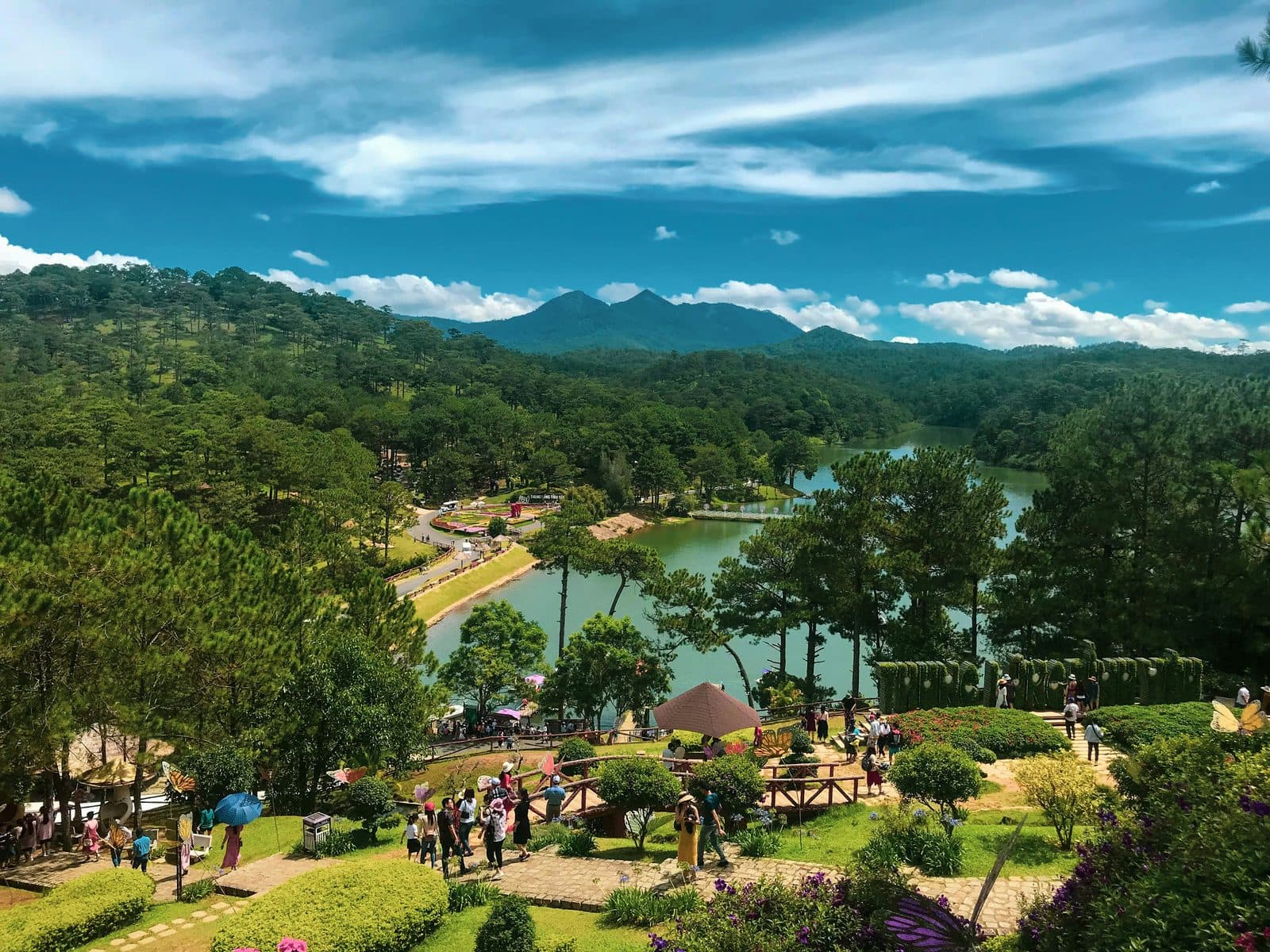
The Manufactured Paradise: Da Lat's Beloved Lake Was Once a Stream