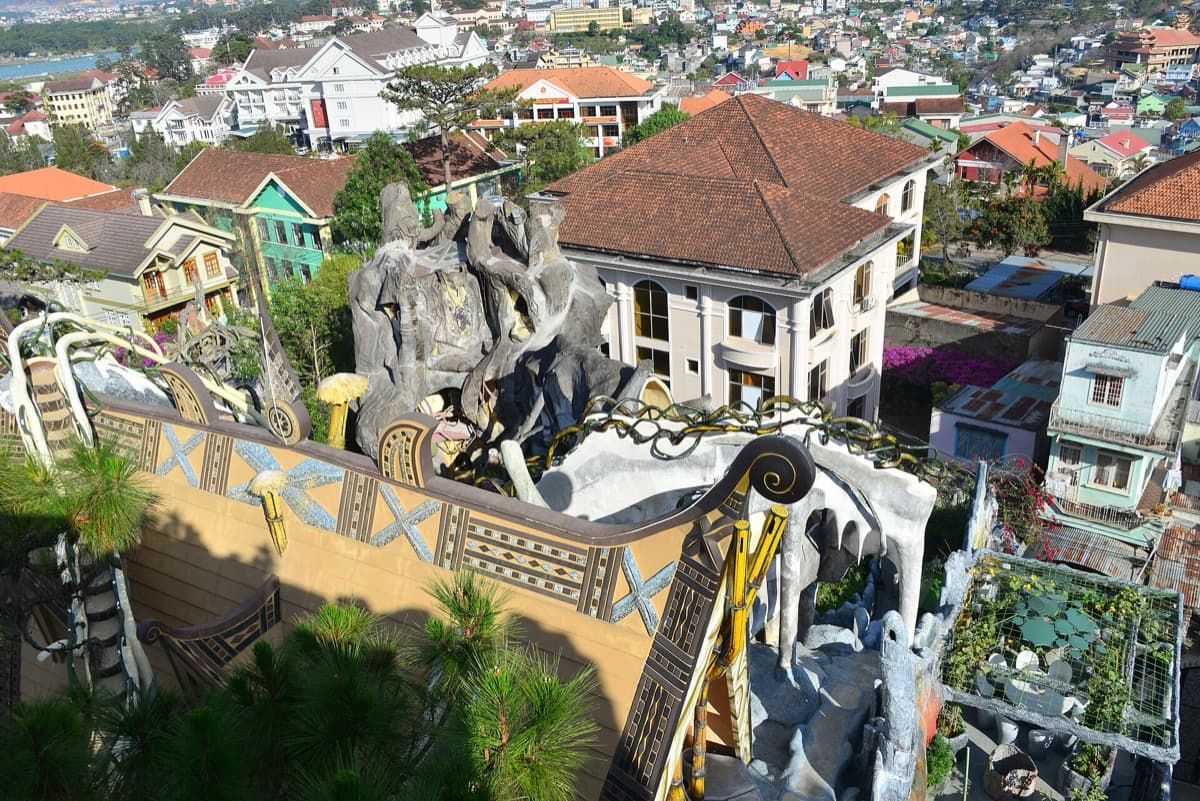
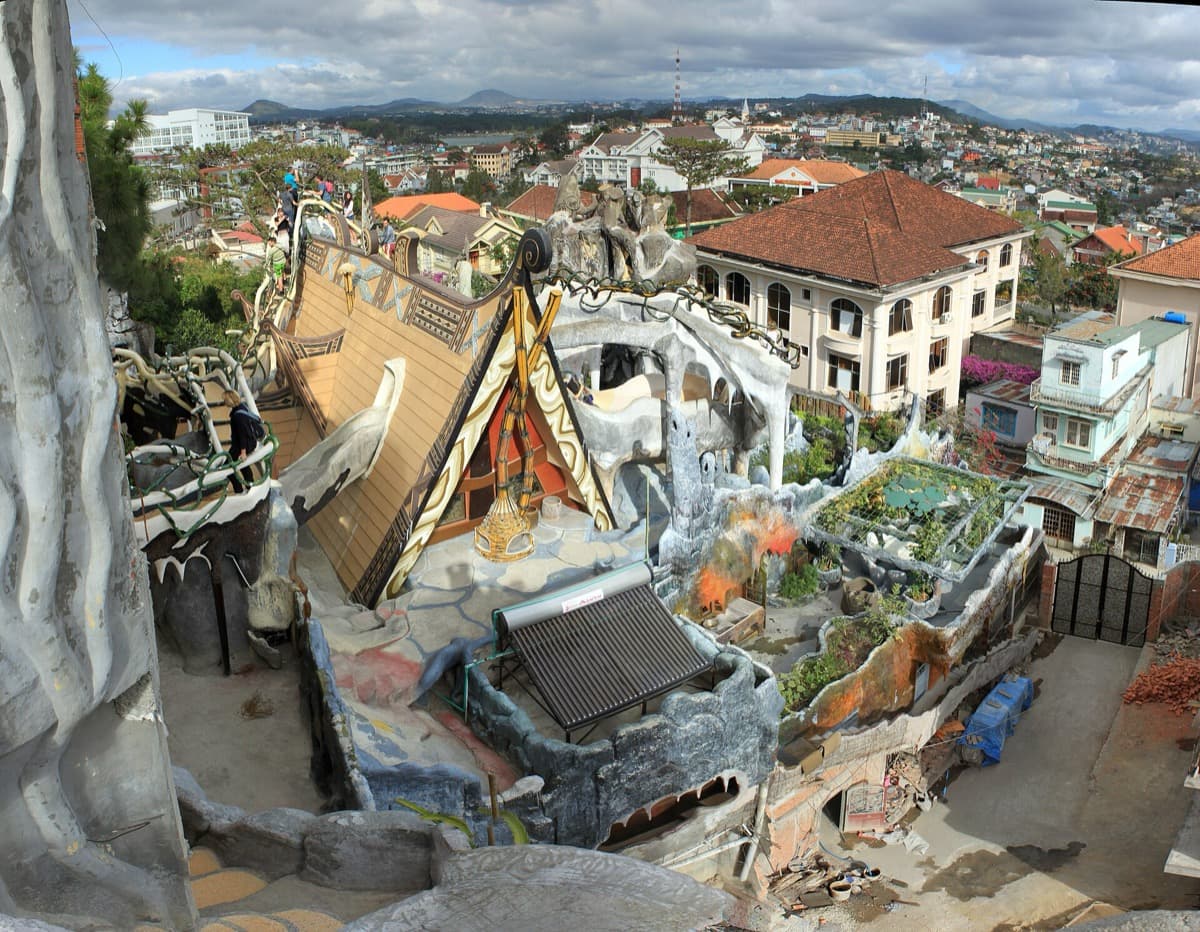
The building at the corner of Huynh Thuc Khang street in Da Lat does not look built so much as grown. Its exterior resembles a five-story-high banyan tree, poured in concrete and troweled by hand into bark and roots and branches, with hollowed rooms tucked inside the trunk and stairways that climb the outside like vines. Visitors named it the Crazy House almost as soon as they saw it, and the name stuck so firmly that its architect eventually adopted it herself. Its formal name is the Hang Nga Guesthouse, and it is a working hotel as well as an attraction, one of ten themed guest rooms available to anyone willing to sleep inside a concrete tree.
It is the strangest stop on the Sacred and Strange walk, and it is easy to file away as a novelty, a Vietnamese answer to Gaudi built for the camera. That reading misses the person who made it. The Crazy House is not the work of an eccentric outsider. It is the work of someone born very close to the center of Vietnamese power, and knowing who she is changes what the building means.
The architect
The Crazy House was designed and built by Dang Viet Nga, a Vietnamese architect who holds a doctorate in architecture. Her training was serious and long. She studied in China, then graduated from Moscow Architectural University between 1959 and 1965, and went on to earn her PhD in architecture in the Soviet Union between 1969 and 1972. By the time she settled in Da Lat and began the house, she had spent well over a decade inside the most rigorous architectural academies the socialist world had to offer.
She is the daughter of Truong Chinh, one of the most consequential figures in twentieth-century Vietnam. Truong Chinh served as general secretary of the Communist Party from 1941 to 1956, the years that carried the movement through the war against the French and the founding of North Vietnam, and he returned to the post briefly in 1986 after the death of Le Duan. Between those two terms he chaired the standing committee of the National Assembly and, from 1981 to 1987, served as head of state as chairman of the Council of State. To grow up in his household was to grow up at the summit of the Vietnamese establishment.
Set those two facts side by side and the Crazy House stops being a curiosity. A woman raised at the center of a party built on discipline, on collective effort, on the straight lines of socialist planning, chose to spend her life pouring a building with no straight lines in it at all. The house is a private argument as much as a public attraction.
How she built it
Hear a stop from this walk
Du Sinh Church: A Temple With a Cross
The most telling thing about Nga's method is that she does not work from standard architectural plans. Rather than drafting blueprints, she produces paintings, and hires non-professional local craftsmen to translate those paintings directly into structural elements in concrete. There is no set of measured drawings to build from. The craftsmen shape the material against the image and against her direction on site, which is why no two surfaces in the house repeat and why the whole thing reads as sculpture rather than construction.
Her stated inspirations were the natural environment around Da Lat and the work of the Catalan modernist Antoni Gaudi, and the debt to Gaudi is legible everywhere: the melting, organic forms, the refusal of the right angle, the sense that the building is a living organism caught mid-growth. But the raw material is pure Da Lat. This is a town near fifteen hundred metres, wrapped in pine forest, cool and misty, and Nga built her tree to belong to that specific mountain rather than to any city Gaudi ever knew.
Inside, the ten guest rooms carry animal motifs, and the stairways and hallways are designed to resemble tunnels and caves, so that moving through the house feels like climbing inside the tree rather than up a staircase. It is disorienting on purpose. You lose your sense of which floor you are on, which is part of the experience she designed.
The debt that opened the doors
The Crazy House began as a personal project, not a business. It was Nga's own house and her own idea, and building it at this scale ran up a debt that a private residence could not carry. To cover the cost, she opened it to paying visitors in 1990, and it has been both an attraction and a working guesthouse ever since. The entry fee today is a small sum, around sixty thousand Vietnamese dong, roughly two to three United States dollars, and rooms rent overnight for a modest rate.
That origin matters to the thesis of the walk it anchors. The house was never conceived as a museum or a monument. It was one woman's dream, and the ticket booth exists because the dream outgrew her budget. In 2009 the building was listed by China's People's Daily among the world's ten most bizarre buildings, and the fame has kept it solvent. But the visitors climbing its stairs are, in a real sense, still paying off the cost of a private vision.
A private heaven, like all the others
Read on its own, the Crazy House is a delightful oddity. Read as the fourth stop on the Sacred and Strange walk, it becomes the sharpest example of a pattern that runs through the whole route. Da Lat is a young town, invented from a doctor's note about the air, and its ridges filled up with people who each raised an idiosyncratic paradise on the same cool hills. A monk founded the town's mother temple. French nuns roofed a convent like a Central Highlands longhouse. A royal priest shaped a Catholic church like a Buddhist temple. And a Party leader's daughter, trained in Moscow, poured a concrete tree and invited the world up its stairs.
The others called it faith. Nga called it art. The impulse is the same: to build something personal and slightly impossible on a mountain that was new enough to allow it. That is why the Crazy House belongs on a walk that also visits pagodas and churches. It is not the exception to Da Lat's sacred buildings. It is their secular twin. For how it fits the full walk, and how that walk sits beside the city's colonial and garden routes, start with How to See Da Lat. Then come climb the tree.
Sources
- Wikipedia, "Hằng Nga Guesthouse."
- CNN Travel, "Vietnam's 'Crazy House': The weird story of Hang Nga Guesthouse in Dalat."
- daihoidang.vn (Communist Party of Vietnam), "Truong Chinh: Party General Secretary."
- Encyclopedia.com, "Truong Chinh."
- People's Daily (as cited by Wikipedia), 2009 list of the world's ten most bizarre buildings.
Ready to experience it?
Crazy House: Sacred and Strange
180 min · 8 km · hard
More from Dalat
Explore more at your own pace.
Da Lat Travel Guide: How Many Days, Getting Around, When to Go (2026)
How to See Da Lat: A Borrowed France That Vietnam Kept
One Day in Da Lat: A Walkable Hill-Station Itinerary (2026)
What to Eat in Da Lat: A Food Guide (2026)
The Empire of Homesickness: How France Built Da Lat to Hide From Vietnam