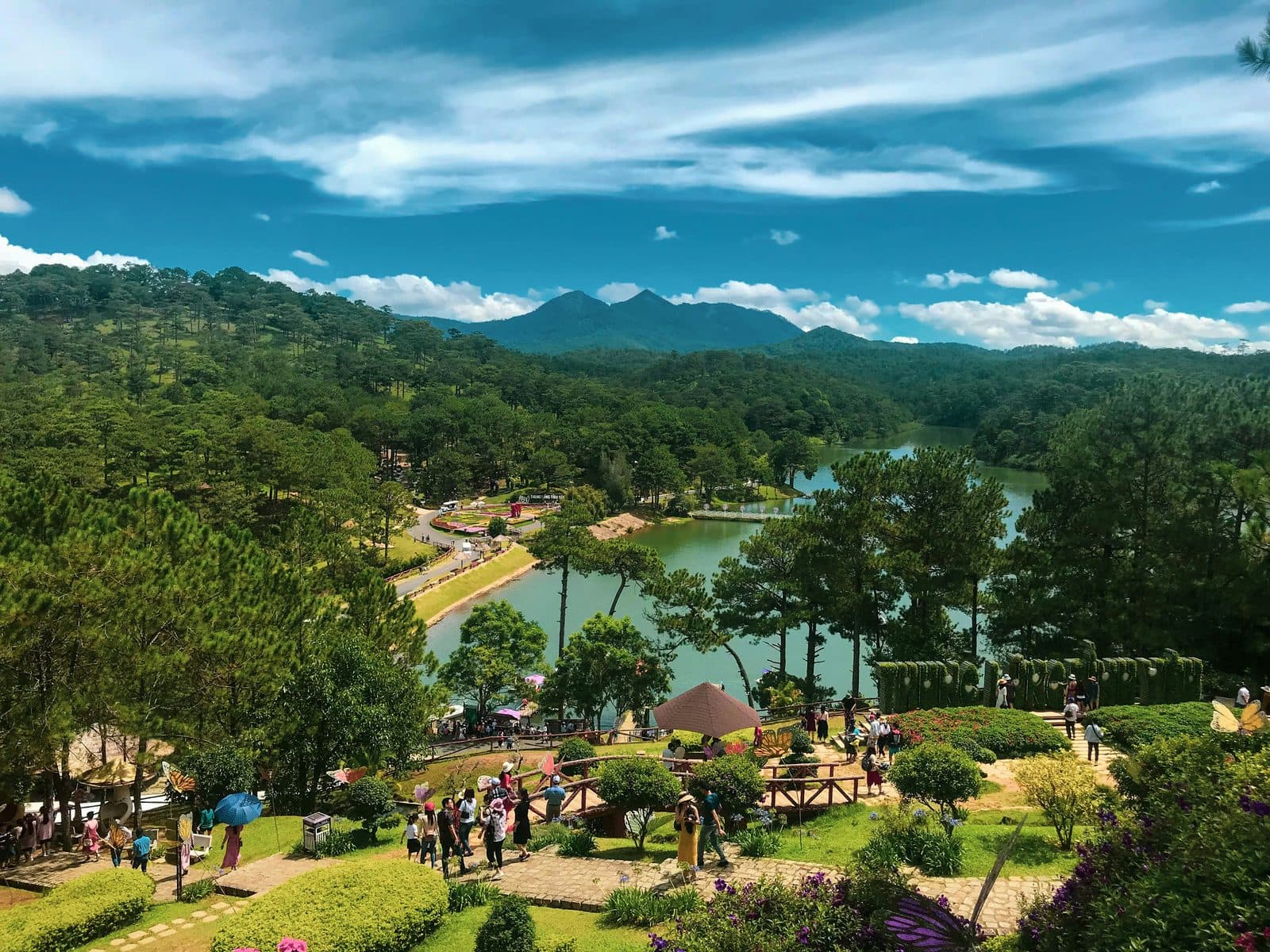
Here is a fact that should change how you look at Da Lat. The lake at the center of the city, the long crescent of water everyone photographs, the thing couples in wedding clothes pose in front of on a cool morning, did not exist a little over a century ago. Before 1919 there was only the Cam Ly stream running down the valley. Someone decided the stream should become a lake, and then the town fell in love with the reservoir behind the dam.
That is the quiet engine of the Garden City walk, which runs west to northeast across town, from the last emperor's summer villa down into the Vietnamese-built downtown, across the wall that makes the lake, along the water, and out to the flower gardens. The colonial bones are everywhere, the dam and the boulevards and the villa, but the life inside them belongs entirely to Vietnam. If the Empire's Escape is the story of how the French built their homesick town, this is the story of what the country did with it after the empire left.
A palace the town simply absorbed
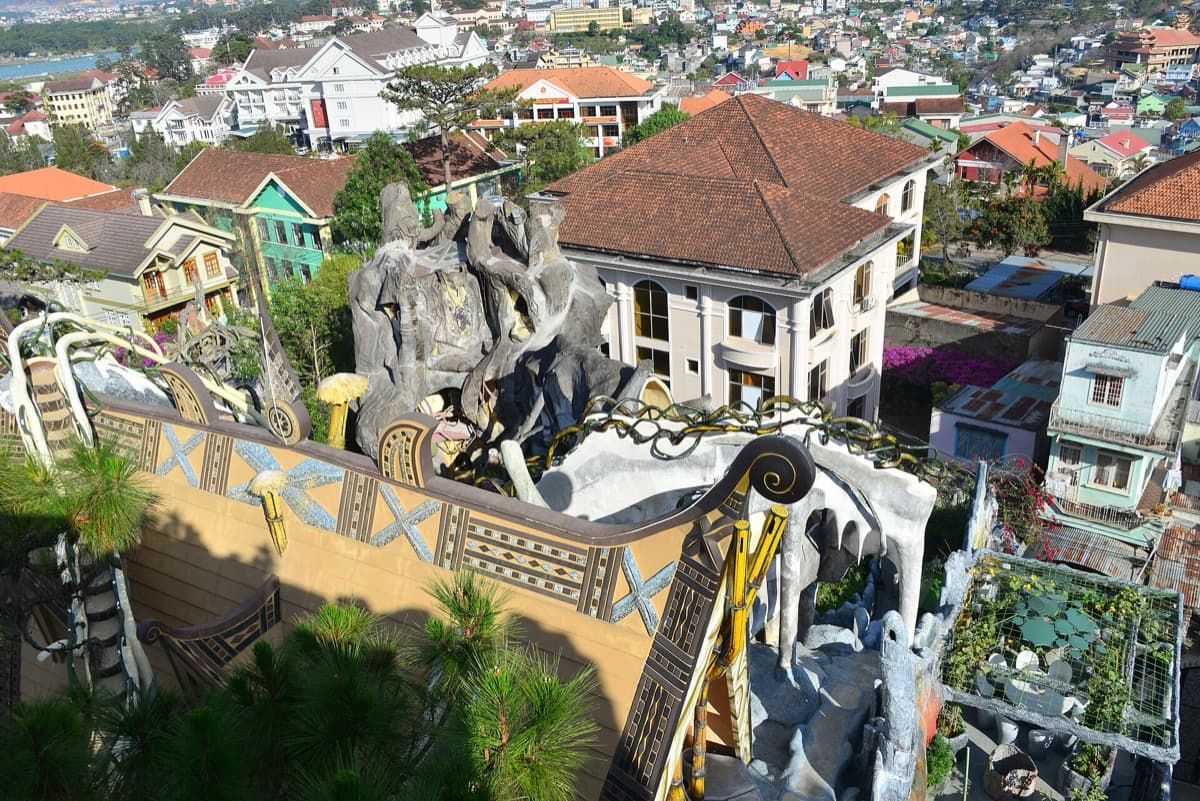
Start among the pines at the Bao Dai Summer Palace, the villa locals call the Third Palace because it is one of three houses the last emperor kept in this small city. It was built between 1933 and 1938, and its design is credited to two French architects, Paul Veysseyre and Arthur Kruze. Look at the clean horizontal lines and the wide windows made to pull in the mountain light, and you can see why most travelers call the style Art Deco. Bao Dai, the final emperor of the Nguyen dynasty, summered here from the late 1930s until the mid 1950s with his consort Nam Phuong and their children, among them the Crown Prince Bao Long. The rooms are still kept in period style, family portraits and busts, a study, the furniture of a working monarchy on holiday.
What matters for the walk is the choice underneath it. France picked this cool hill for European comfort, and the emperor picked it too. When the monarchy ended, the villa stayed, and Da Lat absorbed it the way it absorbed everything else the French left behind. The town did not tear down the emperor's house. It kept it, furnished it, and opened the doors.
The building that is Vietnam's own
Hear a stop from this walk
Bao Dai Summer Palace: the Third Palace
Come down into the town and the thesis of the whole walk clarifies. The covered market, Cho Da Lat, is where the town stops quoting France and starts speaking for itself. A stable two-storey market building stood here by 1960, replacing an older open-air tree market on the same ground, and it went up in a modernist idiom, poured concrete and long horizontal lines, one of the first multi-storey markets in the country. It was designed and built by Vietnamese hands at the end of the 1950s. Accounts name the architect Nguyen Duy Duc, and credit the grand connecting staircase up to the Hoa Binh area to Ngo Viet Thu, the Vietnamese architect who had just won the First Grand Prix de Rome in 1955 and would go on to design Independence Palace in Saigon.
The villa on the hill was colonial. This building is Vietnam's own, and it is still doing exactly its job. Wander the levels, produce and dry goods below, clothing and household things above, the stalls spilling into the surrounding streets after dark. This is not a monument to look at from across a square. It is a working building, busy every day, and it tells you that when the French left, the life of Da Lat did not pause. It just kept trading.
The dam nobody thinks of as a dam
Now walk out onto the wall that makes the lake. Cau Ong Dao is a low dam-bridge at the southern end of the water that both holds the lake back and carries the road across it. It is named for a local mandarin, the exact story softened by time. What is solid is the engineering. A French engineer named Labbe built the first dam in 1919, from an idea put forward by an envoy named Cunhac and approved by the Indochina governor Paul Doumer. A second dam followed within a few years. Then, in March 1932, a storm destroyed both. The current stone dam descends from the replacement, a larger structure built in 1934 and 1935 by the engineer Tran Dang Khoa, which finally held and created the single sheet of water the French called the Grand Lac.
Lean on the rail and consider the strangeness of it. The most beloved, most photographed feature of Da Lat is a piece of colonial infrastructure. The town did not inherit a lake. It inherited a dam, and then it fell in love with the reservoir behind it.
The lake, and the moment the town renamed itself
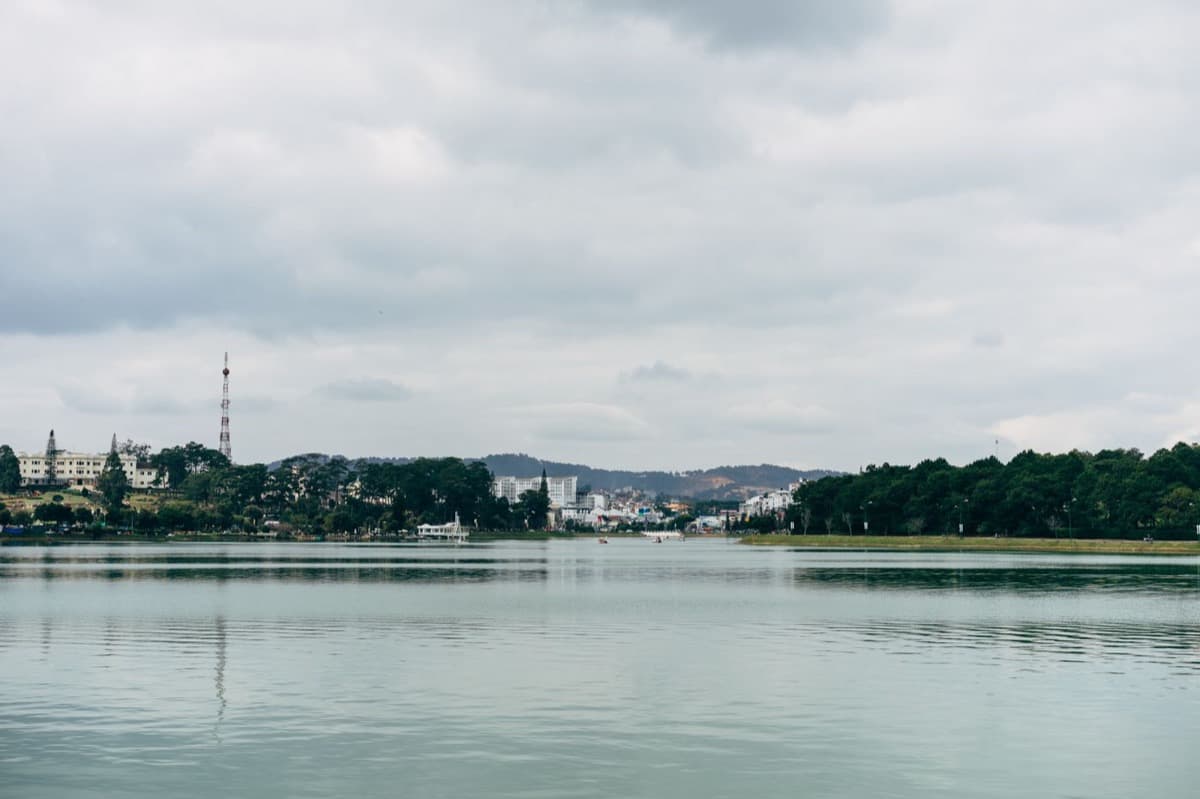
Walk the shore and the lake curves away in a long crescent, mist sitting on it until the sun burns through, swan-shaped pedal boats nosing out from the banks. This is Xuan Huong Lake, about two kilometres long, twenty-five hectares in area, a walkable loop of roughly five kilometres, and artificial from end to end. For its first decades the French simply called it the Grand Lac. The name it carries now was given in 1953 by the town chairman, Nguyen Vy, and here the record forks. One explanation says Xuan Huong means the fragrance of spring, for the flowers along these shores. The other says it honors Ho Xuan Huong, an eighteenth-century Vietnamese poet. The sources do not settle it, so hold both.
Either way, the renaming is the moment the town wrote itself over the map the French had drawn, keeping the water and changing the word. It is the same gesture that runs through Da Lat's sacred and strange buildings on the ridges above, where French forms were fused with Vietnamese ones until the origin nearly disappears. Find a bench and just sit. This is the sensory center of the walk, and it rewards doing nothing.
Flowers built as architecture
Here the garden city stops quoting its past and speaks in the present tense. Lam Vien Square opens on the southern side of the lake, more than seventy thousand square metres of modern plaza, and rising from it are two glass buildings shaped like flowers. One is a giant artichoke bud, about fifteen metres tall. The other, taller at about eighteen metres, is shaped like a wild sunflower and works as a performance hall. Neither is old: construction began in 2009 and the square opened in 2016. Nothing here is colonial, and that is the point. The artichoke is Da Lat's signature crop. The sunflower is the da quy, the wild bloom that washes yellow across these hills at the end of the rainy season. The town took the two things that grow here and built them at architectural scale in steel and glass.
The last leg ends in the thing the whole town is named for. The Da Lat Flower Gardens sit on the northern shore, terraced beds founded in 1966 and rebuilt and expanded in 1985. Walk in and the temperature seems to drop another degree: hydrangeas in that impossible blue, rose beds in long rows, orchids under shade, hundreds of species in one cool bowl of air. This is why Da Lat is called the City of Flowers, and it is not just a nickname. The highlands supply cut flowers to much of Vietnam, so the beds are the ornamental face of a serious farm economy, and a photograph among them has been part of the Vietnamese honeymoon for generations.
Stand here at the end and add it up. A colonial engineer dammed a stream. French architects built a villa in the pines. Vietnamese hands built the market, renamed the lake, raised flowers into architecture, and planted these gardens. The gardeners who laid out the hill station are long gone. The garden kept growing. That is the whole story of Da Lat, and the Garden City walk carries you its full length.
Ready to experience it?
Xuan Huong Lake: The Garden City
210 min · 10.5 km · hard
More from Dalat
Explore more at your own pace.
Da Lat Travel Guide: How Many Days, Getting Around, When to Go (2026)
How to See Da Lat: A Borrowed France That Vietnam Kept
One Day in Da Lat: A Walkable Hill-Station Itinerary (2026)
What to Eat in Da Lat: A Food Guide (2026)
The Empire of Homesickness: How France Built Da Lat to Hide From Vietnam