Da Lat begins with a doctor's note about the weather. In 1893 a Swiss-born bacteriologist named Alexandre Yersin climbed onto this cool pine plateau near fifteen hundred metres and told the French administration it should become a mountain health resort. It did. The spa town, the villas, the lake, the palace hotel, all of it grew from that recommendation, and you can read the whole colonial machine in The Empire of Homesickness. But once the practical, scientific town existed, something less practical happened on the ridges around it. The dreamers arrived. Monks, nuns, an eccentric architect, a priest of royal blood, each of them raised a private paradise on the same set of hills.
That is the argument of the Sacred and Strange walk, and it is the strangest of the three ways to see the city. The other two are legible on their face: the colonial hill station is an empire's homesickness in stone, the garden city is a town that fell in love with its own reservoir. This third walk asks you to hold something less obvious. It puts a Buddhist pagoda and a concrete tree-house on the same route and insists they belong together. By the end you believe it.
The pattern: everything here is the same age
The thing to keep in your head across six stops is a date range. Nothing on this walk is ancient. Da Lat itself is barely more than a century old as a town, and its sacred architecture grew up alongside its villas and its lake, not before them. That single fact quietly demolishes the usual way we sort buildings into holy and secular, old and new.
Linh Son Temple, where the walk opens, was built between 1938 and 1940, funded not by a court or a colonial office but by ordinary townspeople. Two lay Buddhists, Vo Dinh Dung and Nguyen Van Tien, gave the largest gifts. Its great bell is reputed to be bronze alloyed with gold, and the story locals tell about it is the whole town in miniature: the gold is said to make it so heavy that no thief could ever carry it off. Whether the metal is truly precious hardly matters. The tale tells you how the community felt about the thing they had paid for together.
A little north sits the temple that came first. Linh Quang Pagoda is documented as the earliest pagoda founded in Da Lat, honored as the town's mother temple, raised from a simple hermitage by a monk named Thich Nhan Thu in 1931. In 1938, Bao Dai, the last emperor of Vietnam, granted the pagoda an imperial edict, recognizing it as an official sanctuary of the young mountain town. Before Da Lat had settled into its identity, the throne itself reached up here and blessed a modest temple. Buddhism was written into the town's foundation, not added as an afterthought.
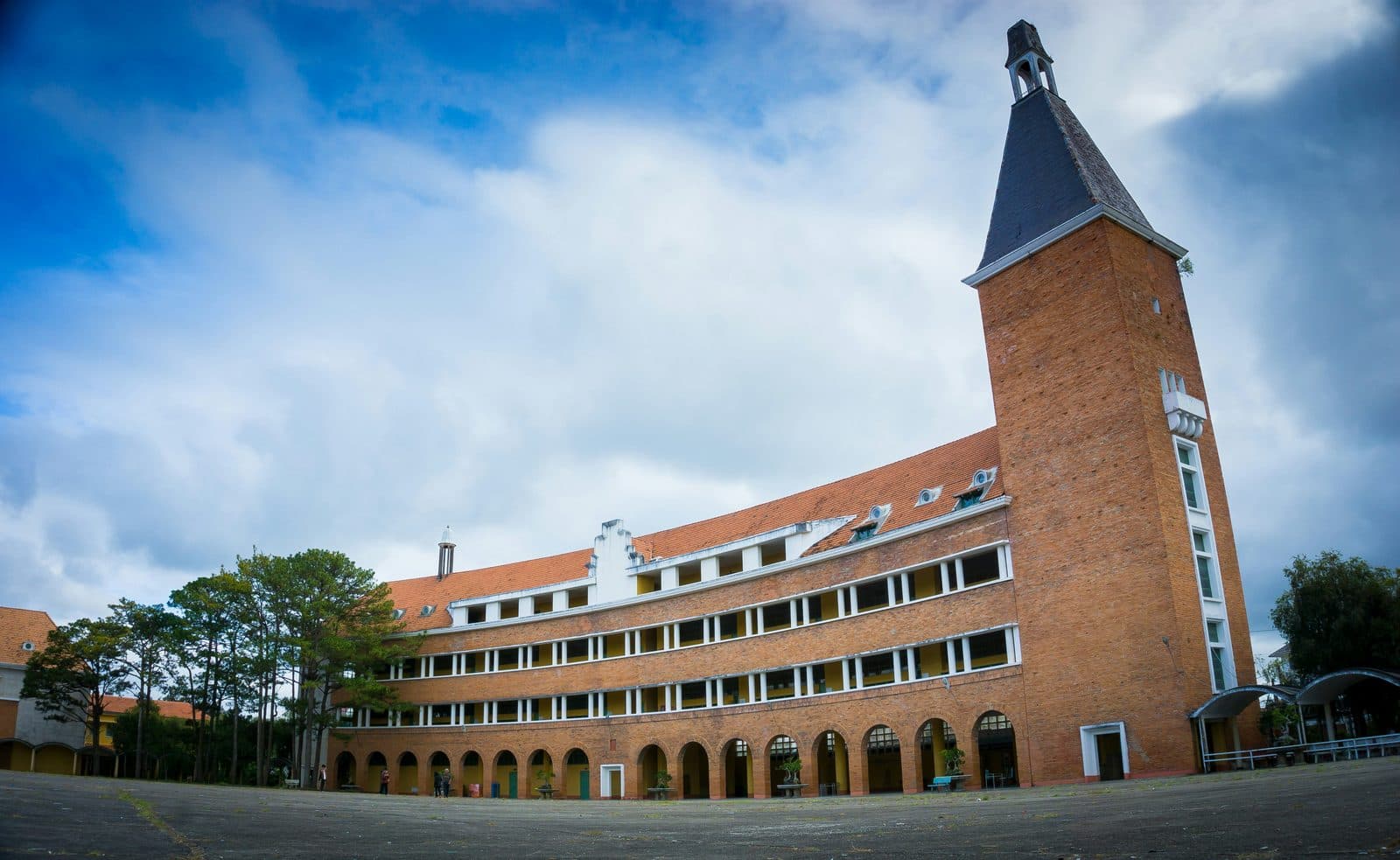
Hold those two dates, 1931 and 1938, against what comes next. The Institut Pasteur de Dalat, the science building that explains why the whole town exists, was established in 1936, first led by Yersin himself. The pagodas and the laboratory are the same age. The monks and the scientists arrived in the same decade, both drawn by the same cool air, until that coincidence stops feeling like a coincidence and starts feeling like an argument.
The fusions: builders who took the mountain seriously
Hear a stop from this walk
Du Sinh Church: A Temple With a Cross
The middle of the walk is where the categories start to blur, and it does so through architecture rather than doctrine.
Domaine de Marie, the pink convent the locals simply call the Pink Church, is the first real fusion. Raised in the early 1940s and initiated by Suzanne Humbert, the wife of Jean Decoux, then Governor-General of French Indochina, it should by rights be a European church. Instead its roofline borrows the silhouette of the Nha Rong, the tall communal longhouse of the Central Highlands peoples. A French Catholic order roofed its convent with the shape of a local stilt-house. There is no towering Gothic spire trying to dominate the sky. The devotion here is horizontal, folded into the shape of the mountains it sits among. Humbert's remains are interred on the grounds of the church she willed into being, and as recently as 2007 the encyclopedia records that roughly twenty-three nuns still lived in the convent, which also cared for hard-of-hearing children. It is a living place, not a monument, so walk it softly.
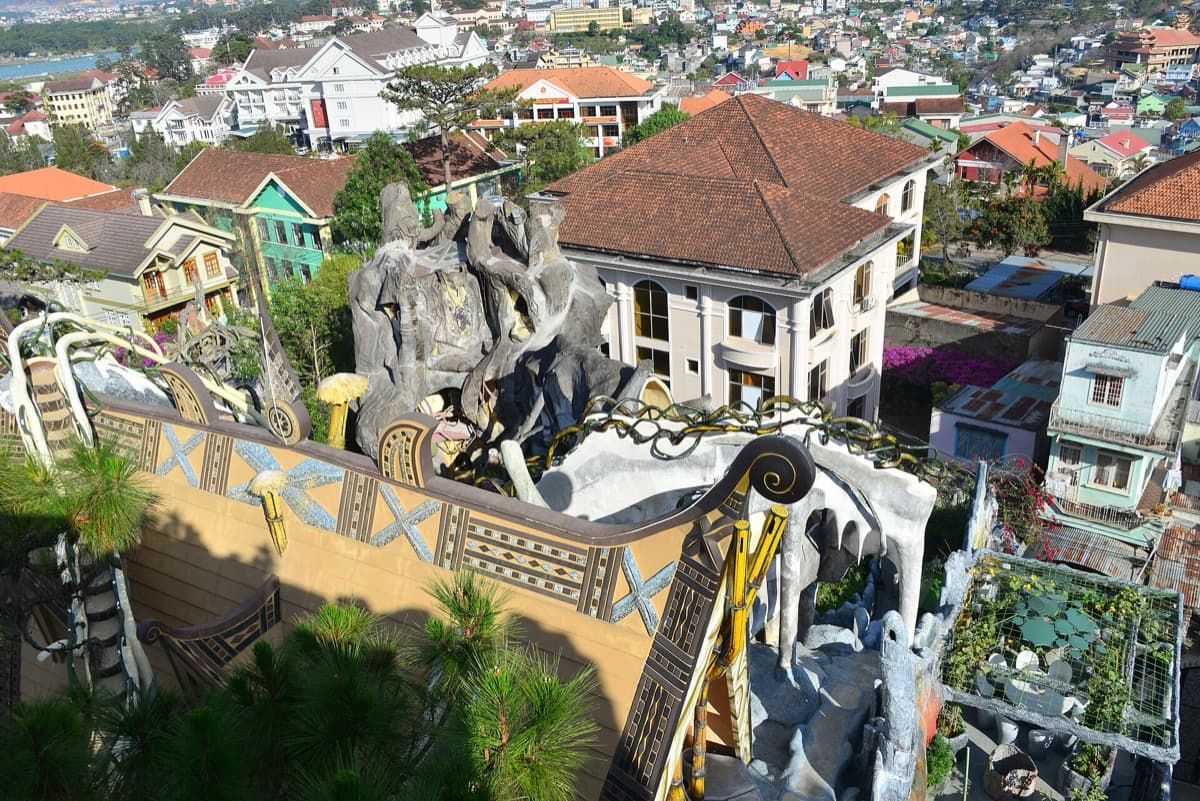
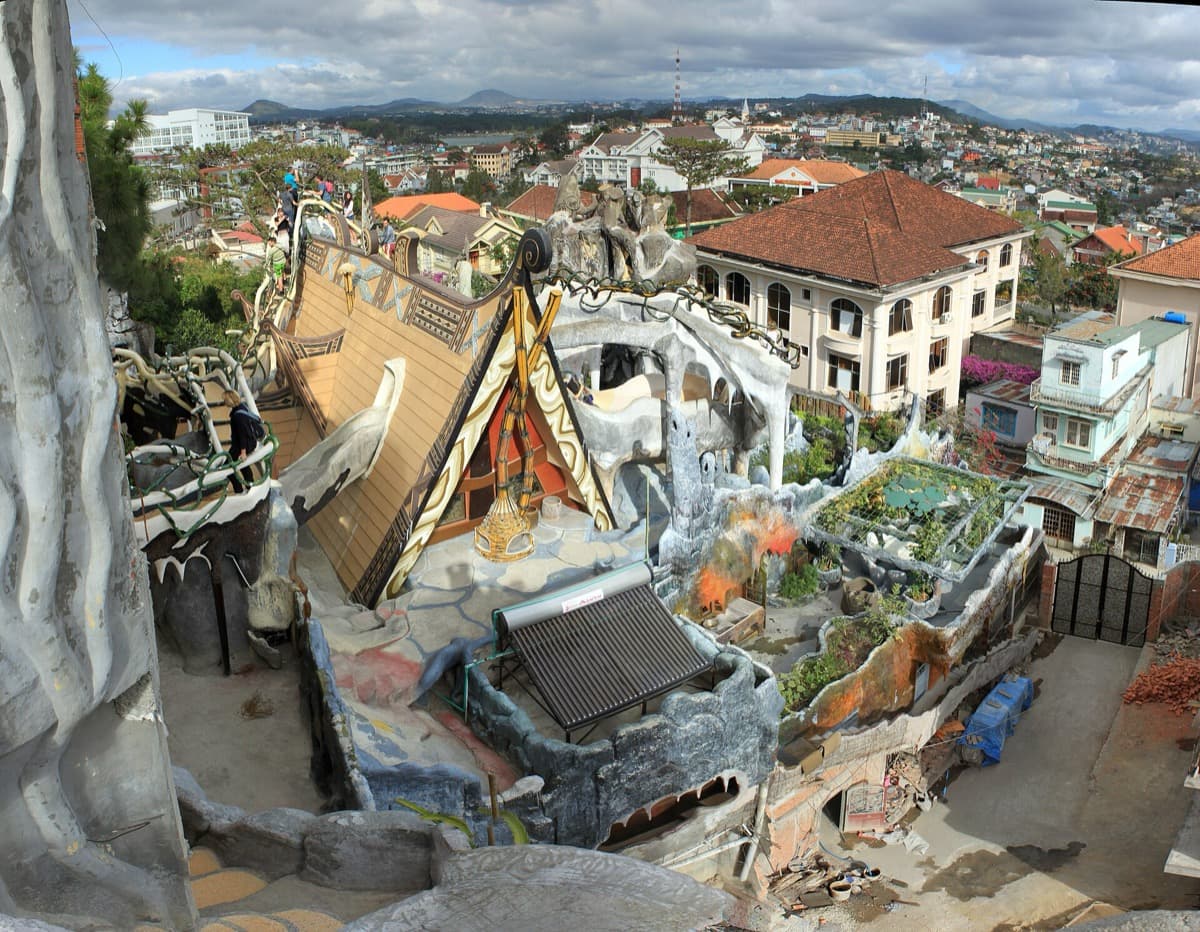
Then the walk crosses a deliberate distance, close to a kilometre and a half, to reach the building that gives the tour its jolt: the Hang Nga Guesthouse, known to nearly everyone as the Crazy House. Nothing about it is straight. The whole structure climbs and twists like a giant banyan tree, with sculpted caves and animals and spider webs growing out of the concrete, and stairways that wander off in unexpected directions. The reframing is this. It was designed and built by a Vietnamese architect named Dang Viet Nga, who earned a doctorate in architecture in Moscow and is the daughter of Truong Chinh, a former general secretary of the Communist Party. She has openly named the Catalan architect Antoni Gaudi as an inspiration. She began the house as a personal project and opened it to paying visitors in 1990 to cover the debt. The full story of how a Party leader's daughter came to pour a dream in concrete is worth its own deep dive.
Standing at the base of that concrete tree is when the thesis of the walk clicks. We have already seen monks and nuns build their private paradises on this mountain. Here a general's daughter did exactly the same thing. She simply called it art instead of faith. The impulse is identical: raise an idiosyncratic heaven on a cool pine ridge, and invite the world up to see it.
The resolution: a temple with a cross
The walk finishes on a hill in the southwest, at Du Sinh Church, which is the purest version of everything the route has argued. Your eye reads a Vietnamese temple: brick walls, a red-tile roof, a bell tower whose four main columns are shaped, by tradition, like a golden bamboo tree. Then you notice the cross, and you realize this is a Catholic church wearing the form of a Buddhist temple.
It was built for refugees. After Vietnam was partitioned in 1954, waves of northern Catholics came south, and this parish rose to receive them. The church was built in 1956 and inaugurated on Christmas of 1957, with the separate bell tower completed in 1962. By tradition its chief designer was a priest named Buu Duong, said to belong to the Nguyen dynasty royal line. Rather than reach for a Western Gothic silhouette, he gave his church the shape of his own country's temples, and even worked dragon imagery into Christian themes. A priest of royal blood shaping a temple to hold a Christian altar is simply the clearest statement of the pattern the whole walk has been building.
Why the walk works
Sacred and Strange is the hardest of the three Da Lat walks to summarize, which is exactly why it rewards the effort. The colonial walk is about power and longing. The garden walk is about infrastructure and love. This one is about the freedom a new town gives its builders.
Because Da Lat was invented from scratch, near fifteen hundred metres, out of nothing but a note about the air, nobody arriving here inherited a fixed idea of what belonged. A monk could decide a raw highland settlement deserved a mother temple. French nuns could roof a church like a longhouse. A Party leader's daughter could build a concrete tree and charge admission. A royal priest could dress a Catholic church as a pagoda. On an old mountain, weighed down by precedent, most of those gestures would read as transgressions. On this young one they read as the local vernacular. The devout and the eccentric were never opposites in Da Lat. They were the same people, dreaming on the same hills, and the walk simply lines up their dreams so you can see the family resemblance.
Practical notes for the walk
The route runs roughly three hours if you linger and covers about eight kilometres across hilly, spread-out ground, so treat the longer legs, especially the transect to the Crazy House, as part of the pleasure. Everything is free to enter except the Crazy House, whose ticket is a small fee of around sixty thousand Vietnamese dong. Start early: the pagodas and the pink convent are quietest in the cool morning, and clear highland mornings tend to give way to afternoon rain. Dress in layers that also cover shoulders and knees, because every pagoda, the convent, and both churches are active places of worship. For how this walk fits with the other two, and how to sequence all three, start with How to See Da Lat. At each stop, ask who chose to build this, and why here. The answer is always a person who looked at a cool, young mountain and decided it was the right place to make something impossible and personal and slightly too much. That is Da Lat. The rest of it is yours to wander.
Ready to experience it?
Crazy House: Sacred and Strange
180 min · 8 km · hard
More from Dalat
Explore more at your own pace.
Da Lat Travel Guide: How Many Days, Getting Around, When to Go (2026)
How to See Da Lat: A Borrowed France That Vietnam Kept
One Day in Da Lat: A Walkable Hill-Station Itinerary (2026)
What to Eat in Da Lat: A Food Guide (2026)
The Empire of Homesickness: How France Built Da Lat to Hide From Vietnam