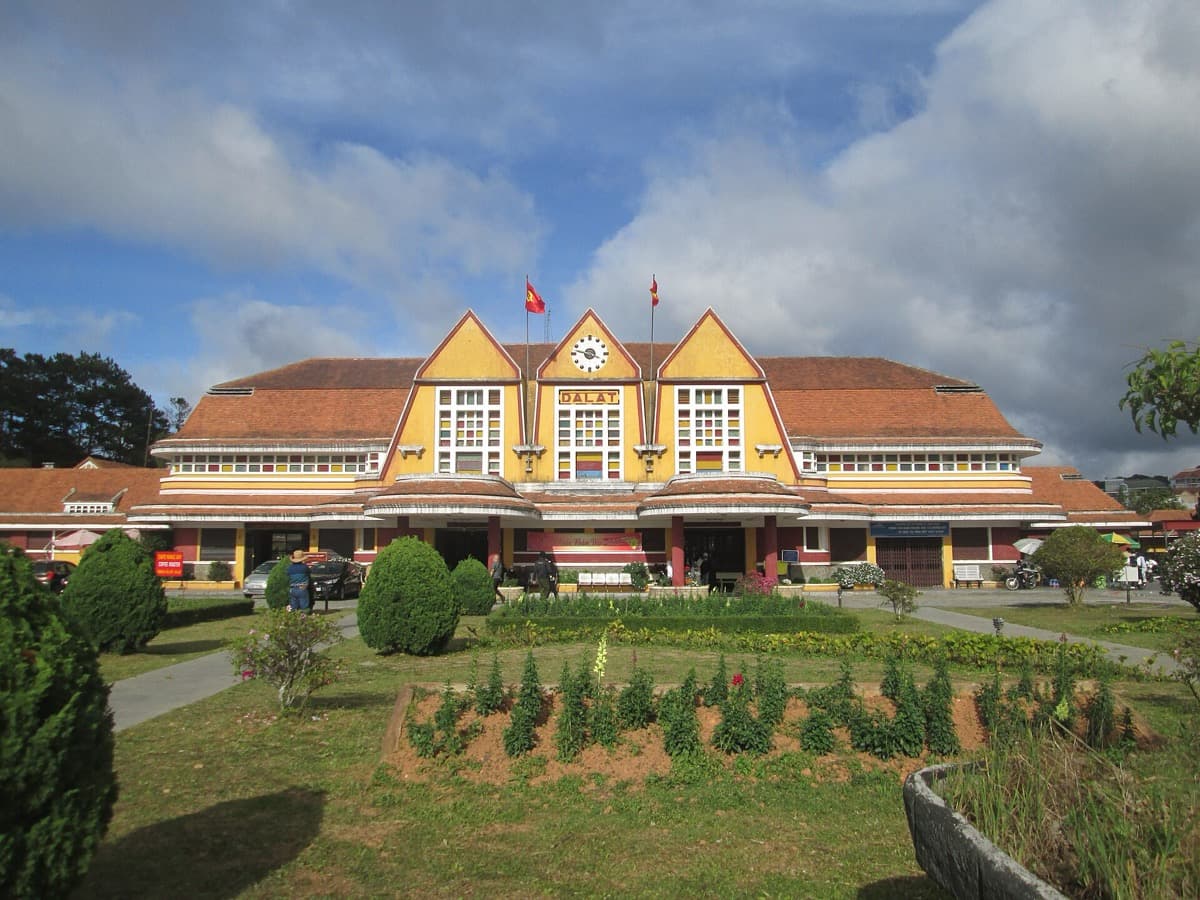
Stand in the forecourt of the Da Lat railway station and the first thing that registers is the roofline. Three steep peaks rise over the entrance, sheathed in Art Deco lines but reading almost like tents, or like mountains drawn by a child. It is one of the most photographed buildings in the city, and it looks, on the surface, like a purely decorative flourish. It is not. That roof is the elegant front end of one of the more stubborn pieces of engineering the French ever attempted in Indochina, a railway built for the single purpose of hauling comfort up a mountain.
The station is the second stop on the Empire's Escape walk, and it is the stop that explains how the whole town was physically possible. Da Lat sits near fifteen hundred metres in the southern highlands. To turn a cool plateau into a working refuge from the tropics, the French first had to solve the problem of getting themselves up there. The answer was a railway that could climb a slope no ordinary train can grip.
The problem: a mountain too steep for rails
The Da Lat to Thap Cham line ran about eighty-four kilometres from the coastal plain at Thap Cham, on the main north-south railway, up to this highland ridge. Along the way the Song Pha to Da Lat section rose almost fourteen hundred metres. That is the crux of the whole story. A conventional steel wheel on a steel rail loses its grip well before such a grade, spinning uselessly against the incline.
The engineers solved it with a rack-and-pinion system. Along the three steepest stretches they laid a toothed cog rail down the center of the track, and fitted the locomotives with a matching gear wheel that could bite into those teeth and haul the train up mechanically rather than by friction alone. The three rack sections climbed at grades of roughly 120, 115, and 60 per thousand, steep enough that the toothed rail was the only thing making the ascent possible. The route also required five tunnels bored through the highlands, of lengths from about seventy metres to more than six hundred. It was, in every sense, a feat of engineering in the service of leisure.
The locomotives that did the climbing
Hear a stop from this walk
Hoa Binh Square: The City That Kept the Stage
The machines built for that climb came largely from Switzerland, a country that knew mountain railways better than anyone. From 1924 the Swiss manufacturer SLM Winterthur supplied HG 4/4-type cogwheel locomotives, five purchased initially, and a German manufacturer contributed additional engines. Later, in 1947, HG 3/4-type locomotives arrived from the Swiss Furka-Oberalp company. These were purpose-built rack engines, the same family of machine that lifted tourists into the Alps, repurposed to lift the French into their tropical highlands.
The railway was not built in a single push. Surveys began as early as 1898, construction started in 1908 on the lower Thap Cham to Song Pha section, and the line opened in stages: a first forty-one-kilometre stretch in 1919, a second forty-three-kilometre stretch reaching Da Lat in 1932. The full climb took the better part of three decades.
The station: engineering wearing a beautiful face
The terminus you see was the last piece to arrive. It was designed in 1932 by the French architects Moncet and Reveron, and construction of the building began in 1935 under Moncet's direct supervision, finishing three years later in 1938. So while trains had already been reaching the plateau since 1932, the grand station that framed the arrival came six years afterward, a deliberate architectural full stop on the achievement.
The style is Art Deco, but the three peaked roofs carry a double meaning that suits a town built out of longing. They are said to stand for the three summits of Lang Biang, the mountain that dominates the horizon here, and their steep pitched form also echoes the tall communal houses of the Central Highlands peoples. Yet some travelers have seen in them something else entirely, a memory of a seaside railway station back in Normandy. The building refuses to settle the question, and that ambiguity is the point. It is at once a gateway to a Vietnamese mountain and a fragment of France, which is exactly what Da Lat itself was designed to be. For the fuller argument that the whole colonial town is an architecture of homesickness, see The Empire of Homesickness.
Silence, and a short revival
The railway did not survive the wars. Regular operations ended in 1968, and after 1975 many abandoned lines, this one among them, were dismantled to salvage materials for repairing the country's main north-south railway. The great cog railway that had lifted the French up the mountain fell silent, its rack rails pulled up, its tunnels left empty.
But a fragment lives on. In the 1990s a seven-kilometre stretch between Da Lat station and the nearby village of Trai Mat was restored and reopened as a tourist attraction, so you can still ride a short piece of the old climb, out through the pines and back. The station itself was recognized as a national historic monument in 2001. Today there is usually a small fee, a few thousand dong, to step onto the platform among the old rolling stock, while the forecourt and the exterior are free to admire.
What to look for
Take in the front first: the three peaked roofs, the horizontal Art Deco banding, the sense of a small alpine terminus dropped onto a tropical ridge. Then, if you pay the platform fee, walk out to the tracks, where the old rail cars and a preserved locomotive sit beside the surviving thread of a line that once ran all the way down to the coast. If a heritage train is running to Trai Mat, ride it; even seven kilometres gives you the feel of the grade and the deliberate slowness of a machine built to climb rather than to hurry.
Hold the arithmetic in your head. Eighty-four kilometres of track. Fourteen hundred metres of climb. Three toothed rack sections and five tunnels. Swiss mountain locomotives shipped halfway around the world. All of it built so colonial officials could escape the lowland heat and take the cool air on a pine plateau. The station is beautiful, but the beauty is the reward at the top of an enormous amount of stubborn work. That is the truest emblem of Da Lat: a lovely surface resting on the machinery of homesickness. For how this station fits the full colonial walk and the other two ways to see the city, start with How to See Da Lat.
Sources
- Wikipedia, "Da Lat station."
- Wikipedia, "Da Lat–Thap Cham railway."
- VietnamNet, "The last vestiges of Vietnam's forgotten cog railway."
- Vinpearl, "Dalat Train Station: Unveil Vietnam's oldest railway station."
Ready to experience it?
Hill Station: The Empire's Escape
180 min · 8 km · hard
More from Dalat
Explore more at your own pace.
Da Lat Travel Guide: How Many Days, Getting Around, When to Go (2026)
How to See Da Lat: A Borrowed France That Vietnam Kept
One Day in Da Lat: A Walkable Hill-Station Itinerary (2026)

What to Eat in Da Lat: A Food Guide (2026)
The Empire of Homesickness: How France Built Da Lat to Hide From Vietnam