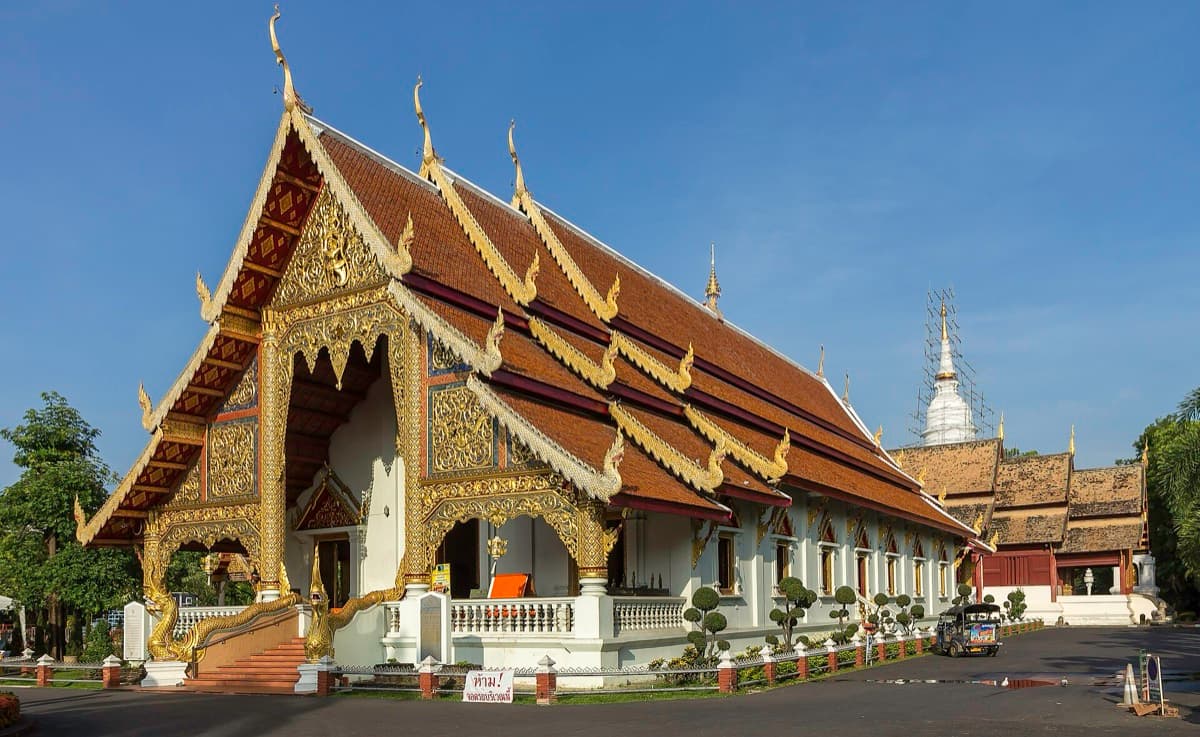
Wat Phra Singh is the western climax of Chiang Mai's old square, a royal temple founded in the year thirteen forty-five by King Phayu, whose small assembly hall preserves Lanna art at its most confident and complete. If you have walked across the moated old city from the eastern gate, this is where the walk ends and, in a sense, where the vanished kingdom of Lanna speaks most clearly. The temple is not the tallest thing inside the walls, nor the oldest, nor the most sacred by tradition. What it holds instead is craft: a room where the deep red and gold of the north survived when so much else was broken, rebuilt, or carried away.
A temple built to hold a king's ashes
The founding of Wat Phra Singh is the last chapter of a dynastic story that runs right through the old city. King Mangrai laid out the square in the year twelve ninety-six. His line continued, and it was the fifth Lanna monarch, King Phayu, who established this temple in the year thirteen forty-five. The reason was personal and dynastic at once. Phayu built it to house the ashes of his father, King Kham Fu, brought south to Chiang Mai from Chiang Saen, the older Lanna center near the Mekong. So the temple begins as a mausoleum for a king, an act of filial duty that also planted the royal presence firmly at the western end of the capital.
That founding logic matters when you stand in front of it. This is not a temple that grew up around a market or a monastery school. It was placed, deliberately, by a reigning king, to anchor his father's memory inside the diagram his great-great-grandfather had drawn. Reading where it sits is reading the plan of the whole square.
The name and the image
Hear a stop from this walk
Three Kings Monument: the founding legend in bronze
The temple takes its name from the Phra Buddha Sihing, usually shortened to the Phra Singh image. This revered Buddha figure has been associated with the temple since around the year fourteen hundred, when the Lanna king Saen Muang Ma received it, and locals have called the complex Wat Phra Singh ever since. Thai Buddhism carries many such palladial images, statues whose histories and origins are argued over by scholars and cherished by the faithful, and the Phra Singh sits among them. The point to hold, standing in the courtyard, is that the temple's identity is bound to an object of veneration rather than to a single architectural moment. The buildings around you were raised, restored, and elevated over centuries in service of that image and the royal ashes it guards.
The Viharn Lai Kham: the room to seek out
The building that rewards a slow visit is the Viharn Lai Kham, a small assembly hall built in the early nineteenth century, roughly between eighteen fifteen and eighteen twenty-one, under the reign of Thammalangka. Step inside and let your eyes adjust to the dim. This is one of the finest surviving examples of Lanna hall architecture, and the reason becomes obvious once the interior resolves.
Two things carry the room. The first is the woodwork, glowing with gilded lacquer in the deep red and gold that define the Lanna style at its finest. The name Lai Kham itself refers to that gold-pattern work. The second is the murals. According to the temple's own history, the walls illustrate two classic tales: the story of Sang Thong and the story of Suwannahong. What makes them worth the pause is not the plots but the treatment. The painters set these old stories inside scenes of everyday northern life, so the murals double as a record of how people in this region dressed, gathered, traded, and moved. You are looking at literature and social portrait at the same time, painted by hands that knew the streets outside.
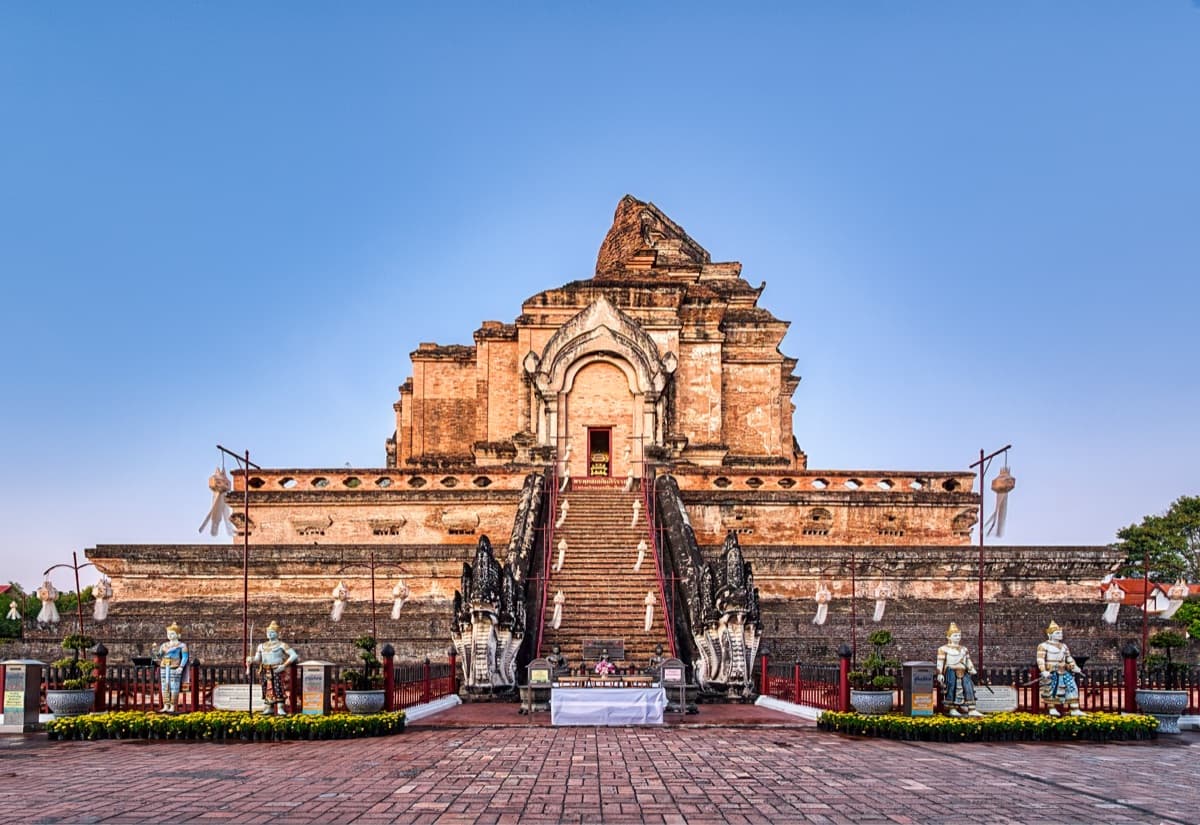
This is the single thing to understand while standing here. Much of the old square is a lesson in loss and reconstruction. The eastern gate is a nineteen-eighties rebuild of a seven-hundred-year-old shape. The great chedi nearby lost roughly its top thirty metres to an earthquake in the year fifteen forty-five. The bronze at the civic center was cast in the nineteen eighties. But inside the Viharn Lai Kham, the art of the kingdom survived intact. You are not reading a copy or a memory of Lanna here. You are reading the thing itself.
Royal rank, and the closing word of the square
The temple's standing was formally recognized in the modern era. In the year nineteen thirty-five it was raised to the status of a first-grade royal temple, a distinction that ties it, on paper as well as in stone, to the crown. That elevation confirms what the founding already suggested: this is a royal house of worship, tied to kings from its first stone to its official title.
There is a satisfying symmetry to ending a walk of the old city here. You may have begun at Tha Phae Gate, a rebuilt gate holding an ancient geometry, brick that is recent over a plan that is old. You finish in a room where the reverse is true, where the actual painted, gilded, carved fabric of the kingdom is still on the walls. The founder's diagram opened the square; the finest surviving hall closes it. Between them sit the founder's camp temple, the founding legend in bronze, the great truncated chedi, and the city pillar that the founders believed held the whole plan together and kept it safe.
Practical notes for the visit. The main hall carries a small entry fee for foreigners, about forty baht, so keep small notes on hand. As at every hall in the square, remove your shoes before entering, keep shoulders and knees covered, and never point your feet toward a Buddha image. Early morning, from about seven to ten, is the sweetest window, before the northern heat builds and while the light is still soft on the courtyards.
Walk the whole square
Wat Phra Singh is the sixth and final stop of a self-guided audio walk that treats the old city as a single designed object, from the eastern gate to this western royal temple. To hear the full arc of founder, pillar, chedi, and this closing hall in order, walk the moated square with Roamer. Start by browsing the Chiang Mai walking tours, or plan your visit from the Chiang Mai city page.
Sources
- Wat Phra Singh, Wikipedia. Founding by King Phayu in 1345, the ashes of King Kham Fu brought from Chiang Saen, the Phra Buddha Sihing image received in 1400, the Viharn Lai Kham built 1815 to 1821, its Sang Thong and Suwannahong murals, and the 1935 first-grade royal temple status.
- The Moated Square, Roamer self-guided tour transcript (fact-audited). Primary source for the dynastic sequence and the walk's western terminus at Wat Phra Singh.
- Wat Chedi Luang, Wikipedia. The 1545 earthquake that sheared roughly the top thirty metres from the great chedi in the same square.
- Lan Na and Chiang Mai history, Wikipedia. The founding of Chiang Mai under King Mangrai in 1296 and Phayu's place as fifth king of the Mangrai dynasty.
Ready to experience it?
Old City: The Moated Square
95 min · 3.5 km · moderate
More from Chiang Mai
Explore more at your own pace.
Chiang Mai Travel Guide: Days, Getting Around, Best Time, Safety, and Budget
One Day in Chiang Mai: A Walkable Morning-to-Evening Itinerary
Chiang Mai: Reading the Lanna Capital in Three Layers
Wat Chedi Luang: The Broken Giant at the Center of Chiang Mai's Moated Square
Wat Ket Karam and the Chiang Mai the Teak Boom Built Across the River