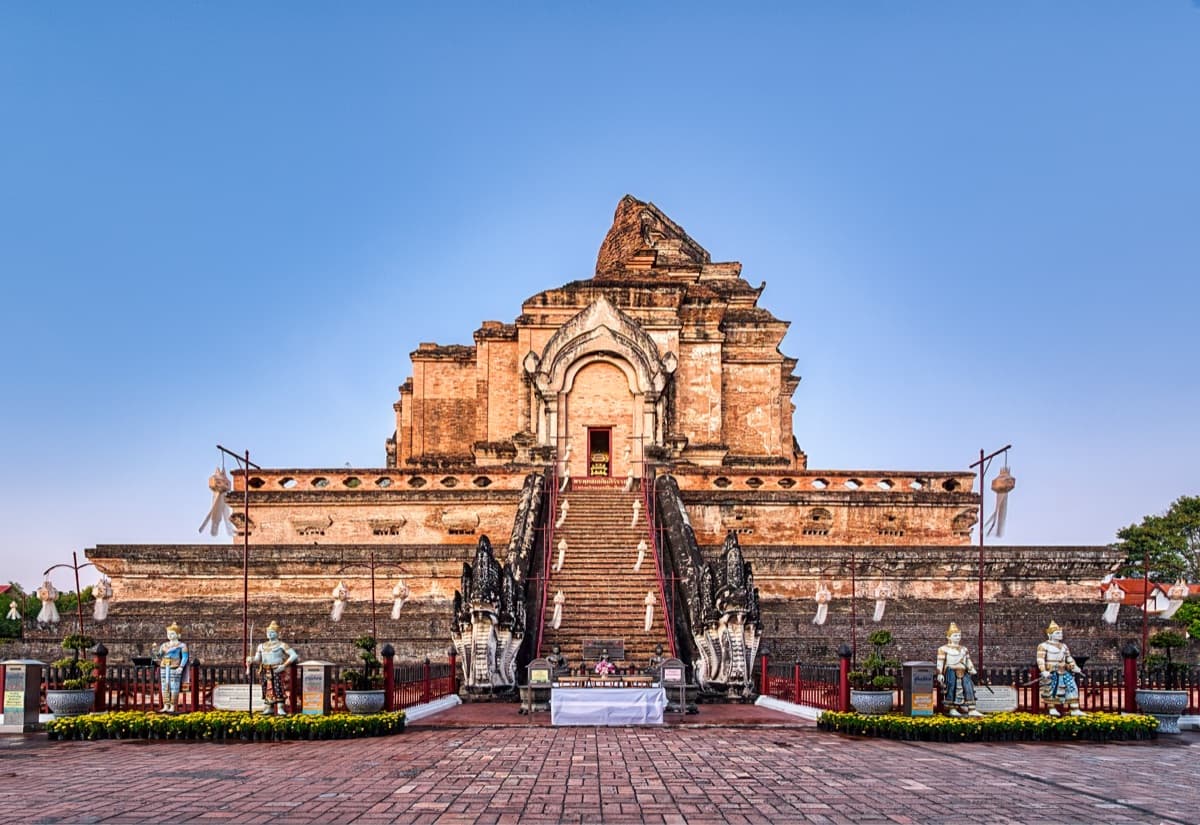
The old city of Chiang Mai is a designed object, a near-perfect moated square laid out in 1296, and the fastest way to read that design is to stand at the foot of its great broken chedi. Wat Chedi Luang sits close to the center of the square, and even truncated it dominates everything around it. That is the argument the whole walk makes: this town is not a village that grew but a capital that was placed, and the giant at its middle is the loudest proof. Look up at the chedi first, and the rest of the moated square starts to read like a sentence with the tallest word already spoken.
The giant at the center
King Mangrai dug the moat and raised the walls of Chiang Mai in 1296, calling his new capital exactly that, the new city. For two and a half centuries the square was the seat of Lanna, a northern Thai-Buddhist kingdom with its own script, its own dynasty, and its own temples, before Burma and later Bangkok absorbed it. Wat Chedi Luang is where that kingdom decided to build tall.
The great chedi went up across generations. It was begun in the late fourteenth century by King Saen Muang Ma to hold his father's ashes, then sat unfinished for a stretch before it was completed in the mid-fifteenth century under King Tilokaraj. At full height it reached about eighty-two metres on a base roughly fifty-four metres across, described as the largest structure the Lanna kingdom ever raised. Raising eighty-two metres of brick in the fifteenth century was a statement, and it was meant to be seen from across the plain.
Then the ground moved. In 1545 an earthquake tore away roughly the upper thirty metres of the tower, and what stands today is the stump that survived. That is why the chedi looks decapitated, a mass of brick that clearly wanted to keep climbing and was stopped. Walk the base slowly and you pass elephants, stairways, and guardian figures at the corners. A word of honesty about those lower forms: much of what you see at ground level was reconstructed in the early 1990s, financed by UNESCO and the Japanese government, and some scholars debate how faithfully those additions echo true Lanna style. Read the details with a slightly critical eye. The scale and ambition, though, are entirely real.
Why a broken tower is the key to the square
Hear a stop from this walk
Three Kings Monument: the founding legend in bronze
For a stretch of its life this was the most sacred address in the region. From 1468 the chedi housed the Emerald Buddha, the small revered image that is now the palladium of the whole Thai nation, until that image was carried off to Luang Prabang in 1551. So the tallest structure in the kingdom also, for eighty-three years, held the kingdom's most precious object. Height and holiness stacked in one place, near the geographic middle of a square built on purpose. That is the diagram the tour asks you to read.
Understanding the chedi is understanding what the other five stops are doing. The Chiang Mai walking tours hub frames the old city as a document, and this stop is where the document speaks loudest. A few steps away, still inside the same temple grounds, stands Sao Inthakhin, the city pillar, the lak mueang that Thai towns treat as the anchoring heart of a place. If the chedi is the tallest word in the square's grammar, the pillar is the deepest one, the point around which the founders believed the whole plan was held together and kept safe. King Kawila moved the pillar to these grounds in the year 1800, and once a year an eight-day festival brings offerings of flowers and candles to it to secure the city's protection. Standing at Chedi Luang, you are within a few steps of both the loudest and the quietest points of the entire founding plan.
Reading the rest of the moated square
The walk begins at Tha Phae Gate on the eastern side, where the moat runs off in long straight lines that close into a square roughly a mile, about 1.6 kilometres, on each side. The brick of the gate is recent, reconstructed between 1985 and 1987, but the geometry is seven hundred years old and the moat still traces the line Mangrai's diggers cut. From there the route moves inward to Wat Chiang Man, regarded as the oldest temple in Chiang Mai, built on the very ground where Mangrai camped while his city was surveyed and walled around him. A stone stele there records a founding date of April 12, 1296.
Next comes the Three Kings Monument at the civic center, three bronze figures about two point seven metres tall showing Mangrai of Lanna, Ngam Muang of Phayao, and Ramkhamhaeng of Sukhothai in consultation. The chronicles say these three kings planned Chiang Mai together, but that is founding legend, not documented fact, and the bronze itself is modern, designed by the national artist Kaimook Chuto and opened in January 1984. It is worth enjoying as exactly what it is: a recent monument to an old story.
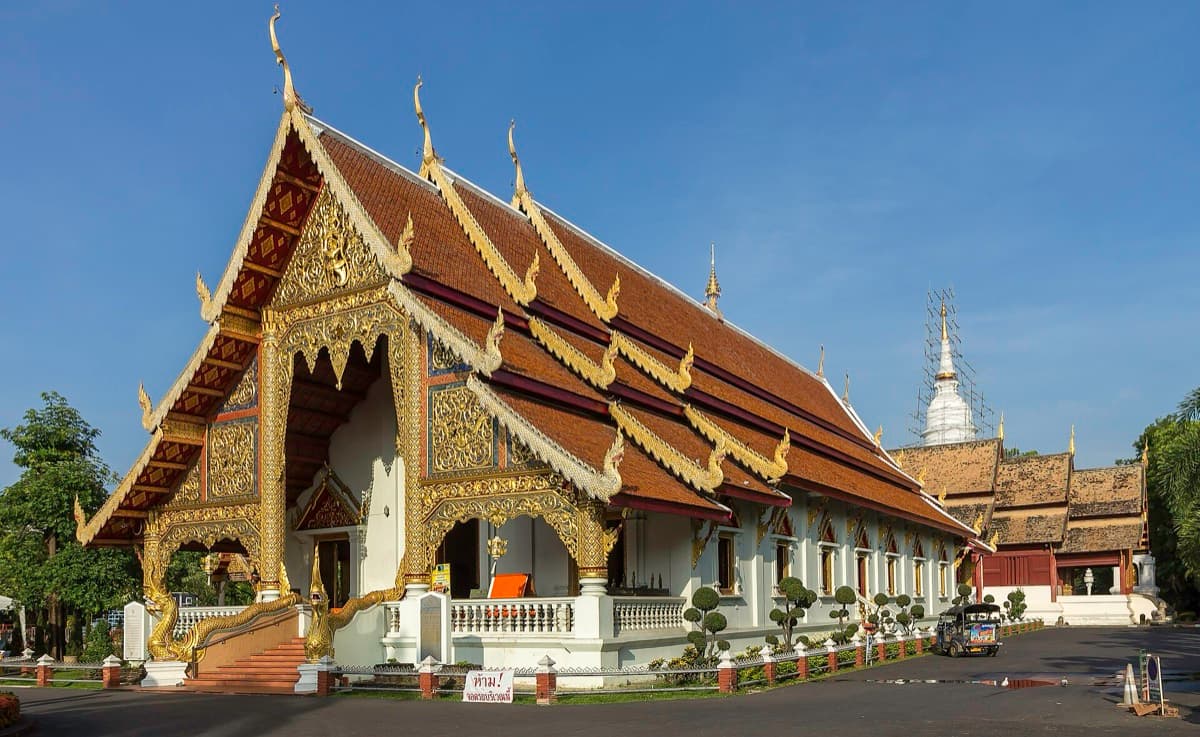
After the great chedi and the city pillar, the walk crosses to the western end of the square and closes at Wat Phra Singh, the artistic peak of the route. Founded in 1345 by King Phayu, the fifth Lanna monarch, to hold his father's ashes, it shelters the Viharn Lai Kham, a small assembly hall built around 1815 to 1821 and widely held to be one of the best-preserved Lanna halls anywhere. Its walls carry murals of the Sang Thong and Suwannahong tales painted as scenes of northern life. The temple was raised to first-grade royal status in 1935. You begin at a rebuilt gate holding an ancient shape, and you end in a room where the old kingdom's art survived intact.
Walking it well
The full loop is six stops, about three and a half kilometres, and a little under two hours at an easy pace. Early morning from roughly seven to ten is the sweetest window: temples open, soft light on the chedi, and the heat not yet built. Carry small baht notes, since Wat Chedi Luang charges foreigners about forty baht to enter while the gate, the moat, and the monument square are free. Dress for temples, covered shoulders and knees and shoes that slip off easily, and keep a scarf in your bag for sun and quick shoulder cover. When you are ready to read the whole diagram, start the tour from Tha Phae Gate and let the chedi pull you toward the middle. Everything you need to begin is on the Chiang Mai city page.
Sources
- Wat Chedi Luang, Wikipedia: construction under Saen Muang Ma and Tilokaraj, the roughly eighty-two metre height on a fifty-four metre base, the 1545 earthquake, the Emerald Buddha residency from 1468 to 1551, and the early-1990s reconstruction financed by UNESCO and the Japanese government.
- Inthakhin (pillar), Wikipedia: the city pillar's move to Wat Chedi Luang by King Kawila in 1800 and the eight-day annual Inthakhin festival.
- Tha Phae Gate, Wikipedia: the 1296 founding by King Mangrai and the 1985 to 1987 reconstruction of the eastern gate.
- Wat Phra Singh, Wikipedia: the 1345 founding by King Phayu, the Viharn Lai Kham murals of Sang Thong and Suwannahong, and first-grade royal temple status in 1935.
- Three Kings Monument, Wikipedia: the two point seven metre bronze of Mangrai, Ngam Muang, and Ramkhamhaeng by national artist Kaimook Chuto, opened January 1984.
Ready to experience it?
Old City: The Moated Square
95 min · 3.5 km · moderate
More from Chiang Mai
Explore more at your own pace.
Chiang Mai Travel Guide: Days, Getting Around, Best Time, Safety, and Budget
One Day in Chiang Mai: A Walkable Morning-to-Evening Itinerary
Chiang Mai: Reading the Lanna Capital in Three Layers
Wat Ket Karam and the Chiang Mai the Teak Boom Built Across the River
Wat Sri Suphan and the Silver Road of Wualai