On the +15 tour, two stops stand almost on top of each other, and they are best understood as a single gesture. The Bow is the 236-metre crescent tower that anchors the plaza. Wonderland is the twelve-metre wire-mesh head sitting in front of it. One is the tallest thing in the frame; the other is the thing everyone photographs. Together they are the signature image of boom-era downtown Calgary.
The Bow: a tower that curves toward the sun
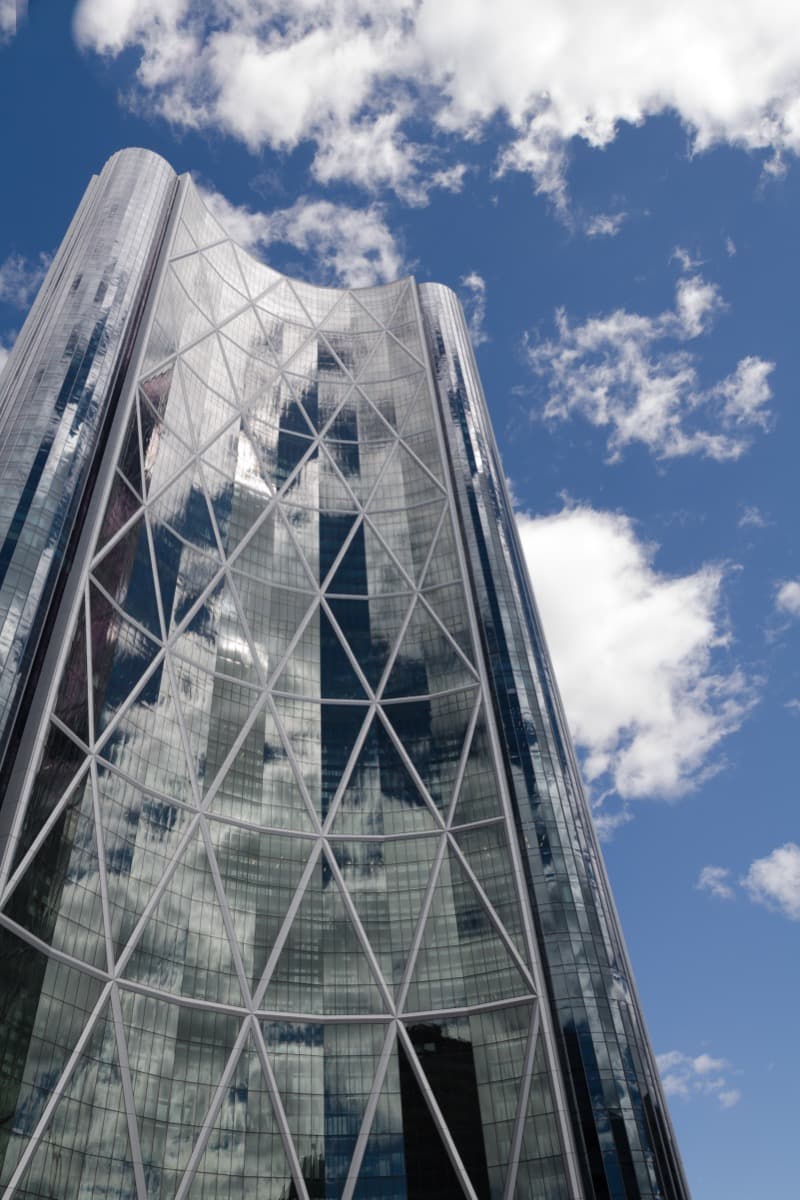
The Bow was designed by the London firm Foster + Partners, with Zeidler Partnership Architects of Calgary, and completed in 2012. It stands 236 metres tall and was the tallest building in Calgary from 2010 until 2016. Its defining move is the curve: the tower bows toward the south, its crescent plan turning to face the sun to capture daylight and heat, and the bowed shape lengthens the perimeter so more offices get an outside wall and a view toward the Rocky Mountains.
The engineering shows on the outside. The exterior is a diagonal steel grid, a diagrid, which lets the structure carry its loads through the skin rather than through a forest of interior columns, opening up the floor plates. It reads as a single confident shape, which is fitting, because it was conceived at the top of a mid-2000s oil boom. Like most of downtown's towers, it was commissioned when the crude price and the confidence were highest and delivered years later into a cooler market. That timing is the subject of the Balance Sheet Skyline tour.
Wonderland: the portrait you can enter
Hear a stop from this walk
Olympic Plaza
In front of The Bow stands Wonderland, unveiled in 2013, by the Barcelona-born sculptor Jaume Plensa. It is a twelve-metre head built from bent white wire mesh, and at the time it was his largest work. The head is a portrait of a young girl from Plensa's native Barcelona, and the mesh makes it transparent, so the tower behind it shows through the face.
The point that surprises people is that you can walk inside it. The wire-mesh construction means the sculpture is hollow and open at the base, and visitors step into the head and look out at downtown through the lattice of the face. Plensa has described the transparency as a bridge between the sculpture and the architecture behind it, linking art, building, and the people passing through. On a boom-era plaza it does something else too: it is the kind of ambitious public gesture a company commissions when the balance sheet is full, which makes it a small artifact of the same cycle that produced the tower.
Why they belong together
Stand on the plaza and the two objects rhyme. The tower curves up and outward toward the sun and the mountains. The head opens outward too, letting the city show through it. Both are about a Calgary at the height of its confidence, looking up and out. And both belong to the +15 tour's larger argument about a downtown that moved up a level: The Bow is a major anchor of the skywalk network, and its plaza is one of the places the upper city meets the ground.
For the wider narrative, see Calgary: the city the oil price built and rebuilt. The Bow and Wonderland are stops on the +15 tour, free to start.
Ready to experience it?
The +15: A City That Moved Indoors
66 min · 2.6 km · easy
More from Calgary
Explore more at your own pace.
Calgary: The City the Oil Price Built and Rebuilt
Inglewood and the Confluence: Two Sides of One River, Two Kinds of Memory

The Balance Sheet Skyline: Reading Calgary's Towers as an Oil-Price Chart
The Bridge Calgary Argued About: Crossing Between Two Calgarys
Inglewood: Calgary's Oldest Neighbourhood Turned Maker District