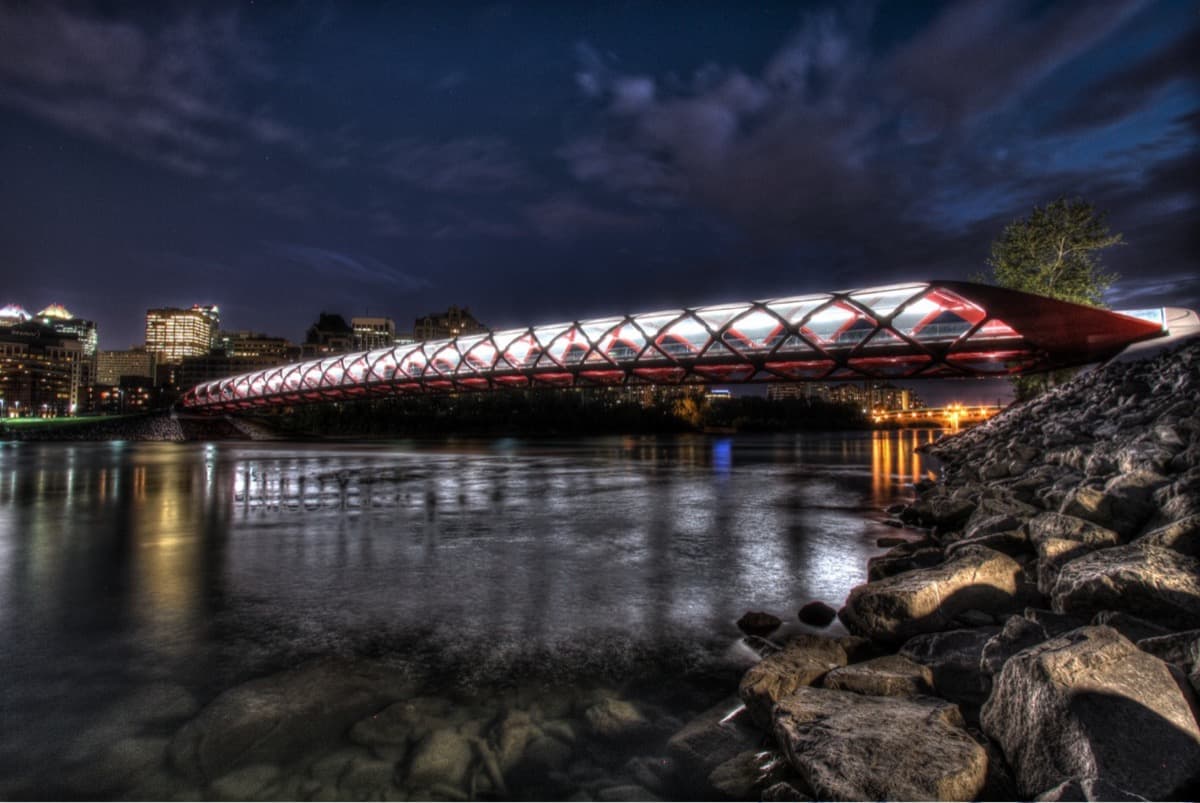
The Peace Bridge is the reason the Kensington tour crosses the Bow where it does. From the water it reads as a red-and-white tube, a helix wrapped around a walkway, and it is now one of the most photographed objects in Calgary. It did not start out beloved. For years it was the thing the city argued about, and the argument was less about the bridge than about how it got built.
What it is
The Peace Bridge was designed by Santiago Calatrava, the Spanish architect and engineer known for expressive, sculptural structures. It opened on 24 March 2012 as a pedestrian and cyclist crossing over the Bow River, linking downtown Calgary to the north bank at Sunnyside and Kensington.
Structurally it is a single-span tube. The walkway runs through a helical steel frame, a spiral of members wrapping the deck so the structure needs no supports in the river below, which matters on a river prone to flooding and ice. Calatrava's bridges are usually white and usually asymmetric, hung from a leaning mast. The Peace Bridge breaks his own pattern: it is symmetric, low, and coloured red and white, the colours shared by the flags of Canada and of Calgary.
The argument
Hear a stop from this walk
The Peace Bridge
The controversy was about process and money. The design was single-sourced to Calatrava rather than put out to open competitive bid, and in a city that likes to see its public money spent competitively, that decision drew sustained criticism. The final cost came to about $24.5 million, roughly $19.8 million of it construction and the balance design, administration, and insurance. The bridge also arrived late, opening well behind its original schedule.
For a stretch, the Peace Bridge was shorthand for public money spent the wrong way: too costly, sole-sourced, imposed rather than chosen. The debate was loud enough that it fed into how the city handled procurement afterward. The bridge became a case study in what happens when a signature design skips the competitive step.
The turn
Then the city changed its mind, quietly and without ever quite admitting it. The bridge is genuinely pleasant to cross. The red spiral photographs against the river and the towers in every light. It carries a large volume of walkers and cyclists between downtown and the north bank, doing exactly what a footbridge is meant to do, which is stitch a divided city together. The object won the argument the process had lost. Today it is one of Calgary's most-loved crossings, and the criticism has faded into the story rather than the verdict.
Why it belongs on this walk
Crossing the Peace Bridge is the pivot of the Kensington tour: behind you the oil-tower downtown, ahead the walkable, remembering north bank. The bridge is the seam between two Calgarys, and its own history is a small, sharp version of the city's bigger habit of building boldly on the boom and then arguing about what it built. For that wider pattern, see Calgary: the city the oil price built and rebuilt.
The Peace Bridge is a stop on the Kensington and Peace Bridge tour, free to start.
Ready to experience it?
Peace Bridge and Kensington: The Bridge Calgary Argued About
96 min · 4.9 km · easy
More from Calgary
Explore more at your own pace.
Calgary: The City the Oil Price Built and Rebuilt
Inglewood and the Confluence: Two Sides of One River, Two Kinds of Memory
The +15: How Calgary Built a Second City Fifteen Feet Up
The Balance Sheet Skyline: Reading Calgary's Towers as an Oil-Price Chart
The Bridge Calgary Argued About: Crossing Between Two Calgarys