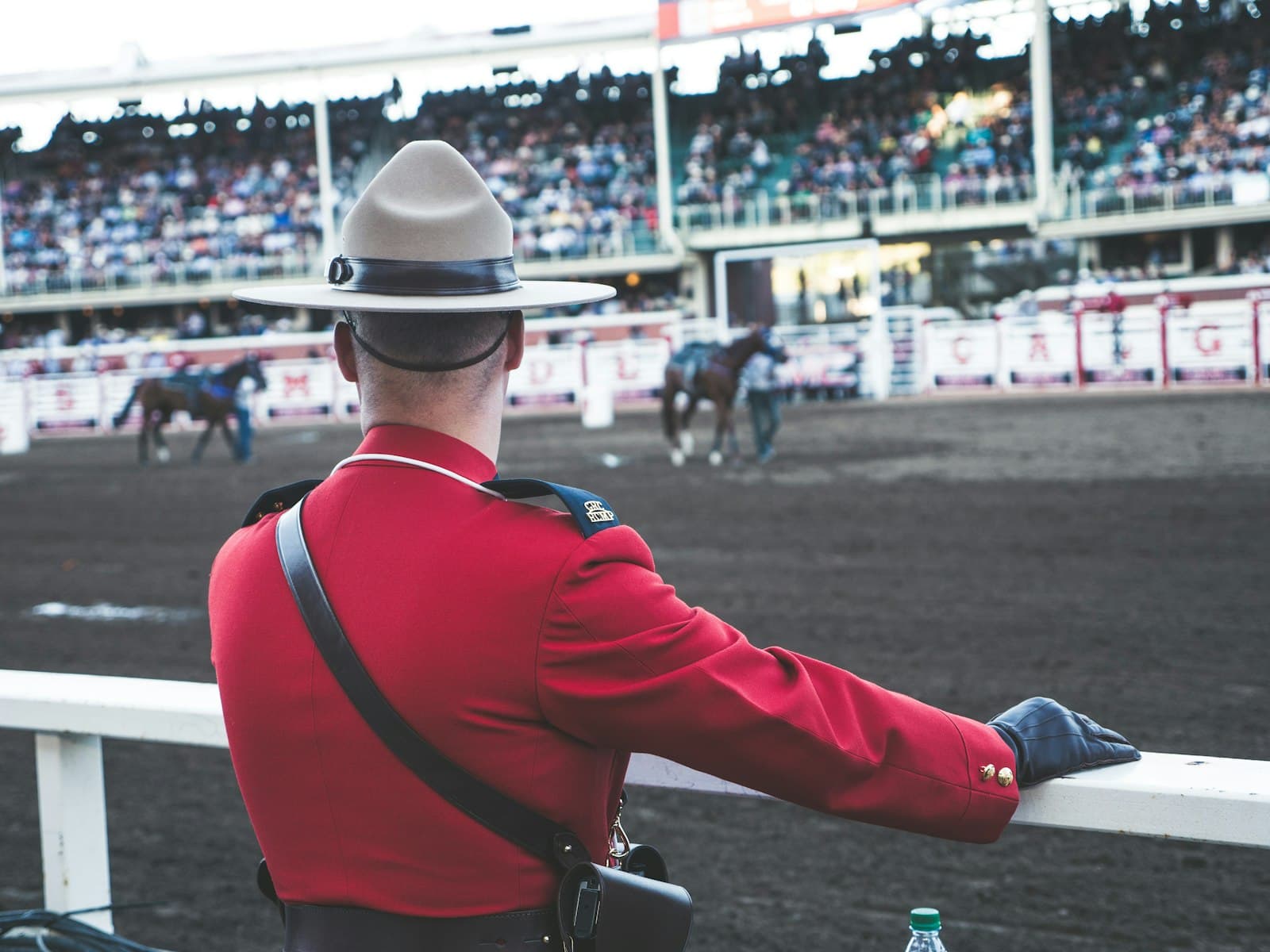
Every July, Canada's oil-and-gas capital puts on a hat and performs a frontier. The Calgary Stampede is ten days of rodeo, chuckwagons, and cowboy pageantry that the city treats as its truest self. The Stampede tour walks the grounds where that self-image is staged and asks two uncomfortable questions: where did this cowboy identity actually come from, and what stood on this ground before the show did?
An imported frontier
The Stampede was not a folk tradition that grew up out of the ranchland. It was staged. The first one was mounted in September 1912 by Guy Weadick, an American trick-roper and promoter who pitched a wild-west show grand enough to make Buffalo Bill's look like a sideshow. Weadick did not have the money, so he found four men who did.
They are remembered as the Big Four: the cattlemen Pat Burns, George Lane, A. E. Cross, and A. J. McLean. Each staked $25,000 to bankroll the first Stampede, and the Big Four Building on the grounds is named for them, for the money behind the myth rather than for any cowboy. The 1912 event drew big crowds and offered a $20,000 purse, importing a frontier spectacle at the exact moment the real open-range frontier was closing. Calgary was already becoming a modern commercial city; the Stampede sold it a past on the way out.
The neighbourhood under the grounds
Hear a stop from this walk
The Vanished Victoria Park: Forty Years of Waiting to Die
The tour's harder chapter is the ground itself. The Stampede grounds sit on what was Victoria Park, a working residential neighbourhood of houses, churches, and shops. As the show grew across the twentieth century, it needed room, and it got it by buying out Victoria Park block by block, over roughly forty years, emptying and paving what had been people's homes. The stop the tour calls the Vanished Victoria Park stands on engineered ground along Olympic Way where that neighbourhood used to be. The myth expanded by erasing the actual community around it.
The self-image and the reality
Set the two facts side by side and the tour's thesis lands. The frontier identity Calgary performs is genuine in the sense that people love it and live it for ten days a year, and manufactured in the sense that it was financed into existence by cattle barons and an American showman, then given a permanent home by clearing out a neighbourhood. Both things are true at once, which is what makes it interesting to walk.
The route takes in the BMO Centre, the Saddledome, the Stampede grandstand where Weadick staged the first show, the Elbow River camp, and Fort Calgary, tying the performed frontier back to the confluence where the actual city started in 1875. For that founding-river history, see the Inglewood and Confluence walk. For how the Stampede's cowboy story sits alongside Calgary's oil-tower reality, see Calgary: the city the oil price built and rebuilt.
The tour runs about 97 minutes over 5 km with eight stops, the longest of Calgary's five routes, and it is free to start: the introduction and first stop play in full, and every later stop plays a short preview. To compare them, see the best self-guided walking tours in Calgary.
Ready to experience it?
Cowtown, Performed: The Frontier Calgary Financed and the Neighbourhood It Erased
97 min · 5 km · easy
More from Calgary
Explore more at your own pace.
Calgary: The City the Oil Price Built and Rebuilt
Inglewood and the Confluence: Two Sides of One River, Two Kinds of Memory

The Balance Sheet Skyline: Reading Calgary's Towers as an Oil-Price Chart
The Bridge Calgary Argued About: Crossing Between Two Calgarys
Inglewood: Calgary's Oldest Neighbourhood Turned Maker District