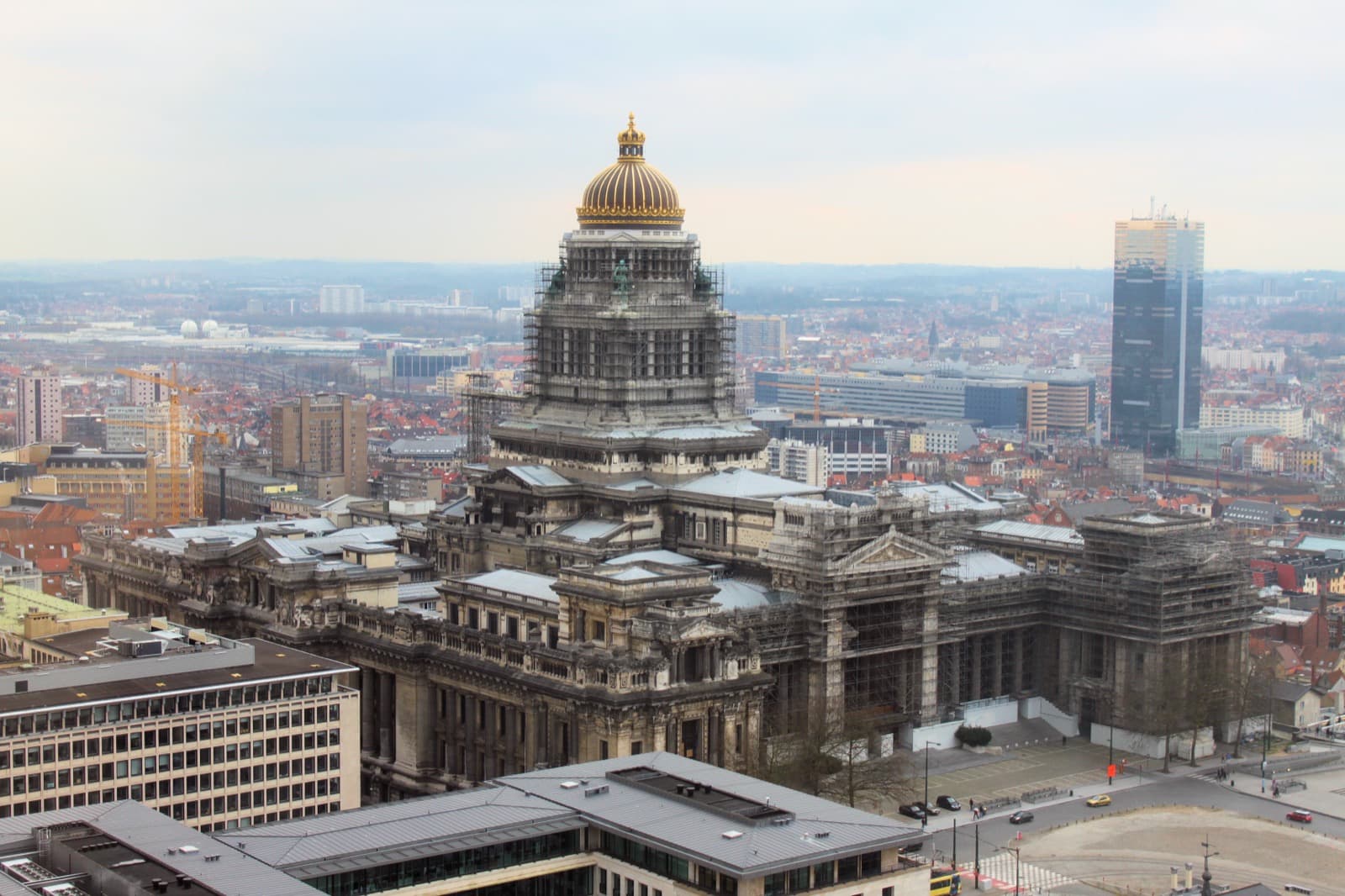
Brussels wrote its class geography straight into a hillside, and the Palais de Justice is the sentence's final, heaviest word: a colossal nineteenth-century courthouse raised on the height once called the Galgenberg, or Gallows Hill, whose construction erased part of the poor Marolles district it still towers over. To understand this building is to understand that its size is an argument. The architect Joseph Poelaert did not design a large courthouse by accident. He designed the largest building of its age, set it on the crest above the working town, and let the law look down on the people it judged. Stand on the terrace of the Place Poelaert, look back over the lower city, and you are reading the divided city made literal in stone.
A building of almost unreasonable size
The numbers are hard to hold in the mind, which is precisely the effect the design intends. The footprint runs roughly one hundred and sixty by one hundred and fifty metres, and the structure rises about one hundred and sixteen metres to the top of its dome. Upon completion in 1883, the city recorded it as the largest building in the world, and it remains among the largest courthouses ever raised. Construction ran from 1866 to 1883, ending on the fifteenth of October that year. Poelaert did not live to see it finished. He died in 1879, and the work was carried on by Joseph Joachim Benoit.
That gap between the man and his monument matters. Poelaert conceived a style that resists easy naming, a heavy blend of classical, Egyptian and Assyrian motifs piled into a single mass, and then he handed the actual completion to another. The building is not a personal signature so much as a state instrument, a machine for producing authority. When you approach the entrance hall, notice how the space swallows sound and scale. The intent is not comfort. It is submission. Ordinary human proportions vanish, and the visitor is meant to feel small before the law.
What the hill cost
Hear a stop from this walk
The Royal Palace: The Crown and the Colonial Reckoning
The height did not come free, and this is the one thing a visitor should carry away from standing in front of it. To clear the ground for the courthouse, a section of the poor Marolles district below was demolished. The record is specific: about seventy-five landlords were bought out with large indemnities, and around a hundred more modest residents were rehoused elsewhere. Money flowed generously to the property owners. The people who simply lived there were moved.
The resentment did not fade with the mortar. To this day, folk memory in the Marolles holds that people still use the word architect as an insult, in bitter memory of what was done to make room for this building. That single detail tells you more about the Palais de Justice than any measurement of its dome. A neighborhood turned a profession into a curse. The courthouse rose as a symbol of order and equality before the law, and the community it displaced answered with a word passed down through generations. Both things are true at the same time, and the honest way to see the building is to hold them together.
The slope, read as a sentence
The Palais de Justice does not stand alone. It is the climax of a walk up the entire upper town of Brussels, and its meaning depends on where you have been. This is a city built on a slope. Below runs the old lower town of markets, guilds and workers, laid along the buried river Senne. Above rises the upper town of palaces, museums and law. The whole tour that ends here parses that division stop by stop, and the courthouse is where the pattern becomes impossible to ignore.
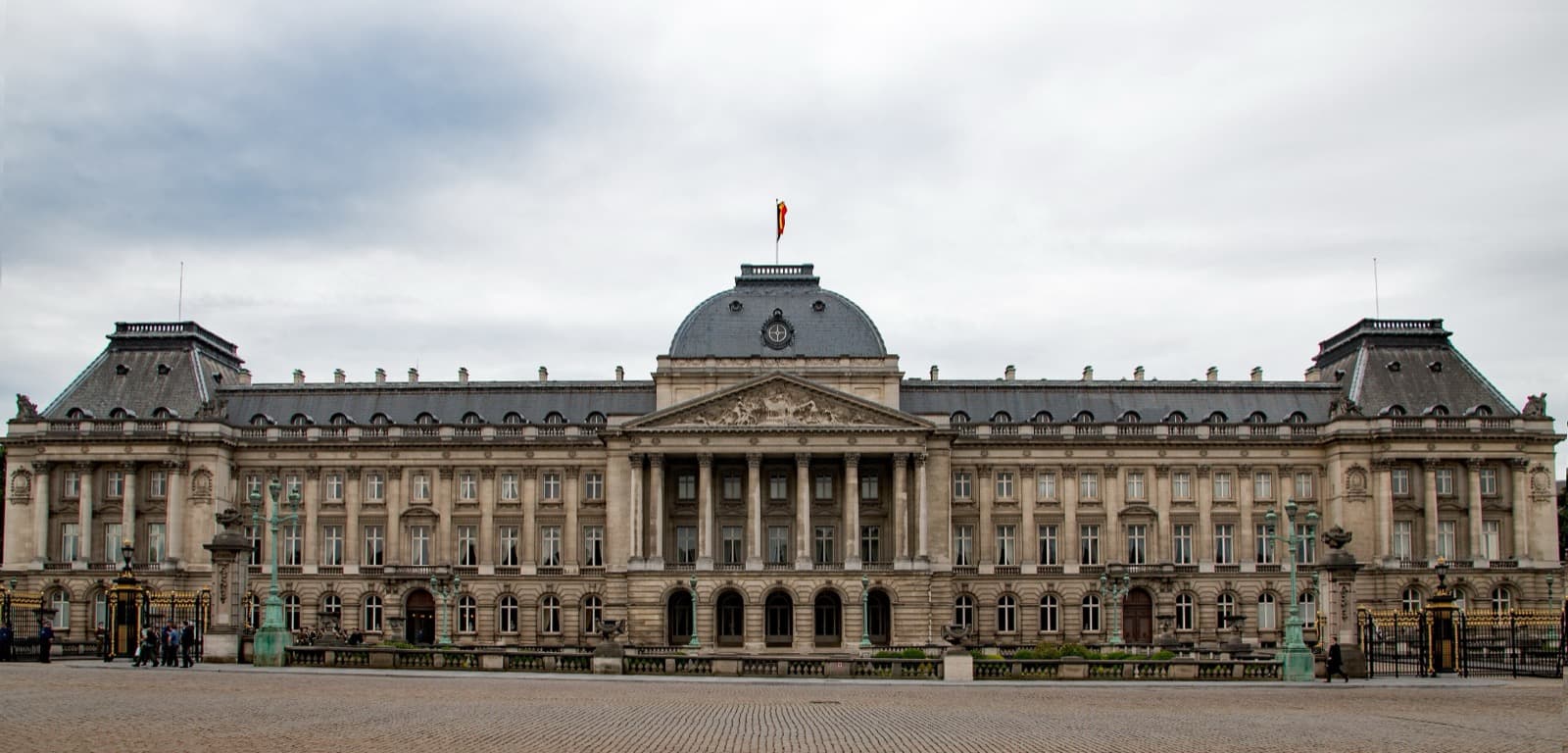
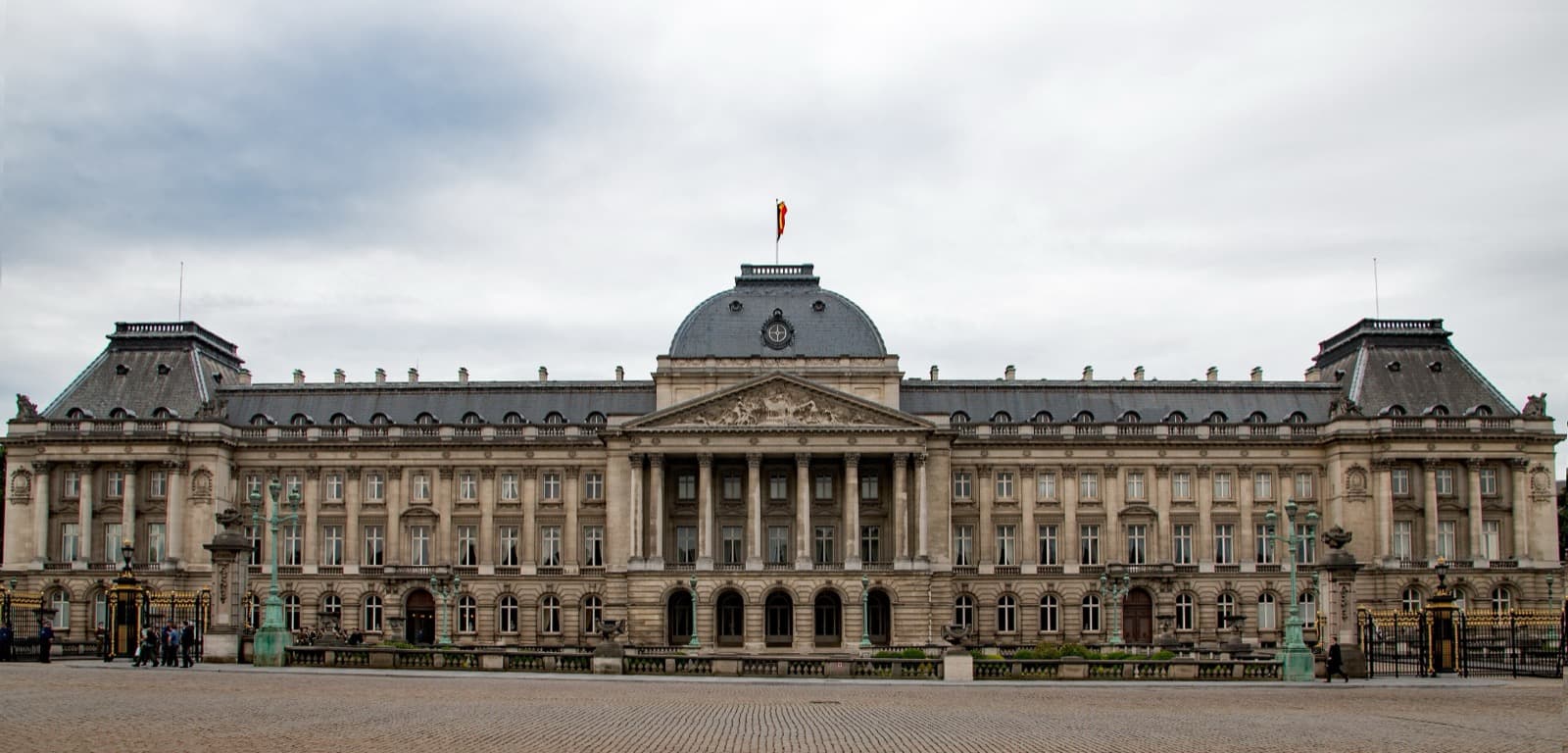
You will have met the pattern already. The Mont des Arts was cleared when the old Saint-Roch quarter was demolished in 1897 and 1898 to open the height for grand building. The Place Royale was laid over the buried ruins of the Coudenberg palace, which burned in 1731. The Royal Palace facade belongs to the era of King Leopold the Second, whose Congo Free State, his personal colony from 1885 until the Belgian state took it over in 1908, sits soberly in the record beside all this monumental grandeur. Again and again, to make the upper town monumental, something below was swept away. The Palais de Justice is the largest, plainest instance of that logic. It is the divided city with its cover removed.
The one thing to understand standing in front of it
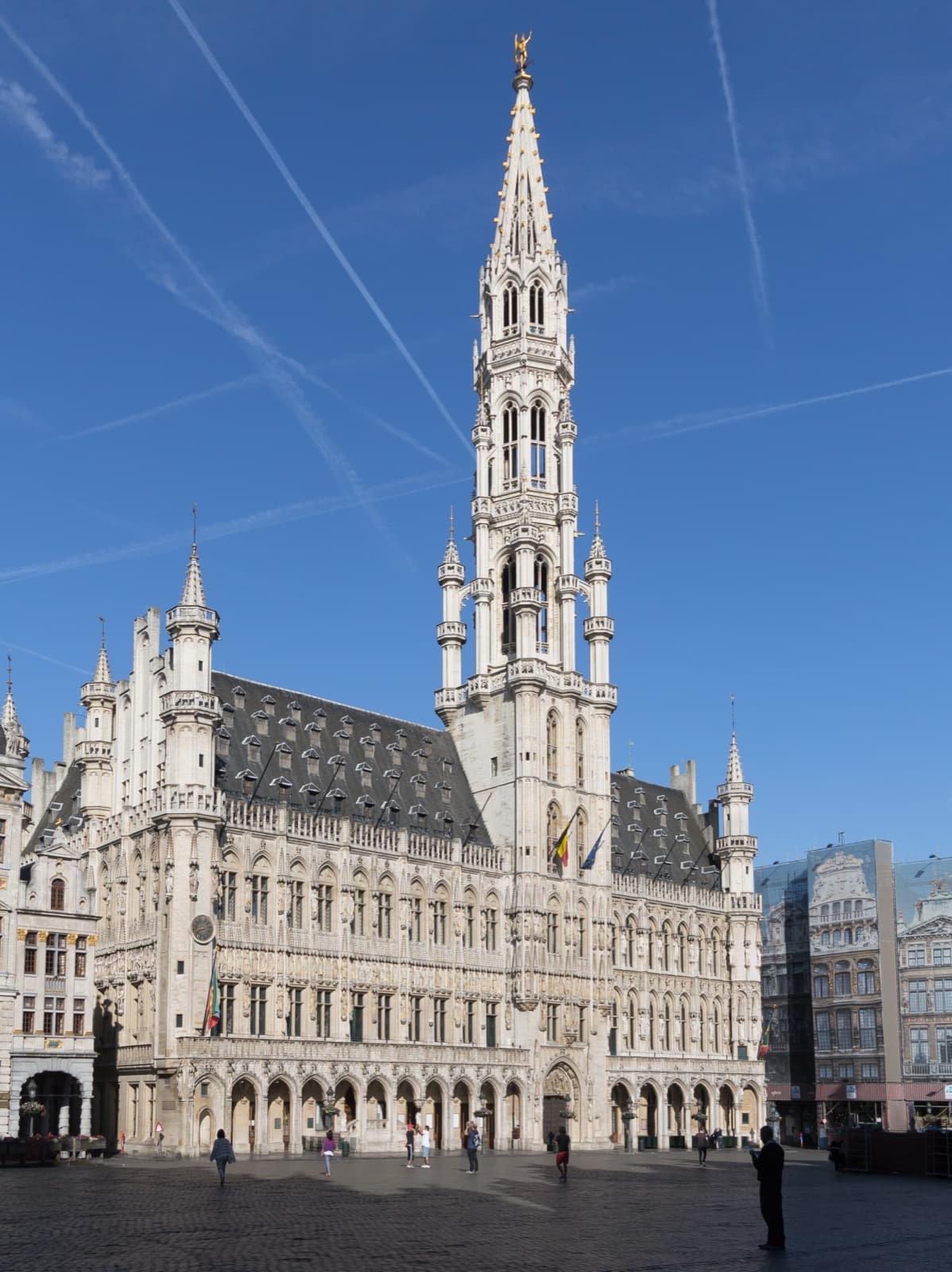
Most visitors photograph the dome and move on. The deeper reading is simpler and harder. This courthouse was placed here to be seen from below, by the working district it displaced, as a permanent statement about who holds power on this hill. From the Place Poelaert terrace, the wide view opens back over the lower town toward the tower of the Town Hall on the Grand Place, the same tower you can see from the Mont des Arts at the start of the climb. The view closes a circle. It also completes an argument. The law of the upper town, housed in the largest building of its age, looms over the town it judges.
You do not need a ticket to feel this. The entrance hall and the Place Poelaert terrace are free and open. Give the terrace ten quiet minutes. Look down at the Marolles. Then look up at the dome. The distance between those two glances is the whole point of the building.
Walk the hill yourself
The Palais de Justice reads best as an ending, after you have climbed the slope and watched the pattern repeat at every stop. The self-guided Royal Quarter walk takes you from the Mont des Arts up through the Place Royale, the Royal Palace, the Royal Museums of Fine Arts and both Sablon squares before it delivers you here, so the divided-city idea builds under your feet the way the hill does. You set the pace, pause on the terraces to rest, and arrive at the courthouse with the full weight of the climb behind you.
For more routes through the upper and lower town, see our guide to Brussels walking tours, or start planning from the Brussels city page. Wear shoes with grip, save the Place Poelaert terrace for last, and let the view do the talking.
Sources
- Palace of Justice, Brussels (Wikipedia): construction dates, Poelaert and Benoit, dimensions, and the Marolles demolition figures used throughout this piece.
- Coudenberg Palace official site (coudenberg.brussels): the buried palace under the Place Royale and its 1731 fire, context for the upper-town clearances.
- Royal Palace of Brussels and Casement Report (Wikipedia): the Leopold-the-Second building era and the Congo Free State timeline named soberly in the tour.
- Roamer tour transcript, "Royal Quarter: The Upper Town of Palaces and the Sablon": the fact-audited primary source for the Palais de Justice stop, including the Galgenberg name and the folk memory of the Marolles.
Ready to experience it?
Royal Quarter: The Upper Town of Palaces and the Sablon
70 min · 2.3 km · moderate
More from Brussels
Explore more at your own pace.
Brussels Travel Guide: How Many Days, Getting Around, Best Time, and Safety
One Day in Brussels: A Walkable Route From the Grand Place to the Upper Town
The Phoenix City on the Slope: How Brussels Reads Its Own Hillside
The Grand Place Is a Burn Scar: Reading Brussels Rebuilt From Fire
The Royal Palace of Brussels: A Facade That Holds the Whole Upper Town