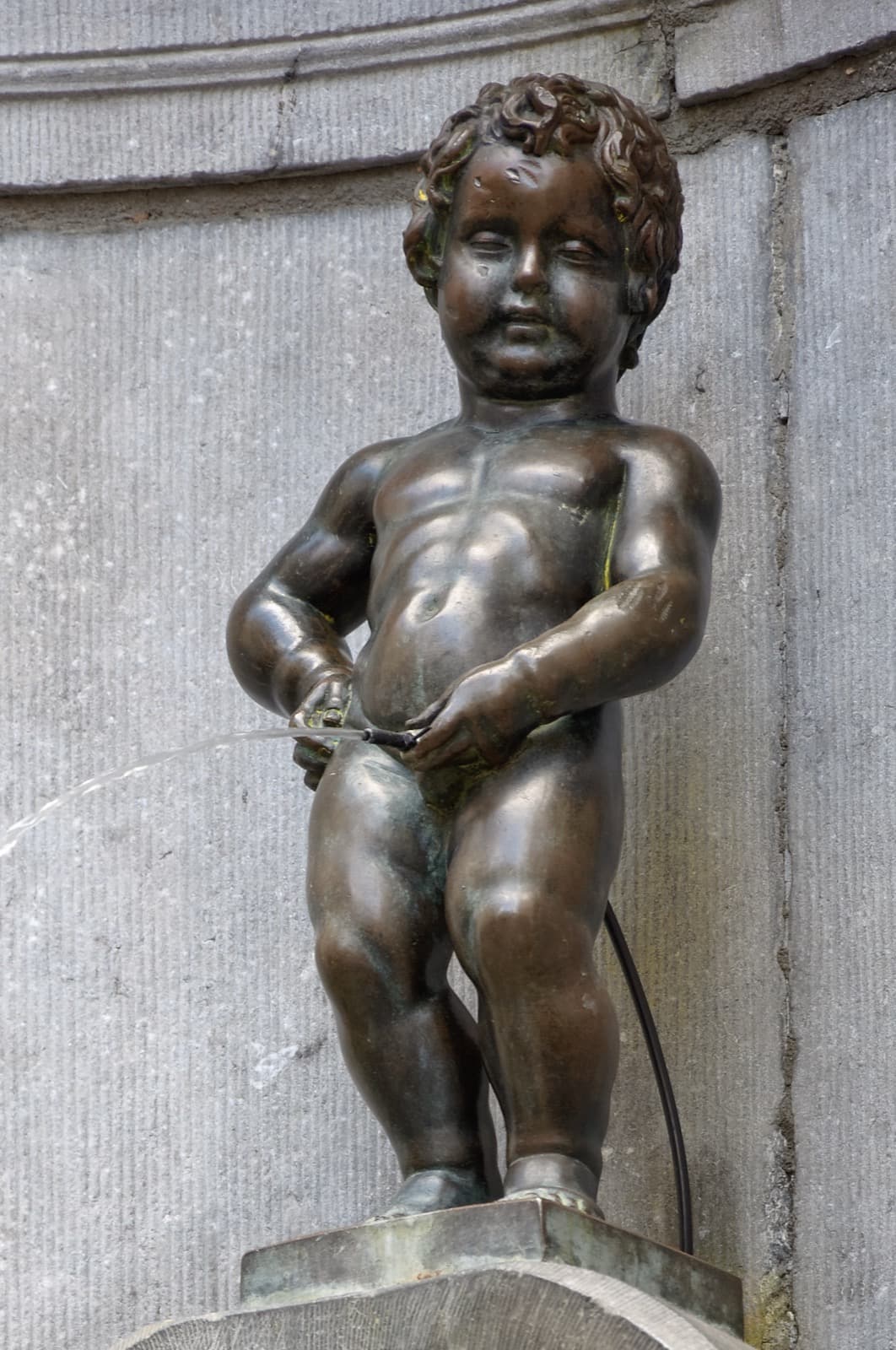
Manneken Pis is a small bronze fountain-boy on a street corner in Brussels, and almost everything a visitor assumes about it is either wrong or beside the point. It is not large. It is not the original. It has no agreed history. What it has instead is a folklore the city decided to keep alive for centuries, and reading that decision is what turns a two-minute photo stop into something worth understanding. Stand at the corner where rue de l'Etuve meets rue du Chene, watch the crowd raise their phones, and the real subject comes into focus: a city that dressed a peeing child in a thousand costumes and made him speak for the whole place.
What you are actually looking at
The first surprise is the scale. The figure is about fifty-five and a half centimetres tall, roughly the height of a toddler, set on a fountain in a corner niche. Most visitors arrive expecting a monument and spend their first moment looking too high. Find the small crowd rather than a grand pedestal and you have found him.
The second surprise is that the bronze in front of you is a copy. The current figure is a replica cast in nineteen sixty-five. The original, made around sixteen nineteen by the Brussels sculptor Jerome Duquesnoy the Elder, is kept safe indoors at the Brussels City Museum on the Grand Place, a few streets northeast. The reason is not sentiment but a long record of abuse. The little bronze has been stolen or damaged repeatedly across its life. In eighteen seventeen a thief named Antoine Licas made off with it and it was recovered broken into eleven pieces. In nineteen sixty-five it was stolen again and broken, and the fragments were pulled from the Charleroi Canal the following year. After that the city retired the original to the museum and put a durable copy on the fountain. So the statue you photograph is genuine to the tradition but not to the metal: a working stand-in for a relic that has been through too much to stand outside.
The corner is older than the bronze. A fountain with a little figure is documented here in a Brussels water-supply record of fourteen fifty-one to fourteen fifty-two, which mentions the spot in Old Dutch as the place "where the little boy pees." So a small pissing figure has marked this junction for well over five centuries, replaced again and again. Duquesnoy's bronze was the version that stuck, and the copy carries it forward. You are standing at a point of continuity far longer than the object that occupies it.
A history the city chose not to have
Hear a stop from this walk
The Cathedral of Saint Michael and Saint Gudula: The National Church on the Hill
Here is the part worth slowing down for. For a landmark this famous, there is no accepted account of why it exists. The city offers legends, and it offers them honestly as legends rather than fact. That candour is the interesting thing.
One tale describes an infant duke lifted in his cradle above a battlefield, urinating down on the enemy to rally his own troops. Another tells of a boy named Julianske who put out the burning fuse of a bomb set against the city walls and saved Brussels from destruction. Another has a wealthy merchant, frantic after losing his small son in the crowd, finding the boy cheerfully relieving himself and commissioning the fountain in gratitude. Yet another has a child dousing a house fire with the only water he had to hand. Take your pick, because the city does not choose for you. None is documented, and all of them survive precisely because none was ever proven and retired.
What connects several of these stories is fire and rescue, and that is a quiet irony worth carrying with you. This is a city whose central square was burned to the ground by a French bombardment in sixteen ninety-five and rebuilt in stone within about four years. In a place raised out of catastrophe, its best-loved mascot is a boy famous, in half his legends, for putting a fire out. Whether or not the tellers intended it, the little bronze answers the city's founding wound with a joke.
The wardrobe that made him a citizen
If the folklore explains why he endures, the costumes explain how the city keeps him alive. Manneken Pis owns a wardrobe of around one thousand outfits, and he is dressed regularly through the year according to a published schedule. The oldest surviving costume in the collection dates to the eighteenth century.
This is not a gimmick bolted on for tourists. The dressing has been managed since nineteen fifty-four by a dedicated body, the Order of the Friends of Manneken Pis, which reviews the designs offered each year, and the changes are often carried out with a brass band playing at the corner. Outfits arrive as diplomatic gifts, national-day tributes, and civic in-jokes, and the full collection now hangs in a museum devoted entirely to his clothes, the GardeRobe MannekenPis, a short walk away. If you want the whole story rather than the naked bronze, that is where it lives: rows of tiny suits, uniforms and folk dress, each a small act of a city talking to itself and to the world.
Understanding this changes what you are seeing on the corner. The bare bronze is only ever the default state. On any given day he may be a soldier, a saint, a footballer or a foreign dignitary, and the fact that a whole civic order exists to make that happen tells you how seriously Brussels takes its own sense of humour. The thing a visitor should understand, standing in front of him, is that the smallness is the joke and the ceremony is the point: the city invests real institutional care in a figure it refuses to take solemnly.
Where he sits on the walk
Manneken Pis makes little sense in isolation and a great deal of sense as one stop on a short loop through the old lower town. He sits a few minutes' walk southwest of the Grand Place, close enough that the guildhall square, the fire that shaped it, and the cheeky bronze that mocks it all belong to the same forty-minute walk. Seen alone he is an anticlimax. Seen in sequence, after the rebuilt square and before the glass arcade and the cathedral on the hill, he is the comic pivot in a serious story.
The self-guided brussels-grand-place-historic-center tour reads the whole lower town in that order, with the fire of sixteen ninety-five as its spine and Manneken Pis as its wink. If you would rather browse the full set of routes first, start with our Brussels walking tours and pick the pace that suits you. Either way, come to the corner knowing what you are looking at, and the smallest famous statue in Europe stops being a disappointment and becomes the best-told joke in the city.
Sources
- Manneken Pis, Wikipedia. Height (55.5 cm), the 1619 Duquesnoy bronze, the 1965 replica, the 1451-52 documentary reference, the theft history, and the Order of the Friends costume tradition.
- GardeRobe MannekenPis, official costume museum (mannekenpis.brussels). The costume collection and the tradition of dressing the figure.
- Brussels City Museum (brusselscitymuseum.brussels). Custody of the original bronze and the paintings of the 1695 bombardment.
- La Grand-Place, Brussels, UNESCO World Heritage Centre (whc.unesco.org/en/list/857). Context for the 1695 bombardment and the rebuilt square near the fountain.
- City of Brussels official page on Manneken-Pis (brussels.be). The costume schedule and the role of the Friends of Manneken-Pis.
Ready to experience it?
Grand Place: The Square Rebuilt in Four Years
60 min · 1.5 km · easy
More from Brussels
Explore more at your own pace.
Brussels Travel Guide: How Many Days, Getting Around, Best Time, and Safety
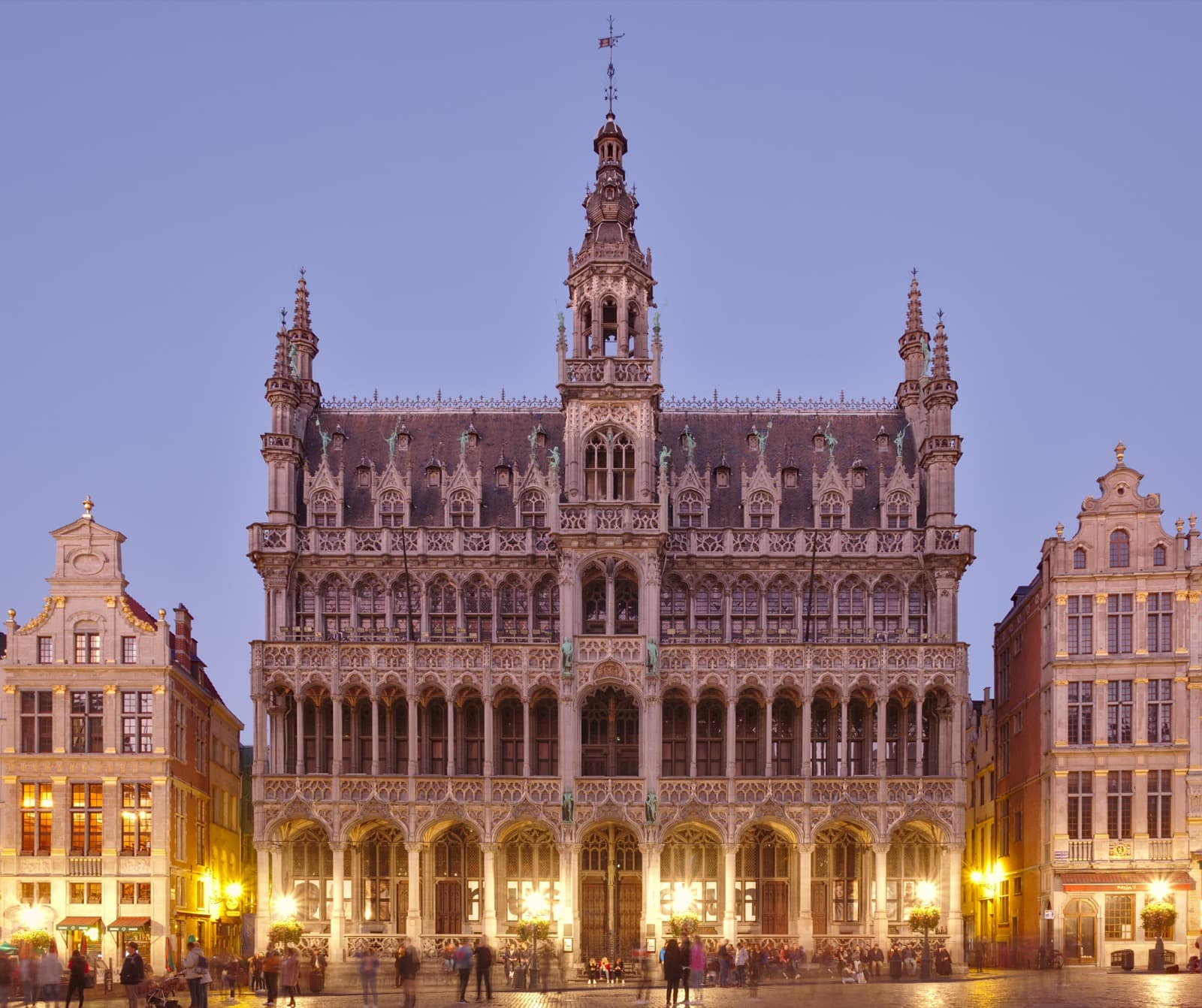
One Day in Brussels: A Walkable Route From the Grand Place to the Upper Town
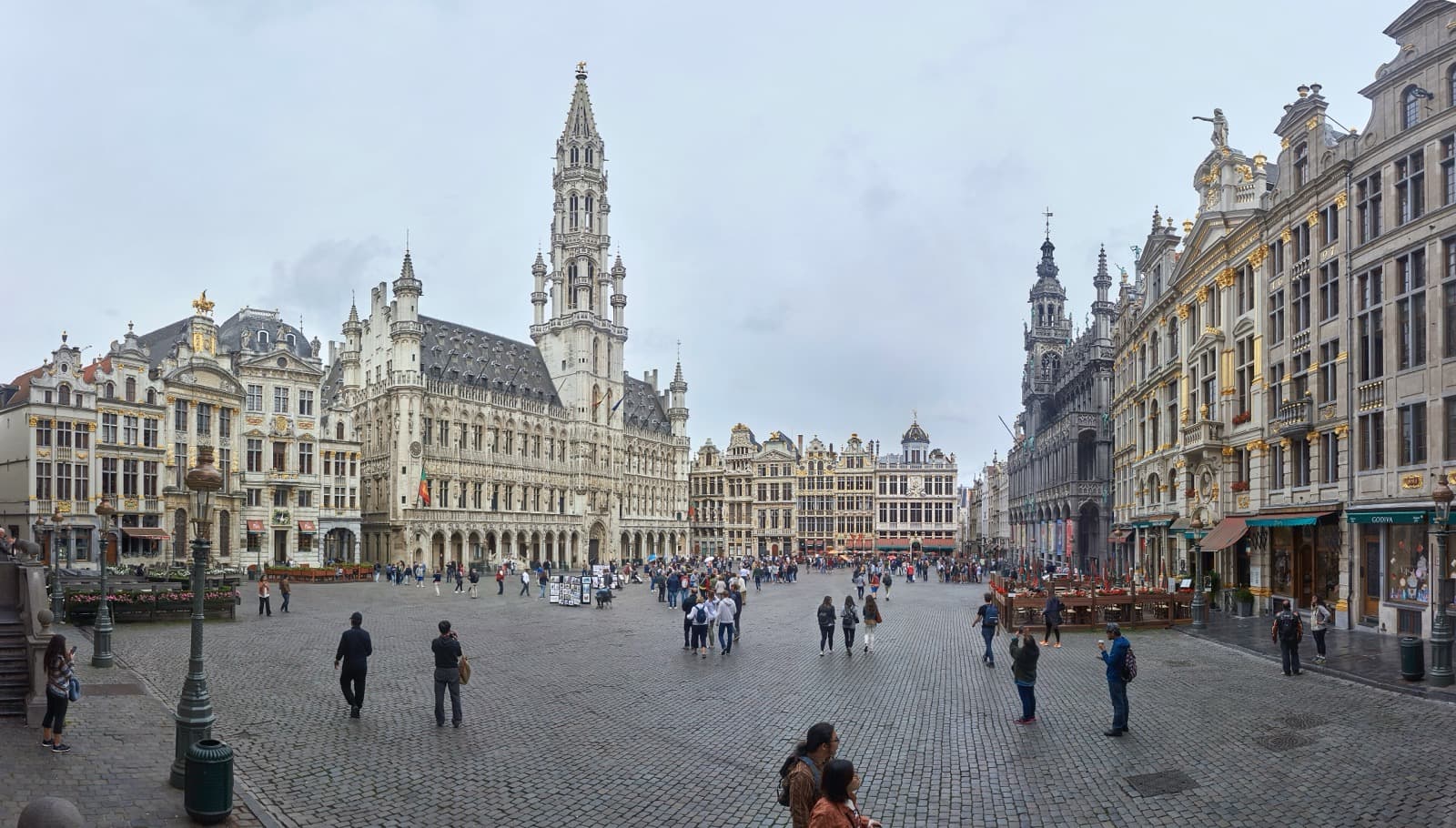
The Phoenix City on the Slope: How Brussels Reads Its Own Hillside
The Grand Place Is a Burn Scar: Reading Brussels Rebuilt From Fire
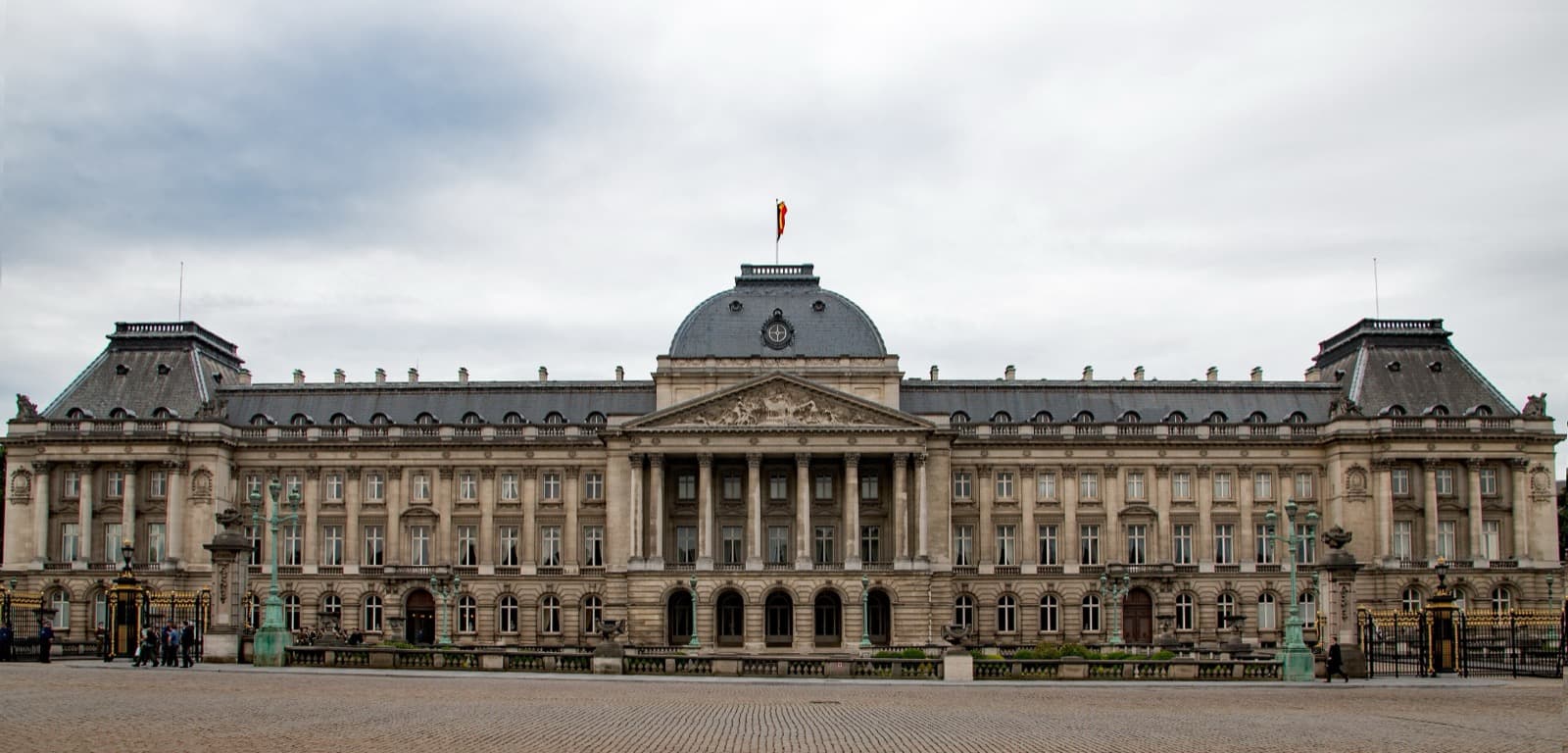
The Royal Palace of Brussels: A Facade That Holds the Whole Upper Town