Lumphini Park was built for a party that never happened. In 1925 a field of royal land at Sala Daeng was chosen for a great national exhibition. Workers dug a wide pond, raised an island in it and cut roads across the ground. Then the king died, the fair was called off, and the city was left with a lake, an island and a network of roads where the crowds were supposed to be. What grew on that ground is what you walk through today: Bangkok's first public park, as the city's own park office calls it, and one of the places the city most plainly lives in public.
A field chosen for a fair
The clearest account comes from Kanthika Sriudom, whose study of Bangkok's early fairs, published in the Chulalongkorn journal Nakhara in 2008, draws on National Archives files and The Bangkok Times of 1925. The Siamese Kingdom Exhibition was planned to open on 23 January 1926, to mark the fifteenth anniversary of the reign of King Vajiravudh, Rama VI. The plan began in January 1925, and so did the construction of the park in the Sala Daeng field.
The city's park office adds the background. The land was Thung Sala Daeng, the king's own land, what was left after a share had gone to Chulalongkorn University. The king paid the first costs of preparing the site himself. The office also records that he meant the ground to become a botanical garden, for the public to study and rest in, once the fair was over. He named it Suan Lumphini, after Lumbini in Nepal, the birthplace of the Buddha.
What the planners drew
Hear a stop from this walk
Chinese Clock Tower
The plan, drawn by the Sanitary Department, was ambitious. Kanthika describes canals all around the ground and two ponds. The big pond, with islands, near Ratchadamri Road, was to display the king's treasury. The small pond near Witthayu Road was to be ringed with foreign commercial pavilions, a Chinatown and a stadium. There were to be halls for the ministries and three exhibition halls near Rama IV Road. A new tram line, the Silom line, was granted to carry visitors, and the plan tied the fair ground to the new residential districts around it: Sathorn, Silom, Surawong and Si Phraya, known together as the Four S.
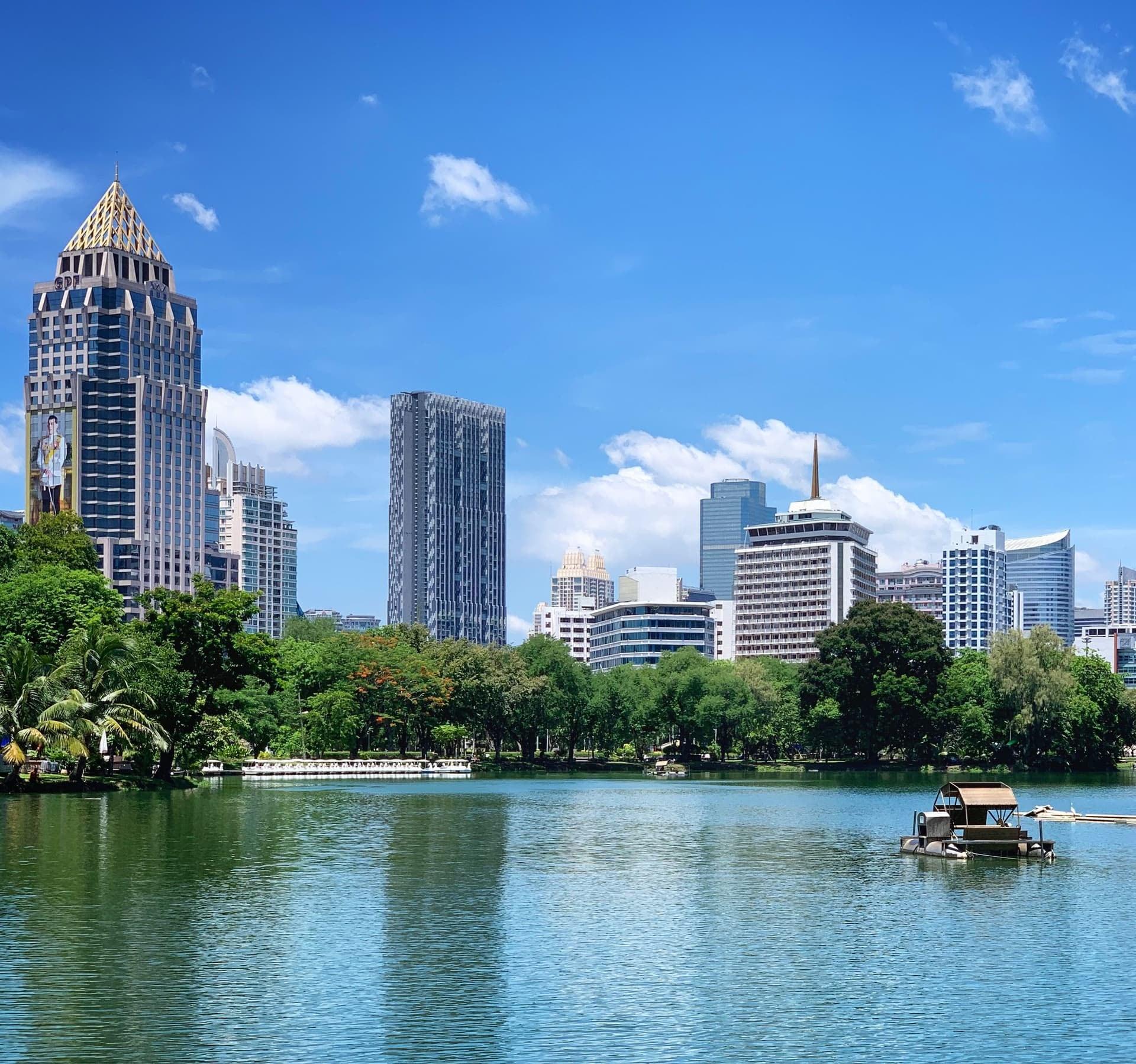
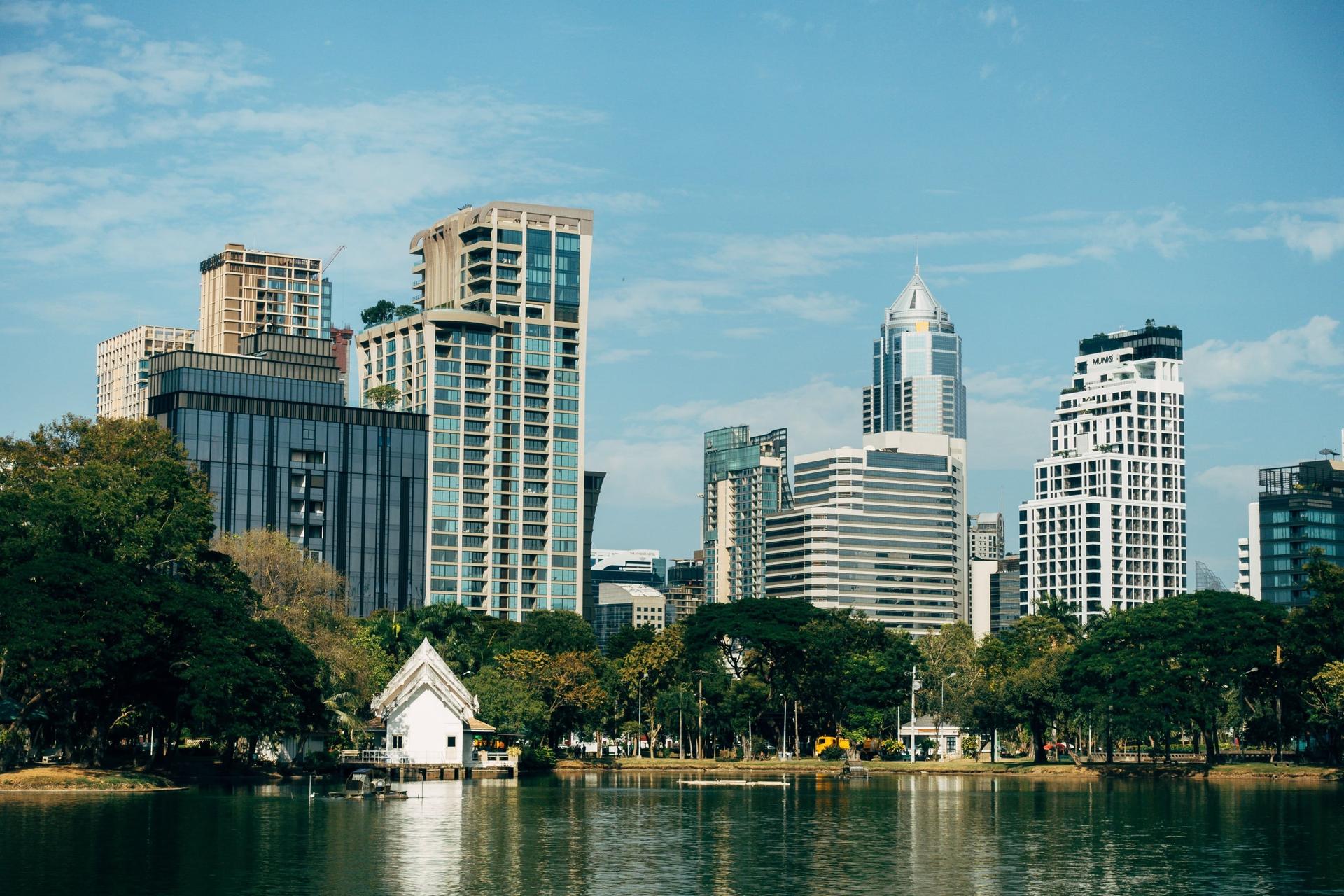
The park office lists what was actually built in 1925: a wide pond dug, a floating island made in the water, roads cut, and permanent structures put up, among them a clock tower. The lake still carries that plain description on the maps as Sa Kwang, the wide pond. Stand at the bridge off the island and you are looking at water that sits on the Ratchadamri side, which fits the plan's big pond. The towers of the Four S now rise above the far trees.
The year the plan stopped
The timeline turns fast. In November 1925 the king died. In December the exhibition was cancelled. As Kanthika puts it, the event never took place, and the Sala Daeng field was developed as a new public park instead of an exhibition ground. The park office says the same: because the king died before the opening date, the fair had to be abandoned.
That changes how you read the park. The lake and the island were dug for crowds that never came, and the roads were laid out for an event that was called off. The park is what the city did with a prepared ground and no party.
A park, and only a park
Under the next king, Rama VII, the park office says, about 90 rai at the southern end were leased as an amusement ground called Wana Roengrom, and the rent went into improving the land while the rest opened as a public park. The park became a place of kite contests, bull races, swings and carousels. Then came the condition that still shapes the place: the land was handed to the government to be used only as a public park.
The park had harder years. During the Second World War it held a Japanese army camp. Afterward, the park's own history says, it hosted the Constitution Fair from 1952 to 1954, with the Miss Siam pageant staged on the floating island. So a fair did come to the island in the end, just not the one it was dug for.
The civic layer of the 1950s
Past the boat pier you reach the decade when the fair ground became a civic ground. The Lumphini Public Library, according to the Association of Siamese Architects, which gave it a conservation award in 2007, was built in 1955 and opened on 24 June 1956 as the first public library in Bangkok. It is a single story of reinforced concrete under a hipped roof, modern in style with classical and Thai touches in its capitals. On its gable the builders wrote in stucco "Public Library of Bangkok, 2498 B.E.", which is 1955 in the Buddhist calendar.
A little farther on stands Lumphini Hall. Time Out Bangkok reports that it opened as a ballroom in the 1950s, with a stage that turns. The park office describes the stage in use for weekend dance classes. By 2024 the hall had been judged unsafe and locked; the city restored it, setting out to keep the turning stage, and Time Out described it as recently reopened in April 2026.
How Bangkok uses it now
The park covers 360 rai, about 57.6 hectares, and it is free. Since 1 August 2022 it has opened every day from 4:30 am to 10 pm. Those first hours are the busiest. The Guardian's reporter, there shortly after dawn in 2025, found joggers on the curving paths, old men straining under barbells at the outdoor gym and women stretching into yoga poses on the grass. The wide ring and central avenue, laid out as roads, now belong to feet and bicycles, with a separate one-way lane for cyclists. On weekday evenings from six an aerobics class takes over part of the park, and at weekends and on holidays from five, MGR Online reported in April 2026.
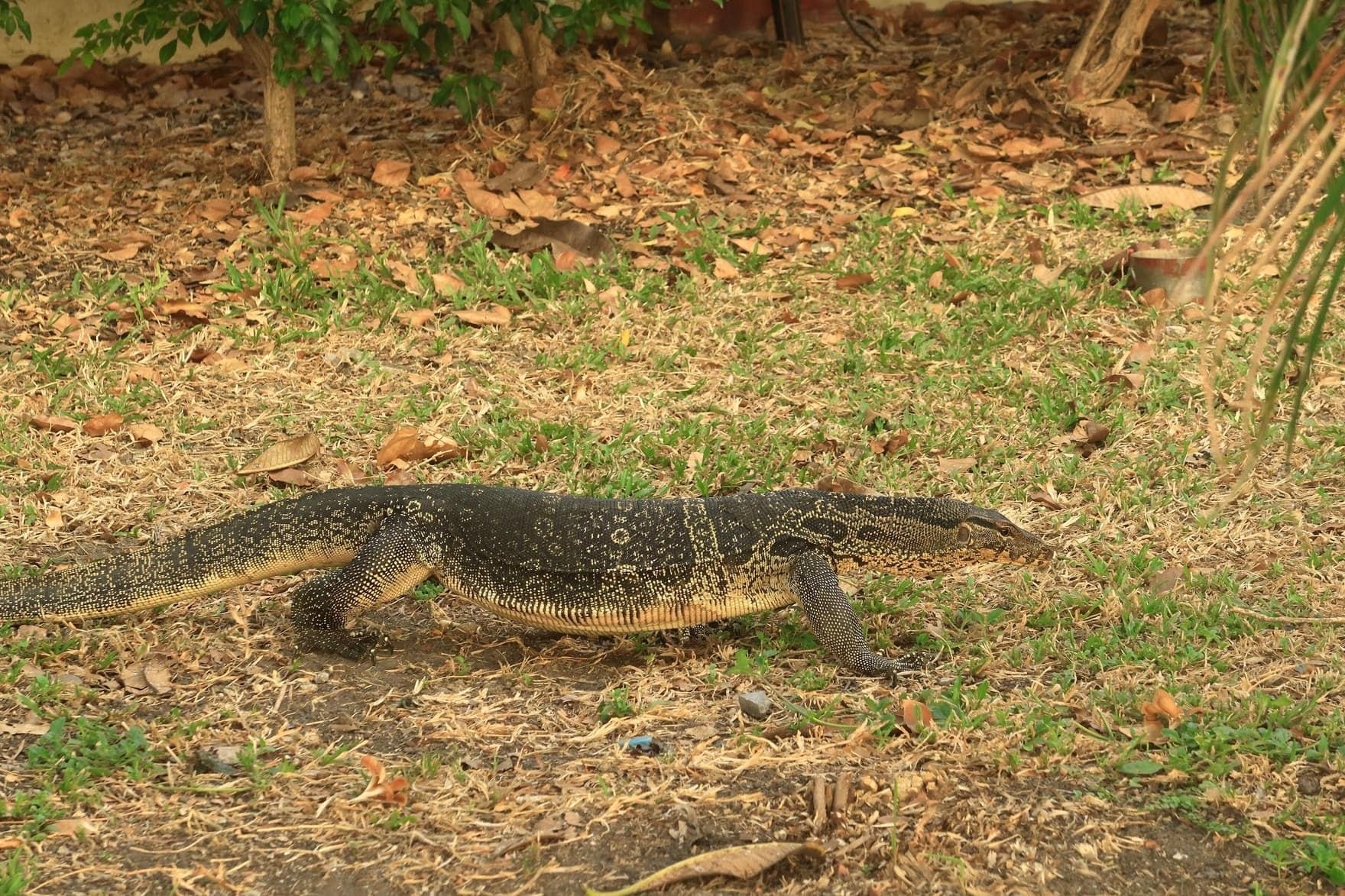
Out on the lake, pedal boats, many of them shaped like swans, go round the island in the morning and again in the afternoon, with a break at midday. On the banks live the park's water monitors, the world's second-largest lizard, about 400 of them by The Guardian's 2025 count. By the southeast pond, a Chinese-style pavilion and a clock tower with stacked Chinese roofs close the circuit; whether that tower is the one built in 1925, the record does not say.
Then there is six o'clock. Thailand plays its national anthem at 8 am and 6 pm, and people in public places stop walking and stand still. At Lumphini the evening anthem plays over the park's loudspeakers, and runners, walkers and cyclists stop where they are until it ends. Then the park moves again. For a ground that was meant to host one great event, it is a fitting daily ritual: the whole city, pausing in the place the fair left behind.
Walk it
Roamer's Lumphini Park walk starts on the plaza at the King Rama VI Monument, beside MRT Si Lom Exit 1, and goes round the park in 12 stops, about 2 kilometers and about 65 minutes, ending at the Chinese clock tower near MRT Lumphini. The park is open 4:30 am to 10 pm; if you are there at 6 pm, stand still with everyone while the anthem plays. It is a walk at your own pace, with no group to keep up with, and you can start it any time the gates are open. Browse the other Bangkok walking tours or start from the Bangkok city page.
Sources
- Bangkok Metropolitan Administration, public park office, Lumphini Park page (capture of 4 May 2017): area, history, the 1925 works, the Rama VII lease and the "public park only" condition, the war years, the Constitution Fair, Lumphini Hall's revolving stage, the boats.
- Kanthika Sriudom, "Fairs and Exhibitions in Bangkok in 1882-1925: A note on the growth of Bangkok city", Nakhara (Chulalongkorn University), 2008: the exhibition dates, the plan, the tram line, the Four S, the cancellation.
- Association of Siamese Architects, Architectural Conservation Award page, Lumphini Park Discovery Learning Library: the library's dates, design and gable.
- InfoQuest, 1 August 2022, and MGR Online, 7 April 2026: opening hours, aerobics and boat hours.
- The Guardian, Gloria Dickie, 15 September 2025: the dawn scene and the water monitors.
- Time Out Bangkok, 1 August 2025 and 22 April 2026: Lumphini Hall's restoration and reopening.
- Bangkok Post, 15 February 2016: the anthem at 8 am and 6 pm.
- Roamer tour, Lumphini Park: The Fair That Never Opened (November 2026).
Ready to experience it?
Lumphini Park: The Fair That Never Opened
65 min · 2 km · easy
More from Bangkok
Explore more at your own pace.
Best Culture Walking Tours in Bangkok (2026)
Best History Walking Tours in Bangkok (2026)
Golden Mount and the Old City Wall: Walking the Edge of Bangkok's First Royal City
Thonburi and Kudi Chin: The Capital Before Bangkok and the Neighbors Who Stayed
Giant Swing (Sao Ching Cha) and the Devasathan: A Brahmin New Year in a Buddhist Capital