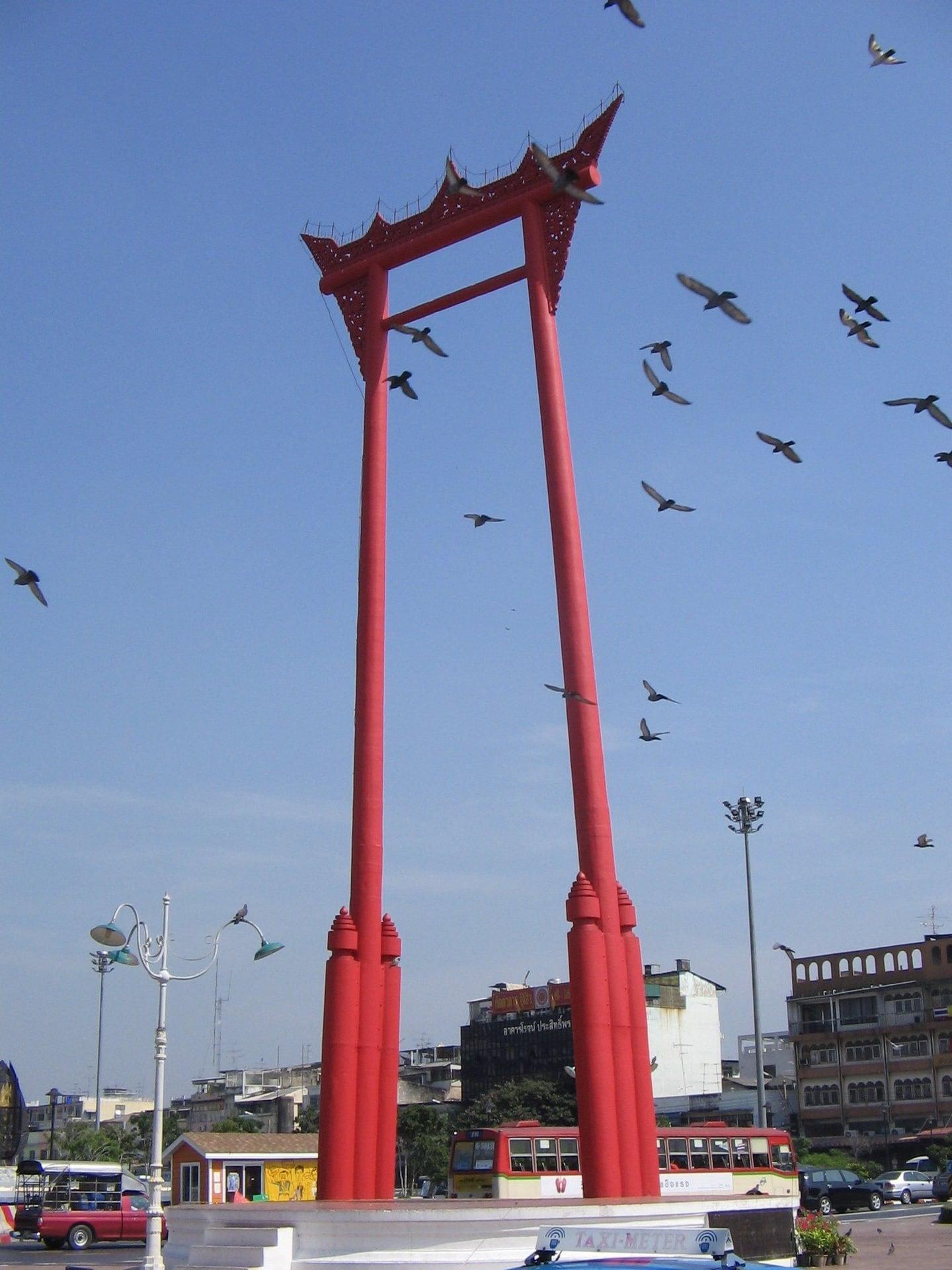
The Giant Swing, Sao Ching Cha in Thai, is two red pillars joined by a carved crossbeam, standing on an oval plaza in front of Wat Suthat with traffic lanes all around it. The Thailand Foundation and The Nation agree it is more than 21 meters tall. It looks like a gateway with nothing to pass through, and that is the puzzle. The answer lies about 70 meters up the street, behind a fence, in a white shrine where Brahmin priests have served the Thai court since the city's first years. The swing is not a temple ornament: it is the working frame of a Brahmin new year rite, built in the 1780s for that royal shrine, and it still stands though the swinging itself was stopped in 1934.
The shrine it was built for
That shrine is the Devasathan, the royal Brahmin shrine on Dinso Road. The Thailand Foundation says King Rama I (Phra Phutthayotfa Chulalok) had it built in 1784, two years after Bangkok was founded in 1782. Inside are two Shivalingas, the stone emblems of the god Shiva, which the Foundation calls a rarity in Brahmin temples. Its court Brahmins, the Foundation says, come from only seven Brahmin families.
Why would a Buddhist king keep Brahmin priests? Because, as the Foundation frames it, the great rites of the court, the coronation and the new year among them, belonged to the Brahmins. One of those rites needed something very large, and the swing was built for it, in the first years of the new capital. The exact year is disputed: The Nation gives 1784 and the Thailand Foundation 1786, so the walk says only the 1780s.
What happened under the beam
Hear a stop from this walk
Democracy Monument: The Change of 1932
The rite is known as Triyampavai-Tripavai, the Brahmin new year swing ceremony. The swingers were the naliwan, whom the Thailand Foundation describes as men adorned with naga headdresses and The Nation as young men. They rode a board hung from the crossbeam and swung out, higher and higher, reaching for a bag of coins, which they had to catch with their teeth.
It was dangerous, and it was expensive. The Thailand Foundation says the swinging was stopped in 1934, in the reign of King Rama VII, because of its high risk and cost. The Nation dates the end more loosely to the early twentieth century. What stopped was the swinging, not the rite. The Foundation says the court Brahmins kept the new year prayers at the Devasathan, and the ceremony was later restored as a public event, without the swingers.
The swing you see today
The pillars stayed in place, a frame for a ritual that no longer uses them. The Tourism Authority of Thailand says the swing you see was rebuilt from 11 to 13 September 2007, of golden teak from Phrae, in the north. Other dates and stories about earlier rebuilds circulate in travel listings, but they disagree with each other and are left out here.
Stand on Wat Suthat's front sidewalk and face the swing. Behind you, over the wall, rises the temple's great roof. Wat Suthat is ticketed, and fees and hours differ between listings, so check at the gate if you want to go in. The swing's plaza is open at all hours and costs nothing to see.
Back at the Devasathan, no official page gives visiting hours, so the fence and gate are as close as most visitors come. White shrine halls stand behind the fence. Keep your voice low by the gate.
The street behind the swing
Walk east from the plaza and the shrine's story turns into a street. The Tourism Authority of Thailand says the shops near Wat Suthat "stock a very comprehensive range of Buddhist religious supplies." Saffron robes, alms bowls, altar tables and Buddha images fill the windows of Bamrung Mueang Road. Those images are sacred objects made for temples and home shrines. Look with care, and do not photograph them up close or touch them.
Together, the shrine, the swing and the supply street show a court that drew on more than one tradition for its ceremonies, and a city that still keeps the frame of a rite whose swinging ended almost a century ago.
Walk it
The Giant Swing is the second stop on Roamer's Golden Mount and Giant Swing walk, which starts outside the Devasathan shrine by the swing; from MRT Sam Yot it is about 10 minutes on foot to the north. The walk covers 12 stops in about 1.8 kilometers and about 80 minutes, along the temple supply street, over the old moat to Wat Saket and the Golden Mount, along the city wall to Mahakan Fort, and on to the Democracy Monument. The Golden Mount climb is optional and ticketed: the Tourism Authority of Thailand lists 100 baht, but check on the day. Go at your own pace, with no group to follow, and start whenever you like.
Sources
- Thailand Foundation, Soonyata Mianlamai and Tayud Mongkolrat, "Triyampavai-Tripavai: The Swing Ceremony," 30 January 2024: the Devasathan, the swingers, the height, the 1934 end of the swinging and the rite's later restoration.
- The Nation, "The Giant Swing of Bangkok: A monument of spiritual heritage and daring rituals," 10 July 2025: the height, the 1784 date and the young men who swung.
- Tourism Authority of Thailand, Sao Chingcha and Wat Suthat attraction pages, read from archived captures: the 2007 rebuild in golden teak from Phrae and the religious supply shops.
- R. Lingat, "History of Wat Saket," Journal of the Siam Society 23:3 (April 1930): the founding of Bangkok in 1782.
Ready to experience it?
Golden Mount and Giant Swing: A Tower That Became a Hill
80 min · 1.8 km · easy
More from Bangkok
Explore more at your own pace.
Best Culture Walking Tours in Bangkok (2026)
Best History Walking Tours in Bangkok (2026)
Golden Mount and the Old City Wall: Walking the Edge of Bangkok's First Royal City
Lumphini Park: The Fair That Never Opened and the Park Bangkok Got Instead
Thonburi and Kudi Chin: The Capital Before Bangkok and the Neighbors Who Stayed