Ubud: The Town That Turned Art Into a Way of Life
150 min · 4.9 km · moderate
In Bali, art and water became forms of devotion, and you can read both on foot. In the highland town of Ubud, a working royal palace still hosts dance in its courtyard, a temple to the goddess of the arts rises from a lotus pond, a ridge path opens into rice-field silence, and a forest of macaques guards a temple of the dead. Out toward the coast stand the temples between land and sea: a serene royal garden-temple whose ceremonies once governed a thousand-year-old irrigation philosophy, and a sea-rock shrine that the tide cuts off twice a day. Two of Bali's self-guided walks trace this single idea, that the island turned making things and managing water into acts of faith, and both are designed to be read at your own pace, sarong in hand.
Ubud: a town that made art its civic religion
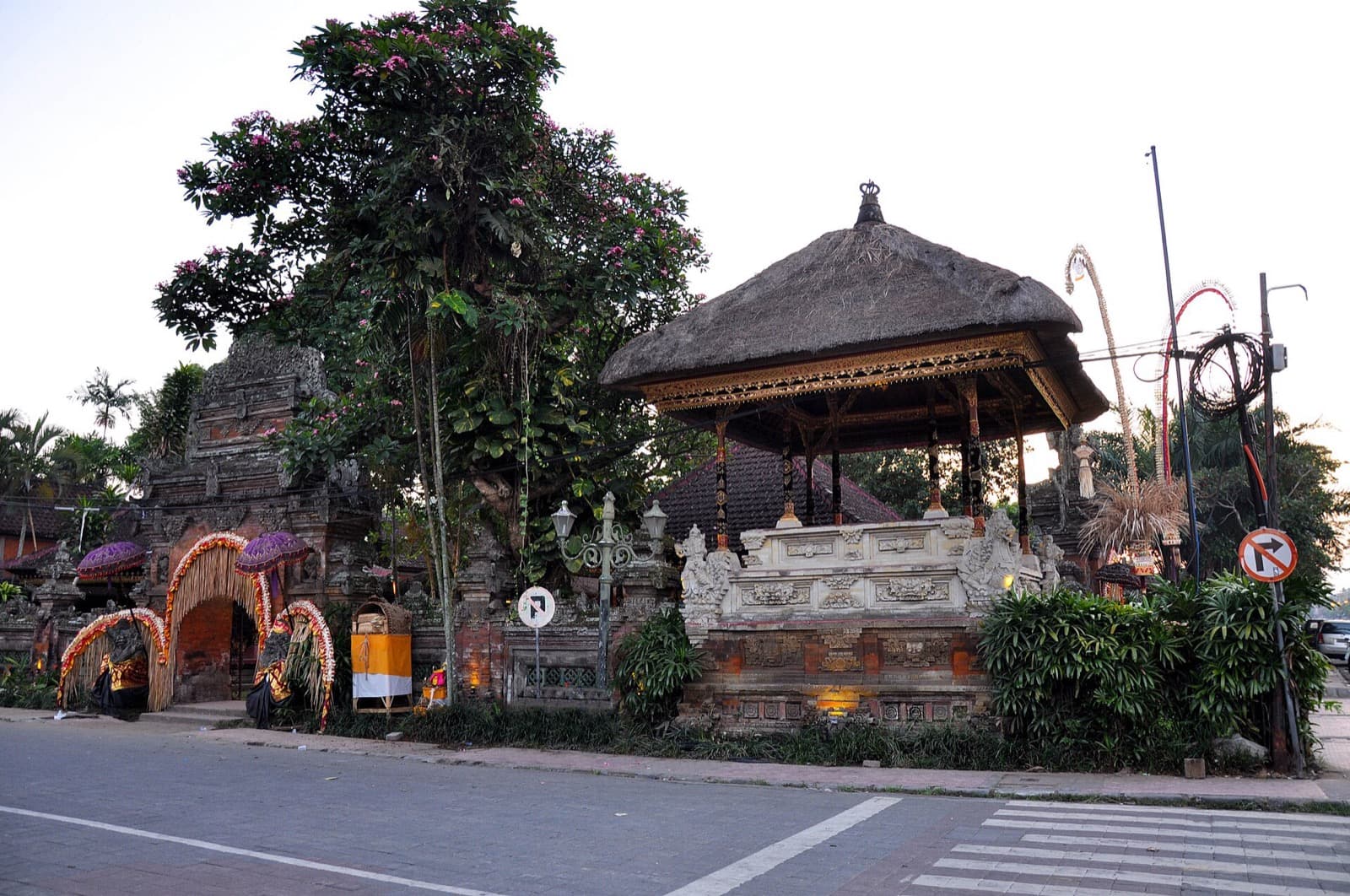
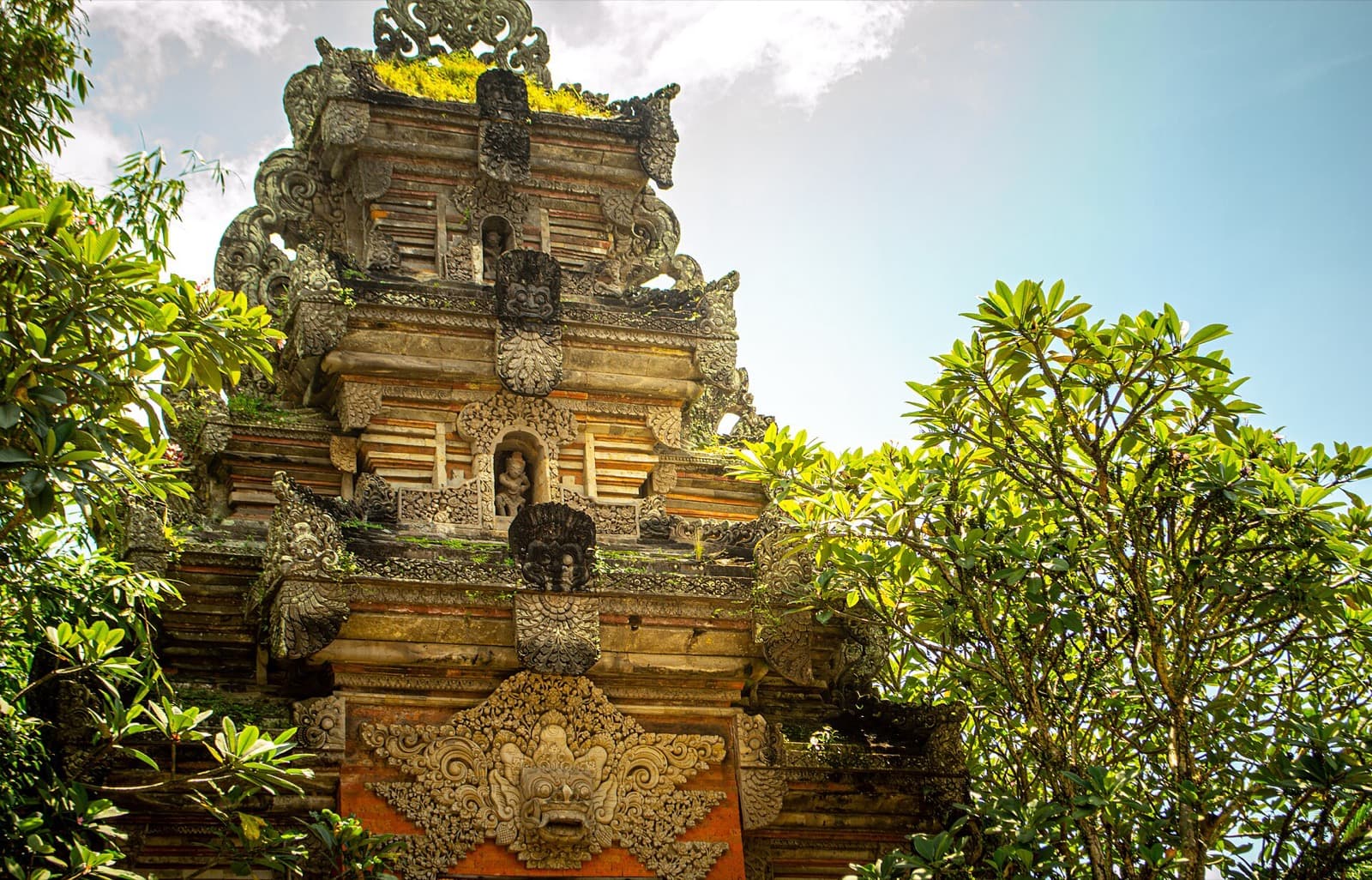
Ubud sits in the green uplands of Bali, and its meaning lives in unhurried attention. The Ubud palace and Monkey Forest walk gathers seven stops across the compact old core, roughly two and a half to three hours if you linger. It opens at Puri Saren Agung, the Ubud Palace, which is not a museum but the residence of the Sukawati ruling family. The compound took its present form during the reign of Tjokorda Putu Kandel, who ruled from eighteen hundred to eighteen twenty-three, was damaged by an earthquake in nineteen seventeen, rebuilt with local artisans, and opened to foreign guests in nineteen twenty-eight.
The palace records a family that treated art as duty. Ubud's last official raja, Tjokorda Gede Agung Sukawati (nineteen ten to nineteen seventy-eight), co-founded the artists' collective Pita Maha on the twenty-ninth of January, nineteen thirty-six, together with the foreign painters Rudolf Bonnet and Walter Spies. The group gathered around a hundred and fifty Balinese artists and lasted about six years, ending with the Japanese invasion of nineteen forty-two. The clearest proof that art here is a living thing comes after dark, when the front courtyard becomes a stage for gamelan and the Legong and Barong dances. You can stand in the daytime courtyard for free and simply read the carving, or return in the evening for the ticketed performance. The choice is entirely yours.
Directly across Jalan Raya Ubud stands Pasar Seni Ubud, the art market, where the town's reputation left home. Much of what fills its craft hall was not made here. It comes from the neighbouring villages of Pengosekan, Tegallalang, Payangan and Peliatan, each with its own hand and specialty. That is the quiet truth of Ubud's fame: the town became a name for Balinese art partly because it sat at the centre of a web of village workshops and gave them a marketplace.
The goddess of art, rising from a pond of lotus
Hear a stop from this walk
The Ubud Palace: The Royal House That Still Dances
A short walk west brings you to Pura Taman Saraswati, sometimes called the Ubud Water Temple, dedicated to Saraswati, the Hindu goddess of learning, literature and art. That dedication is the whole thesis of Ubud carved in stone. The temple was designed by the celebrated Balinese sculptor and architect I Gusti Nyoman Lempad, commissioned by the prince of Ubud, and built across nineteen fifty-one and nineteen fifty-two. Its signature is the broad lotus pond that fronts the gate, edged with frangipani, so you approach along a raised walkway with pink blossoms on either side. A town built its finest quiet water garden not for a king but for the goddess of art herself.
Then Ubud dissolves into landscape. The Campuhan Ridge is a paved track, barely a metre wide in places, running about two kilometres along a green spine between the east and west branches of the Wos river. The word campuhan means where two rivers meet, and tradition holds that an eighth-century sage named Rsi Markandya was drawn to this confluence and founded both the nearby temple and Ubud itself. The path is free and open, with no ticket and no fixed hours, which means you can walk the full length or turn back at any point that feels right, exactly the kind of choice a scheduled group never gets to make.
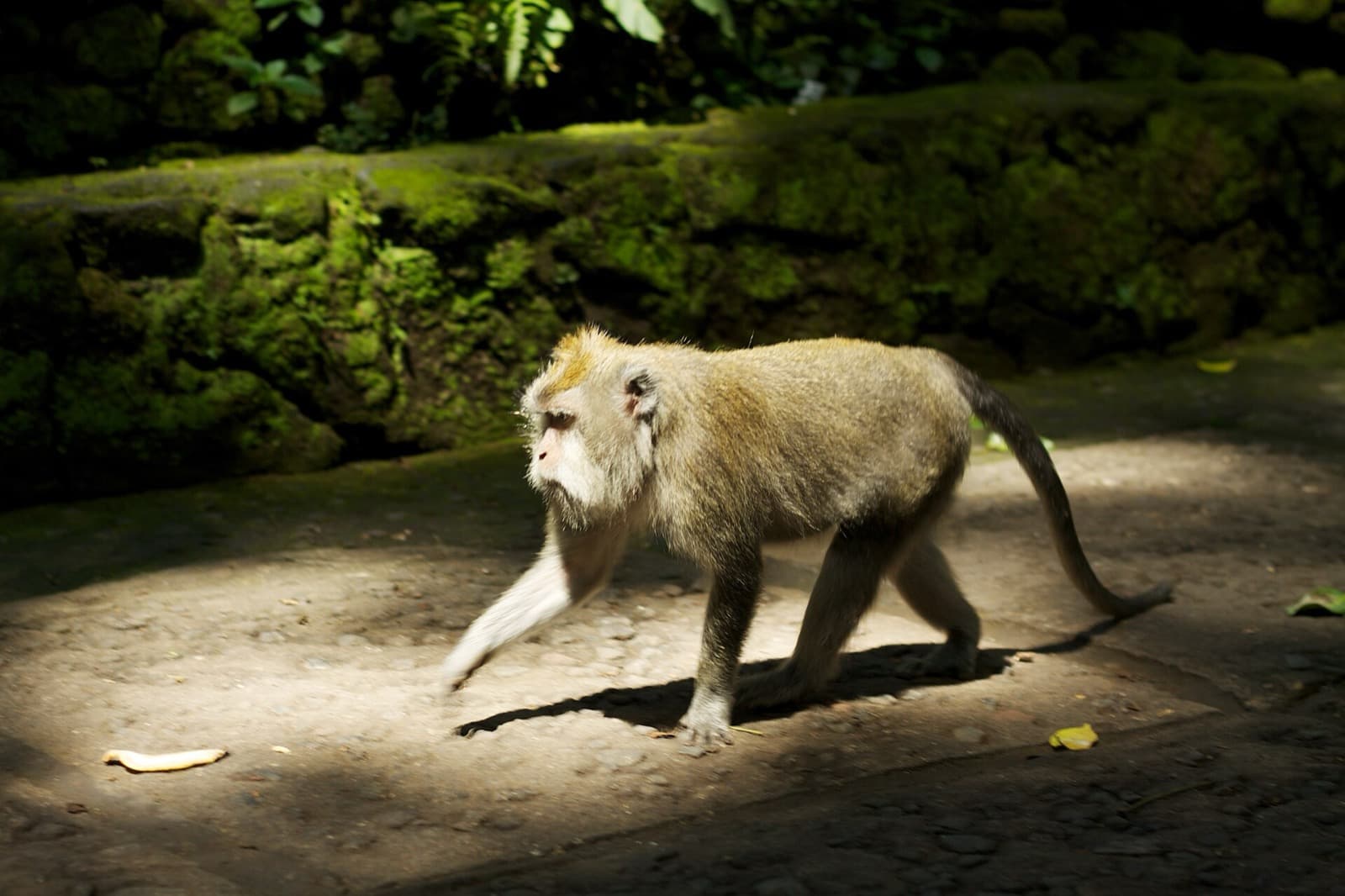
The walk closes in the Sacred Monkey Forest, known in Balinese as Mandala Suci Wenara Wana. It is about ten hectares owned and managed by the village of Padangtegal, run on the Hindu principle of tri hita karana, harmony among people, nature and the divine. Among moss-dark stone stand three temples dated to around thirteen fifty, and its Balinese long-tailed macaques have grown from around six hundred in twenty eleven to well over a thousand in recent counts. In the southwestern corner stands Pura Dalem Agung Padangtegal, the temple of the dead, its gates carved with Rangda, the demon-queen of Balinese story. Here the deepest questions of the faith, death and dissolution and the unseen, are answered not with a plain wall but with sculpture, the same carving impulse that fills the market stalls and the water temple up the road.
Two temples, one element
Where Ubud fuses art with faith, the coast fuses water with faith, and does so in two opposite ways. The Tanah Lot and Taman Ayun temple circuit holds Bali's whole relationship with water in a single half-day. The two sites sit about fifteen kilometres apart, a short drive of roughly half an hour, and that drive is the point of doing it your own way: no fixed group departure, no van idling while you photograph a moat.
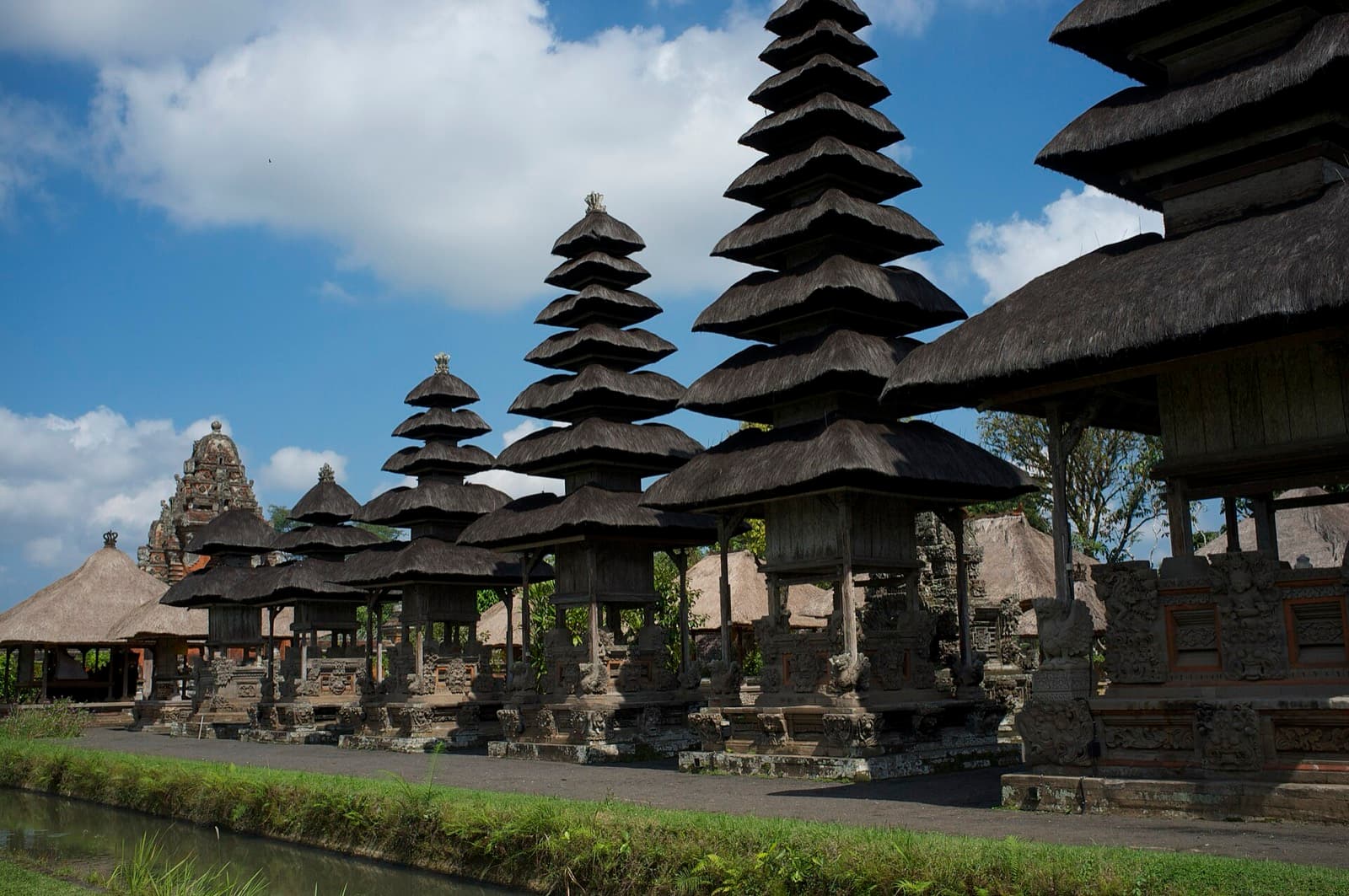
It opens inland at Taman Ayun, whose name means beautiful garden, a temple that appears to float inside a wide moat. Here water, not a stone wall, separates the secular world from the sacred ground. The site records place its founding in sixteen thirty-four A D, in the Balinese saka calendar year fifteen fifty-six, built by the king of Mengwi, I Gusti Agung Putu, as a royal family temple honouring the ancestors of a dynasty that endured until eighteen ninety-one. Its meru towers climb from two tiers up to eleven, the tallest reserved for the highest deities, their stacked roofs reaching symbolically toward Bali's sacred mountains, the source of the island's water.
The heart of it is what UNESCO recognised. On the sixth of July, twenty twelve, Taman Ayun was inscribed as a Royal Water Temple, one of five component areas of the Cultural Landscape of Bali Province, the Subak System as a Manifestation of the Tri Hita Karana Philosophy. The subak is Bali's cooperative water-management system, a network of canals, weirs and water temples that developed in the ninth century A D and shares irrigation between rice farmers. Water temples like this one hosted the ceremonies that governed the fair sharing of water. So Taman Ayun does not worship water as a threat. It worships water as cultivation, as harvest itself.
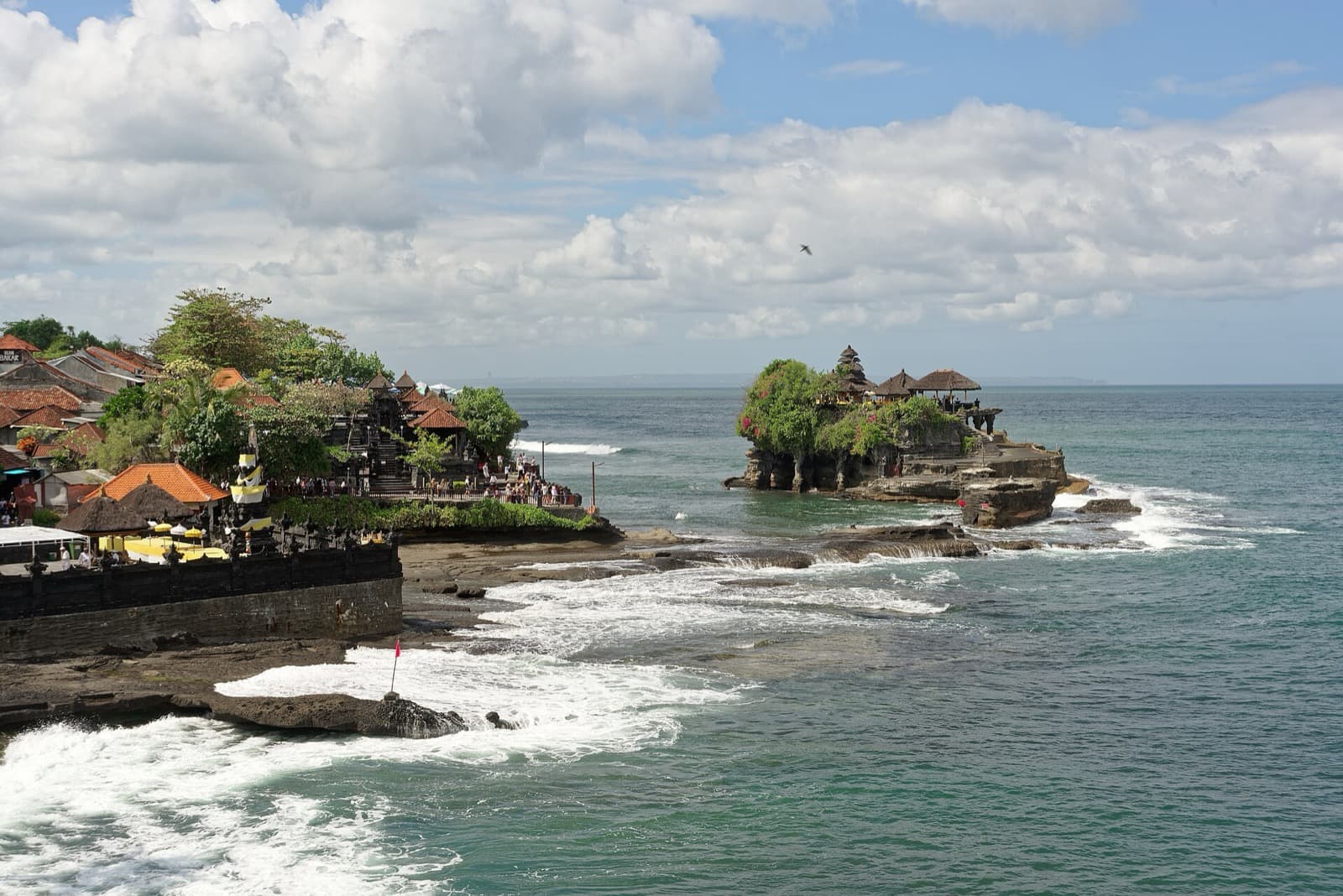
Half an hour southwest, the philosophy flips. Tanah Lot means land in the sea, a temple built on a large rock with the surf breaking around its base. Tradition credits its founding to the sixteenth-century wandering priest Dang Hyang Nirartha, and its primary deity is the sea god Dewa Baruna. The counter-intuitive turn is complete here: the temple that manages water lets you walk right up to it, while the temple that confronts water seals its shrine off entirely. The rock is only reachable on foot at low tide, the sea encircling it twice a day, and the main shrine on top is closed to non-worshippers. You come to face this temple, not to enter it.
At its base rises Tirta Pabersihan, a spring that flows fresh despite the surrounding salt sea, treated as holy water in temple blessings. Legend holds that Nirartha cast his sash into the ocean, where it became sacred sea-snakes charged with guarding the temple. And as the light drops over a west-facing rock, Tanah Lot becomes Bali's most famous sunset temple, one link, tradition says, in a chain of seven sea temples ringing the island in protection. A day that began with water as a gift ends with water as a power held at bay.
Reading Bali at your own clock
What unifies these walks is autonomy over devotion. Ubud's palace courtyard, lotus temple and forest are all working sacred sites where offerings still sit on the stone, and the coastal circuit crosses two living temples where a sarong and sash are expected. Reading them slowly, on foot, with the freedom to linger at the carving or wait for the tide, is not a lesser version of a guided day. It is the closer one. For more routes across the island, see the full set of Bali walking tours.
Sources
- UNESCO World Heritage Centre, "Cultural Landscape of Bali Province: the Subak System as a Manifestation of the Tri Hita Karana Philosophy" (inscribed 2012).
- Sacred Monkey Forest Sanctuary (Mandala Suci Wenara Wana), Padangtegal village official visitor information.
- Puri Saren Agung (Ubud Palace) and the Pita Maha collective, Ubud royal-family and Balinese art history records.
- Pura Tanah Lot official site and Tabanan Regency tourism, on the temple's founding tradition, tidal access, and sea-temple chain.
- Pura Taman Ayun / Mengwi royal temple heritage documentation, on its 1634 founding, meru towers, and subak connection.
Frequently asked questions
- Why is Taman Ayun a UNESCO World Heritage Site?
- Taman Ayun was inscribed by UNESCO on the sixth of July, twenty twelve, as a Royal Water Temple, one of five component areas of the Cultural Landscape of Bali Province, the Subak System as a Manifestation of the Tri Hita Karana Philosophy. The subak is Bali's cooperative water-management system, a network of canals, weirs and water temples that developed in the ninth century A D to share irrigation among rice farmers. Water temples like Taman Ayun hosted the ceremonies that governed the fair sharing of water, so the site recognises a thousand-year-old link between faith, farming and water.
- Can you enter the temple at Tanah Lot?
- No. The main shrine on top of the Tanah Lot rock is closed to non-worshippers. Non-Hindu visitors may reach the foot of the rock at low tide but never the shrine above. The rock is only reachable on foot at low tide, since the sea encircles the temple completely and cuts it off from the shore twice a day. Tanah Lot is a temple you come to face, not to enter.
- What makes Ubud famous for art?
- Ubud is a royal town that treated art as civic duty, centred on the Sukawati ruling family. Its last official raja, Tjokorda Gede Agung Sukawati, co-founded the Pita Maha artists' collective in nineteen thirty-six with painters Rudolf Bonnet and Walter Spies, gathering around a hundred and fifty Balinese artists. The town also sits at the centre of a web of specialist craft villages such as Pengosekan, Tegallalang, Payangan and Peliatan, and its Pura Taman Saraswati is dedicated to Saraswati, the Hindu goddess of learning and art.
- How far apart are Taman Ayun and Tanah Lot?
- The two temples sit about fifteen kilometres apart, roughly a thirty-minute drive. Taman Ayun lies inland near Mengwi and Tanah Lot sits on the Tabanan coast to the southwest. They are so commonly combined into a single half-day circuit that the pairing has become a classic Bali outing, and doing it self-guided lets you leave the garden when you are ready rather than on a group van's schedule.
- Do you need a sarong to visit Bali's temples?
- Yes. Pura Taman Saraswati and the Monkey Forest temples in Ubud, along with both Taman Ayun and Tanah Lot on the coast, are active Balinese Hindu temples where a sarong and sash are expected and modest dress is required. They are usually lent at the entrance, though bringing your own means you are never left waiting. By Balinese custom, menstruating women and anyone with a bleeding wound are asked not to enter the inner courtyards, and non-Hindu visitors generally may not enter the innermost sanctums.
Ready to experience it?
Ubud: The Town That Turned Art Into a Way of Life
150 min · 4.9 km · moderate
More from Bali
Explore more at your own pace.
Bali Travel Guide 2026: Days, Transport, Season, Cost, and Safety
One Day in Bali: A Walkable Ubud-to-Tanah Lot Itinerary
Tanah Lot's Tidal Causeway: The Temple That Faces Water Instead of Blessing It
Ubud Palace: The Royal House That Still Dances After Dark
Taman Ayun's Meru Towers: How to Read the Tiers