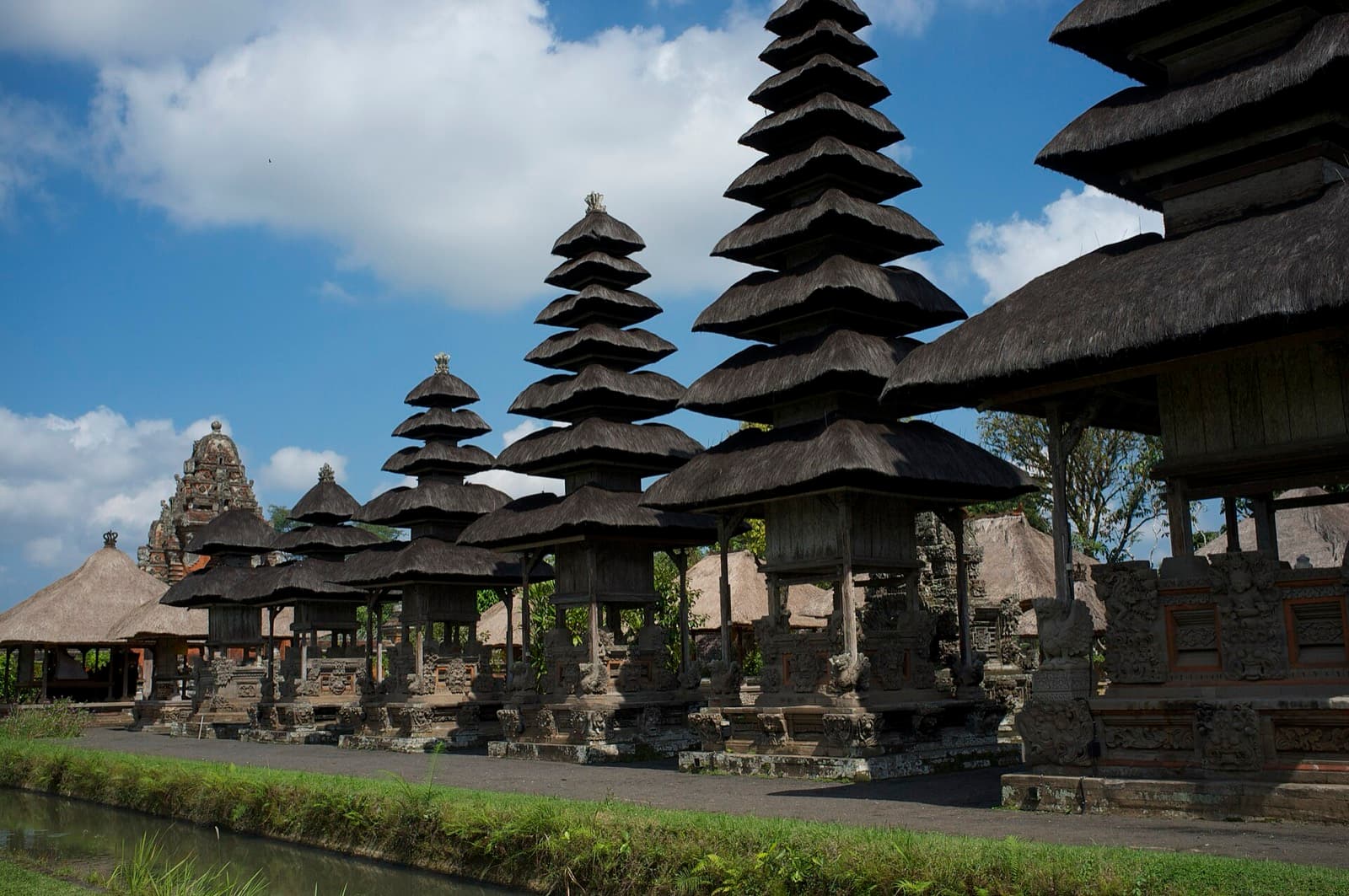
Stand on the walkway around the inner sanctuary of Taman Ayun and the rows of meru towers ahead of you are not decoration. They are a hierarchy you can read with your eyes. Each tower is a pagoda-like shrine whose thatched roofs stack one above the next, and the number of roofs tells you exactly which deity or ancestor lives there. The taller the stack, the higher the god. Once you understand that the count of tiers is a rank, the whole inner court of this royal garden-temple near Mengwi turns from a pretty silhouette into a diagram of who matters most, and why the whole compound keeps pointing away from the sea and back toward the mountains.
What a meru actually is
A meru is a multi-tiered Balinese shrine tower, and the word itself carries the meaning. It refers to Mount Mahameru, the sacred mountain that sits at the center of Hindu cosmology, the axis around which the universe is imagined to turn. So a meru tower is not just a tall roof. It is a small architectural mountain, a way of building the cosmic peak into the middle of a temple. When Balinese Hindus look at those climbing roofs, they are meant to read them as a symbolic reach toward the high volcanic peaks of the island, the places believed to be the dwelling of the gods and, just as importantly, the source of the water that feeds everything below.
The construction is more careful than a casual glance suggests. The tower has a masonry base and a wooden chamber, and the tiered roofs are made from ijuk, the black fibers of the sugar palm tree. That is why the roofs at Taman Ayun read as dark, almost charcoal, rather than tiled or gold. The whole thing is put together according to a traditional Balinese architectural discipline called Asta Kosala Kosali, a set of rules governing proportion and orientation. None of this is improvised. A meru is a coded object, and the code is legible once someone points it out.
Reading the tiers
Hear a stop from this walk
Tanah Lot: The Sunset View
Here is the one thing to understand while you stand in front of them: the tiers are a language of rank. At Taman Ayun the roofs range from two levels all the way up to eleven, and the tallest towers, with the most stacked roofs, honor the highest deities. Across Bali the tier count, known as tumpang, is nearly always an odd number, climbing from one up to a ceiling of eleven, which is reserved for the greatest gods. Taman Ayun is a mild exception worth noticing: among its towers is a rare meru of just two levels, one of the few even-numbered merus you will find anywhere on the island. That small oddity is a reminder that these are not standardized kit structures. Each was built for a specific occupant.
Those occupants are the point. The shrines here are dedicated to the deified ancestors of the Mengwi royal line and to major Hindu gods, including the mountain gods of Bali. This is a pura kawiten, a royal family temple, raised to bind a living dynasty to its ancestors. The kingdom of Mengwi endured until 1891, and its kings needed a place where the family's dead could be honored alongside the gods. So when you count the roofs and notice one tower stands higher than its neighbors, you are watching a decision someone made centuries ago about which spirit outranked which. The heights are an argument in wood and palm fiber.
Why you view them from the path
You will notice you cannot walk in among the towers. The inner court that holds the meru is kept for worshippers at prayer, and visitors take in the whole row from the surrounding walkway. That distance is not a disappointment. It is arguably the better vantage. From the path you can see the full sweep of the rows at once, count the tiers on each, and read the hierarchy written into their varying heights, which is exactly what you would miss standing among them at ground level. It also fits the deeper logic of Taman Ayun. This is a temple built to be read slowly, its shrines doubling in the still water of the surrounding moat, and the meru are the summit of that reading.
That summit connects to the reason this place carries a distinction most garden-temples never earn. On 6 July 2012, UNESCO inscribed Taman Ayun as a Royal Water Temple, one of five component areas of the Cultural Landscape of Bali Province. The listing recognizes the subak, Bali's cooperative irrigation system that developed in the ninth century and still shares water among rice farmers through a chain of temples. The towers you are counting sit at the spiritual head of that system. Their roofs reach toward the mountains because the mountains are where the water comes from, and this temple's entire purpose is to bless that water as harvest rather than fear it. The meru are the visible expression of an idea that runs all the way down into the flooded terraces of Badung Regency, where the temple's waters feed three subak cooperatives.
Standing in front of them
If you take one habit away from this stop, make it counting. Pick a tower, count its roofs, and ask who it was built to honor. Then look for the tallest one in the row and understand that it holds the highest-ranked deity present. Look for the odd little two-tier meru and remember that even the rules bend for a specific ancestor. The founding date of the temple is recorded as 1634, in the year 1556 of the Balinese saka calendar, and the towers have been carrying this coded hierarchy ever since, their ijuk roofs rethatched by hand across the generations.
The meru towers are the marquee sight of Taman Ayun, and they are only the second stop of a circuit that goes on to do something surprising with the same theme. This inland garden-temple blesses water as a gift and lets you walk right up to it. Its partner on the coast, Tanah Lot, was built to confront the sea as raw power and seals its shrine off from visitors entirely. To walk both temples in a single afternoon, on your own schedule with no group van waiting, follow the self-guided audio route in the Roamer app. You can browse more routes across the island through our Bali walking tours hub, or start from the Bali city page and pick your pace from there.
Sources
- Pura Taman Ayun, Wikipedia. Founding date of 1634 (saka 1556), the Mengwi dynasty, the pura kawiten designation, the 6 July 2012 UNESCO inscription, the two-to-eleven tier range, and the three subaks fed in Badung Regency.
- Meru Towers: The Principle Shrine of a Temple, NOW! Bali. The etymology from Mount Mahameru, ijuk roofing, the odd-numbered tumpang tier system, the Asta Kosala Kosali discipline, and the two-level meru unique to Taman Ayun.
- Meru tower, Wikipedia. Structural description of the masonry base, wooden chamber, and multi-tiered palm-fiber roofs, and tiers reflecting the deity's rank.
- Cultural Landscape of Bali Province, UNESCO World Heritage Centre. The 2012 inscription, the ninth-century subak system, and Taman Ayun as one of five component areas.
- Kingdom of Mengwi, Wikipedia. The fall of the Mengwi kingdom to Badung and its allies in 1891.
Ready to experience it?
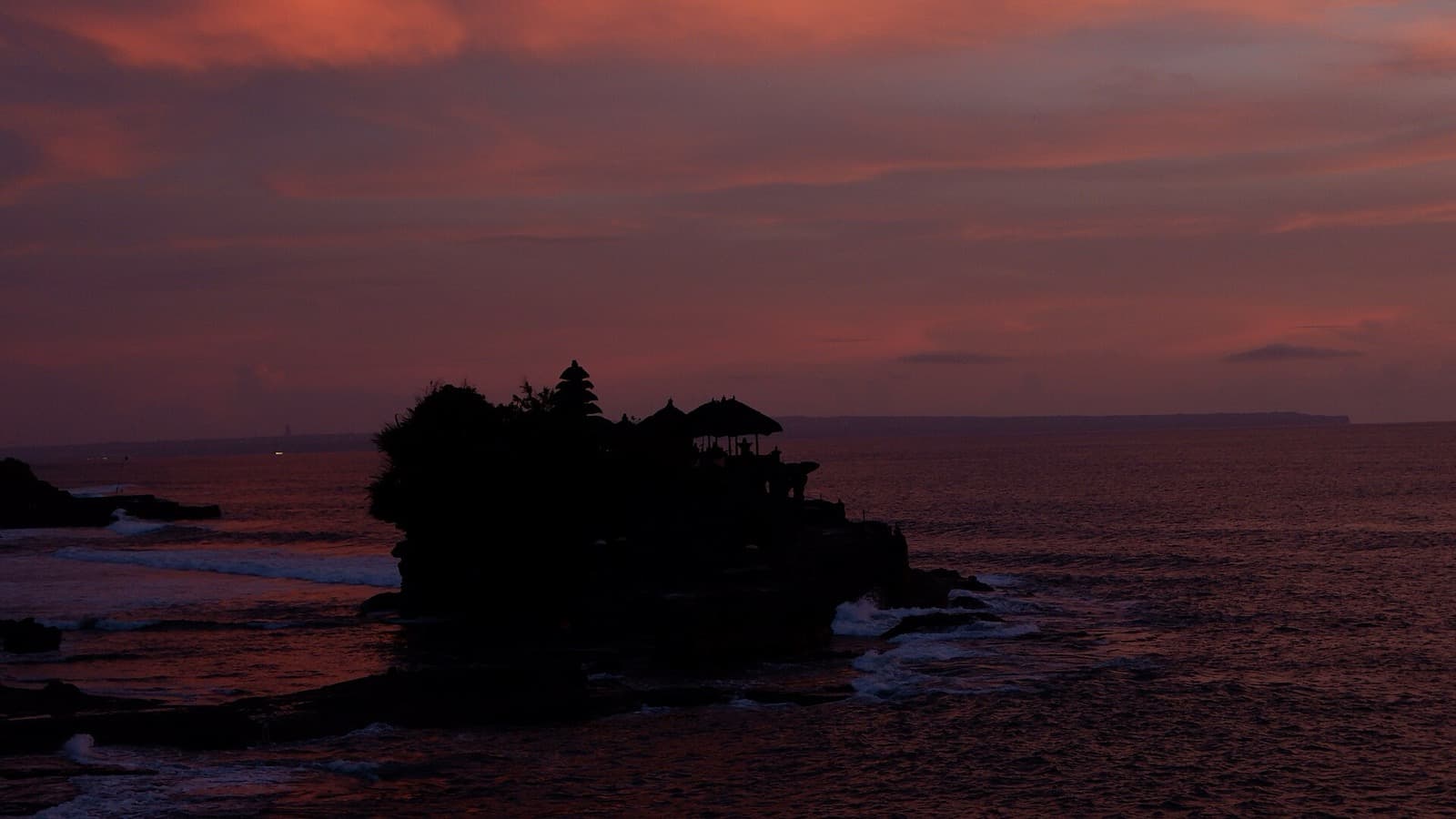
Tanah Lot: Bali's Temples Between Land and Sea
150 min · 17.7 km · easy
More from Bali
Explore more at your own pace.
Bali Travel Guide 2026: Days, Transport, Season, Cost, and Safety
One Day in Bali: A Walkable Ubud-to-Tanah Lot Itinerary
Bali: The Island Where Art and Water Became Devotion
Tanah Lot's Tidal Causeway: The Temple That Faces Water Instead of Blessing It
Ubud Palace: The Royal House That Still Dances After Dark