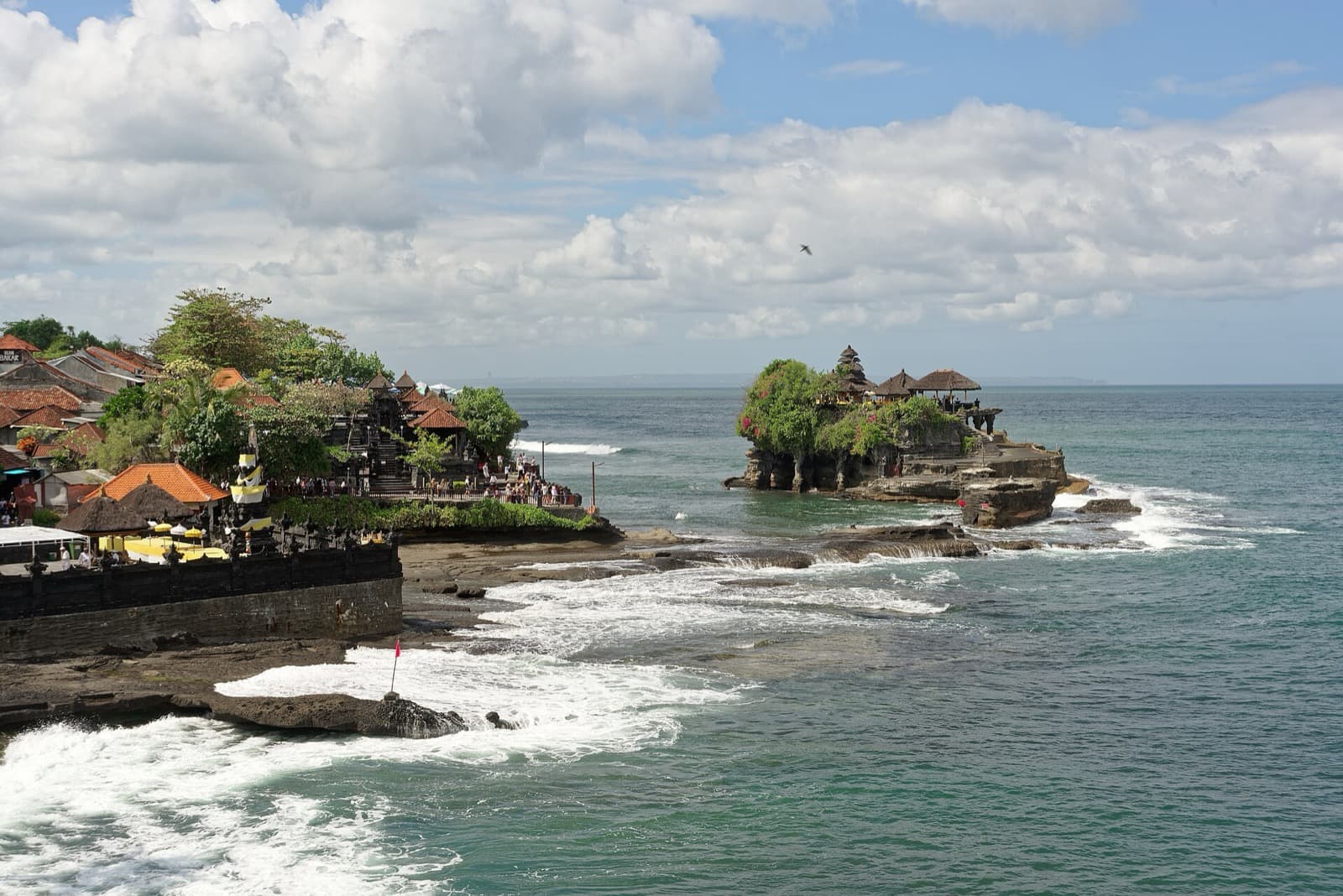
The tidal causeway at Tanah Lot is the moment a whole afternoon of Bali temple-going flips its meaning. Twice a day the sea rises and encircles the rock, cutting the temple off from the shore, and even at low water the main shrine on top stays closed to non-worshippers. You come to face this temple, not to enter it. That single refusal is the counter-intuitive turn that the rest of the circuit is built to set up: Bali worships the same element, water, in two opposite ways, blessing it inland as harvest and confronting it here at the coast as raw power.
The rock that lets the sea set your pace
Tanah Lot means land in the sea in Balinese, and the name is literal. The temple sits on a large rock offshore, surf breaking around its base. Whether you can walk out to the foot of that rock at all depends entirely on the tide. At low water a causeway of wet stone opens across the gap; at high tide the ocean seals it shut. Non-Hindu visitors may reach the base, but never the sanctuary above. The ocean itself controls access, which is a strange and quiet thing to stand in front of: a temple where the deciding factor is not a ticket booth or an opening hour but the moon and the sea.
That is why timing matters more here than at almost any other Bali stop. If you want to cross to the base, you check the day's tide chart before you set out and aim your arrival for low water. Get it wrong and you will watch the rock from the shore with the sea in the way, which is still beautiful but not the same. The rocks around the base can be wet and slippery, so it pays to tread carefully and stay clear of where the surf can reach you.
Look closely and you will notice the rock has been reinforced. By the nineteen eighties the sea-carved stone had begun to deteriorate, and a Japanese-funded conservation project stabilised it. A good portion of what reads as natural rock today is actually strengthened stone from that work. There is something honest about that. Even a temple built to defy the ocean needs help holding the line, and nobody pretends otherwise.
Why the shrine stays sealed
Hear a stop from this walk
Tanah Lot: The Sunset View
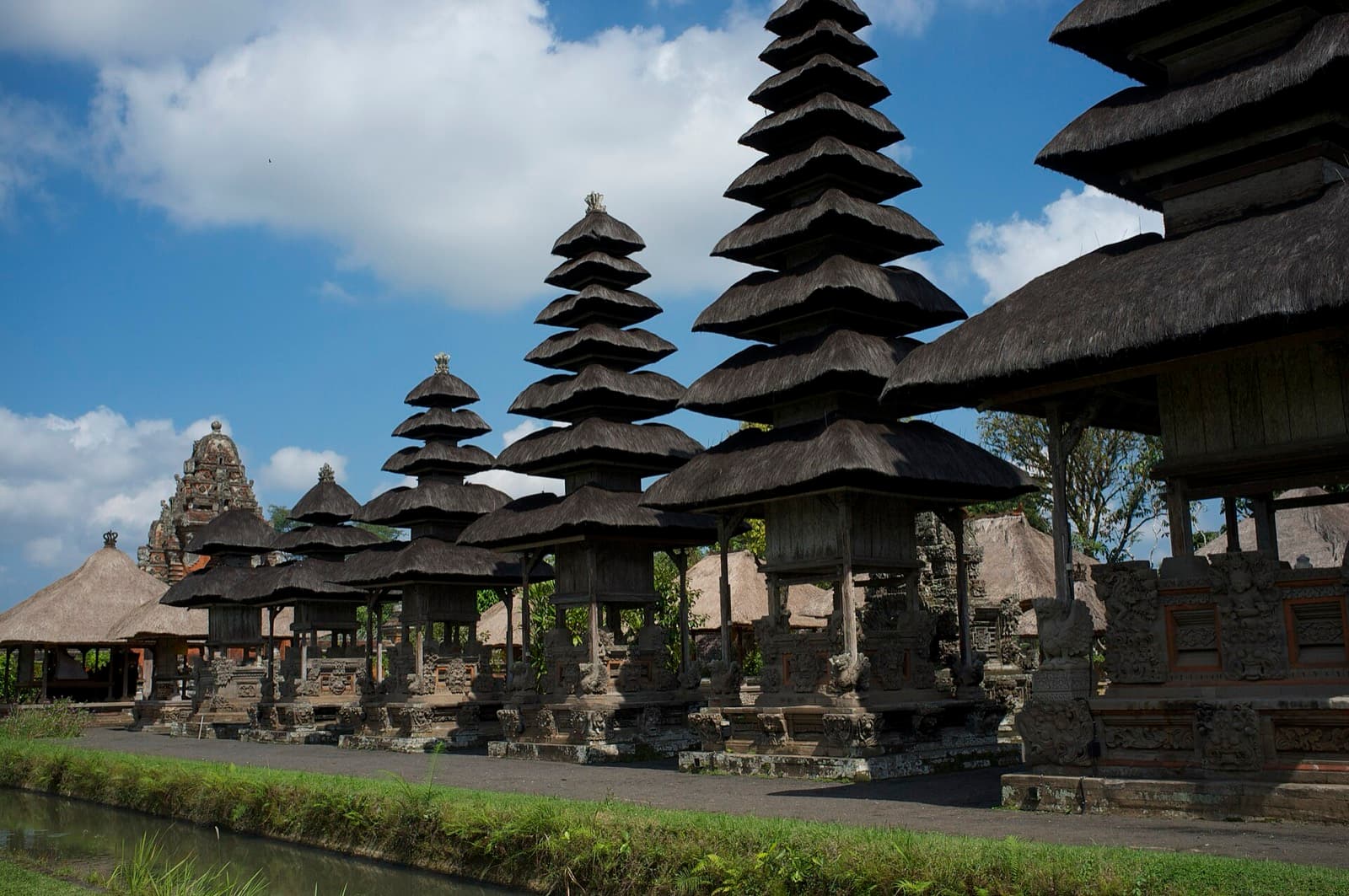
To understand why the closure at Tanah Lot feels deliberate rather than merely restrictive, it helps to have stood at the other temple first. The circuit opens inland at Taman Ayun, a royal garden-temple near Mengwi founded in sixteen thirty-four by the king of Mengwi, I Gusti Agung Putu. That temple appears to float inside a wide moat, water standing in for a wall, dividing the everyday world from the sacred ground. And crucially, it lets you walk right up to it. You move along its paths and outer courts freely, reading the rows of meru towers whose tiered roofs climb toward Bali's sacred mountains.
Taman Ayun is not just pretty. On the sixth of July, twenty twelve, UNESCO inscribed it as a Royal Water Temple, one of five component areas of the Cultural Landscape of Bali Province recognised for the subak system. The subak is Bali's cooperative water-management network of canals, weirs, and temples that shares irrigation among rice farmers, and it developed in the ninth century. Temples like Taman Ayun hosted the ceremonies that decided when each field flooded and drained. So the inland temple worships water as cultivation, as the gift that feeds the terraces. It blesses water as a friend, and it opens its gates to you.
Tanah Lot says the opposite about the very same element. Tradition credits its founding to the sixteenth-century wandering priest Dang Hyang Nirartha, who felt the spiritual power of the rock and established a sanctuary dedicated to the sea god Dewa Baruna, also called Bhatara Segara. This is a temple built to confront the ocean's danger, and its posture toward you matches its posture toward the sea. The temple that manages gentle water invites you in. The temple that faces dangerous water holds its shrine apart. The tidal causeway is where that logic becomes something you feel in your feet.
The corner that rewards standing still
Just below the causeway, at the base of the rock, is the detail that makes the whole place feel charged. A freshwater spring called Tirta Pabersihan rises there, yielding fresh water even though salt sea surrounds it on every side. Balinese Hindus treat it as holy water, and priests bless visitors with it. A fresh spring beside the salt ocean is exactly the kind of impossibility that marks a site as sacred.
Then there is the legend, told as tradition rather than history: that when Nirartha established the temple he cast his sash into the sea, where it became sacred snakes charged with guarding the rock, still said to dwell in caves around its base. You may see snakes there. Whether or not you decide the story is true, the respectful move is the one Balinese worshippers make, treating the spring as genuinely holy and the guardian as genuinely honoured.
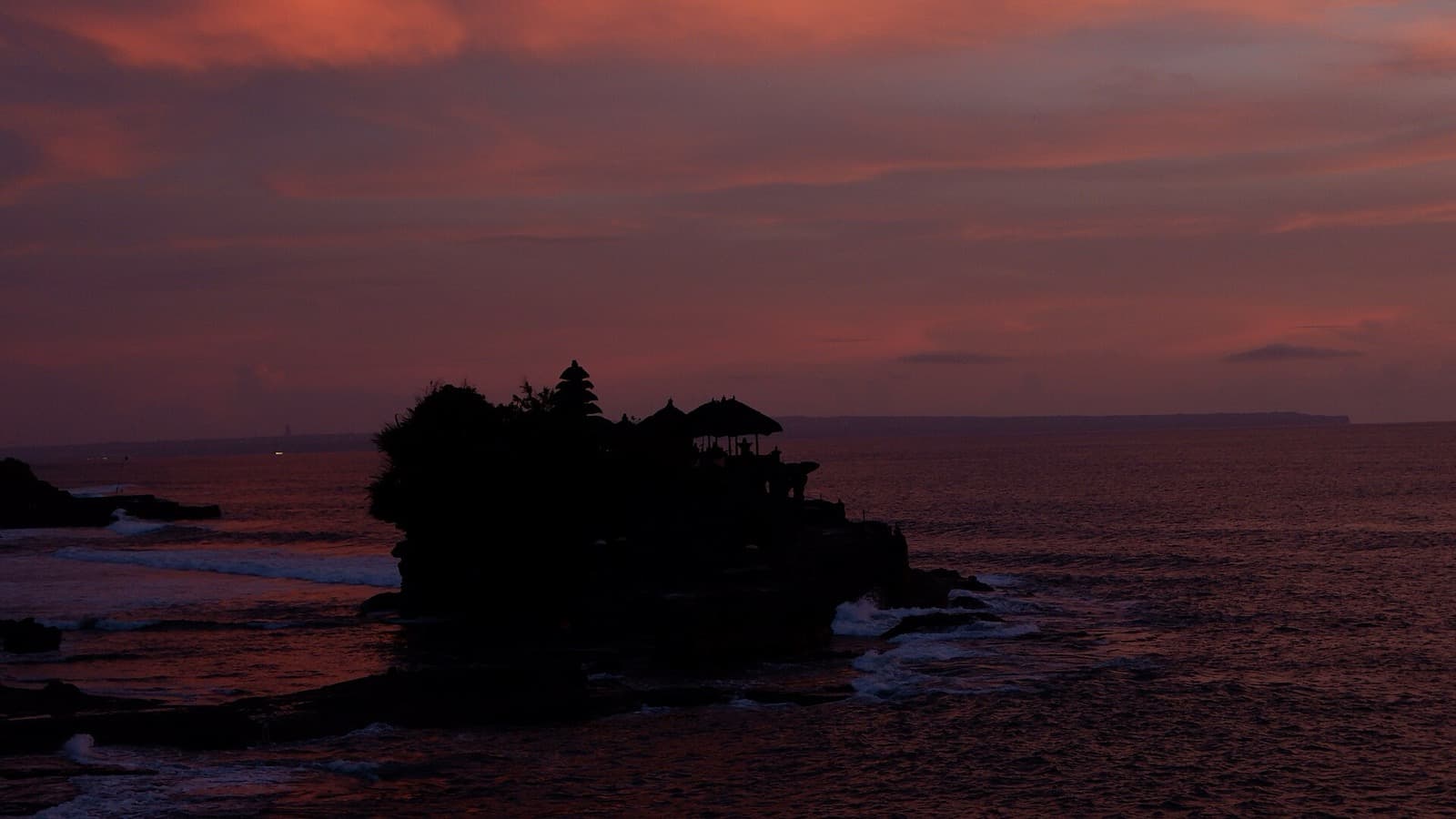
The finish is the sunset. This rock faces west, straight out to open sea, which makes Tanah Lot Bali's most famous sunset temple. A study cited in the site's history records it averaging about five hundred thousand visitors a year, among the most visited places in Indonesia. Tradition also places it among seven Balinese sea temples along the coast, each said to be within sight of the next, together forming a ring of protection around the island. The rock you have been facing is one link in that circle.
This is where doing the circuit yourself pays off. No group van idles with a departure time while you wait for the light. You leave the garden at Taman Ayun when you have taken it in, make the roughly half-hour drive southwest on your own clock, and settle in at the western rail for as long as the sunset holds. The tide and the day are yours to time. If the counter-intuitive shape of this walk appeals, read how the meru towers at Taman Ayun encode the same water story, or start planning from the Bali city page, then walk the full eight-stop route from moat to sea.
Sources
- Tanah Lot, Wikipedia. Background on the offshore temple, its tidal isolation, Dang Hyang Nirartha, and the nineteen-eighties conservation work.
- Cultural Landscape of Bali Province: the Subak System, UNESCO World Heritage Centre. The twenty-twelve inscription and Taman Ayun's role as a Royal Water Temple.
- Pura Taman Ayun, Wikipedia. Founding date, the Mengwi royal dynasty, meru towers, and the compound's layout.
- Subak (irrigation), Wikipedia. The ninth-century cooperative water system linking faith, farming, and irrigation.
- Tanah Lot Temple, Indonesia Travel (official). Visitor guidance on tides, access, and the sea-temple setting.
Ready to experience it?
Tanah Lot: Bali's Temples Between Land and Sea
150 min · 17.7 km · easy
More from Bali
Explore more at your own pace.
Bali Travel Guide 2026: Days, Transport, Season, Cost, and Safety
One Day in Bali: A Walkable Ubud-to-Tanah Lot Itinerary
Bali: The Island Where Art and Water Became Devotion
Ubud Palace: The Royal House That Still Dances After Dark
Taman Ayun's Meru Towers: How to Read the Tiers