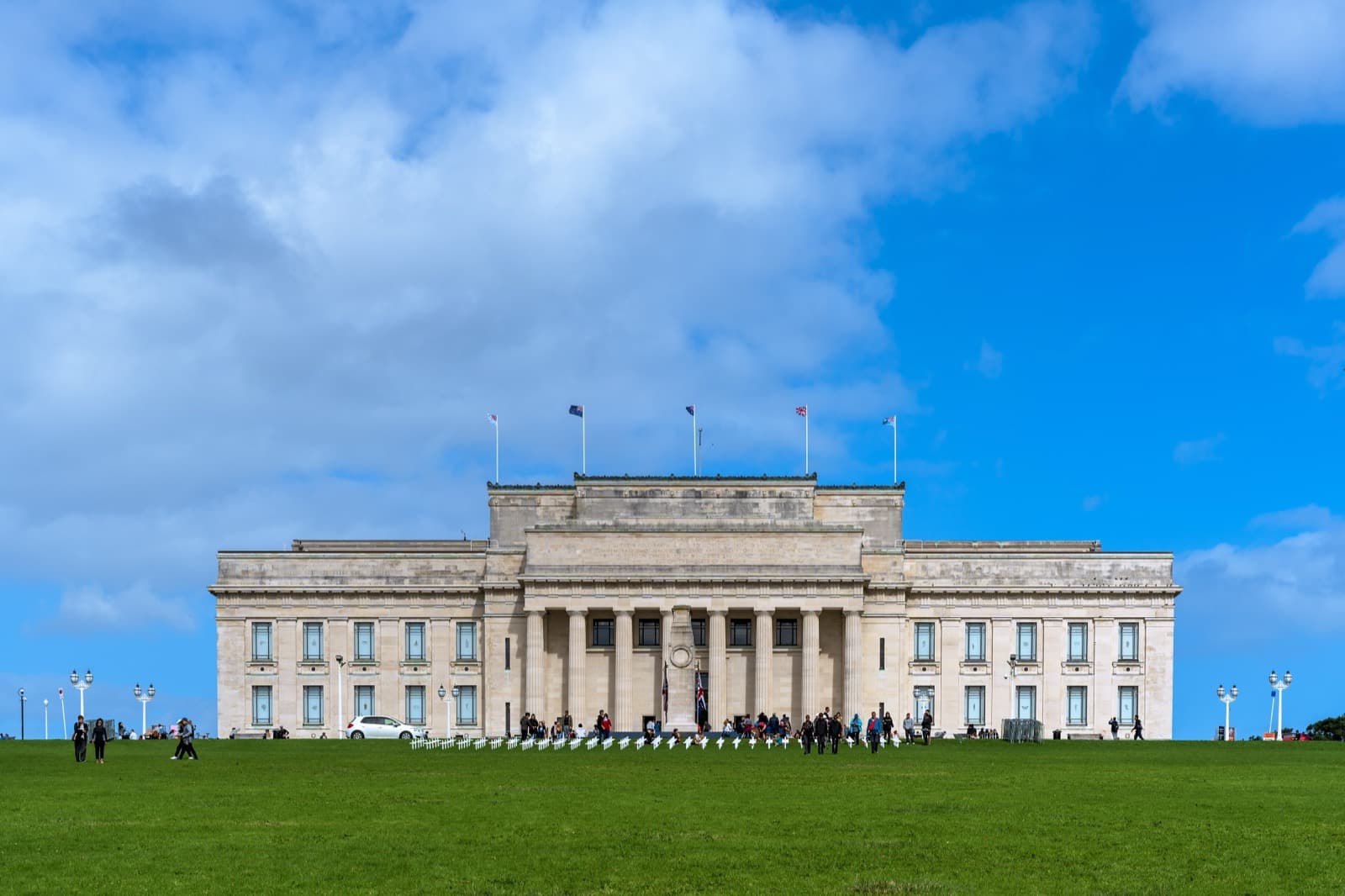
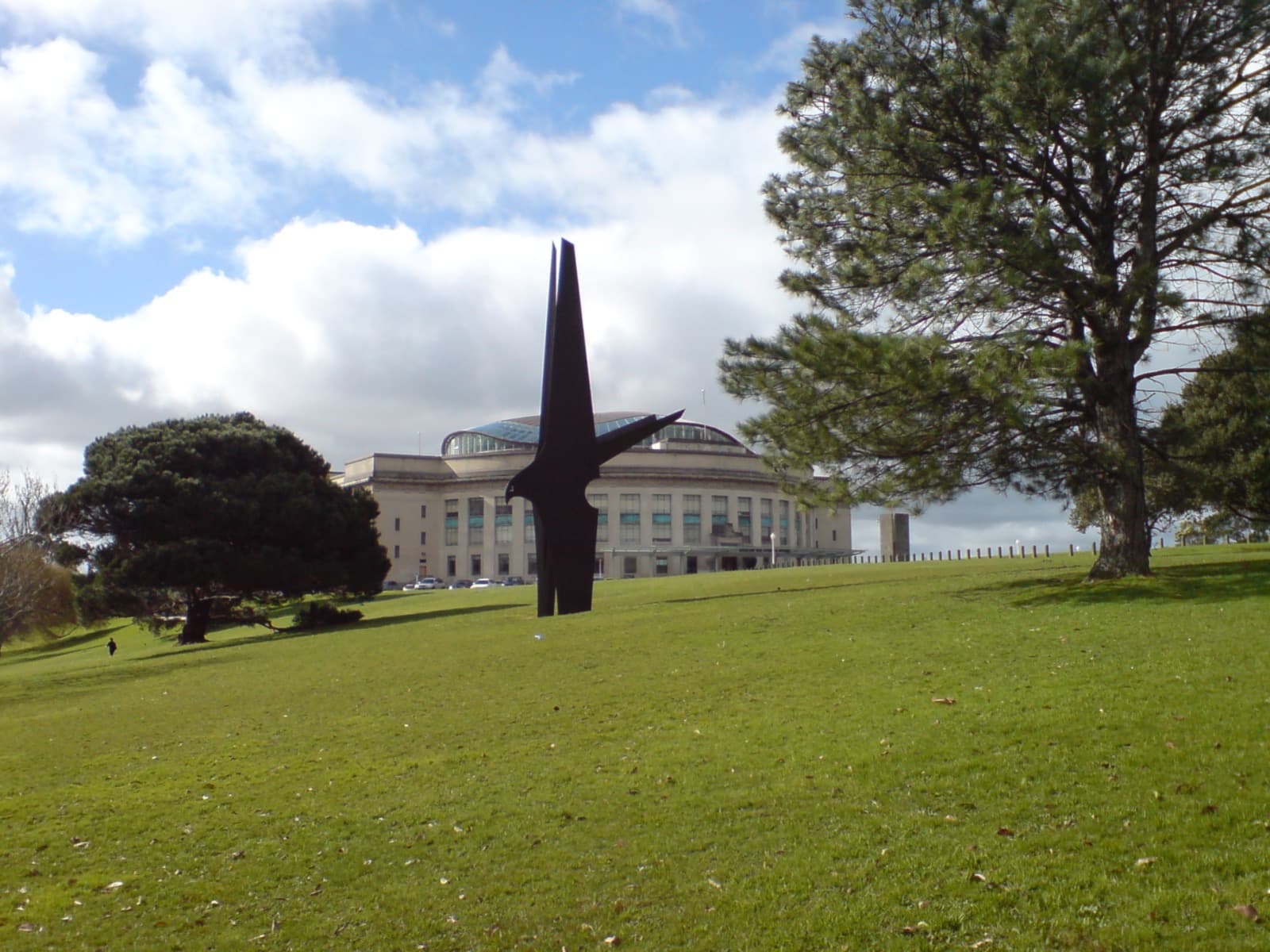
The Auckland War Memorial Museum was raised in 1929 as a single building doing two jobs at once. It remembers the New Zealanders who died in the First World War, and it guards one of the world's greatest collections of Māori and Pacific treasures. That double purpose, held in one neoclassical temple on the crest of a volcanic crater, is the thing to understand while you stand in front of it. Most great museums are built to hold objects. This one was built to hold both objects and names, and the tension between remembrance and keeping runs through everything inside.
A temple built for two purposes
Look first at the building itself. It is a monumental neoclassical structure, designed by the firm of Grierson, Aimer and Draffin and opened in 1929. The choice of a Greek-temple form was not decoration for its own sake. In the years after the First World War, a young country was working out how to grieve at civic scale, and the classical temple was the era's chosen language for that grief. So the museum was conceived from the start as a memorial as much as a display hall. It carries the names of the war dead, real people from a small nation that had sent an enormous share of its young men across the world.
That is the first job. The second is stranger and, in a sense, older. Under the same roof sits a collection of Māori and Pacific taonga, treasures, ranked among the finest anywhere. The building therefore asks two different kinds of quiet from you: the quiet owed to the names of the dead, and the quiet owed to living cultural treasures that were carved, used, and in some cases fought over long before the museum existed. Neither of those is the ordinary hush of a gallery. Both are closer to the silence of a sanctuary.
The house within the museum
Hear a stop from this walk
The Auckland War Memorial Museum: The Temple on the Maunga
The heart of the Māori collection is Hotunui. It is a whare whakairo, a carved meeting house, built in 1878 and brought here from Thames, on the Coromandel. Its posts and lintels are alive with carving, and encountering it indoors, a whole building standing inside another building, resets your sense of scale. A meeting house is not a static exhibit. It is a form of architecture that embodies ancestors and gathers a community, and its presence here is the museum's way of saying that these galleries are not only about the past.
Near it lies the object that concentrates the museum's whole double story into a single hull: Te Toki-a-Tapiri. This is the last of the great waka taua, the Māori war canoes. It runs about twenty-five metres long, could carry around one hundred warriors, and was carved from a single tōtara log around 1836 by Tamati Parangi and Paratene Te Pohoi for the iwi, the tribe, of Ngāti Kahungunu near Wairoa. To grasp that is to grasp a craft of astonishing ambition: one tree, one hull, a hundred people.
The canoe that carries the country's hardest years
Te Toki-a-Tapiri is where the memorial building and the treasure house stop being two separate ideas and become one. The canoe's history touches New Zealand's most painful decade directly. It was confiscated by the government in 1863, the year of the Crown's invasion of the Waikato, a war that was supplied and staged through Auckland itself. So a museum built to memorialise a later war holds, in its greatest single object, the physical record of an earlier one fought against Māori.
The story does not end at confiscation. The Auckland War Memorial Museum records that Paora Tuhaere of Ngāti Whātua was later given guardianship of the canoe and negotiated its placement here for its protection. That detail matters. It reframes the museum from a place that simply acquired treasures into a place where mana whenua, the customary people of this ground, made a deliberate decision about where a taonga would be kept safe. The one thing to carry away, standing in front of this building, is that its two purposes are not politely separate. The temple to the war dead and the guardian of Māori treasures are the same walls, and the seam between them runs right through the canoe.
Why this hilltop
The site is not incidental either. The museum sits on the crest of the Auckland Domain, the city's oldest park, which fills the broad crater of Pukekawa, a volcano that erupted roughly one hundred thousand years ago. The Domain was set aside as public land in the 1840s and formally proclaimed Auckland Park by Governor Robert FitzRoy in 1844, but the land is Māori ground long predating the colonial park. It held a contested pā, a fortified settlement, and lay within the area Ngāti Whātua transferred to the Crown following the Treaty of Waitangi of 1840.
So the building crowns a maunga, a volcanic cone, that was already layered with meaning before a single stone of the museum was laid. A temple to the war dead, on a hilltop that was Māori before it was a park, holding treasures that Māori chose to keep here. Every layer sits on the one below it, and the museum is the visible top of a very deep stack.
Before you go: a temporary closure to know about
One current caveat, and it is an important one. Since May 2025 the museum has been carrying out asbestos remediation in the older parts of the 1929 building, and that work has closed Te Marae Ātea, the Māori Court, along with the Pacific galleries. Those are the very rooms that hold Hotunui and Te Toki-a-Tapiri. As of 2026 the museum expects this section to stay shut for several years while a major redevelopment runs, so the two objects at the centre of this story may not be on view when you visit. Most of the rest of the museum, roughly two-thirds of it, has reopened. Check the museum's own website for the current gallery status before you climb, so you know what you can and cannot see. Understanding the history still makes the building worth the walk; just do not count on standing in front of the canoe until those galleries reopen.
Walk it, don't just read it
The museum reads far better as the summit of a walk than as a lone destination, because the climb up through the crater and the ridge above it teaches you the layers before you reach the top. That is exactly the route the auckland-parnell-domain tour takes. It threads Auckland's oldest suburb, Parnell, past its little wooden churches and a restored village lane, then opens into the Domain and rises through the Wintergardens to finish here, at the temple on the maunga. Because it is your own map rather than a scheduled group, you can take the war-memorial hall and whichever galleries are open at your own pace, and give the ground and the building the unhurried attention they ask for.
While the Māori and Pacific galleries are closed for remediation, international admission is discounted to reflect the reduced access, so an overseas adult ticket is around twenty-seven New Zealand dollars rather than the usual higher rate. Entry stays free for Auckland residents. Prices and gallery access can change, so confirm the current figures on the museum's website before you set off. For the full route and the other stops, start with our guide to Auckland walking tours.
Sources
- Auckland War Memorial Museum, Wikipedia and Auckland Museum "History of Auckland Museum": 1929 opening, Grierson, Aimer and Draffin as architects, and the neoclassical memorial design.
- Te Ara Encyclopedia of New Zealand and Auckland Museum collections, "Te Toki-a-Tāpiri": dimensions, tōtara construction, makers, 1836 carving, 1863 confiscation, and Paora Tuhaere's guardianship.
- Auckland Domain, Wikipedia, and Auckland Council: the Pukekawa crater park, the 1844 proclamation by Governor FitzRoy, and the land's Ngāti Whātua history.
- RNZ and 1News reporting (2025 to 2026): the asbestos closure of Te Marae Ātea Māori Court and the Pacific galleries and the discounted admission during remediation.
Ready to experience it?
Parnell and the Domain: Auckland's Oldest Village and its Volcano Park
80 min · 2.9 km · moderate
More from Auckland
Explore more at your own pace.
Auckland Travel Guide: How Many Days, Getting Around, Safety, and Budget
Auckland: The Harbour City Read in Layers
Albert Park and the Barracks Wall: The Garden Auckland Built Over a Fort
The Auckland Domain: A City Park Built in a Volcano's Crater
The Auckland Ferry Building: A Front Door Built on Water