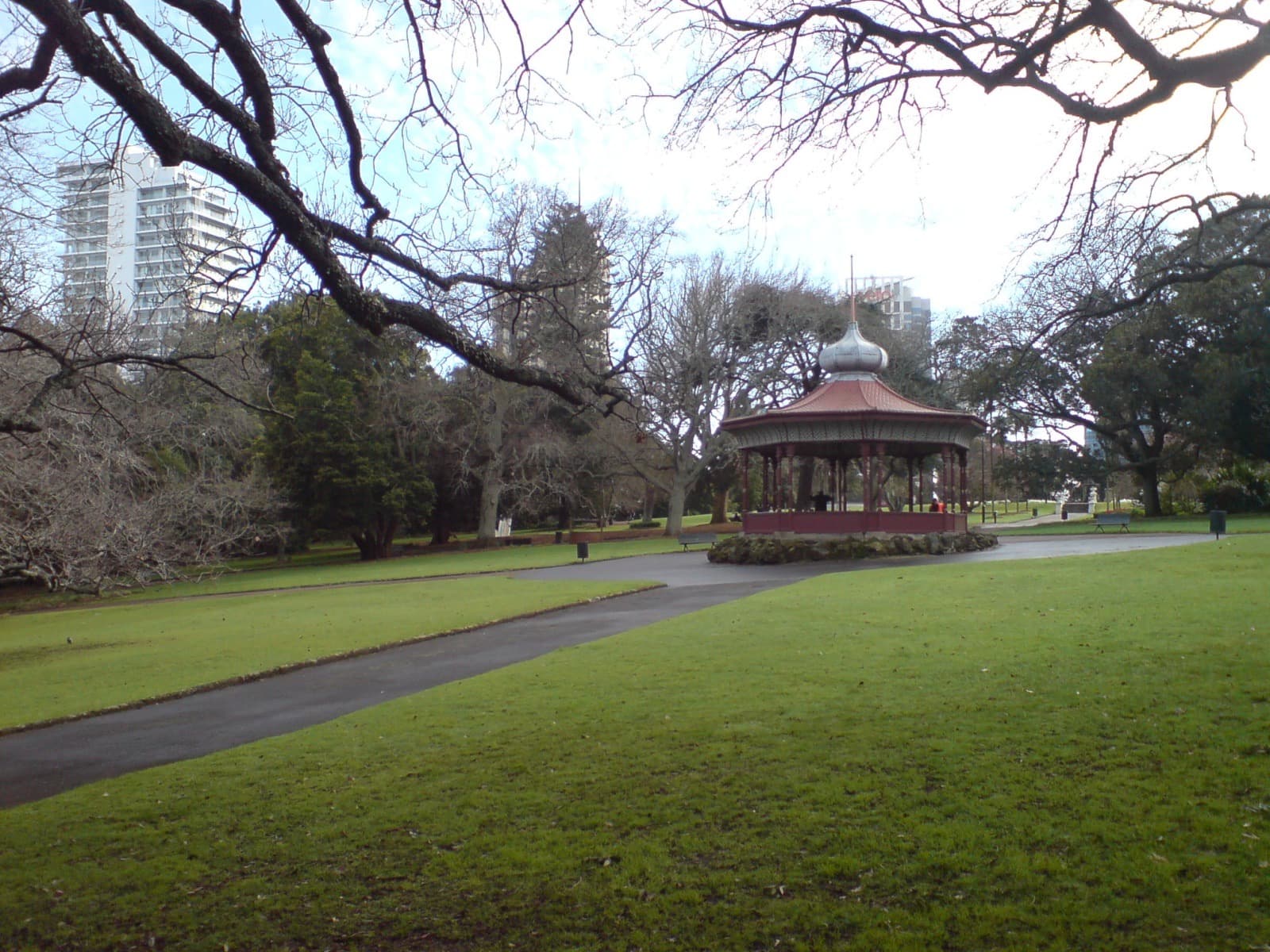
Albert Park is a Victorian flower garden laid over a fort, and that single fact is the key to the whole Queen Street walk. Climb the short rise to Auckland's eastern ridge and you reach lawns, flowerbeds, and mature trees laid out from eighteen eighty-one. It is a gentle, pleasant place. It is also built directly over the Albert Barracks, a fortified British Army post, and a fragment of that post still stands: a stretch of loop-holed basalt wall in the university grounds a short walk away. Read the garden against the wall and you understand what this entire tour is doing. It walks up a buried valley where every calm surface covers something the settler city drained, hid, or built upon.
The garden and what it covers
The barracks were built between eighteen forty-six and the early eighteen fifties, prompted by fighting in the north. For much of the eighteen fifties and sixties this was the headquarters of the British Army in New Zealand. NZHistory records a loop-holed stone wall about three and a half metres high, built of basalt by both European and Māori workers, enclosing roughly nine hectares and housing about nine hundred soldiers. When the last imperial regiment left in eighteen seventy, most of the wall came down between eighteen seventy-one and eighteen seventy-three, and the ground was turned into an ornamental park.
That sequence is the point. A place built for muskets became a place built for roses. But the history is not softened by the flowers, and the tour does not let you pretend it is. Troops from this post were part of the Crown invasion of the Waikato in eighteen sixty-three, one of the New Zealand Wars, a conflict that brought large-scale loss of Māori land through war and confiscation. This is the Country of Ngāti Whātua Ōrākei and the wider iwi of Tāmaki Makaurau, the Māori name for the Auckland isthmus, and Māori culture, language, and iwi survive and continue today. Walking the park at your own pace means you can hold both things at once: the calm of the garden and the plain fact of what the calm was laid over.
About eighty-five metres of the basalt wall still stands on Alfred Street in the University of Auckland grounds, pierced with loopholes for muskets. It is recorded as the oldest surviving piece of British military infrastructure in the country. It is easy to miss, which is exactly why it matters. You have to walk up Alfred Street to find it. The reward for that small detour is the moral centre of the whole route made visible in stone.
Why this stop unlocks the rest
Hear a stop from this walk
Albert Park and the Albert Barracks Wall: The Garden Over the Fort
The premise of the tour is stated at its very first stop, and Albert Park is where it pays off. Queen Street, Auckland's commercial spine since the eighteen forties, runs up the floor of a valley that once carried the Waihorotiu Stream down to the Waitematā Harbour. The town walled and canalised that stream, and a sewer along its eastern side was finished in eighteen seventy-three. The water did not vanish. It still runs in nineteenth-century culverts beneath the pavement. For mana whenua, the iwi holding customary authority here, the Waihorotiu was a taonga, a treasure, and an ancestral watercourse home in tradition to a taniwha, a guardian spirit named Horotiu.
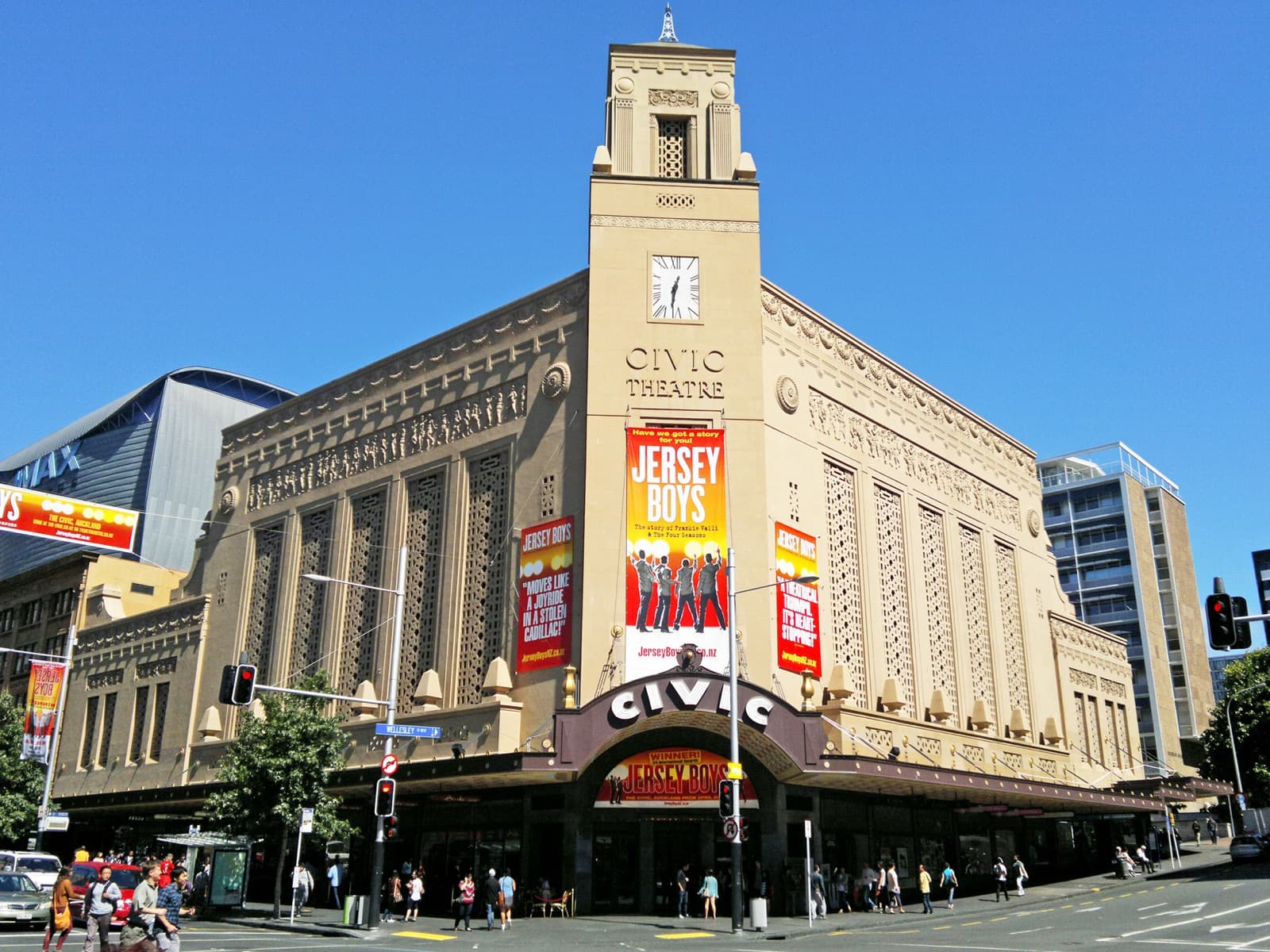
So the walk begins with a stream the settler city drained and hid, and it climbs toward a fort the settler city later buried under a garden. Between those two points, the tour reads every grand building as a clause the boom city added to the valley's long line. St Patrick's Cathedral, on land the first Catholic bishop in New Zealand acquired on the first of June eighteen forty-one, is one of the earliest clauses: faith written in Gothic stone near the harbour flat, rebuilt into its present form by nineteen oh seven. Further up comes the Civic Theatre, opened on the twentieth of December nineteen twenty-nine, an atmospheric picture palace whose auditorium ceiling is an illusion of an open night sky with drifting clouds and twinkling stars. Heritage New Zealand records it as the largest surviving atmospheric cinema in Australasia and still the largest theatre in the country.
Then the Auckland Town Hall, opened in nineteen eleven on a triangular wedge of land that locals compared to a wedge of cheese, its Great Hall acoustics modelled on the Gewandhaus in Leipzig, a room the Beatles once played. East off the valley floor, High Street and Vulcan Lane keep the fine grain of the colonial shopping town, the lane named for the Vulcan Foundry, an ironworks established in eighteen forty-six. And after Albert Park, the walk closes on the ridge at Old Government House, completed in eighteen fifty-six for Governor Thomas Gore Browne and built of native kauri timber worked to imitate stone, beside the university's fifty-four-metre ClockTower of nineteen twenty-six, inspired by Tom Tower at Christ Church, Oxford.
Every one of those stops repeats the lesson Albert Park teaches most clearly. The surface is not the whole story. A main street sits over a stream. A concert hall sits in a wedge. A governor's house of timber pretends to be stone. And a flower garden sits on a fort. Once you have stood at the barracks wall, you cannot walk back down Queen Street the same way, because you have learned to read the city as a text with something underneath every line.
Walking it yourself
This is a seven-stop route of about two and a half kilometres that takes roughly two hours, a gentle rise from the harbour flat to the civic ridge. Start at the lower, harbour end of Queen Street so the short climb to Albert Park comes when you are warmed up. Each stop is short and skippable, so you can linger for the light you want, sit in Aotea Square, or move straight on with no group and no schedule to keep. When you reach Albert Park, take the detour up Alfred Street to the wall, treat the site soberly, and give yourself a moment before the walk finishes on the ridge above the buried stream.
For the full route with GPS-triggered audio at each stop, see the Auckland city page, and for more essays like this one browse our guide to Auckland walking tours.
Sources
- Heritage New Zealand, Albert Barracks Wall listing: Category One record for the surviving basalt wall on the University of Auckland campus.
- NZHistory, Albert Barracks: details of the wall's height, construction by European and Māori workers, enclosed area, and garrison size.
- Wikipedia, Albert Barracks: the barracks as British Army headquarters through the eighteen fifties and sixties, the last regiment's departure in eighteen seventy, and the wall's demolition in the early eighteen seventies.
- Roamer tour, Historic Heart: The City in the Queen Street Valley: the fact-audited stop transcripts for Queen Street, St Patrick's Cathedral, the Civic Theatre, the Town Hall, High Street and Vulcan Lane, and Old Government House.
Ready to experience it?

Historic Heart: The City in the Queen Street Valley
75 min · 2.6 km · moderate
More from Auckland
Explore more at your own pace.
Auckland Travel Guide: How Many Days, Getting Around, Safety, and Budget
Auckland: The Harbour City Read in Layers
The Auckland Domain: A City Park Built in a Volcano's Crater
The Auckland Ferry Building: A Front Door Built on Water
The Civic Theatre: Auckland's Picture Palace With a Ceiling of Stars