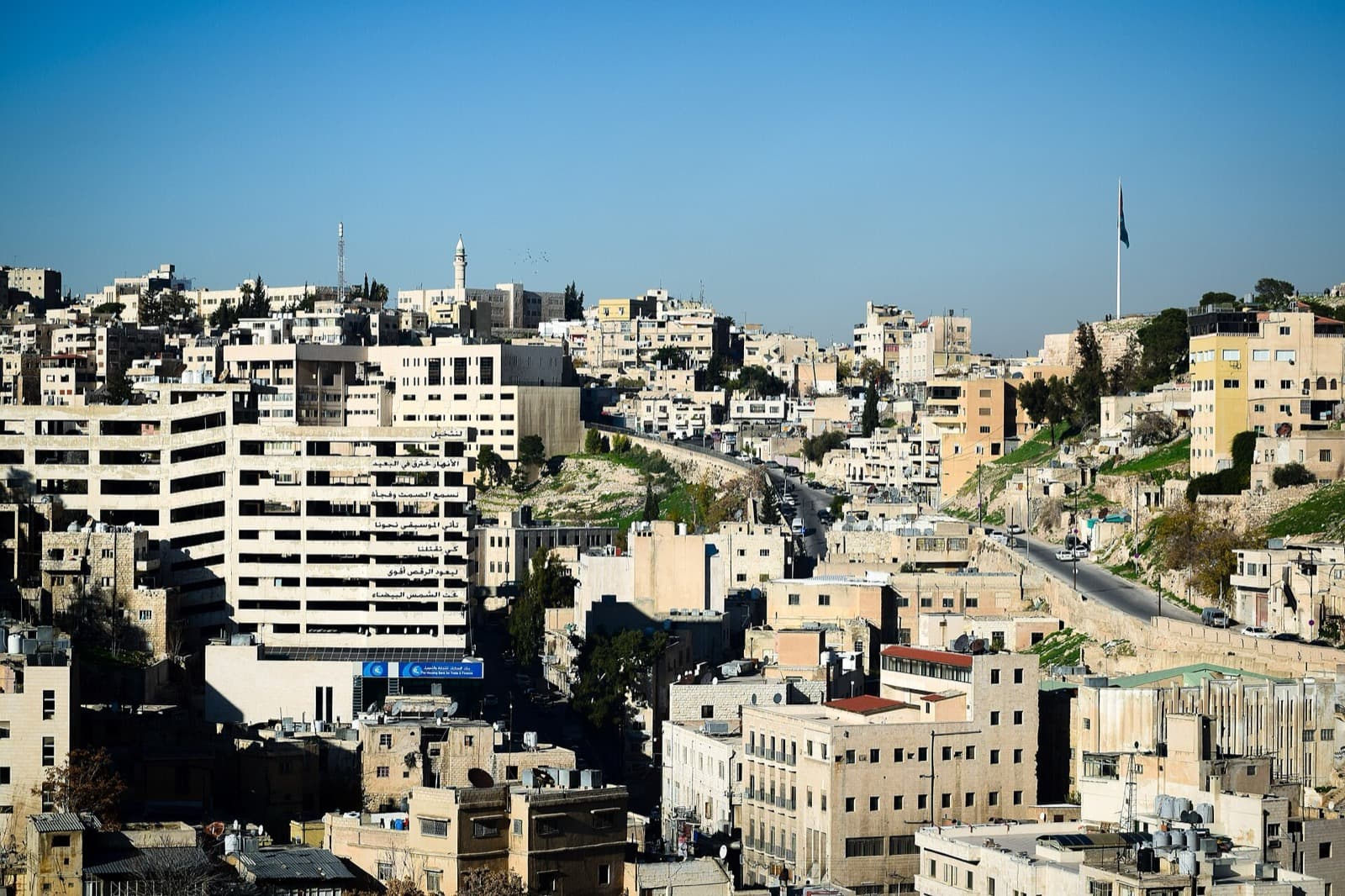
The Grand Husseini Mosque sits at a crossroads in downtown Amman where a Byzantine basilica, an early Islamic mosque, and a twentieth-century capital are stacked on the same patch of ground. Read that one pink-and-white building carefully and you have the argument of the whole Al-Balad walk in miniature: deep antiquity lying directly beneath a loud, working market, and the whole thing best read slowly, on your own clock. This is a pre-purchase deep read of Downtown Amman: The Living Heart of Al-Balad, a six-stop self-guided audio tour, and the mosque is the door into it.
The mosque that holds three cities
Walk the lanes of Al-Balad and they open at a crossroads onto the Grand Husseini Mosque, also called the King Hussein Mosque. Emir Abdullah the First ordered the old structure levelled and rebuilt in nineteen twenty-four, and the new mosque was finished within a few years, completed in nineteen twenty-seven, its warm pink stone banded with white. He named it for his father, Sharif Hussein bin Ali, who led the Great Arab Revolt. It was one of the first buildings the government put up after the Emirate of Transjordan was founded in nineteen twenty-one, so it came before the big markets and the hillside villas took shape.
Then the layers begin. The present mosque stands on the site of a far older one. Tradition holds that a mosque of the seventh century stood here, said to date to around the year six hundred and forty and attributed to the caliph Umar ibn al-Khattab. That attribution rests on the building's character rather than a documented founding record, so it should be held lightly. Beneath even that, the record notes a Byzantine basilica, remains of whose wall came to light when the old mosque was cleared. A single spot therefore marks the turn from Roman Amman to Islamic Amman: basilica to mosque to mosque, one built over the next.
This is why the mosque is the right way into the tour. It is not a monument set apart from the town. It is a working congregational Friday mosque, and for about a century it has been one of the great gathering points of Al-Balad, a place people meet as much as pray. Watch the crossroads for a while and the whole downtown seems to flow past its steps. That is the tour's thesis made visible: history is not behind glass here, it is load-bearing under a market that never stopped trading.
A working market on top of a Roman city
Hear a stop from this walk
The Nymphaeum: The Roman Fountain in the Souk
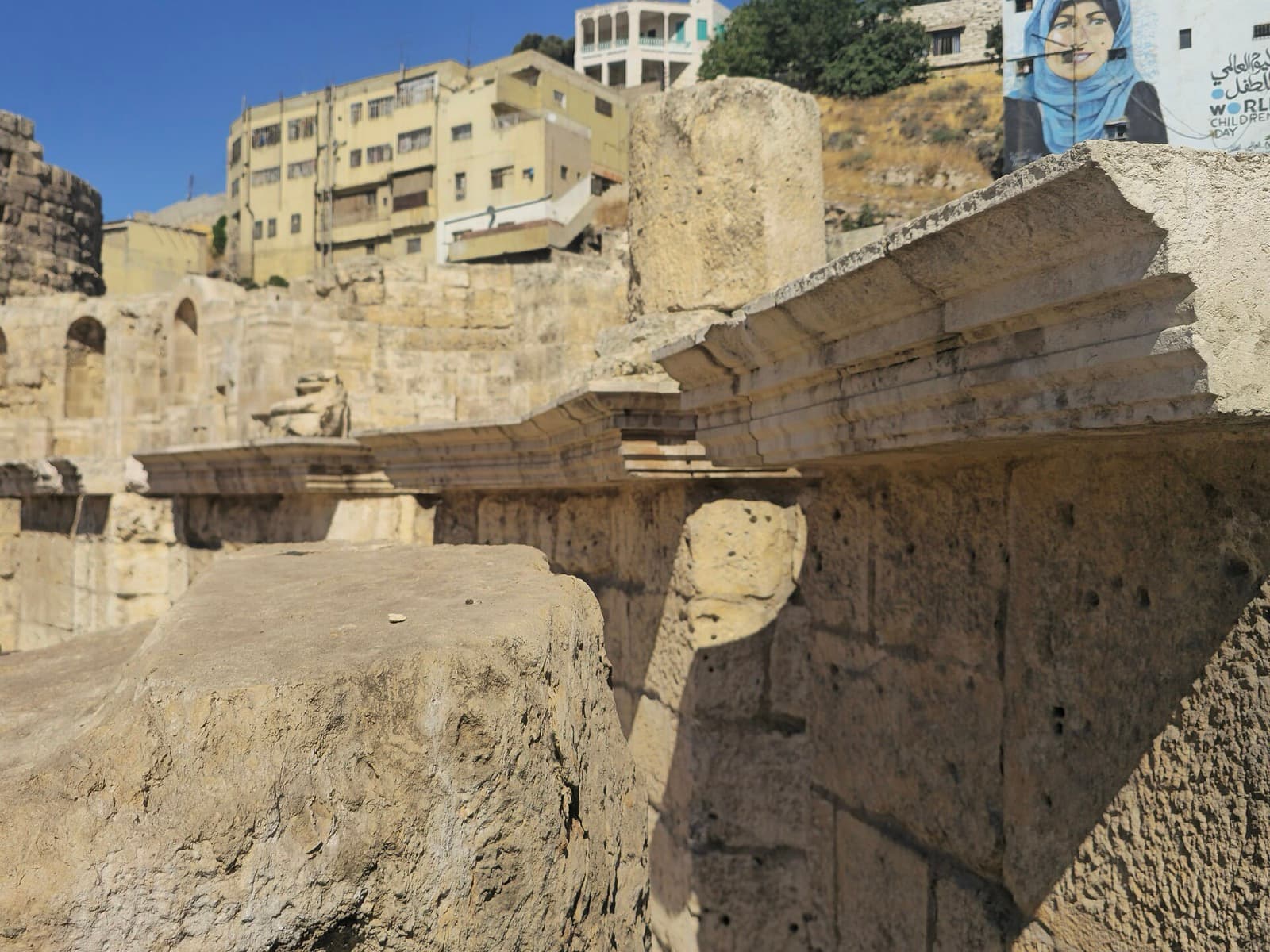
The stop just before the mosque makes the depth literal. The walk opens at the Nymphaeum, a monumental Roman public fountain of the city the Romans called Philadelphia, one of the cities of the Decapolis, built in the second century. Picture it whole: a half-octagonal building faced with carved stone and columns, its pool holding about six hundred square metres of water, roughly three metres deep, refilled continuously by the springs that watered the ancient town. For a long time it lay buried and forgotten under the growing town. A restoration begun around twenty fifteen, funded by the United States embassy and carried out with archaeology students from Jordanian universities, cleaned it stone by stone. What you see now is a partly recovered ruin hemmed in by traffic and shopfronts.
From the fountain to the mosque, you move about a thousand years and a few hundred metres at once. That compression is the reason the tour insists on autonomy. A group tour would march you past both in twenty minutes. On your own map you set the rhythm, standing as long as you like and letting the Roman city rise up under the modern one. There is no ticket at either stop and no one hurrying you.
Where a marriage is weighed by the gram
After the mosque, the walk turns fully sensory, and the argument shifts from depth to abundance. Turn off King Faisal Street and the light changes because the windows are full of gold. This is the gold souk, known as Souk al-Sagha, from the goldsmiths themselves, and also described as the gold market, Souq al-Dahab. It is a whole lane rather than a single shop, dozens of jewellers side by side. What makes it a living institution rather than a display is what people come to do: this is where Ammanis buy wedding and dowry gold. Because pieces are sold by weight and purity, with little added for the craftsmanship, a marriage is quite literally weighed out here, set on the jeweller's scales and priced by the gram.
Follow your nose from there into the spice and produce souks, among Amman's oldest central markets. The smell arrives before you do: open bins of zaatar, the green blend of thyme, sesame and sumac that Jordanians eat almost daily, the deep red of ground sumac, the sweet warmth of cardamom, coffee roasting from whole beans blended with cardamom in the Jordanian way. These are working markets that feed the city, not scenes staged for anyone. The pleasure is the density, and alone you can drift, double back to a smell you liked, or watch a seller weigh zaatar into a paper cone.
The street where a nation was declared
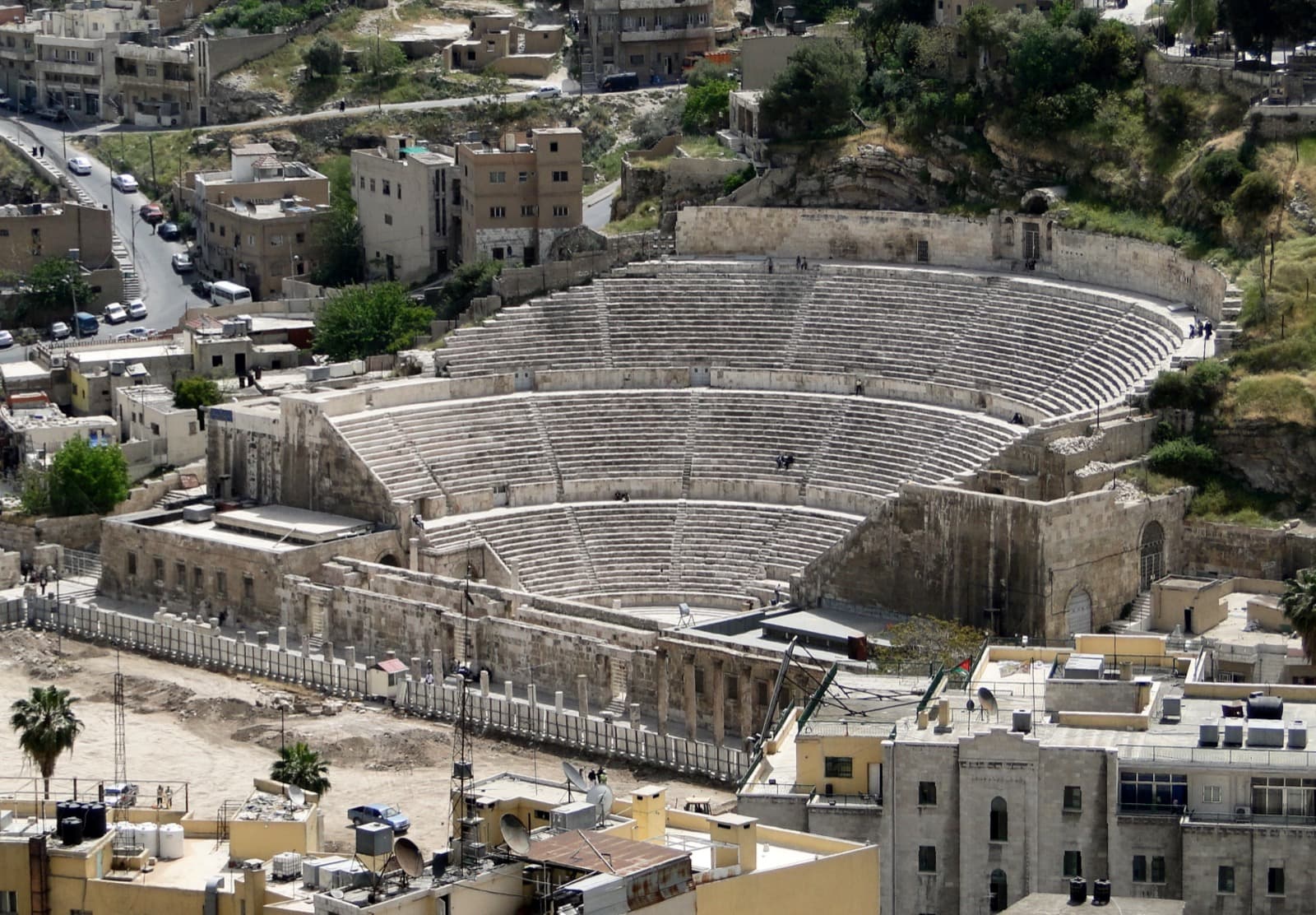
The route then steps out onto King Faisal Street, the spine of the modern city. It began as Municipality Street, taking its name after the Amman municipality was established in nineteen oh nine and a municipal building went up. When Amman became the capital of the Emirate of Transjordan in nineteen twenty-one, this became the main thoroughfare, gathering the new city's early hotels, cinemas and cafes. It was renamed for Faisal the First of Iraq in the nineteen fifties. It also carries the biggest date: Jordan's independence was declared in this downtown in nineteen forty-six. Under the official story runs a human one, since Circassian immigrants had settled Amman from eighteen seventy-eight, first around the Roman Theatre, and a small settlement became a capital in barely a generation.
The walk resolves quietly at number twelve King Faisal Street, at Duke's Diwan, built in nineteen twenty-four by Abdul Rahman Madi. It served as Amman's first post office, then briefly as the Finance Ministry, then the Haifa Hotel for about fifty years from nineteen forty-eight. In two thousand and one the heritage conservationist Mamdouh Bisharat, known as the Duke, rented it, reportedly at double the price to keep the owner from demolishing it, and turned it into a free cultural salon for artists, thinkers and poets. After the loudness of the souk, this hushed room is where the whole walk settles.
Six stops, about ninety minutes, roughly one kilometre of flat lanes, all on foot with no taxi to arrange. The Grand Husseini Mosque is where the tour's whole logic clicks: Roman fountain, Byzantine basilica, early mosque, pink stone, and a market weighing out weddings around all of it. If you want to walk it, browse more Amman walking tours or start from the Amman city page.
Sources
- Grand Husseini Mosque, Wikipedia. The nineteen twenty-four order to rebuild under Emir Abdullah the First, completion of the new mosque by nineteen twenty-seven, and the layered site over an earlier mosque and a Byzantine basilica.
- Nymphaeum (Amman), Wikipedia. Roman Philadelphia's public fountain, its second-century dating, the roughly six-hundred-square-metre pool three metres deep, and the restoration begun around twenty fifteen.
- King Faisal Street (Amman), Wikipedia. Origins as Municipality Street after the nineteen oh nine municipality, its role after Amman became capital in nineteen twenty-one, and the nineteen forty-six independence declaration.
- The Duke's Diwan, Wikipedia. The nineteen twenty-four townhouse by Abdul Rahman Madi, its successive uses as post office, ministry and Haifa Hotel, and Mamdouh Bisharat's rescue in two thousand and one.
- Culture Trip and Tourist Jordan souk guides. Downtown Amman's Souk al-Sagha gold market where jewellery is sold by weight, plus its spice and produce lanes.
Ready to experience it?
Downtown Amman: The Living Heart of Al-Balad
90 min · 1 km · easy
More from Amman
Explore more at your own pace.
Amman Travel Guide: Days, Season, Getting Around, Safety, and Budget
Rainbow Street and the Hill Where Amman Grew Up
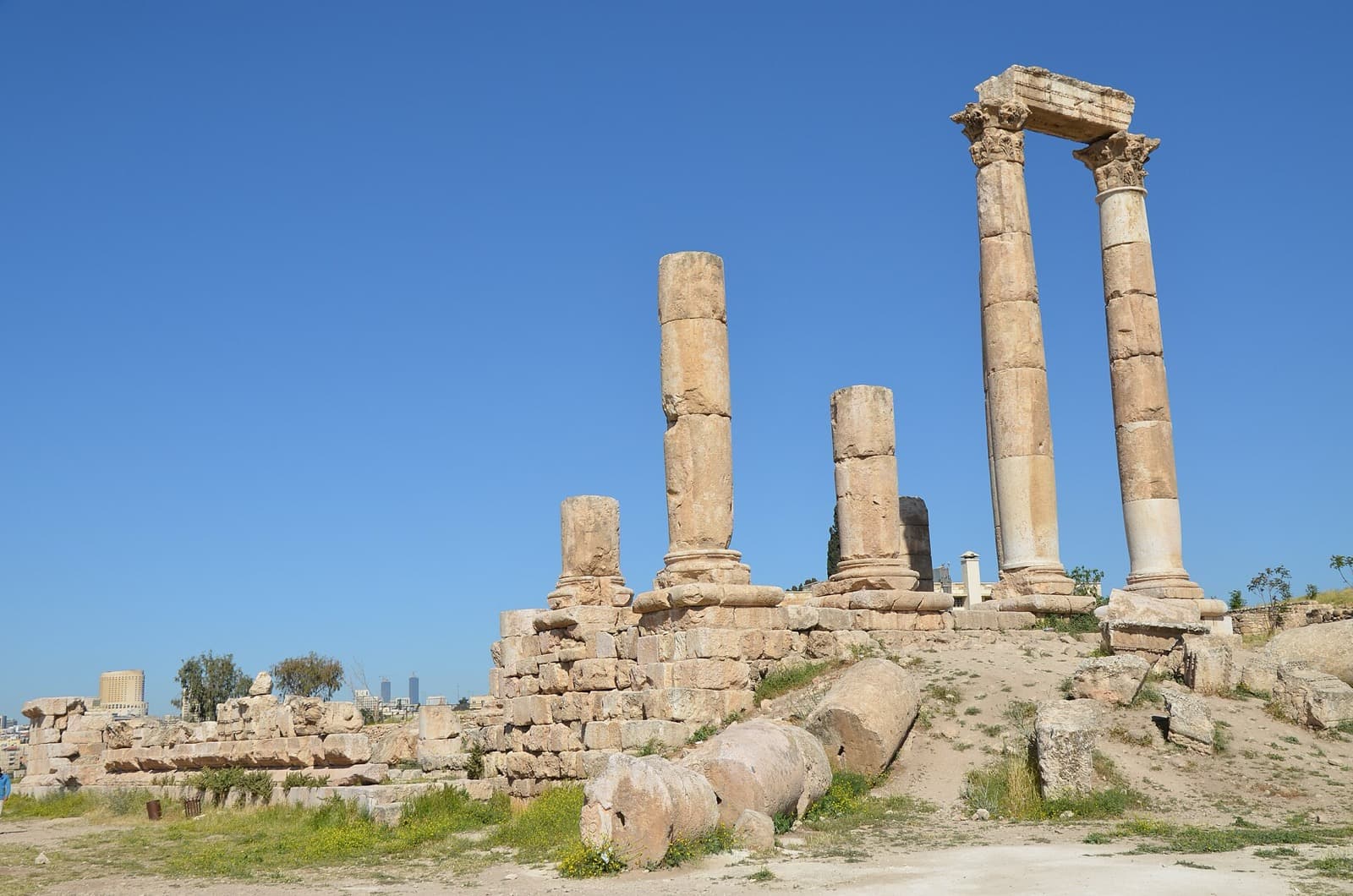
The Umayyad Palace on Amman's Citadel: A Caliph's Court on a Roman Hill
The Al-Kalha Stairs: Amman's Roads Before the Roads
The Roman Nymphaeum of Amman: A Marooned Fountain in the Souk