The Catacombs of Kom el-Shoqafa preserve, on a single tomb wall three levels below Alexandria, the fusion of Egyptian, Greek and Roman worlds that defined the ancient city, and reading that wall underground is the clearest way into a walk built to reach a city that fell below the surface and out to sea. Alexandria is a strange place to visit precisely because so little of it survives above ground. The library is a legend, the royal quarter lies on the seabed, and the famous lighthouse is scattered in blocks across the harbour floor. To reach what is left, you go down. And the deepest, most legible fragment is this Roman necropolis, where the descent itself becomes the argument.
A stair into fused bedrock
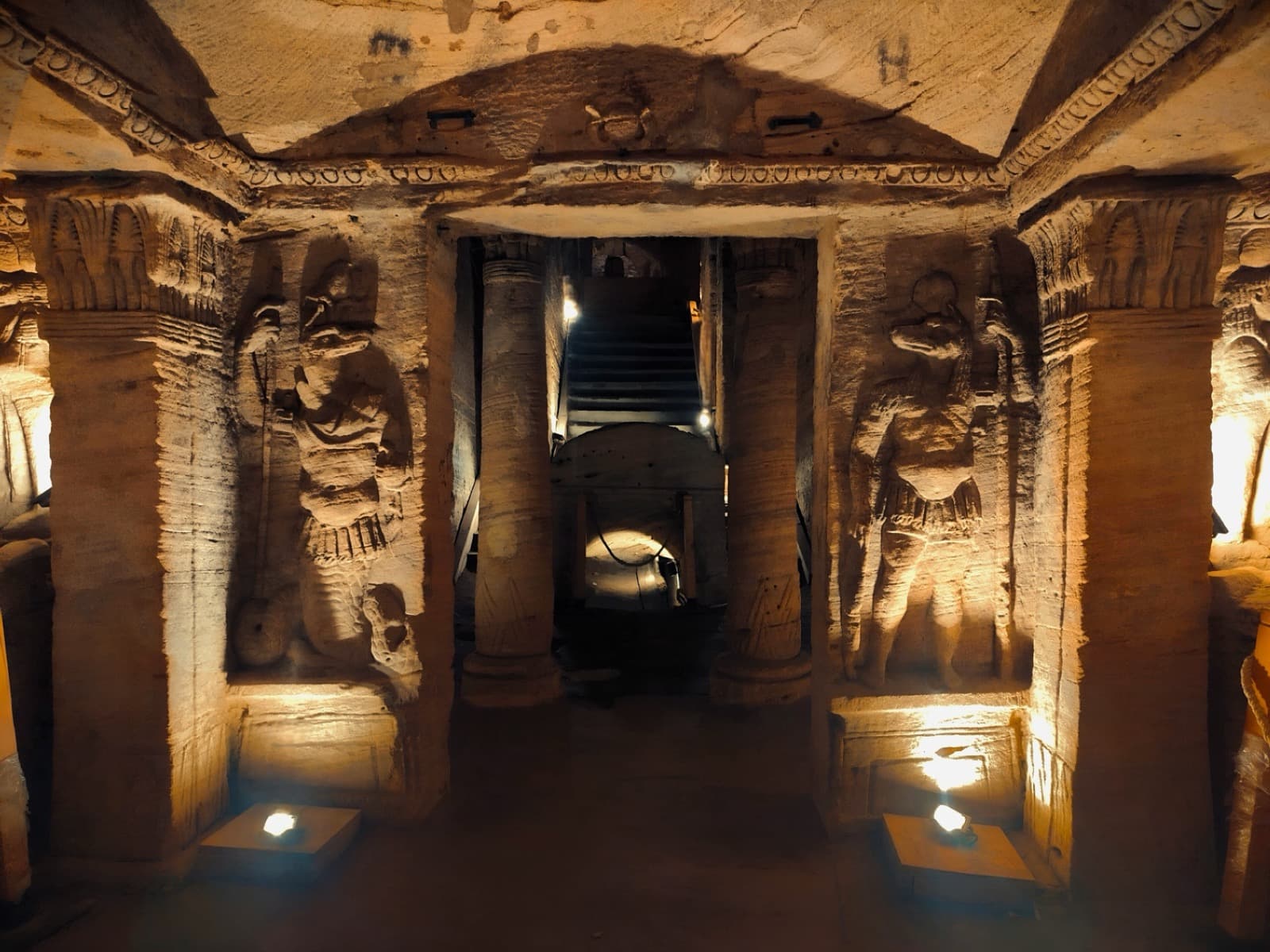
From Pompey's Pillar it is no more than six hundred metres to the mouth of the catacombs, but the distance that matters is vertical. A spiral staircase winds around a central shaft and drops three levels into solid bedrock, the lowest of them once underwater and reachable only after the site was drained. The complex dates to the second century A D, the age of the Antonine emperors, and it stayed in use for a couple of centuries after that. The air cools as you go, and the light thins. This is a place of the dead, and it still holds human remains, so it asks for a quiet, unhurried presence rather than a hurried camera.
The name itself carries the evidence. Kom el-Shoqafa means Mound of Shards, and it comes from the broken terracotta that piled up here over generations: the fragments of vessels mourners used to carry food and wine down to the dead, then left behind. Every generation added to the mound. The place is named for its own litter of grief.
The wall that reads three ways at once
Hear a stop from this walk
The Site of the Pharos: The Wonder That Lit the Sea and Fell Into It
What makes this necropolis unusual, and what makes it the hinge of the whole tour, is the fusion carved into its walls. On a single tomb you can find Egyptian gods rendered in Roman dress, standing in a Greek artistic style, with Greek mythological scenes set beside Egyptian funerary imagery. The families buried here were Egyptian, Greek and Roman all at once, and they wanted an afterlife that honoured every part of who they were. Nowhere else does that blend survive so plainly, on the same stone, in the same room.
That single wall explains why the rest of the route exists. Alexandria was a city that fused worlds as a matter of habit, and it did so even in its heaven. A few hundred metres uphill, at the Serapeum, the Ptolemies had done the same thing on purpose. When Ptolemy the First took control of Egypt after Alexander, he ruled Greek settlers and native Egyptians who worshipped in completely different ways. In the third century B C he promoted a new god to bind them: Serapis, built from the Egyptian Osiris fused with the sacred Apis bull, but given a fully human, Greek-style face resembling Hades, because Greeks were uncomfortable with the animal-headed gods of Egypt. The cult spread across the Mediterranean and deep into the Roman Empire, and the face of Serapis even appeared on Roman imperial coinage under the Flavian emperors. A city engineered a god to fuse its peoples. Two levels underground at Kom el-Shoqafa, ordinary families did the fusion themselves, for their own dead.
The city that is mostly gone
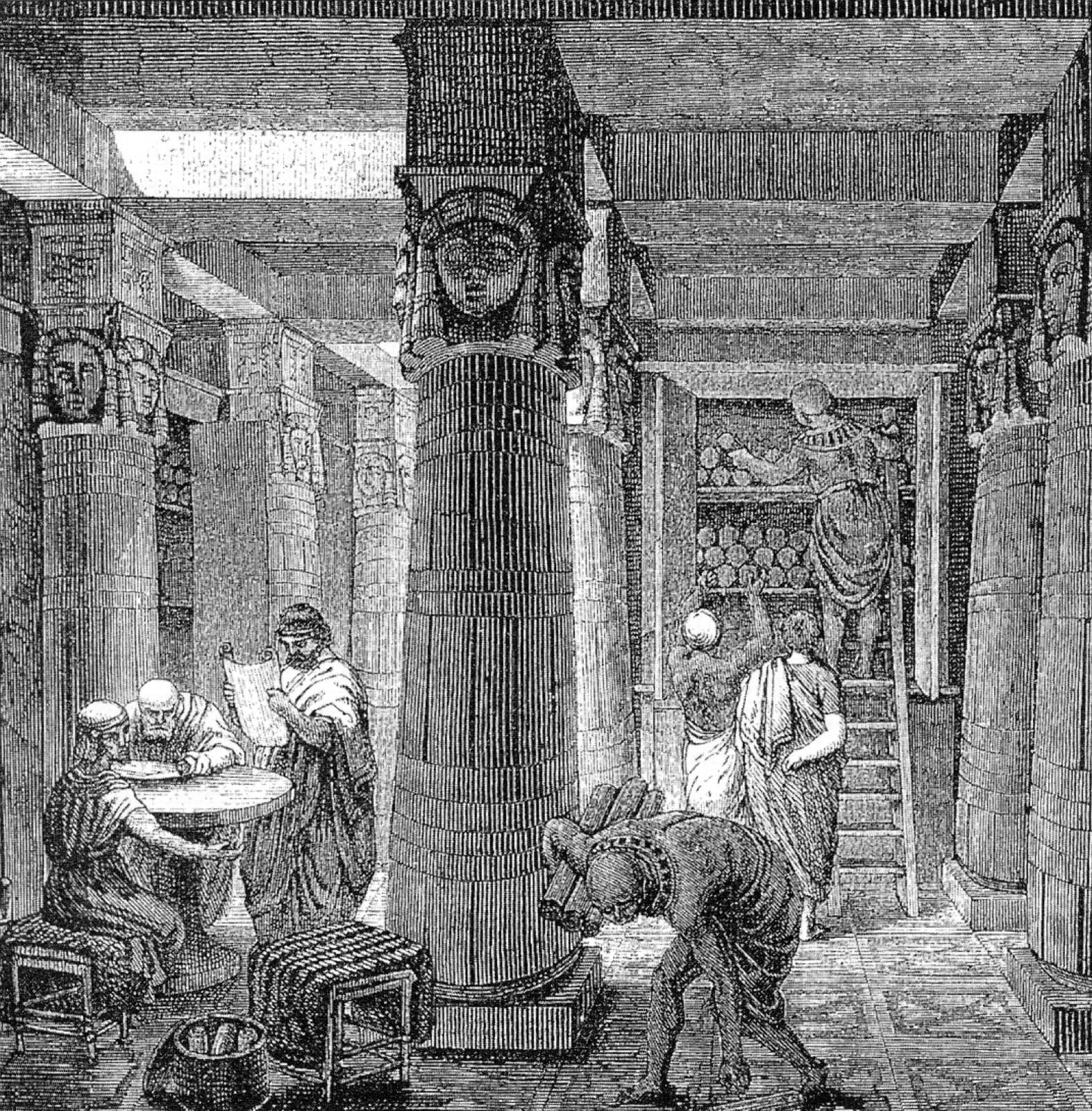
The catacombs also frame the tour's harder truth: most of ancient Alexandria cannot be reached at all. The tall red column beside the necropolis is called Pompey's Pillar, but that is a medieval mistake, a misread Greek inscription that confused a governor named Publius with Pompey the general. It stands over the ruin of the Serapeum, which held a daughter collection of the great Library of Alexandria according to the geographer Strabo. That library did not burn in the single dramatic fire of legend. The documented catastrophe happened on this hill in the year three hundred and ninety-one A D, when the Serapeum and its books were destroyed after the Emperor Theodosius the First ordered pagan temples closed.
Down at Kom el-Dikka, in the modern grid, an excavated hollow keeps a small Roman theatre, imperial baths and around twenty lecture halls where teachers taught rhetoric, philosophy and medicine. A Polish and Egyptian mission has been digging there since nineteen sixty. It is the largest ancient complex you can walk through above ground in the whole city, and it is tiny against a metropolis that once held hundreds of thousands. The old royal quarter sank under earthquakes and slow subsidence. Since the early nineteen nineties the underwater archaeologist Franck Goddio has mapped that drowned city block by block on the harbour floor.
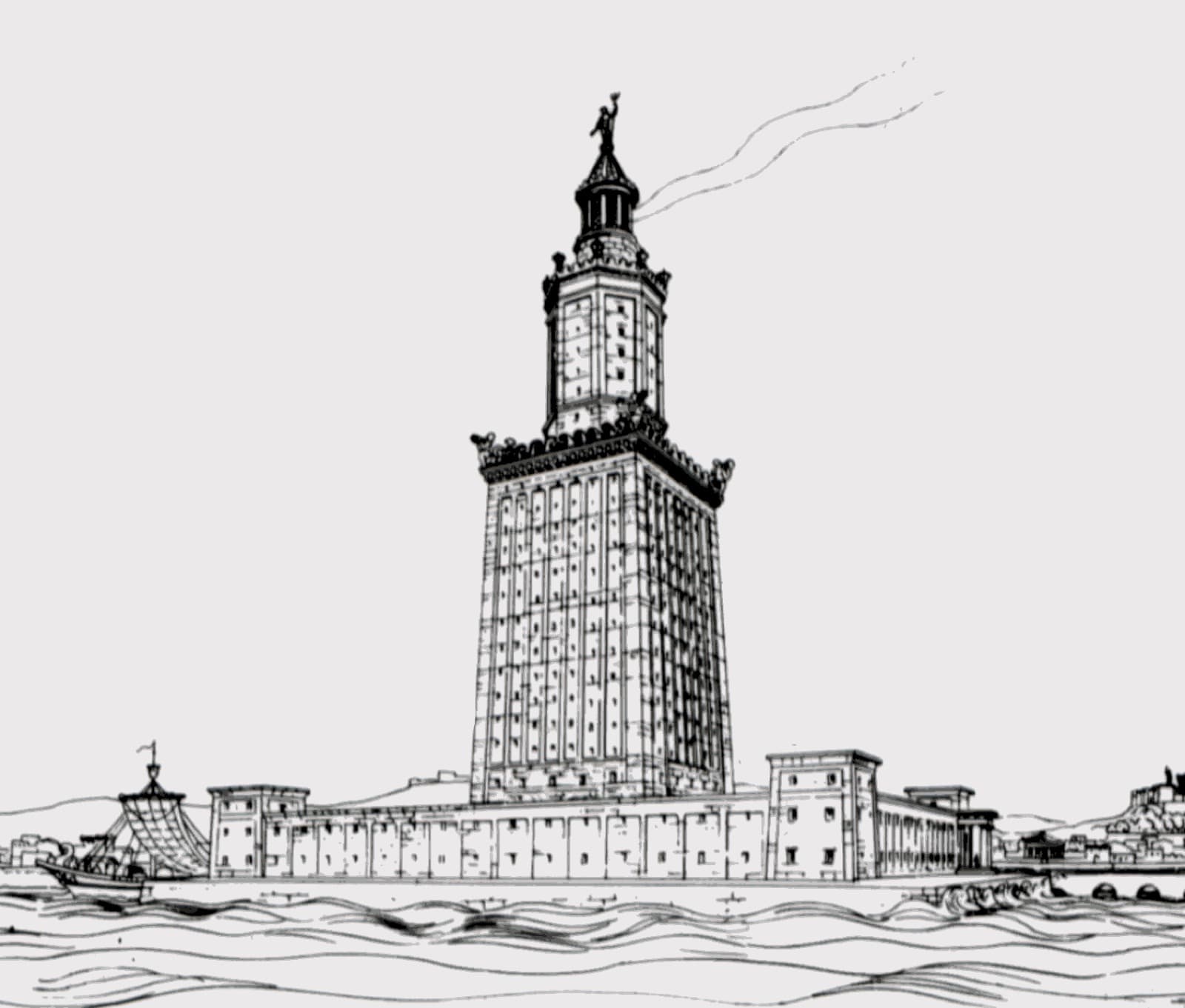
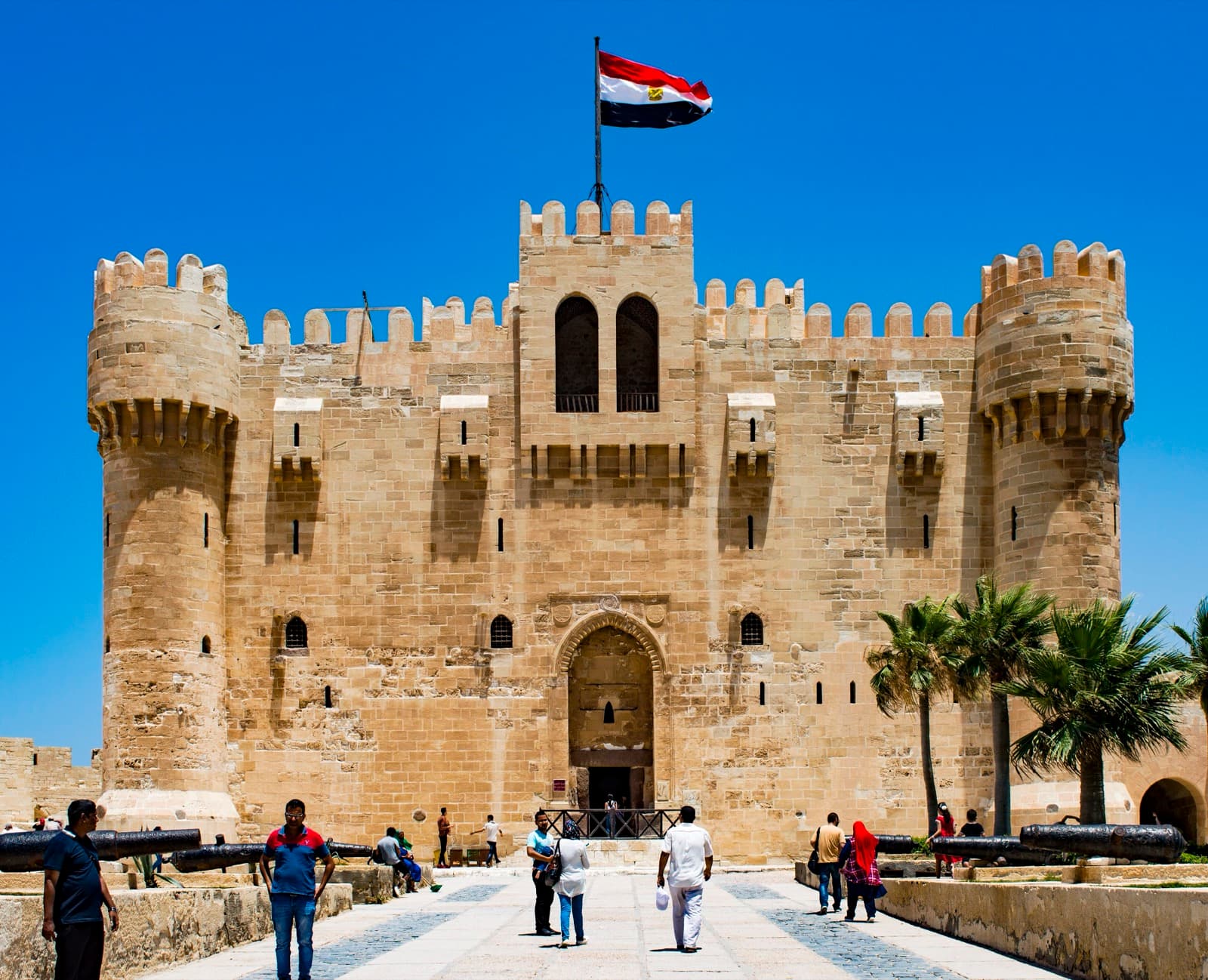
The same is true of the wonder at the harbour mouth. The Pharos, the Lighthouse of Alexandria, was begun under Ptolemy the First around three hundred and five B C and finished by Ptolemy the Second, standing perhaps a hundred metres tall and throwing firelight out to sea for over a thousand years. Earthquakes brought it down: a serious collapse in the year nine hundred and fifty-six, and a devastating quake in thirteen oh three. In nineteen ninety-four French archaeologists led by Jean-Yves Empereur went into the water and found its blocks, some weighing as much as sixty tonnes, on the seabed. Then, in the fifteenth century, the Mamluk Sultan Qaitbay built a fort on the exact spot, lifting some of the lighthouse's own fallen stone into its walls between roughly fourteen seventy-seven and fourteen seventy-nine. Stand in Fort Qaitbay and you stand not only where the wonder stood, but partly within it.
Why walk it yourself
The catacombs teach you how to read the whole city: look for the fusion, and look below the surface. That is a discipline better done at your own pace than in a group. The six stops sit apart across a working modern city, connected by short taxi rides rather than a single walk, so a self-guided route lets you linger in the cool of the tombs, skip the seafront if the sun is high, and finish at the harbour when the light goes gold. Save the exposed stops for the late afternoon; give the catacombs the heat of the day. If you are planning the day, start with the full list of Alexandria walking tours and the practical overview of Alexandria itself.
Alexandria keeps almost nothing on the surface. Go down the spiral stair into the Mound of Shards, then out to the water where the lighthouse fell, and the greatest city of the ancient Mediterranean is still there to be read.
Sources
- Catacombs of Kom El Shoqafa, Wikipedia. Overview of the Roman-era necropolis, its three levels, and its blended funerary art.
- Serapis, World History Encyclopedia. On the deliberate Ptolemaic creation of Serapis to unite Greeks and Egyptians.
- Lighthouse of Alexandria, World History Encyclopedia. Construction under the early Ptolemies, height, earthquake collapses, and underwater rediscovery.
- Alexandria, Kom el-Dikka, Polish Centre of Mediterranean Archaeology. The long-running excavation of the theatre, baths and lecture halls.
- Citadel of Qaitbay, Wikipedia. The Mamluk fort built on the Pharos site with the lighthouse's reused stone.
Ready to experience it?
Catacombs and the Pharos: Underground Alexandria and the Lost Lighthouse
210 min · 10 km · moderate
More from Alexandria
Explore more at your own pace.
Alexandria Travel Guide: Days, Transport, Season, Safety, Budget
One Day in Alexandria: A Walkable Morning-to-Evening Itinerary
Alexandria: The City That Remembers Being the Centre of the World
Alexandria's Bibliotheca: The Library Built to Answer the One the City Lost
The Site of the Ancient Library of Alexandria: A Monument With Nothing to See