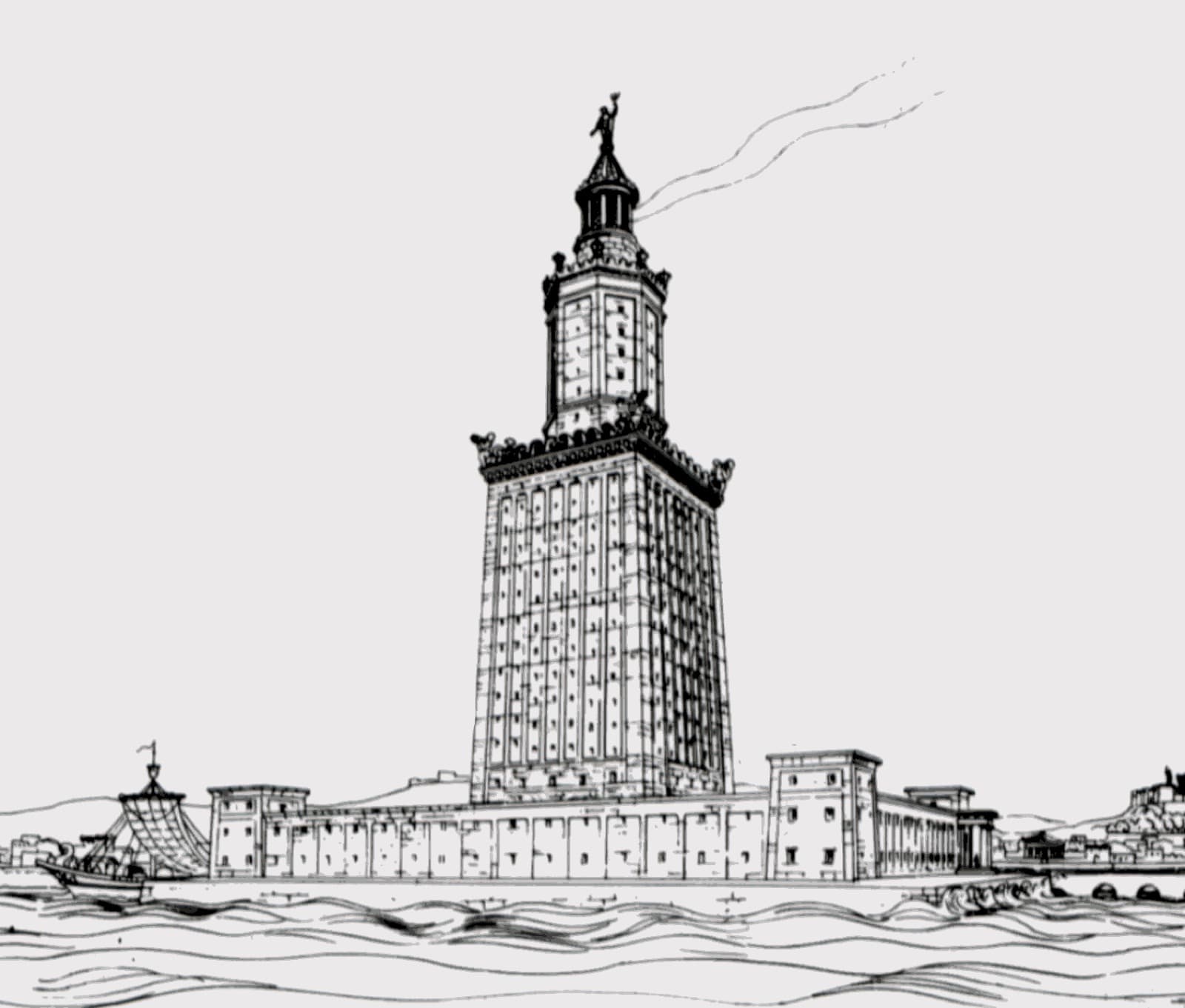
The Bibliotheca Alexandrina was built as a deliberate answer to a library that vanished. That is the fact worth carrying up the harbour steps before you look at anything else. The ancient Library of Alexandria left no wall, no column, not a single stone that anyone can point to, and the vast modern building on the Eastern Harbour shore was raised on that absence, a promise made on the same coast that a city can lose its greatest treasure and still choose to build another. Reading the new library that way turns it from a photo stop into the doorway of an entire walk, one that follows the Greek city Alexander founded by the sea down a route the water, fire, and time have been quietly emptying for two thousand years.
The building as an argument
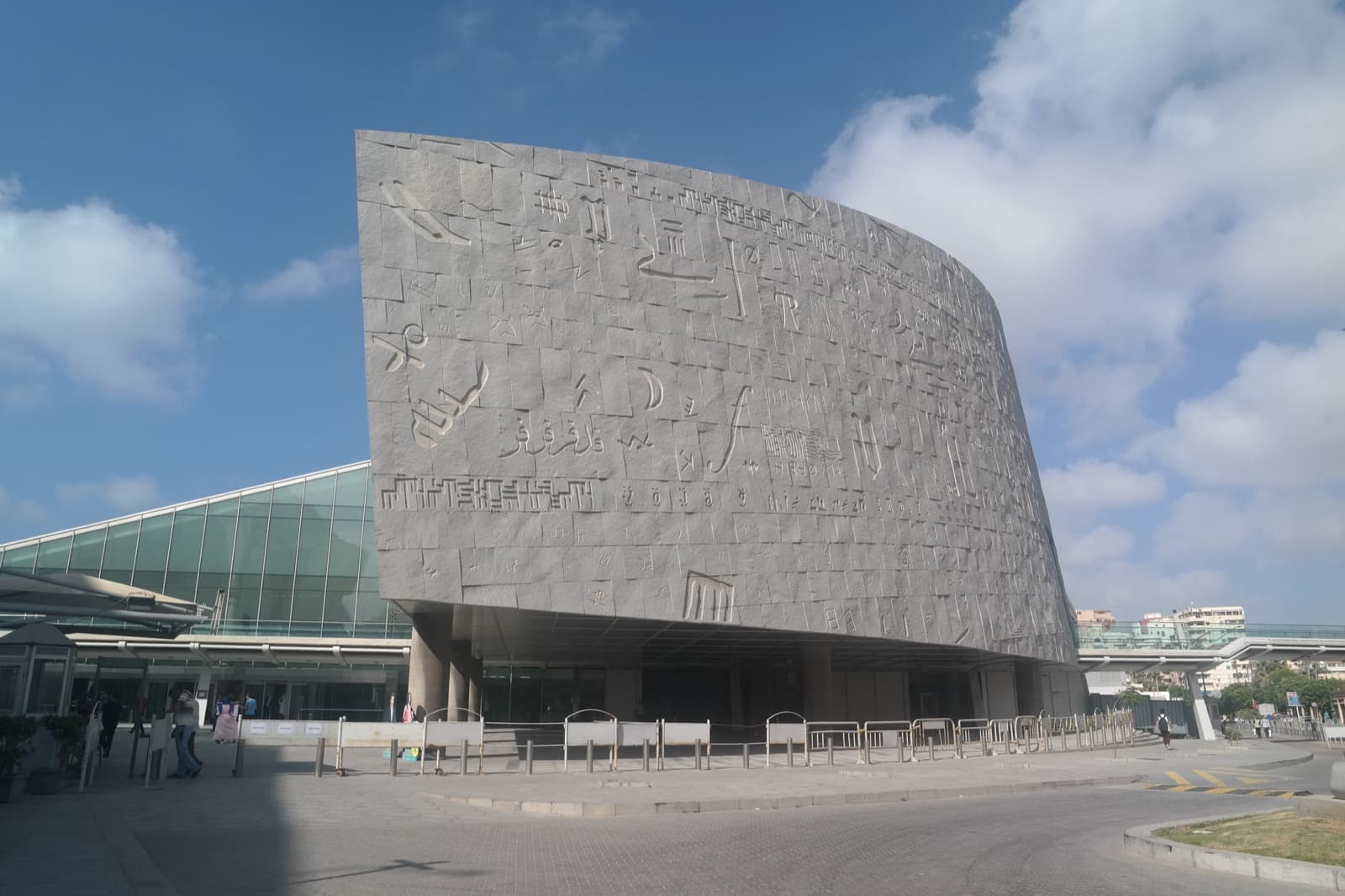
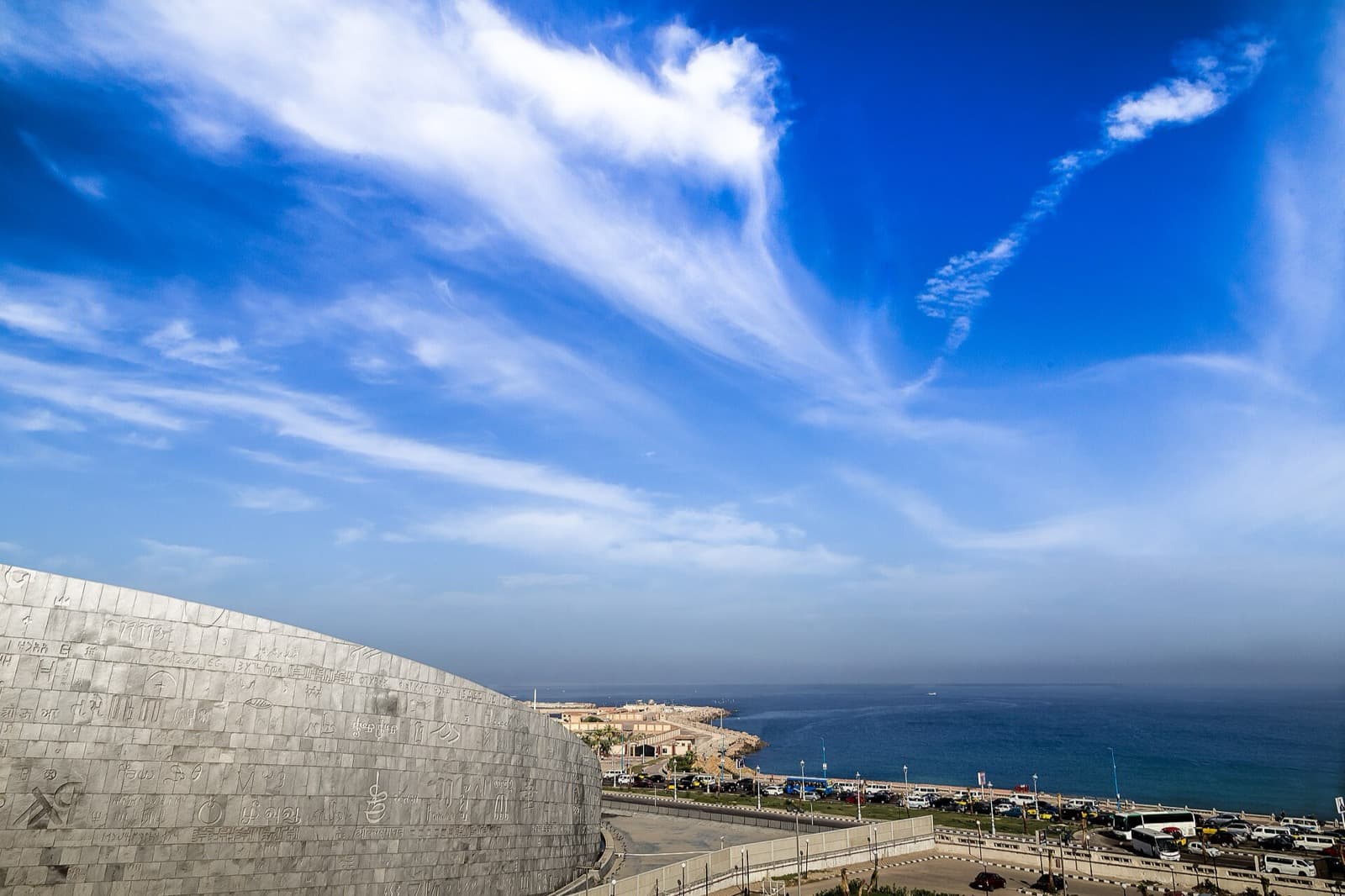
Stand in front of it and the shape starts arguing with you. The main reading room sits under an enormous circular disc, about one hundred and sixty metres across, tilted up toward the Mediterranean like a sundial half sunk into the ground. Glass and aluminium panels wash a soft north light over cascading terraced levels inside. The curved grey granite wall that wraps the building is carved with characters drawn from about one hundred and twenty of the world's writing systems, letters and hieroglyphs and musical and mathematical symbols, an alphabet of the whole human record pressed into stone. According to the Bibliotheca Alexandrina, the shelves can hold up to eight million books, and the complex folds in four museums, a planetarium, art galleries, and a laboratory where fragile manuscripts are restored.
None of this is a reconstruction of the ancient library, and it does not pretend to be. It opened on October sixteenth, two thousand two, conceived as a symbolic revival, and its design came from the then young Norwegian firm Snohetta, whose winning entry was chosen from hundreds of submissions to an international competition held with UNESCO's involvement. The building does not try to look old. It tries to mean something old: that the impulse behind the first library, gathering the world's knowledge on this exact shore, is worth restarting even when the original is gone beyond recovery. The interior is calm and air conditioned, and you are free to wander the terraces or move straight on. Either way, the ache the building is answering only makes sense once you walk a few hundred metres and stand where the lost one stood.
The library gone without a stone
Hear a stop from this walk
The Roman Theatre at Kom el-Dikka: The Ancient City Surfacing
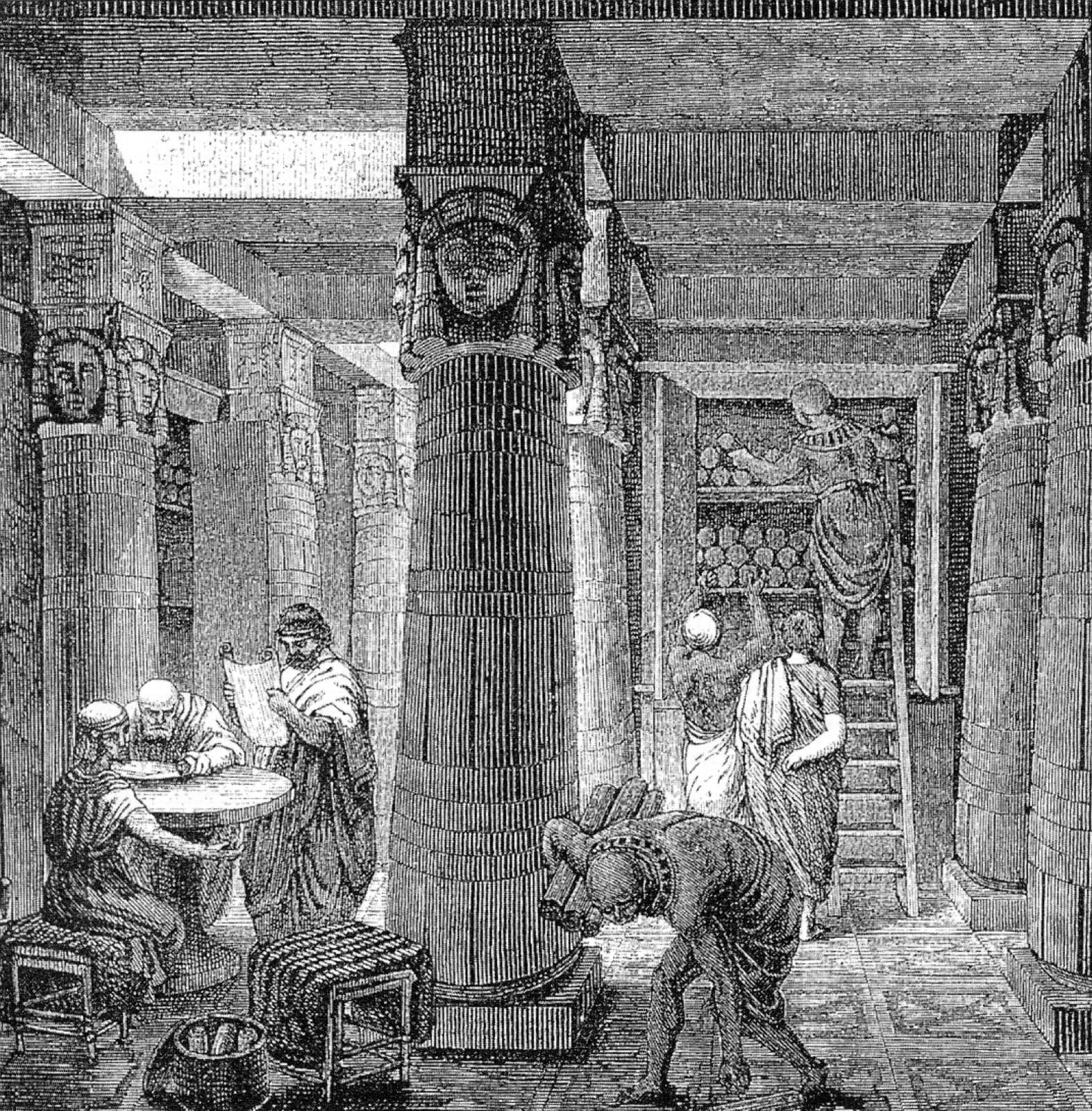
The second stop is the emptiest place on the walk, and that is the point. Somewhere near the seafront, though no one can mark the spot, stood the greatest library of the ancient world. It was never a single building but part of the Mouseion, an institution of the Muses, most likely established under Ptolemy the Second Philadelphus, who reigned from 285 to 246 B.C. That word, Mouseion, is where our word museum comes from. To this place the Ptolemies drew the finest minds of the age: Eratosthenes, who served as chief librarian and measured the circumference of the Earth; Euclid, who worked out his geometry here; Callimachus, who compiled the Pinakes, one of the first great library catalogues; and Aristarchus, who pored over Homer.
You have probably heard that the library burned in one terrible fire, often blamed on Julius Caesar in 48 B.C. Treat that as legend, not fact. Caesar's fire did damage warehouses by the harbour, but the institution itself likely survived, and modern scholarship holds that the library declined gradually over centuries. Its exact fate is uncertain. The daughter library at the Serapeum was destroyed in 391 A.D., and by then the great collection had long faded. What makes this stop matter is precisely that there is nothing to see, which is exactly what the modern building behind you is answering.
A harbour holding a drowned city
From here the Corniche does the rest of the work. The long seafront curves around the Eastern Harbour, which the ancients called the Portus Magnus, the Great Harbour of Alexandria. It looks like an ordinary working waterfront of fishing boats and feluccas, but since the early 1990s the marine archaeologist Franck Goddio, working with the Egyptian Ministry of Antiquities and the Hilti Foundation, has surveyed the submerged royal quarter on the harbour floor. Divers have recovered statues, sphinxes, columns, coins, and even the long timbers of a ceremonial pleasure boat. They have mapped the little island of Antirhodos and a peninsula that ancient writers linked to the palaces of the Ptolemies, the quarter where, by educated interpretation rather than settled certainty, Cleopatra the Seventh, Julius Caesar, and Mark Antony once stayed. It all sank over centuries through earthquakes, tidal action, and the slow subsidence of the land. The greatest palaces of the ancient world are not in a museum far away. They are directly beneath the water you are looking at.
The city that remembers holding everything
The route then leaves the sea for the streets, and the theme of loss sharpens into something you can feel. Saad Zaghloul Square, beside the historic Ramleh tram terminus, is the civic heart of downtown, ringed by Belle Epoque facades that recall the mingled city of Greeks, Italians, Jews, Armenians, and Levantines who lived side by side a century ago. It is named for Saad Zaghloul, the nationalist leader who died in 1927 and whose exile in 1919 helped ignite the revolution against British rule, and beneath it lies the ground of the Caesareum, a temple begun by Cleopatra, near where the two obelisks called Cleopatra's Needles once stood before they were carried off to London and New York in the nineteenth century.
A few quiet streets inland, the walk finds its keeper of memory. Constantine Cavafy, who lived from 1863 to 1933, was the great Greek poet of modern Alexandria, born and buried here, and his second floor apartment survives as the Cavafy Museum, inaugurated on November sixteenth, 1992. His spare, elegiac poems made this city a lasting symbol of memory and lost time, the same city Lawrence Durrell later set his four novel Alexandria Quartet inside. Then the walk ends where the ancient city breaks back through the modern one: Kom el-Dikka, the only Roman theatre ever found in Egypt, a small marble hemicycle with baths, lecture halls, and the mosaic Villa of the Birds, all uncovered by chance in the twentieth century, with systematic excavation beginning in 1960 under the Polish Centre of Mediterranean Archaeology. After a whole walk chasing a city the sea drowned and time buried, the ground simply hands a piece of it back.
That is the shape of the day, and it is why the Bibliotheca is the right place to begin: the answer stated first, then the losses it answers, one by one along the shore. If you want the full route and the practical timing, start with the tour itself, then read more about Alexandria walking tours or browse everything on offer in Alexandria.
Sources
- Bibliotheca Alexandrina (Wikipedia): opening date, roof disc dimensions, the 120 writing systems on the granite wall, and the eight million book capacity.
- Snohetta project page for the Bibliotheca Alexandrina: the international competition, UNESCO involvement, and the design approach.
- Library of Alexandria (Encyclopaedia Britannica) and Mouseion (Wikipedia): the Ptolemaic origins, the scholars, and the gradual-decline scholarship.
- Franck Goddio Presents: The Portus Magnus of Alexandria (Hilti Foundation): the underwater survey of the drowned royal quarter and Antirhodos.
- Kom el-Dikka, Ministry of Tourism and Antiquities, and the Polish Centre of Mediterranean Archaeology: the Roman theatre, Villa of the Birds, and 1960 excavation history.
Ready to experience it?
Bibliotheca and the Corniche: The Greek City by the Sea
150 min · 2.7 km · easy
More from Alexandria
Explore more at your own pace.
Alexandria Travel Guide: Days, Transport, Season, Safety, Budget
One Day in Alexandria: A Walkable Morning-to-Evening Itinerary
Alexandria: The City That Remembers Being the Centre of the World
The Catacombs of Kom el-Shoqafa: Reading Alexandria's Fused Underworld
The Site of the Ancient Library of Alexandria: A Monument With Nothing to See